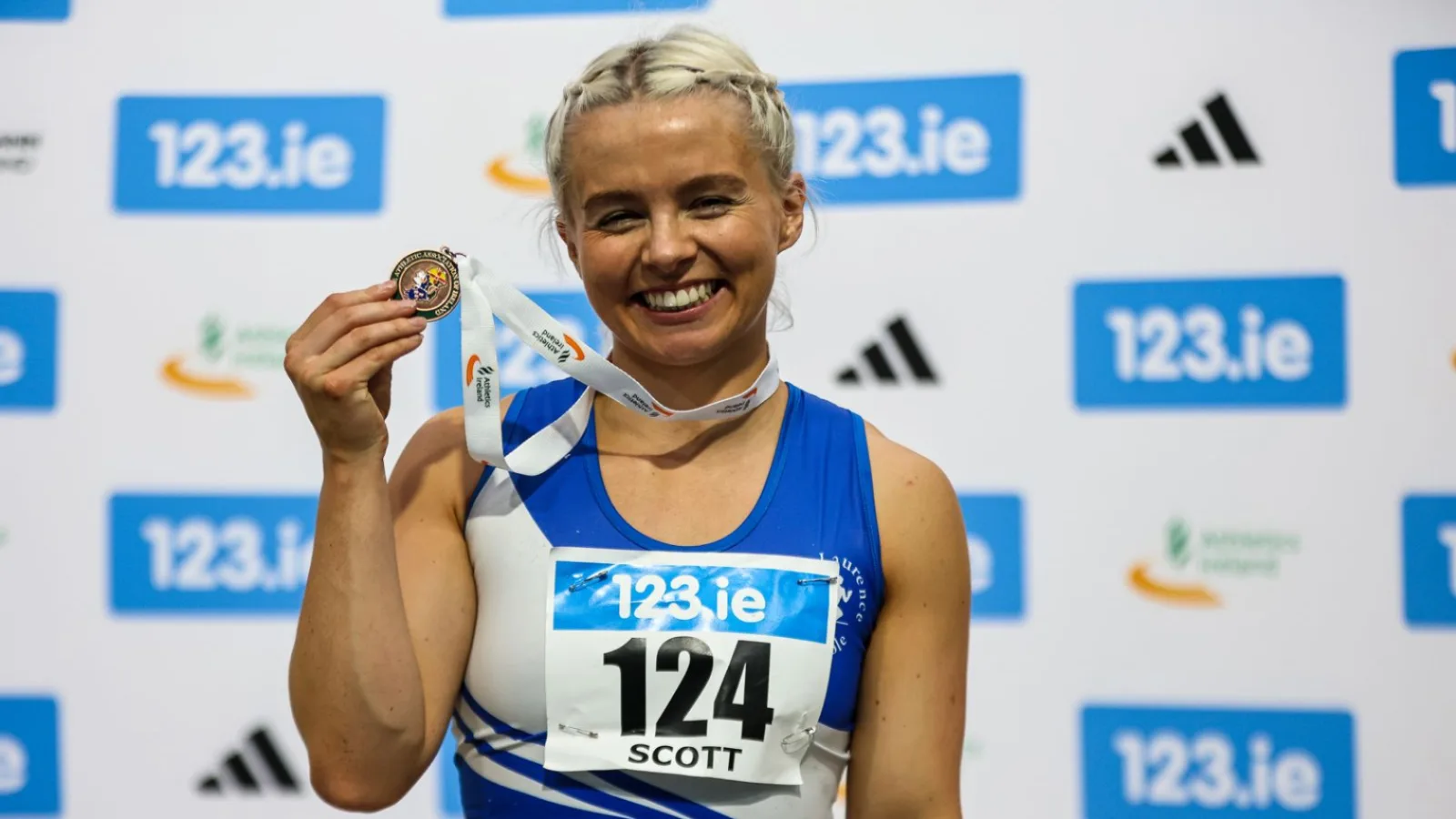
Molly Scott put a post up on Instagram the night after the nationals. Four words in it did all the work.
Cheers for never quitting.
She had taken bronze in the 100m. She had been picked for the European Championships. Good weekend by any measure. But the post wasn't really about the weekend. It was about the four years it took to get back.
Santry
Molly came into the nationals off the back of three races. Eisenstadt, Cork and London, and Cork was not her best result by her own reckoning.
Scott is a barrister in her second year at the Bar, based in the Four Courts, so she can't race all summer and peak in July as well.
"I had to siphon off four or five weeks of racing where I could actually peak coming into nationals."
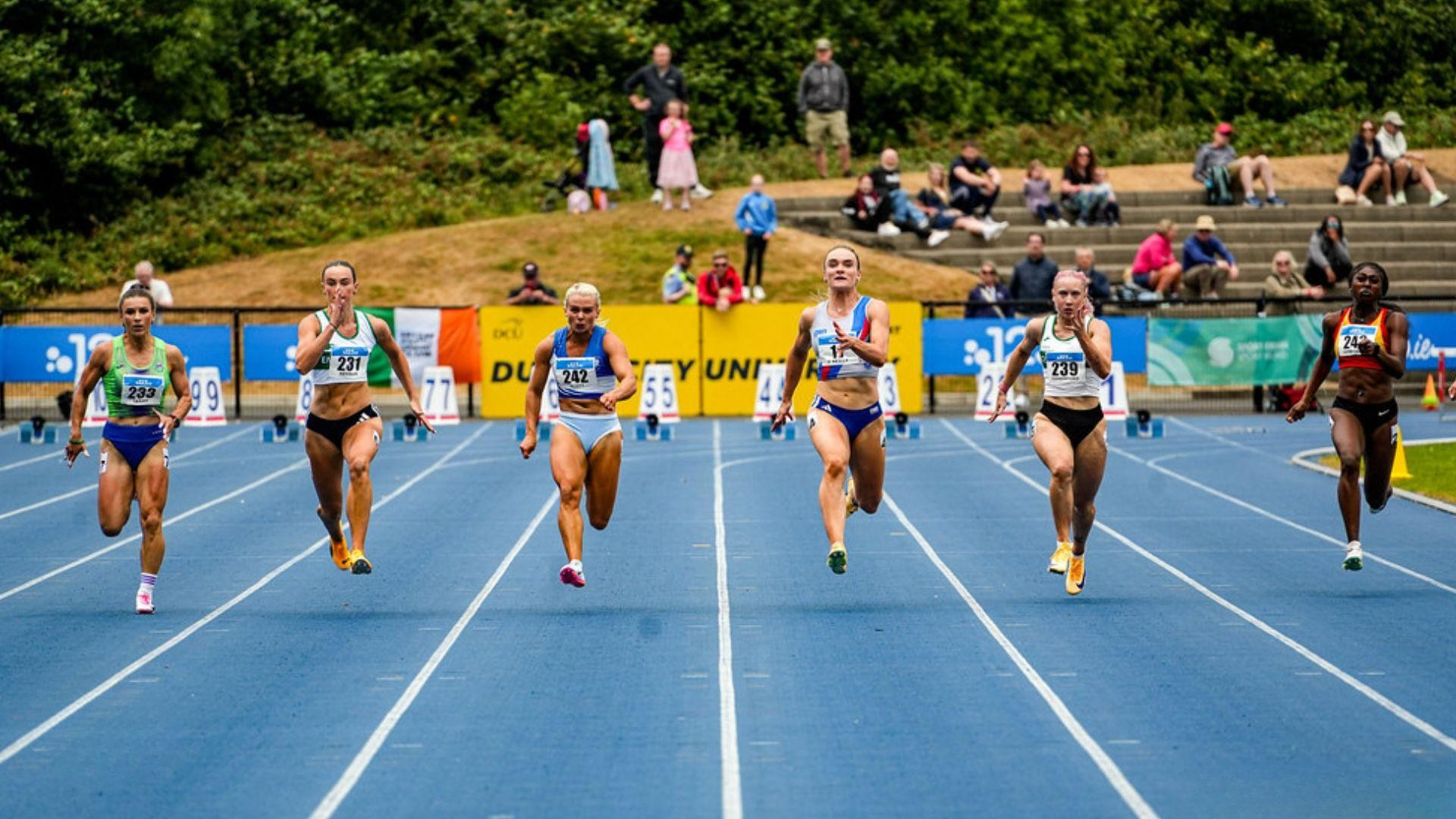
The standard of sprinting has improved over recent years. This years national final was the deepest she's ever stood in. Eight women in and around the same times, a handful of relay places going. Knowing the European Championship places were being decided, Molly knew she had to turn up.
"If you go in thinking I'm going to try get this place, or I'm going to try not to lose, I think they're quite limiting mindsets. I went in thinking I can win."
She didn't win. She loved it anyway.
"Obviously you never want to come third. But for where I'm at, and the progression of where I've come from, I was quite happy with it."
Image: Jimmy English
Munich
2022 was the fastest Molly had ever been. Three weeks out from the European Championships in Munich, qualified individually in the 100m, she suffered a seventeen centimeter longitudinal tear through her posttibial tendon. The consultants told her they hadn't seen one like it and couldn't say exactly how it would go, or how long, or even if it would heal. A surgeon decided to let it heal on its own. That period of going from peaking as an athlete to having months away from the sport was challenging. She couldn't jog for six months. Four years on she still feels it when she runs.
"I'd never been injured before that. So it was a massive, massive shock."
She made the Europeans in 2018 with the relay and never got on the track. She qualified for Munich individually and never made the start line.
"I still have never run individually at a European outdoors. But we're moving on."
She did come back from it. Two years later she ran a personal best in Copenhagen and thought this was the next step.
The Winter That Was Tougher Than the Injury
Progress is never linear. This time, the challenge was not down to injury. Scott is pragmatic in her stance that it is vital for athletes to prepare for their professional career once athletics ends. Having experienced how a severe injury can take everything away, she followed her dream to be a barrister.
October 2024. It was her first year at the Bar. The first years of being a barrister means no guaranteed income.
She was living at home in Carlow. Up every morning at 6:30 to be driven by her father for half an hour to the station. An hour and fifteen on the train to Heuston. Then the Luas to the Four Courts. Then a full day in the court trying to learn, understand her profession, with what would seem like never-ending cases to review and read. After a grueling day in court, she then did training, then home around ten at night. Then up at six. By her own account, this was a tough year.
"Your first year at the Bar is incredibly difficult. It's an adrenaline spike every single day. It's basically the same nerves as running a race, because you're in court every day and you're learning."
She gave that winter everything she had, expecting to run fast off it. Given the long days, trying to balance life as an athlete, and life as a barrister, Molly reflects on her preparation, where she says plainly she wasn't eating enough.
"It was all just one perfect disaster."
She ran 7.66 indoors. Her personal best is 7.19. Worse than the time was what came after it. She describes a total physical burnout, a nervous system that wouldn't fire, and nothing she could do to hurry it.
"I'd turn up to the track and I could feel it in my body. I didn't even want to warm up. My body just didn't want to move."
It took months. There was no fixing it. She had to wait it out.
These moments are incredibly tough on anyone, yet alone someone who is throwing themselves into an intensive profession and trying to be a pro athlete. So when she says there were times she wanted to walk away, it is easy to see why those thoughts crossed her mind. Her parents told her she could. So did her boyfriend.
"They've said at times, we think you should walk away, we think it's enough. It depends on how much happiness you're getting out of it, not what you're achieving. If I left it tomorrow, no one would really care.
"I'm a Whole Person Without This"
She didn't leave it. What changed was why she was doing it.
"Am I doing this for myself, or am I trying to fulfil some prophecy I decided on when I was nine years old?"
That question has been the whole project of the last year. She's turned it into something she can actually use on a start line.
"If I feel like I have to beat a certain person, I ask what does that suggest about myself if I don't? Does it suggest I'm less of a person? Because that's what your internal story is telling you. I'm a whole person without this."
Athletics is difficult. Most athletes have to pay their own expenses for physio, flights, entry to competitions. Scott showed depth and resilience. Her goal has been to rediscover the ‘why’, and her edge. She's fiercely competitive, and she reckons athletics is the only place in her life where that part of her gets out at all.
"Winning feels great. But you can't need it. You absolutely can't need it."
As with most people who compete in sport at a national or international level, inspiration often comes from other sports. Scott has an interest in many sports, but in particular, she has been watching a lot of figure skating.
"A lot of my inspiration has come from figure skating. I adore Alysa Liu."
What she took from it, especially the short programmes, was being able to see who was skating for the love of it and who was skating to prove something.
Then there's the other reason, the one with no medal attached. Every so often in training she hits a flow state. She compares it, jokingly, to jumping out of a plane.
"One day I'll be older and I won't be able to do this. It's a beautiful experience I get to have with myself."
Two Careers, One Set of Legs
Scott was very open about her experience, her career, and even with advice to athletes about building a life outside the sport.
"In 2022 I woke up one day and it was all gone."
So she sat the Bar exams and went to work. She's honest that year one was a failure of balance rather than a triumph of it. Moving to Dublin and removing the commute is what finally made it workable, and she's only getting there now.
"Now I can compete and run to a somewhat good level and also work. I'm happy I'm getting into that flow."
She's blunt about the money too, which athletes rarely are.
"I don't have any support. I pay for physio, I pay for everything myself, I pay for every single training camp."
The Bar doesn't fix that either. It takes years to build an income. "You just have to hold firm."
What it gave her was something much more important than money.
"Coming to the Bar made me a way better athlete and a way better person."
Some of it is harder to say, and she says it anyway. The collegiality she found at the Bar, particularly from other women, is not something she's always felt in athletics.
"I started here with no connections and no friends, and the uplift I've gotten from people has been incredible. I didn't always find sport collegiate. Sport can be brutal, so let's call a spade a spade."
She's quick to balance it. Her club, individual friends, coaches in other countries, were all spoken about glowingly. She has found balance again, and feels she is improving.
Carlow
Scott's coach is her mother, with support from John Clearyt. Her mother was new to coaching when Molly was twelve. Keen to support her daughter, she bought a book and started watching videos.
Her father made her a sled out of an old tyre and a length of climbing rope. She still uses it. Drivers still pull in to ask if she's all right. Sometimes it’s the basic things that work. It also keeps her rooted in her beginnings.
A story that Scott recalls from her early days, and the frustration of not finding her rhythm. At her first hurdle session with club coach Billy Delaney when she was about ten, she couldn't get her steps. She cried the whole way home in the car. Was this even going to be for her.
The next day her mother walked her across the field outside the house, pulled a set of old horse jumps out of a neighbour's ditch and produced a measuring tape.
"That's how I started practising. In a field with a measuring tape and these old rusty horse jumps."
Raw. Simple. It was here where it all clicked.
She's got a soft spot for Laurence O'Toole Athletics for another reason too. As an under-12 she was in a different club and a bylaw stopped her transferring until she was sixteen, so she competed unattached. She won a national title in plain white vest. Her parents were frustrated that a child who wanted to transfer, and follow their dream was prevented from doing so. They took the rule on and got it overturned.
"When I could finally wear it, I remember thinking it was the coolest thing ever."
She's warm about what the club has become, and about the man who built it from nothing, P.L. Curran, and spent the best part of twenty five years getting the track in. He died recently, having seen it finished and full of kids.
"That's a legacy for all of us. He gave everyone this gift."
She's combative on the subject of parents, in the best way.
"Parents in Ireland get labelled very quickly as pushy. If a child shows any sort of incentive to be competitive, I think they should absolutely be pushed, if that's what they want."
She repeats the qualifier, twice. If it isn't what the child wants, that's another thing entirely.
"When I got older, a lot of people I knew wished their parents had done the same for them."
Scott talks about the resilience she has found from athletics.
"I got the chance to fail over and over and over again as a teenager. That makes you strong for your twenties, whether it's an interview or college or a bad experience. Sport teaches you that."
Birmingham
She's on the panel for the Europeans. Her goal is to make it to the track. She was picked in 2018, didn't run. She qualified for Munich in 2022, didn't run. She’s pragmatic, and optimistic about getting to the track, and talks about how she prepares the same. Warms up the same. She’s ready, just needs the opportunity.
"I wonder will I make it onto the track this time. Who knows."
Having had more than her fair share of disappointment and setbacks, Scott is able to reflect on her career with more appreciation than earlier in her career. She’s embracing the moments, the achievements, the little things.
"I'm only understanding the importance of running for my country now, at 27. When I was younger I just thought I'd make team after team after team. It's only now I realise it's actually very, very special."
The conversation was refreshing. Honest. Raw. It was also pragmatic, and its clear she has developed a resilience over the years. Asked what her advice would be for up and coming athletes, she draws on her own experience.
"Ask yourself why you're doing it, and go from there."
Then she quotes Usain Bolt on Justin Gatlin, and what bothered Bolt was that Gatlin turned up every single time convinced he was going to win.
"That's a real sign of resilience. Keep showing up."
Four years. One seventeen centimetre tear. One burnout. A demanding career. Doubts. A few serious conversations about packing it in.