In October 2018, Sandra Caulfield lined up for the Dublin City Marathon six weeks after being talked into entering it. She was grieving, she had never run further than about 14 kilometres before that summer, and friends from home had more or less dragged her to the start line because they could see she needed something to aim at.
Somewhere in those last six weeks of long runs, a Kiltimagh man named Shane Freeman started turning up alongside her.
Shane, known to everyone as Peach, was in the shape of his life and on for a 3:30 marathon. He slowed himself right down to Sandra's pace and ran beside her. He did not say a great deal.
"He came to me in my darkest hour, when some of my closest girlfriends ran away from me," Sandra says. "This person that wouldn't really have known me personally, but knew me through our running, came, ran beside me, slowed down his pace, and was just there to get me to the start line of Dublin City Marathon."
On race day she wore a top made specially for it and got in under four hours. The first person she met after she crossed the line was Shane.
"He gave me this big hug, and it was like, you did it, Sandra."
She assumed he had run his own time and asked him how he got on.
"He was like, didn't go so well for me, but we won't worry about that. And he didn't focus on himself whatsoever. It was just about me and getting me across the finish line."
Three or four months later, Shane Freeman was diagnosed with bowel cancer. That was why he had not got his 3:30 in Dublin. He had cancer on the day, and none of them knew it.
He lived with it for six and a half years. He died on 2 September last year, aged 50.
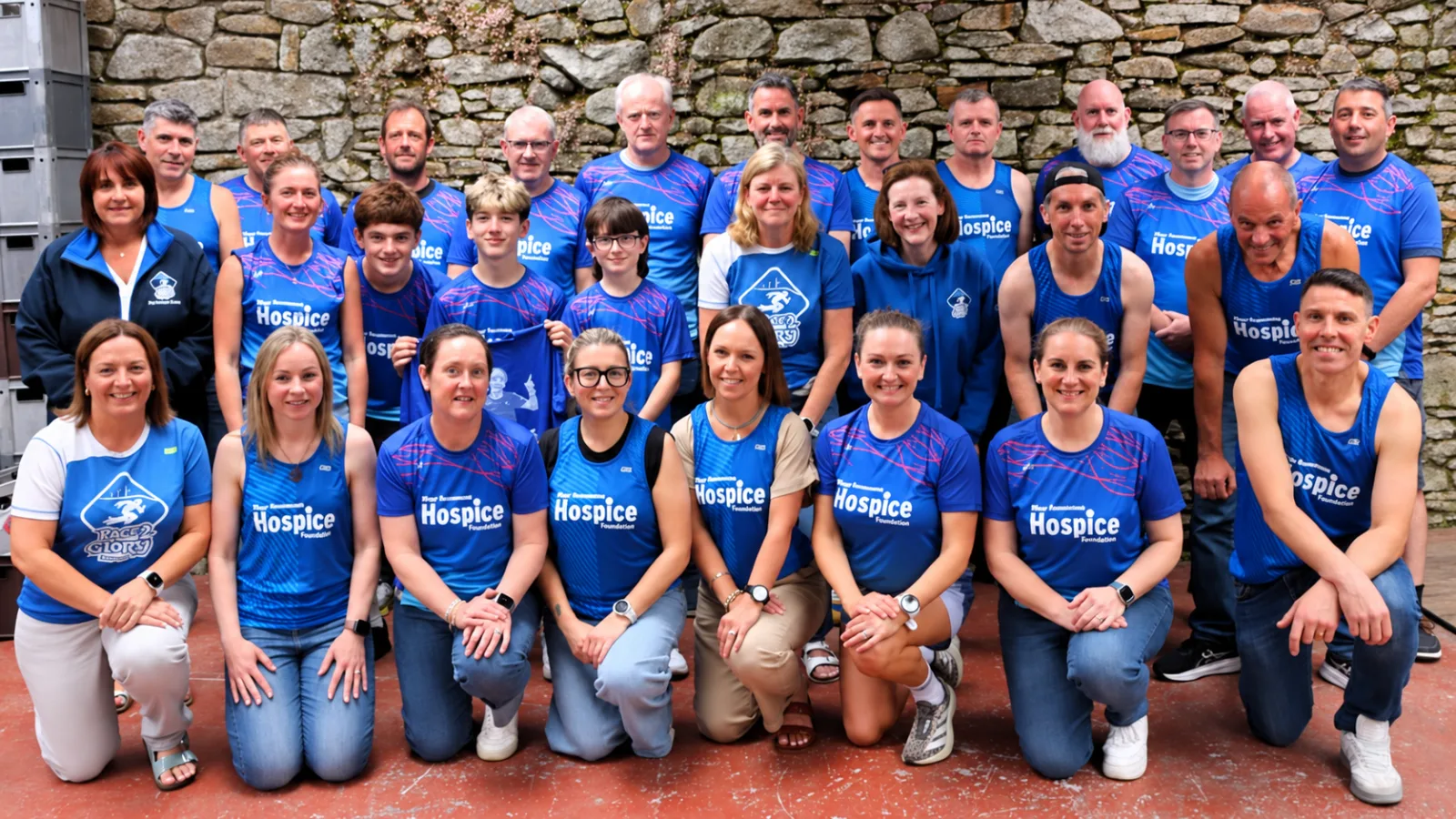
This October, Sandra and her husband Jonathan will run Dublin again, with Shane's picture on their backs, as part of a group of 56 runners raising money for Mayo Roscommon Hospice.
Kiltimagh
Sandra and Jonathan Caulfield are both Charlestown people who have lived in Kiltimagh for the guts of twenty-eight years.
Sandra was a hairdresser for over twenty-seven years and now works as a special needs assistant in a primary school. Jonathan is 44 and has worked as a construction plant fitter with the same Mayo firm for twenty-six years.
Between them they have a long history in Swinford AC, running cross country around Connacht and coaching the juveniles at the club. Jonathan was pulled into endurance sport by his older brother Chris, who landed down to the house one day with two bikes and the notion of doing the Race to Glory, the adventure race in Kiltimagh that involves a mountain run, 22 kilometres on the bike and a river run to finish.
"We never looked back after that, between cycling and running," Jonathan says.
Sandra started running after her first child, largely to shift baby weight, then discovered she was quite good at it and spent years chasing times on her own. That has changed.
"My PBs are just being around," she says now.
There is a line she uses about the two of them and the sport that is worth repeating.
"I would always say that God sent us up the hills and the mountains running and cycling before he sent us any challenges."
Who Peach Was
Ask either of them about Shane Freeman and the same picture comes back, of a man who was constitutionally incapable of making a conversation about himself.
"He'd say, oh, the cancer's back again," Sandra says. "And you're like, oh no, Shane, I'm awfully sorry. And he'd actually end up consoling us."
He had three boys with his wife Orla. Rory is 15 now, Dara is 14 and Owen is 11. Golf with one, running with another, football with the third.
"He just made a connection with all three of his children," Sandra says, and then she says the thing that should probably be carved somewhere.
"He died at 50. The father that he was to his children, some fathers could live till they're 100 and they wouldn't be the father that he was, through the sickness and through his suffering."
Jonathan puts it more simply.
"He's one of them kind of guys everyone liked."
A Week After the Funeral
The idea for all of this came out on a run, a week or two after Shane's funeral, when Sandra was out with his brother Barry, who everyone calls Baz, and who was in no state at all.
"I said, you know what we're going to do now, Baz? Next year, we're going to do the marathon in memory of Peach, and we'll get the jerseys, and we'll get a picture and put them on our back."
She knew exactly why she was suggesting it, because the same thing had been done for her in 2018 by people who could see she needed somewhere to put it.
Orla's one condition was where the money went. She wanted it to go to Mayo Roscommon Hospice.
From Five Kilometres on a Wednesday Night to 56 Runners
They set up a WhatsApp group in September and started running on Wednesday nights. The first ones were five kilometres, and they added a kilometre a week, straight through an Irish winter.
"Bad nights," Jonathan says. "One night we were twenty-seven of us, all out with headlamps."
The thing nobody had planned for was the teenagers.
Dara and Rory came out, which was expected, and then their friends came, and kept coming, in numbers.
"The amount of friends that Dara came out with, and Rory, every night, they came out in droves," Jonathan says. "As a lad, I suppose, they can't talk about these things."
Barry had to have a word with them at one stage about the pace they were setting on the long ones, and they would not give in, because they were there for Dara.
"It was great to see. Dara's a great lad, like Shane. He might be gone, but he's not. He lives in his kids."
The group has grown from a handful to 56 runners and will likely be 60 by race day. It includes Shane's three sons, his brothers Barry and Mark, and a wide spread of people from Kiltimagh and Swinford AC and beyond. The jerseys have a peach on them, front and back.
For context on the scale of that, the Caulfields looked up last year's club finisher numbers in Dublin and found that a well-established club like Raheny had 93 finishers. This is a group assembled from one man's funeral.
Trish
One of the 56 deserves her own paragraph.
Trish is a Swinford AC member and a mother of four or five who was diagnosed with the same cancer as Shane about a year and a half ago, and who is not long out of treatment.
Sandra met her at the start line of a three-quarter marathon earlier this year and assumed she was doing a shortened version of it.
"I said to her, you're not doing all this, Trish, are you? And she said something about 15 or 16k, so I thought that's what she was doing."
Sandra ran it with Shane's two brothers, and they came in at 2:56.
Trish was already at the finish. She had run the whole thing in 2:50.
"I was like, Trish, you didn't do all that. I did. I said, you were just unbelievable."
"It's Far From the End When You Go to Hospice"
This is the part the Caulfields most want people to read, and Jonathan starts it by admitting he used to think exactly what you probably think.
"I'd look at hospice and think, if someone has cancer and you have to go to hospice, you kind of think, well, this is it now. This is the end."
"But as Orla said herself, it's far from the end when you go to hospice."
Sandra puts the correction more bluntly.
"They didn't help him die. They helped him live longer."
The example both of them reach for happened in July last year, weeks before Shane died.
The Race to Glory, the adventure race Jonathan's brother had dragged him into all those years before, was on in Kiltimagh as part of the town's festival. Shane had always either competed in it or helped run it. He asked the hospice whether he could go home for two days.
They made it happen.
"He got home, and he went to every section, every stage," Jonathan says. The mountain run, the bike, the river run to the finish.
"Orla said he was kind of saying goodbye to everybody that day."
The second day he went to the junior golf. He was a very good golfer and he coached the juveniles, and there were 27 children playing a tournament in Ballyhaunis as part of the festival. He was there for all of it, and by every account had a great day.
"He said goodbye to everyone, I suppose, that day. But because of hospice, they did that."
What It Gave Orla
The other thing the hospice bought, and Jonathan is very clear that this is the part people do not think about, was six months in which Orla stopped being a carer.
She had been caring for Shane for six years.
"The hospice allowed Orla to be the wife," Jonathan says. "In the last six months, she didn't have to care for him like she did for the six years. She could just be with him and have a laugh with him. She didn't have to be his carer."
Sandra takes it a step further, relaying what Orla has told her since.
"There was nothing unsaid, because they had that time together to be together. I mean, that is an absolute beautiful gift to give to someone."
"And he died knowing that she was going to be okay with the boys."
That last part is the one that stops the conversation. A man of 50 with three children under 16, leaving, and not having to leave frightened about what happens to them.
"That's a great gift to give someone, that they knew everything was going to be okay when they were gone," Sandra says. "That's just peace of mind, isn't it?"
The Bit That Keeps Going
More than a year on, Mayo Roscommon Hospice is still involved with Shane's family, and this is the piece of it neither of the Caulfields knew about before.
There are bereavement workshops for the family. The week before we spoke, vouchers arrived in the post for Westport House, which is an outdoor adventure day out for three boys who need one.
And at Christmas, the hospice gives the family presents made with Shane's fingerprints on them.
"It's memory making, and it's still landing," Jonathan says.
"Something tangible when your loved one is gone," Sandra says. "Something still tangible belonging to them that helps you to keep going. These are things I never knew."
Why the Caulfields Knew Already
Sandra and Jonathan are not coming to Mayo Roscommon Hospice as strangers, and the reason is one they mention only briefly and without dwelling on it.
Their own daughter, Hope Rose, lived eight days and died in September 2017. In her last days, a hospice nurse knocked on their door in Kiltimagh to help them.
"People just associate hospice with end of life for older people dying from cancer," Sandra says. "I didn't realise it was end of life regardless of age, or whatever your sickness is."
It has come round again more recently too. Sandra's aunt died in the hospice about two months before this interview, after only three weeks of illness.
The family have been fundraising in one form or another for eight years now, ever since Swinford AC came to them at a cross country meet six weeks after Hope Rose died and asked whether they could dedicate the club's Christmas run to her. That run still happens every year as Run for Hope. Last year's proceeds went to Mayo Roscommon Hospice, the Sunflower Hospice appeal and a family centre in Castlebar.
But Sandra is firm about whose story this particular marathon is, and she says it more than once.
"This isn't about us. This is about Orla and her boys getting her through. This is about Barry and Mark. This is about their parents. This is about raising money for the hospice."
€18,000, and a Target That Keeps Moving
The goalposts on this campaign have been moving since the day it started, in the best possible way.
It began as a notion that maybe they would get 25 people. Then it was 40. Then somebody said wouldn't it be great to get 50, and now there are 56 with more likely to come.
The fundraising has followed the same pattern. At the time of the interview they were at €18,000, with Orla's target set at €50,000, and a substantial matched corporate donation in the conversation but not yet confirmed.
Sandra is unsentimental about why the number matters, and she connects it directly to everything above.
"It needs money behind it. In order for the service to be there, and to reach as many families and help as many people die with dignity, and to leave families not so broken, and to leave that there was nothing unsaid."
The Training
The group follows a plan that Gerard Brennan puts up online, and the Caulfields run it in pairs. Sandra trains with Mark, Shane's brother. Jonathan trains with Barry.
The Saturday before we spoke they ran 35 kilometres, which is further than either of them has ever gone in training for a marathon.
Sandra has put more into this year than any year of her running life. She has parked her cycling entirely to concentrate on the run, which is no small thing for someone who has climbed and cycled as much as she has.
Her personal best is 3:49, set in 2023. She wants 3:45 in Dublin, and the reason for the number is not a coincidence.
Shane had been on for somewhere between 3:30 and 3:45 in the days when he was running well.
Jonathan, whose first marathon was Dublin in 2013, is going for under 3:25.
Fuelling for both of them is Beta Fuel gels, which they find easy enough on the stomach, taken roughly every seven kilometres so they line up with the water stations on the course. They have bought running shorts specifically for carrying them, which is the sort of detail that tells you how seriously this group is taking the day.
What They'd Tell a First Timer
Jonathan's advice comes from years of coaching juveniles and from watching people burn themselves out on Strava.
"Starting off, people just want to get quicker. So they go out every day of the week and push a 5k, and they won't get any quicker."
His rule is simple and it is the one most beginners ignore.
"At least 75% of your runs need to be slow. They'll burn out, and they'll get sick of it, and they'll stop. When they don't see their time getting quicker, they'll just give up."
He makes the case for slow running on its own terms, too, not just as a training tool.
"A slow run is where you can think, listen to music, actually take the run in."
And he points out that the hard part is over long before you get anywhere near a finish line.
"The moment you tie the laces, you've already won."
Sandra's version is shorter and comes at it from the other end.
"There can only ever be one winner in a race."
So it is about putting one foot in front of the other, and about the people you pick up on the way. If a 5k takes you forty minutes, or an hour, she says, you will never regret having done it.
She is also direct about what the sport has done for her, with a caveat she is careful to include.
"My own mother would have suffered from her mental health, so I've dealt with that for most of my life. That for me was a great lesson in life, that medication isn't always the answer. I know for some people it is the answer, and you need that too."
"But what sport has given me for my mental health has been second to none. And you do not have to be winning races. You just have to be taking part in the human race and being a good human being."
Running Through It
There is one more line of Sandra's worth finishing on, and it comes from a conversation with her priest years ago, when he asked her whether all the running was a way of getting away from things.
"He said to me, Sandra, are you running away from it?"
"And I said, no. I'm running through it."
On the last Sunday in October, 56 people will run through Dublin with a peach on their jerseys. Three of them will be Shane Freeman's sons. Two of them will be his brothers. One of them will be Sandra Caulfield, who will have his picture on her back this time, eight years after he slowed his own race down to a crawl to get her round hers.
"It's kind of like a full circle moment."
You can support the group's fundraising for Mayo Roscommon Hospice ahead of the Dublin Marathon here.