Ally McKenzie reckons he has run somewhere between 60 and 100 races in his life.
His dad came to one of them.
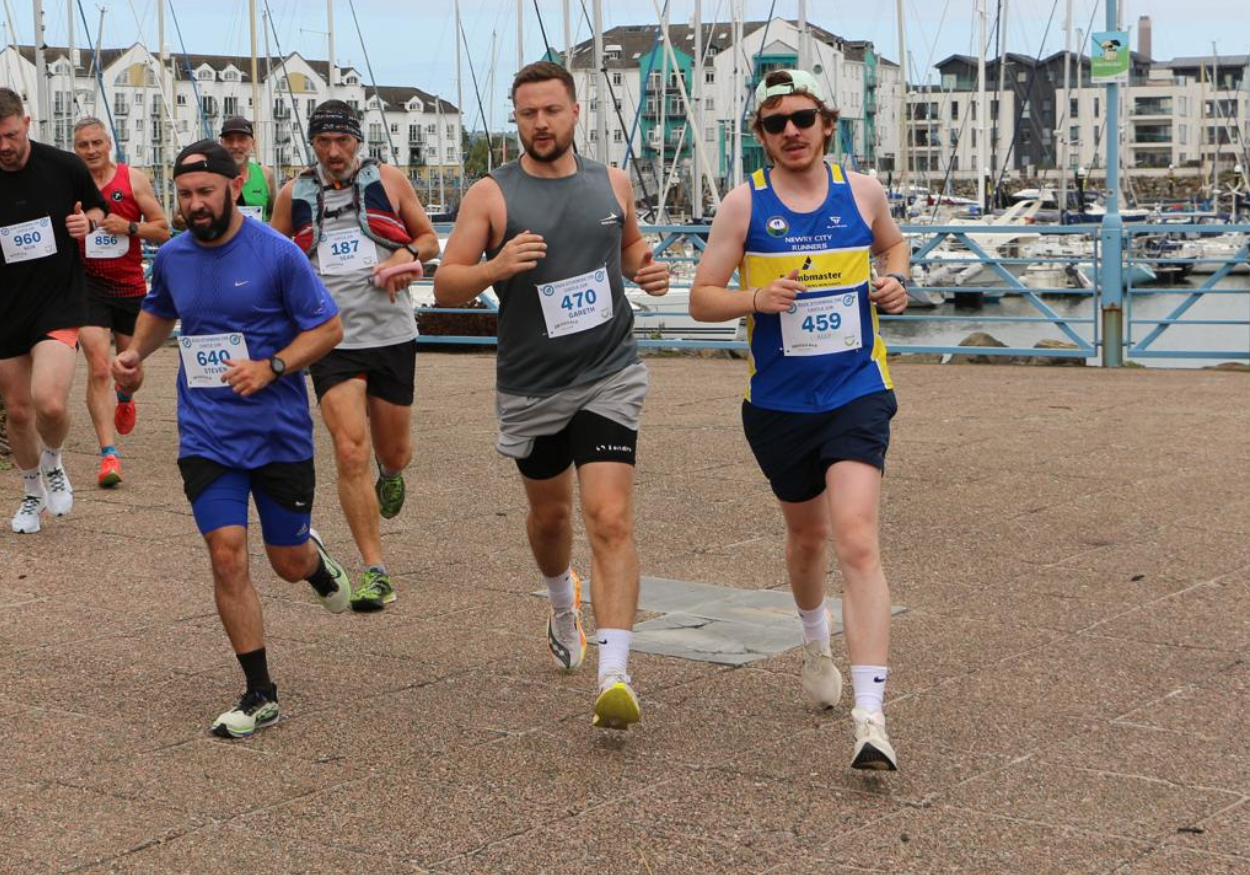
It was the Newry half marathon in 2023, the first race Ally booked after a few years away from it, and his father stood at the halfway mark, right at the turning point, with gels and a drink ready to hand over. Ally's wife took a photograph of the moment.
Sadly, Ally’s dad died suddenly this May. The loss is something which is still raw, and Ally speaks of the legacy of his dad with heartfelt memories. After Ally’s dad passed away, his wife went and found that photo of Ally’s dad handing over his fuel at the halfway point of the Newry Half Marathon, and printed it, something Ally now hangs proudly on his wall, as well as being tattooed on Ally's arm.
"You can just see that he's about to hand the stuff over. I'm looking for it, I'm looking right up at him."
But it is what is going on behind the two of them in the picture that Ally keeps coming back to.
"On a deeper level, you can see the road going past him, and he's standing there. He handed that stuff over, and I had to keep going myself anyway. I'm going to have to continue on the next part of this race without him. That's the way I looked at it."
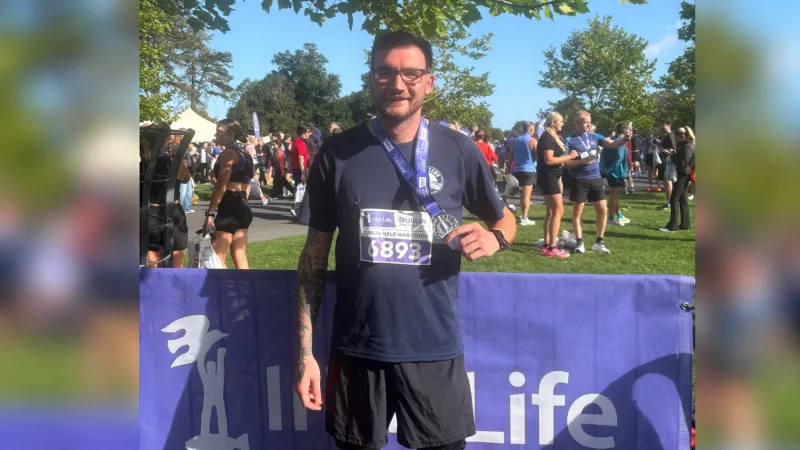
On the last Sunday in October, Ally will run the Dublin Marathon for Evora in Newry, in his father's memory, in a vest with his dad's photograph on it and "running for dad" across the bottom.
Bessbrook
Ally is 35 and lives in Bessbrook, a couple of hundred metres off the road as you come down off the motorway outside Newry.
He works for the BBC, making history documentaries and the kind of true crime where an old case gets taken out, looked at with fresh eyes and retold like a thriller. The last one he finished was about the Cork IRA in the 1920s hijacking a British navy ship carrying 120 tons of weapons, landing it at Ballycotton and distributing the lot before the British had worked out what had happened. The bullet that killed Michael Collins is thought to have come off that ship.
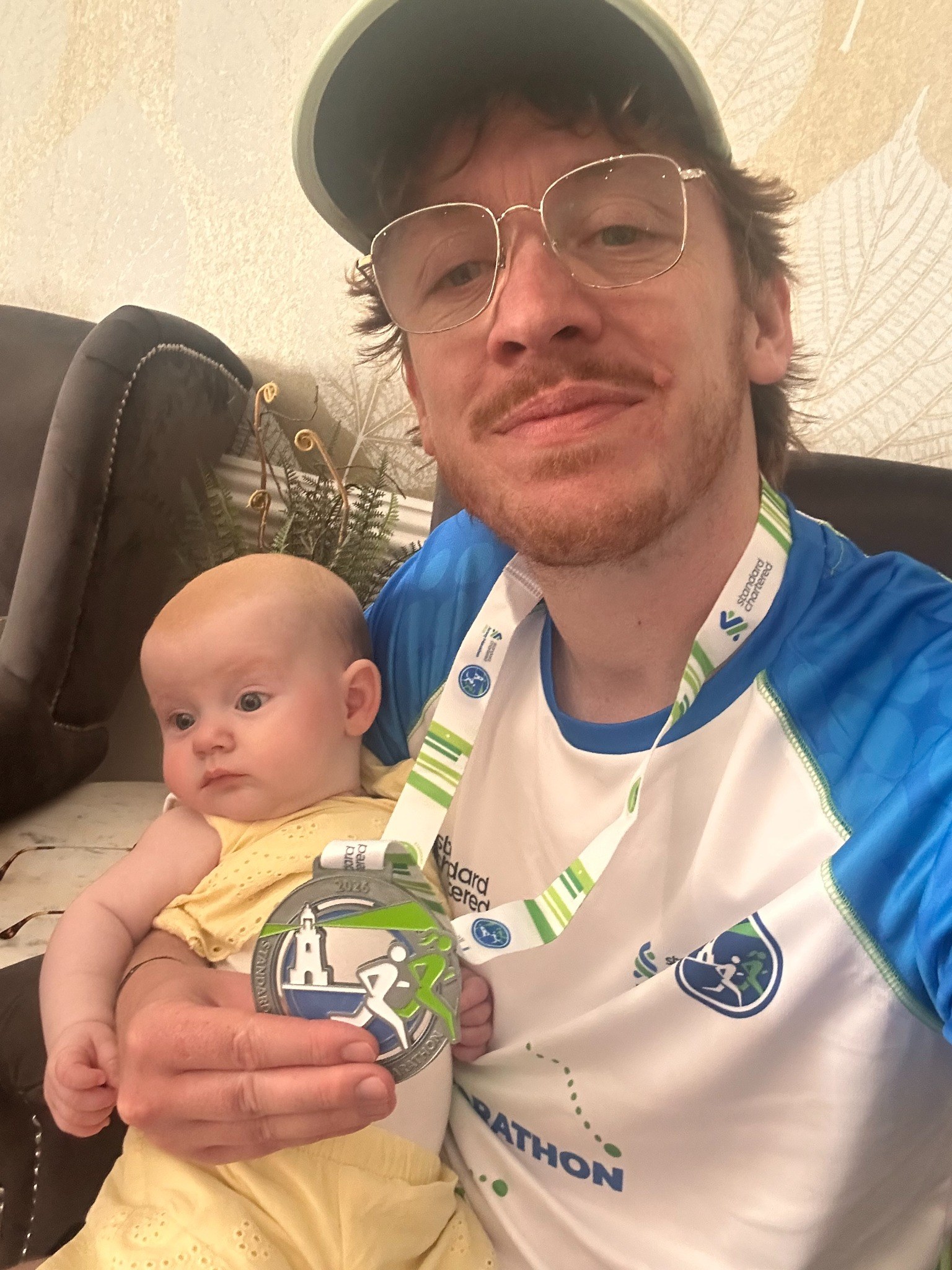
He and his wife have two very young children, the elder around two and a half and the younger only months old.
Which brings us to the timeline of this year, and it is worth laying out plainly, because everything else about his training follows from it.
His dad died in May. The baby arrived three weeks later. He started marathon training a week after that.
"The training has been how you'd expect for somebody who has had a life altering loss, has had a baby three weeks after that, and has a family and full time work to get done with."
How It Started, Which Was Entirely His Wife's Doing
None of this was ever the plan. Ally came to running by complete fluke, and his wife is the reason. She boxed for Ireland, so staying fit was never a question for her. Ally in his early twenties was, by his own description, fairly lazy and out drinking every weekend.
She booked a 5k and told him to come along. He had not run since school football. He ran it in about 22 and a half minutes.
"She was like, that's actually pretty good. And I had no concept of what was good or bad. I just ran."
He was beating her soon enough after that, which he reports with the appropriate amount of guilt.
Fives and tens followed, and then in 2019 he joined Newry City Runners, for the most relatable reason there is. What he had been doing had stopped working.
He had been running the same 5k as hard as he could, three times a week.
"And then you actually go backwards. So I was like, great, there must be some logic to this."
So he went down to the track sessions, spent a couple of weeks working out which group he belonged in, and got asked what his goals were, which he did not have. He just wanted to get better.
What he found there was the thing that surprises nearly every self-taught runner.
"It was like, slow runs exist, and they actually help you. And you're like, what? And then going out and running slow on purpose to get faster."
He did a half marathon in 2019 and sickened himself off the distance for a few years. His first marathon came not long after his first child was born in 2024, and he has done at least one a year since. Longford last year was his best, 3:13, two weeks before he ran the Great North Run with his wife.
Then he tore his groin at the end of last year and did not run for nine months.
"The Most Important of the Least Important Things"
Against last year's Longford build of five or six days a week, this year has been two days, sometimes three, sometimes four. Ally is not pretending otherwise, and he has made his peace with it in a phrase that is going to stick with a lot of readers.
"Running at the moment is the most important of the least important things."
"It's well down in the pack in order, after the family and work. And I'm just accepting that that's where I am at the minute. I know it's not a PB year for me."
What has carried a lot of it is company. He runs most evenings with a group of about five lads who meet up down the road from him, nearly all of them sub three hours, one of whom ran 2:47 at Dublin last year. That is a good standard to be dragged along by on an evening when you would rather not be out at all.
His fuelling is uncomplicated, the orange SiS gels, one every four miles, which is the marker he rebuilt his racing around after the nine months out.
And he is honest about what the last few months actually asked of him, in a way that reframes what an achievement even is.
"I probably shouldn't have thrown myself in so deep to do marathons. But I had a real low after my dad died."
"When I look back at that, how proud I am to be able just to get up and get out the door. Because there were days I couldn't even face running. I couldn't face really getting out of bed."
Jersey
Dublin is the middle one of three marathons this autumn. The first was Jersey, a couple of weeks before we spoke, and it went wrong in most of the ways a marathon can go wrong.
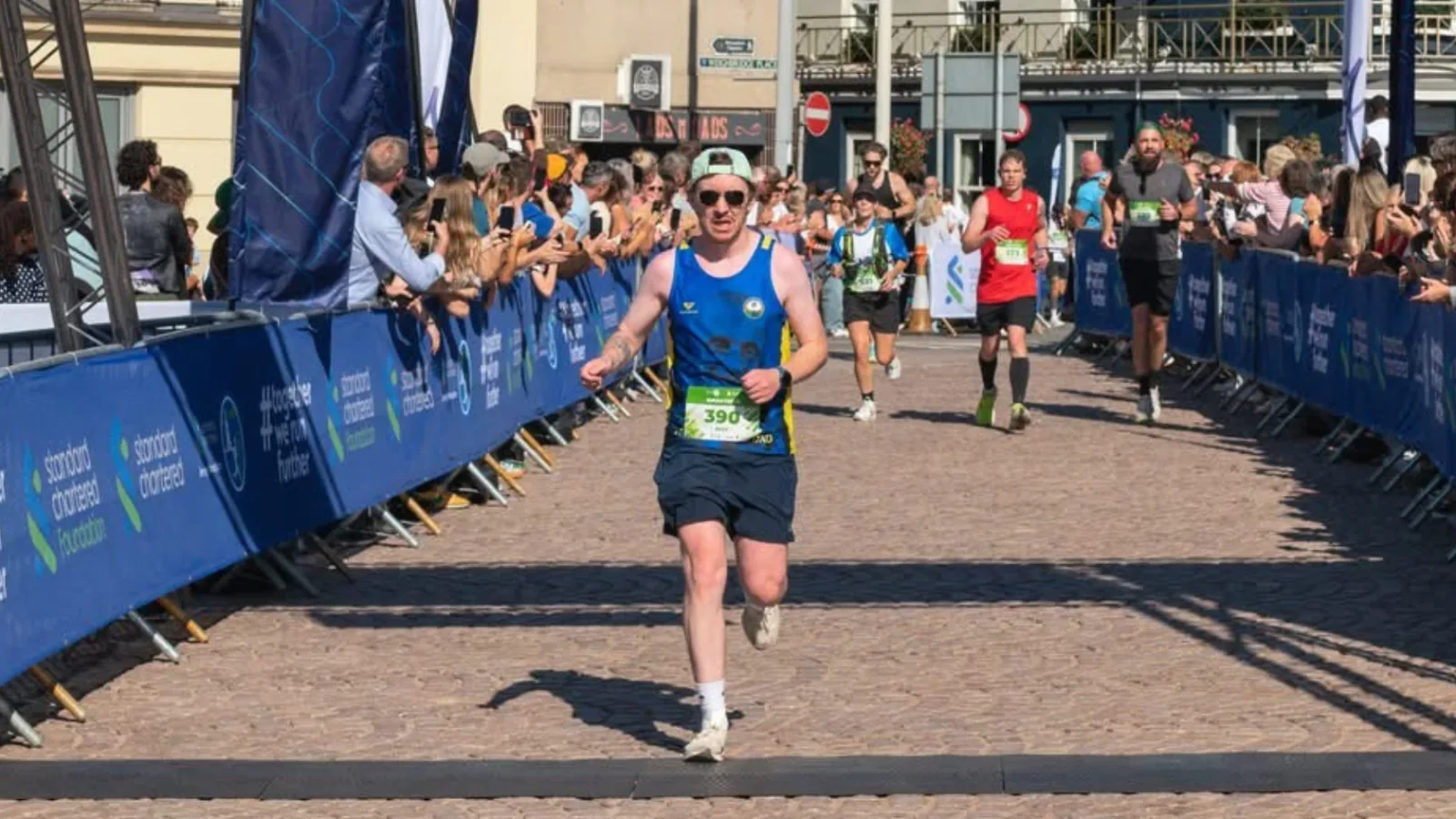
It was twenty two degrees. He was on for about 3:24 when an old injury came back at 18 miles, and the last seven or eight were walked and jogged. He finished on the promenade holding onto the wall from the pain of it, having pushed the final mile to come home just under four hours.
Somewhere in the thick of that, on a downhill stretch, when he was very close to packing the whole thing in, a woman came up alongside him out of nowhere.
She was around his mother's age and was only doing the second half of the race. She read the back of his vest.
"She said, your dad would be very proud, because it said running for dad on my back."
He could barely speak at that stage. He ran about a mile and a half with her.
"She was like an angel at that moment. I'll never forget her coming up beside me out of the blue."
He is prouder of that finish than of the 3:13 at Longford, and his reasoning is the heart of this whole piece.
"I've run my PB before of 3:13, which for me was fantastic. But I took more pride in finishing that marathon because of what I had to tap into. It took everything I had."
"I tapped into something that I never had before. A resilience. Because the way I looked at it was, everything that I've been through was the toughest thing I'll ever go through. And I chose to run that race. In comparison, it really wasn't that difficult."
At his lowest point out on that course, he looked down at the tattoo on his arm and gave himself a kick, which he reckons is exactly what his father would have done.
"There'd be no sympathy whatsoever."
And then he says the thing that turns the usual running cliché inside out, and he knows himself that it is a strange thing to be saying.
"The marathon is always a good metaphor for life. But this time I was actually using life as the metaphor for the marathon."
His Dad
Ally's father was a footballer first, and a good one.
He grew up in Scotland and did plenty of running over there, largely because his own brother was a serious marathon runner, somewhere around 2:45. Ally's dad stuck mostly to half marathons, and he was fit right up until he needed a knee operation in recent years.
The plan, before he died, was to get the weight back off so that he could start doing the Newry 10k.
He was old school about praise, in the Brian Clough mould, which is to say there was not a lot of it handed out directly. But there was a ritual.
He would always ring the next day to ask how the race had gone.
And of all the races he could have gone to, he went to the one in Newry in 2023, and stood at the turn with a gel in his hand.
Ally is careful about how much he says about the night his father died, and he said just enough to explain where this year has come from.
"My mum and myself were with him during the toughest part of that night."
Evora Hospice
Ally's dad never used the hospice himself, which is part of why the choice of charity is worth explaining.
A few years ago, a close friend of his parents was cared for there, and the pair of them were up visiting him constantly. That is when they understood what the place actually was.
"I think they quickly realised that it wasn't just for end of life care. It was also for supporting friends and families."
So when his dad died, donations in lieu of flowers went to the hospice.
And then the hospice came to them.
"When dad died, the hospice reached out to us. They offered counselling and grief meetings as well, to go with other people, and go on walks, grief walks. These sorts of things that were in place at a time when you were really struggling."
The grief walks are the detail Ally keeps returning to, because of what they gave him that nothing else could.
"It was nice to know that there was other people there."
He is clear that this is not an abstract cause in that part of the world.
"It's important in this part of the world especially. The hospice is the big charity in Newry, and everybody tries to do a bit."
The page itself tells a story that anybody nervous about fundraising should read.
"When we put it up online for dad, it was £500. I thought it was a humble amount, but it was instead of flowers that people wanted to give."
It has since passed £4,000. Rather than start a new page for the marathon, Ally simply kept the same one open and turned it into the fundraiser.
Fitting It Around Two Small Children
The other thread running through all of this is time, and the lack of it.
Ally is now a man with a full time job, two children under three, and a marathon in a fortnight, and he is straightforward about where running sits in that pile. It goes where it fits, and when it does not fit, it does not happen.
Three days a week counts as a win. There is no 60 or 70 mile week, and there is no target time dragging him out the door at six in the morning.
What there is instead is a reason, and he thinks that is why this one is different from every marathon he has run before.
"It's probably the first time that it's not a selfish race. It's always quite selfish. I'm doing this because I want to get a better time."
"But for me, this time, it was just, I need to get myself back functioning again. And I suppose it's the perfect way of honouring dad."
Dublin
The plan for the day itself is modest by his standards. He is going to go out at 3:45 pace and see what happens.
His wife will most likely stay at home with the two of them, because a Sunday in Dublin in late October is a long day to keep small children entertained in exchange for two glimpses of their father.
Newry City Runners have a bus going down, 52 seats, booked out, with plenty travelling purely to shout.
He has been told by everybody that Dublin is second only to London for atmosphere and support and route, and he arrives at it with the vest made and the tattoo on his arm.
London is next, and after that he wants all of them, the capitals of the UK and Ireland, over the next couple of years. At least this time there will be more than three weeks between marathons.
What He'd Tell Someone Who Hasn't Started
Ally gets a bit stuck on this one, and he knows it is awkward for a written piece, but the honesty is better than a neat answer.
The start, he says, is the hard bit. Your body is in shock. You might not have exercised since school PE. You run a hundred metres and walk a hundred metres and wonder what the point of it is.
Get through that stage, is his advice, because what comes after it is not something he can put into words.
"It's very, very hard to describe. You just get something from it, and either you get it or you don't. If you have to ask, you'll never know."
He is far more fluent on what a strange pastime it is once you are in it.
"It's one of the only hobbies where you turn off and talk to people about your toilet habits that morning. I've been out running with mates who've had the runs and had to jump in the hedges. No other walk of life has that happen. It humbles you and strips you right back down."
He also has a steady objection to the way runners talk to each other, and it is one worth adopting.
"Those are just arbitrary numbers that don't really mean anything to anybody afterwards. Once you tell people your time, it's forgotten about. So I always try not to ask people their times. I say, how did it feel? How did you feel about that race?"
And he pushes back on the idea, now that half the country seems to be doing one, that a marathon is somehow no longer a big deal.
"Because so many people do them these days, it's almost like, oh well, other people have done it, it's not that great of an achievement. But it's a hell of an achievement."
Coming from a man who buried his father in May, had a baby in June, started training in July and has got himself to a start line regardless, that is worth taking at face value.
You can support Ally's fundraising for Southern Area Hospice ahead of the Dublin Marathon here.