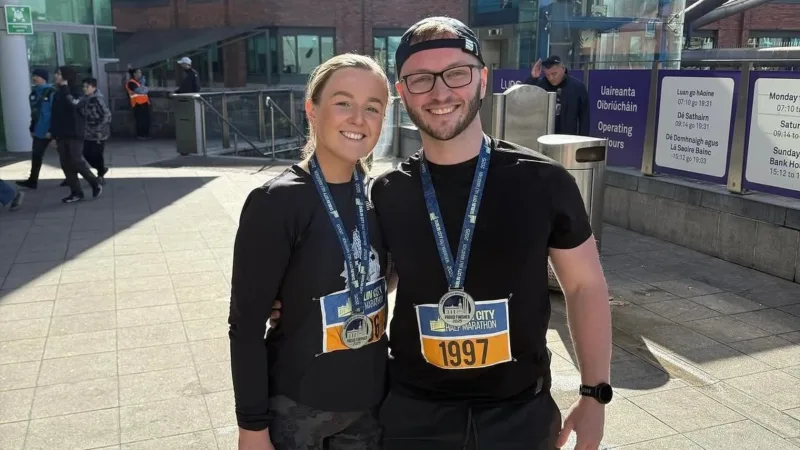
There is a thought Derek Hennessy has on the bad days, when it is raining and the long run is still in front of him and he would rather be anywhere else.
"I can show you I can suffer for twenty weeks, or I can put myself out there for twenty weeks."
"These kids, or these SNAs and teachers, they're the real heroes."
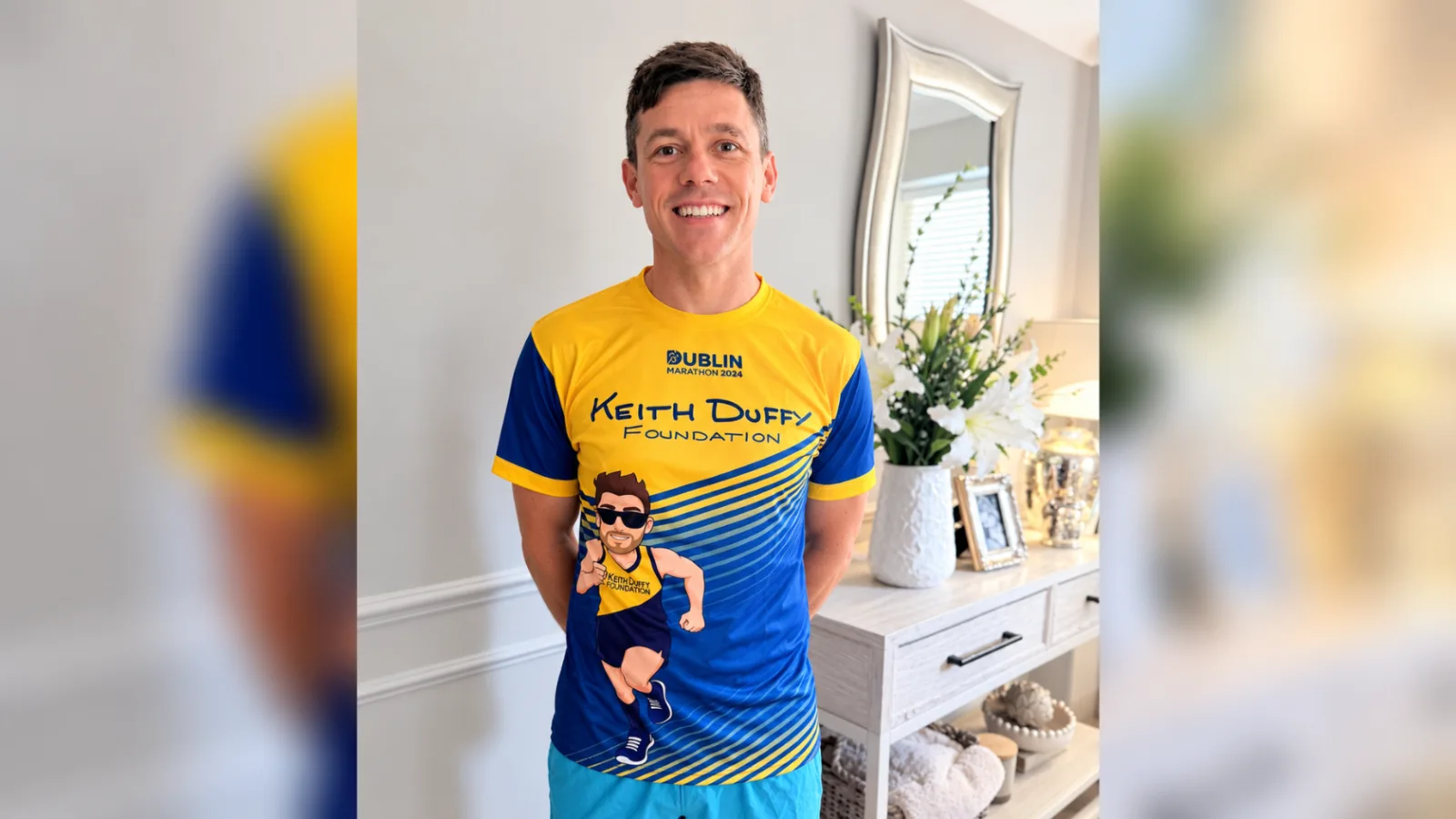
Derek turns 40 a couple of weeks after the Dublin Marathon. He is running it for the Keith Duffy Foundation, and he will tell you straight out that the race is the least interesting part of the whole project.
Ballymun, and a Ball Against the Flats
Derek grew up in Ballymun, lives in Dunshaughlin now, and runs the warehouse at a distribution centre in Clonshaugh. He is a qualified electrician who left school with good grades and did a bit of college after it.
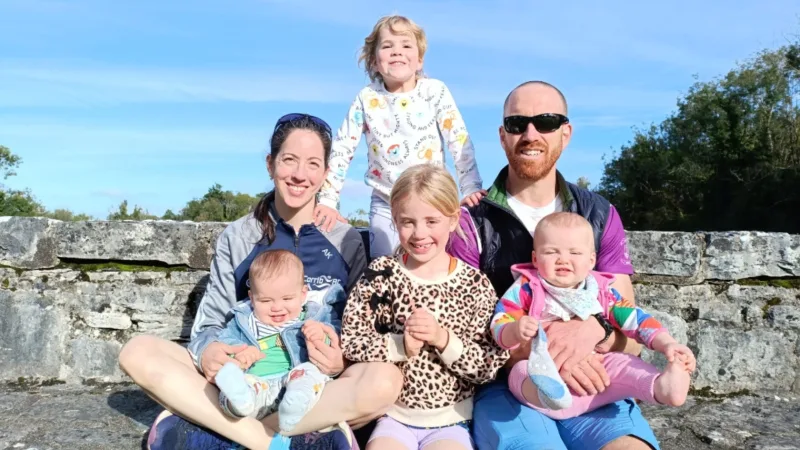
He and his wife Amy have three boys. Kean is 15, Cillian is 8, and Finn is 5.
Sport was the whole of his childhood, and he describes the shape of it in a way that will land with anybody who grew up in a Dublin estate in the nineties.
"All you used to get when you're a kid is, here's a football, kick it against the flats."
Soccer was the passion. Anything with a ball in it, he would have a go at.
The athletics happened almost by accident, and for reasons that had nothing to do with athletics.
"In school, they used to give you extra half days if you signed up for canoeing or running or long jump."
"So I just saw it as a way to go. I was like, oh yeah, happy days, it's another half day."
Then he actually ran.
"But when I went and I'd done it, I was actually alright. I was decent. I was school champion. I went out and ran for the schools, and a bit of long distance."
And then he left school, and that was the end of that for twenty years.
"When I left school, it was football on the weekends. And nobody was really running back then. It wasn't as popular as it is now."
Work and family did the rest. The kids started playing sport themselves, he was working, and like most people he let his own go and settled for a bit in the gym.
The lads from Ballymun started up a running club and asked him down several times. He never took them up on it, and the reason was always the same. He is forty minutes away now, and forty minutes each way for an easy run was never going to happen.
Falling Back Into It
What finally started him was somebody arriving into work. About a year ago a lad joined the warehouse who was into the same thing.
They started running together, and Derek discovered he liked it on terms he set himself.
"I could do it when I wanted. I could go for how long I wanted. I could pick my own pace."
Racing took longer to talk himself into, and the reason he gives is the reason half the country never enters anything.
"I was a bit apprehensive at the start. I was like, I can't finish it, and people looking at you."
He did his first half marathon in a forest park last January anyway. The field was small and the crowd was small, and it did not matter in the slightest.
"Even though the crowd, for a small one, I got a great buzz off it."
So he did another, and another, and somewhere in there the thought arrived that he might be able for a marathon, which he had never believed before.
He also knocked the drink on the head and started taking it seriously.
Finn
Around February or March of the same year, the family began applying for school places for Finn, who is autistic and nonverbal.
"My own son is nonverbal, and from my own experience, it changes the whole family dynamic."
That process is where the marathon stopped being about running.
"You're going on these forums online, and you're talking to liaisons, and you're starting to see how little is available."
They were offered a couple of places in the end. The school Finn is in now, Derek is unreserved about.
"The one he's in now is fantastic. They've done loads of stuff."
But he saw others during the process, and what he saw stayed with him.
"The resources are next to none, compared to what it should be. These children are vulnerable enough."
Finn's school is fifteen kilometres from the house. Both Derek and Amy changed their working hours around it. The two older boys go to a Gaelscoil.
He is honest about how much of this he simply had not understood before it was his own child, including his own attitude to charities.
"Before I had Finn, I could always donate to charities. I'd always just think, oh yeah, you might just do this, this and this."
"But when you start interacting with them, you start looking into the charity themselves. Where the money goes. What it's actually used for."
"You don't realise until you're in that situation what it's actually like."
He is equally honest about the early days after the diagnosis, which is the part most parents reading this will recognise.
"When we first got diagnosed, we were trying to do everything all at once. Do you need this, do you need that, is he in a bad form?"
"And you think you're letting the child down. You think you're not doing them justice, or you're not doing enough for them."
What helped was hearing people with every resource in the world describe exactly the same thing. He mentions a well-known former footballer who has spoken publicly about his own nonverbal son, and the effect of hearing it.
"Multimillionaire, unlimited resources, and he's gone through the same thing that I'm going through."
"At least you can go, right, we're actually doing alright."
"It doesn't make it any easier, but it helps you along the way to manage the day-to-day stuff."
His own view on the wider picture is firm without being angry, and he has a constructive suggestion rather than just a complaint. He would like to see something like a national think tank for this, on the basis that different disabilities need different things and nobody seems to be sitting down and working out what.
"I don't know whether they're just not asked, or there's no funding there, or they just don't have to deal with it and they're hoping it'll just go away."
"But it's nice to be listened to."
The Family Around Him
One of the better parts of the conversation is the bit Derek does not present as remarkable at all, which is how the people around them have adjusted.
There is a big age gap between his eldest and his youngest, and no friction whatsoever.
"They're a close-knit family, even the surrounding family. Parents, grandparents, friends."
If there is a party on and the timing will not work for Finn, somebody moves the party.
"They might alter their party so I can bring my own son. He's included."
"It's great to see it. It's brought us all closer together, in a strange way."
There are things the boys will never do together, and holidays get planned differently, and none of that is presented as a grievance. It is simply the shape of the family.
"Where Would You Like Your Money to Go?"
Signing up with a charity was a deliberate way of removing his own escape route.
"If I don't get it done, or if I'm injured, at least it's only me I let down. But once I signed up with a charity, then I'm going to have to do it."
The other reason was his two older sons, and showing them what you do with your own time.
What he did not expect was how the charity handled him.
He rang up and asked where the money actually goes, braced for a polite non-answer.
"I was expecting her to say it goes into a pool. She's like, where would you like it to go? Where would you like your money to go?"
He has thought hard about his answer to that, and it says everything about him.
If his own son's school is already provided for, he wants it to go somewhere else. He had read about another runner in the series raising money for a playground, and he named that instead.
"I don't know the criteria, how you decide. You might look at my son's class or school and say they have enough. But I'd rather give my money to one of the other runners, say to the playground."
"I'm not selfish enough to think I'm only going to raise money for my own son."
What he values about this particular organisation is that it is small and mostly run by volunteers.
"They're not paying a CEO."
"People are giving up their own time. Their Saturday evenings, Sunday mornings, Wednesday afternoons."
He has noticed that people assume the famous name on the door is personally answering the emails, and he puts them right every time.
Awareness, for him, is half the point of the fundraising. People say they have never heard of the charity, and then they hear what it does.
After the marathon, he intends to get involved himself.
"I'll try and get into a bit of volunteer work myself, just because you can see the difference and the help it's making to people."
Sixty or Seventy Companies
The fundraising has been a campaign rather than a page.
"I hounded, I begged, and I moaned at people to sponsor me."
He felt bad about it, which is why he looked for other ways to do it.
"I went around and contacted maybe about 60 or 70 companies asking would you donate a prize for a raffle."
He came back with vouchers from M&S and SuperValu, recovery room sessions, the Wax Museum and a long list besides, sold tickets on all of it, and ran spot prizes on top.
One company that could not give him a prize sent him something else entirely, and he took it.
He also wanted to shave his head for it. Amy said no.
He expects the final total to land somewhere between €2,500 and €3,000, and he is clear about what that is worth against where it is going.
"To know that I've done a bit. It makes you feel a bit better, to recognise these people, these kids who are being left behind."
There has been an unexpected second effect at work, which is that the conversation started other conversations.
"Even in work, people have relations who are in a similar position, and they've come out when I was talking about it."
"You'd be surprised how many people it affects."
Ten O'Clock at Night
Derek does not follow a plan and does not do intervals, and he knows this is a weakness.
"Every spare minute. Sometimes I'll be on call, I'll be finishing work at eleven o'clock at night. I'll be going out for a 10k run, a 15k run, at ten, eleven at night."
"Sometimes I go on my lunch. Sometimes I go in the morning before work. Sometimes I go twice. If I've only got half an hour, I'll go on the bike, or the gym."
He rates himself accurately, which is rarer than it should be.
"I'm an average runner. I wouldn't say I'm great."
"I just like to run. I don't really like the whole training, doing intervals."
He has also worked out where that gets him, which is why next year will be different.
"I reckon I'm hitting a bit of a wall at the moment. I won't get any faster unless I start doing the likes of intervals and really easy runs."
"The PBs are getting smaller and smaller. So if I want to improve, which I do, I'll need group training, or guided training."
He is planning to join a club.
The other thing the running does for him has nothing to do with times.
"Some days I do think about the effect from school. Or you're seeing nephews or cousins, and sometimes it hits home."
"Then you just want to get out and clear the head. You say, I'm going to run here, and it's going to help to level it off."
"And then when you're on that run, you get a bit of clarity, and you say, I can't be the only one feeling like this. How can I help?"
The Bets
There is a running feud at work that Derek is winning.
The lads slag him about the lunchtime runs, and he keeps taking them on.
"I've had a few bets with a few of them."
He once gave a nephew a twenty-minute head start at a half marathon and then spent the fortnight beforehand quietly putting in serious work to make sure it would not matter.
"I just made sure I won."
His record on this is a matter of some pride.
"I haven't lost a bet yet."
Race Day
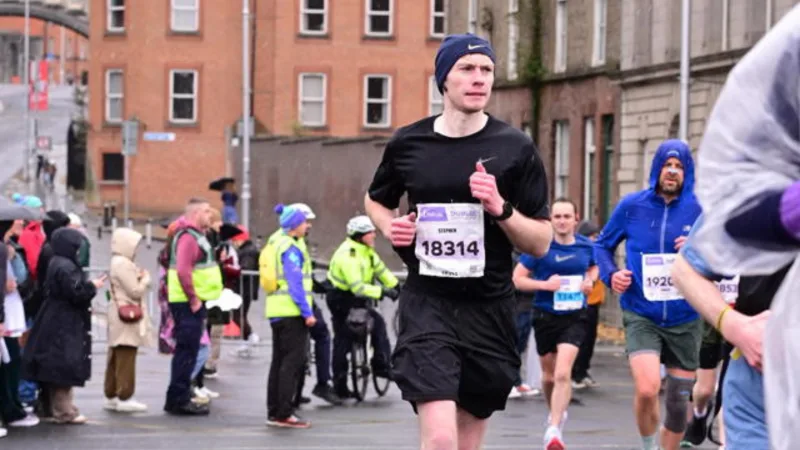
Derek is in wave four, off at 8:45, targeting 3:10. His app says it is there. He is not saying it out loud until the day.
"If I go over 3:10, I'll be very disappointed."
But the number has a hard limit on how much it matters.
"It doesn't matter if I have to walk, crawl, jump, skip, roll, or be carried across the line."
The spectating plan is built around Finn rather than around convenience, and it is the most thought-through thing in the interview.
"He would be in the Phoenix Park, because the crowds, it's easy to find a spot where it's not congested."
"If we're in the city centre, he won't just stand there and watch all the people run. He'll want to be running around himself."
So Finn gets a long open stretch of park with room to move. Amy's mother may bring him into the finish afterwards, tracking Derek on the app to time the arrival.
His dad will be there for certain. Amy and the two older boys most likely. A few friends have booked the weekend and are coming in, which Derek files, cheerfully, under extra pressure.
"I'm not going around drumming up support to get a boost out of people. I'd rather meet them after for a drink."
What the Medal Is Actually For
Asked what crossing the line will feel like, Derek does something unusual. He moves the significance off the finish line entirely.
"It's not so much the race. It's nearly the sacrifice of the last sixteen, seventeen, eighteen weeks of training."
"Crossing the line is the reward for your training."
And then the thing he keeps saying, in different words, every time anybody asks him about any of it.
"The main priority for me is raising as much money as I can, and awareness."
"The marathon is second or third."
You can support Derek's fundraising for the Keith Duffy Foundation ahead of the Dublin Marathon here.