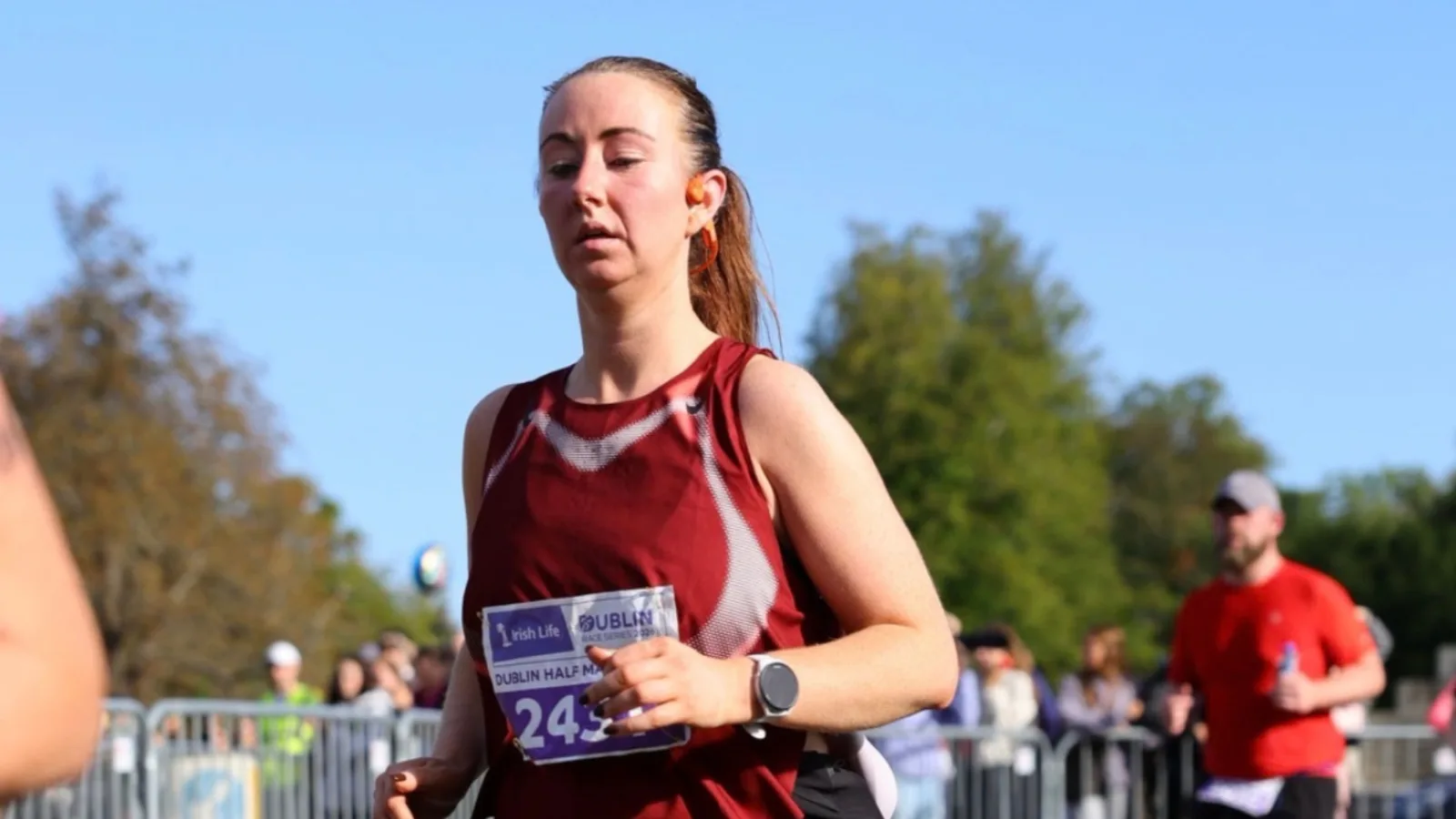
Fiona McGarry cried the whole way round her first half marathon. Not at the finish line, and not through one bad mile in the middle. The whole way.
"Honestly, it was awful."
Then something happened that anybody who has ever finished a hard race will recognise.
"And then I'd say, like, a week later, do you want to do that again?"
She is 35, from a small town in Mayo, six years living in Dublin, and she works in construction as a health and safety adviser. In October she runs her first Dublin Marathon for the Sunflower Children's Hospice, which is being built in the west of Ireland by Mayo Roscommon Hospice and which, at the time of writing, does not exist yet.
https://www.idonate.ie/fundraiser/fionamcgarry
"I Think That We're the Bad Guy, but We're Not"
Start with the job, because Fiona has a view on it and she is not shy about putting it across.
Everybody assumes the health and safety adviser is the one who arrives on site to shout about hard hats.
"That's the perception that we have. It's always PPE, health and safety adviser. But technically we're not like that. I think that we're the bad guy, I suppose, but we're not."
Her own description of what the job actually is has a lot less shouting in it.
"We're initially there to just have a chat, make sure that everything's safe, and everybody gets to see their family at the end of the day."
She has seen the culture shift over the years, and she is clear about where the shift is coming from.
"It's coming from the younger crew coming through in college now. They're learning an awful lot more about safety, and then they're seeing and hearing the accidents that happen through the years."
The harder conversation is the one with a man who has been doing the same job the same way on sites for thirty years, and who now has someone younger than him suggesting there might be another way.
"The hardest point to get safety across is to the people that have been on site for years. Me being younger than that person, they probably think that I'm telling them what to do, when technically I'm not. I'm just trying to advise them and say, listen, that's not the safest way to do it. There is other ways of doing this. Think before you actually act."
She comes back twice, unprompted, to the same idea, which tells you it is the part of the job she actually cares about.
"It's all about coming in and going home the exact same way, and everybody needs to get that mindset. Everybody needs to go home to family. Everybody has somebody that loves them, somebody out there."
Sligo, Westport, and a Very Fast Month
Fiona studied occupational health and safety at IT Sligo for four years, then went to work for a small electrical contractor in Westport, on pharmaceutical sites including Allergan and Baxter.
COVID changed that, the way it changed a lot of things in construction.
"During COVID, obviously there were layoffs and stuff like that. So I decided, you know what, let's apply for somewhere bigger in Dublin."
What happened next was the kind of recruitment process most people only hear about secondhand. She applied to JJ Rhatigan, got an interview the week of the first St Patrick's Day lockdown, got the job the following day, and was living in Dublin a month later.
"I haven't looked back. It was so fast."
She has been in Dublin six years now and gets home to Mayo once or twice a month, most recently for the kind of county-wide celebration that only happens every so often, with the cup going round every town in the place.
"That cup has been everywhere."
Dublin, she says, is a second home at this stage.
"Lovely spot, close to everything. You step out of your door and there's so much you can do."
The Child Athlete
Running is not new to Fiona. It just went missing for the guts of twenty years.
In primary school she was in the relay team for her local athletics club, and she was good. There was a Community Games gold, and she represented Mayo at Mosney twice. She did the 1,500 metres and hurdles as well.
She also played Gaelic football, and she is refreshingly honest about how that went.
"Tried playing, but two left feet. So I was mostly on the sideline."
Athletics was the thing. And then secondary school arrived, and it quietly stopped, and she brings that up herself more than once across the interview without being asked about it.
"I went to secondary school and kind of just let it slip, focused on other things, and I wish I didn't do that. I wish I kept going and kept running, because it was so enjoyable."
What she remembers is not the medals so much as the days out.
"My family loved it. Going to different tracks, competing in the championships. They were amazing days."
She misses the specific feeling of being on a start line as a child, which is a thing most adult runners lose and never get back.
"Just the nerves you get before competing. It's kind of enjoyable. It's a bit of a rush."
But she has no interest at all in going back to the track.
"I wouldn't go back to track. I'm kind of enjoying my long runs now and just being free and looking around and just taking it all in."
The Spare Ticket
The way back in was entirely accidental. A friend had a spare ticket for a half marathon, and Fiona took it without much thought about what it would involve.
"One of my friends actually had spare tickets. And I was like, right, I'll give it a go and see what happens."
Which brings us back to the crying.
She got round, she got home, and within about a week the thing had flipped from an ordeal into a plan. She started running three or four days a week off the back of it, found a training app, put another half marathon in the diary and worked the plan.
Then came Christmas, two weeks off work, and a notion.
She had seen the Dublin Marathon before, out on the streets, and she had noticed something about the people running it that did not match her own experience of racing.
"People doing it were actually smiling and having the craic. Not crying like I was, I suppose."
That was the moment she decided to enter. And the second decision followed immediately, and she describes it as though it was never really a decision at all.
"I said, if I'm going to do something, I want it to mean something."
The Training, and the Hill in the Phoenix Park
Fiona's week has tempo work and short sprint sessions in it, and a long run that has been climbing steadily.
Her longest to date was 27 kilometres, and her account of it will be familiar to anyone who has been out that far for the first time.
"A lot of pain. But it wasn't too bad. I did actually keep going. It's kind of a different burst of energy throughout it. It's weird. One minute I'm tired, I want to give up, and then I'm flying it again. Don't know how that happens, but it did."
Thirty two kilometres was the plan for the weekend after we spoke.
She also ran the Dublin 0.5 Marathon in the Phoenix Park the same week, and the Park found her out, which she reports with a laugh.
"That hill in the Phoenix Park, that got me. It was tough going. I was going so well up until that, so I'm going to have to start practising a little bit more."
She Has Already Run the Hard Part
The most impressive bit of preparation Fiona has done is not a session at all. It is homework.
She lives on the southside, so she knows the stretch of the course that comes up from Milltown, turns past Ashton's and drags on up through Clonskeagh. She has been out supporting the marathon before and she has seen exactly what it does to people.
"Faces aren't great. It's tired at that point."
So she has been running it, deliberately, and she has been breaking the whole course down into 10k blocks in her head to work out what each one will ask of her.
"I know that's going to be the block. It's going to be the hardest part."
She is also banking on the other half of that equation, which is the thing first timers often miss about that section.
"But it's also going to be where the most support is. So I'm hoping that's what's going to help get me over that line."
She is not letting herself get too comfortable about it either.
"Just because I've incorporated it, it doesn't mean that on the day it's going to be the best, because it's the last section. So I'm trying to not think about it too much. I do want to soak it all in as well, and I do want to enjoy it."
Fuelling, Which Is Still a Work in Progress
This is the section where Fiona is most useful to any first timer reading, because she is honest that she has not cracked it.
She is training on High5 gels and avoiding the caffeinated ones, because caffeine does not agree with her.
"It's all about practice, I suppose. They're not easy. They don't taste good at all. They're tough on the stomach."
The carbohydrate drink that half the runners in this series swear by did not work for her at all, and she gave it a proper go before giving up on it.
"The first few tries was not good for me at all. I had to stop. I was sick. And I really thought that was going to be the one."
She had done it by the book, too, taking it twenty minutes before and sipping it through the run, which is exactly how you are supposed to.
She is still looking, and there are a few weeks left to find something her stomach will tolerate.
A Hospice That Isn't Built Yet
Here is the thing that makes Fiona's fundraising different from most of the charity runners in this year's field. The building she is raising money for does not exist.
The Sunflower Children's Hospice is being built by Mayo Roscommon Hospice, the regional charity behind both the Mayo Hospice and the Roscommon Hospice. The land is secured, ground is due to be broken just before Christmas, and every cent of it comes from fundraising.
"They do completely everything they build on fundraising. Solely fundraising. Not from the government. Nothing through anything else."
The numbers Fiona quotes are stark. They have raised eight million euro. They need twenty.
When it opens it will be the first children's hospice outside Dublin, where LauraLynn has been the only one in the country. The Sunflower will cover the Western Seaboard, from Donegal all the way down to Limerick, which means families in Mayo and Sligo and Galway and Donegal will stop having to drive the width of the country to be with a sick child.
Fiona's description of what that means is the best thing she says in the whole interview.
"It's a place where children can be children and, I suppose, parents can be parents."
"It's going to be a place where families don't have to travel long distances, where they get that time back to spend with their children. And that's so important. Every bit of time that you have with a child that's ill, it's making memories. It's being there for them."
One Brick on the Wall
The reason this particular project landed with Fiona goes back to her first career, before the health and safety qualifications.
When she was working for that electrical contractor, she worked on the building of the Mayo Hospice itself.
"I've actually seen that building from the ground up, and it's fantastic."
So when she heard the same organisation was taking on a children's hospice, the decision made itself.
"I thought, I have to be involved in some way or another."
She has no illusions about the scale of what she can personally contribute against a twenty million euro target, and she has made her peace with that in a line that is worth holding onto if you are ever weighing up whether your own fundraiser is worth the bother.
"Even if it was just one brick on the wall, it's something."
€825, and Counting
Fiona only put her fundraising page out into the world about four or five weeks before we spoke. At that point she had raised €825 against a target of €1,500.
She started where a lot of people start, which is at work.
"I started off with my company because they're fantastic. They really love getting behind charity work, and the donations coming in has been really, really good."
From there it has spread out to friends and family, and she intends to keep the page live well past race day, for two reasons.
"I'm going to keep it open after it as well, just to show people that I actually did do it, so they can still donate after it."
The Finish Line
Ask Fiona how she expects to feel crossing the line and she gets the personal achievement out of the way in about four words before moving on to what she actually wants to talk about.
"Yes, it's a personal achievement, obviously, to do something like that. But it's so much more than that. It's about the charity. I want people to know that it's not me."
She has family travelling up from Mayo to watch.
"It's going to be raw. It's going to be so emotional. I have loads of family coming up to watch and support. They know how much this means to the west of Ireland."
And then she says the thing that stops the conversation, and she says it flatly, without any performance about it.
"The pain that I might be in going over that line, compared to what some families are going through, mine is minor. Mine can go away in a few days. They're going to deal with that for a lifetime."
What She'd Tell Someone Who Hasn't Started
Fiona's advice is not about distances or times or plans, which is unsurprising from a woman whose own way in was a borrowed ticket and a good cry.
"Try it out. It's a breakaway from work. It's a breakaway from everything else going on in your life. You get to just enjoy yourself, look around."
"Getting out in the fresh air, it really does help, and it helps your mindset as well."
And she is firm that nobody should be put off by the idea that running has to look like what she is doing this October.
"Running doesn't have to be difficult, and it doesn't have to be the longest distance. You can make it fun for yourself, or with your friends. It's not just fitness."
"It's Not About Me"
At the end of the interview, asked whether there was anything she wanted to add, Fiona went straight back to the hospice, which by that stage was the fourth or fifth time she had steered the conversation there.
"It's just based on fundraising alone, and they can't do it without us. They need us."
"Knowing that it's going to something that's going to benefit families and young kids, and give them that little extra time or treatment, or even just a little bit of happiness. I think that's the most important part."
Then, in case it had not landed the first four times:
"It's not about me. It's about them. I'm running something that they possibly can't do."
https://www.idonate.ie/fundraiser/fionamcgarry