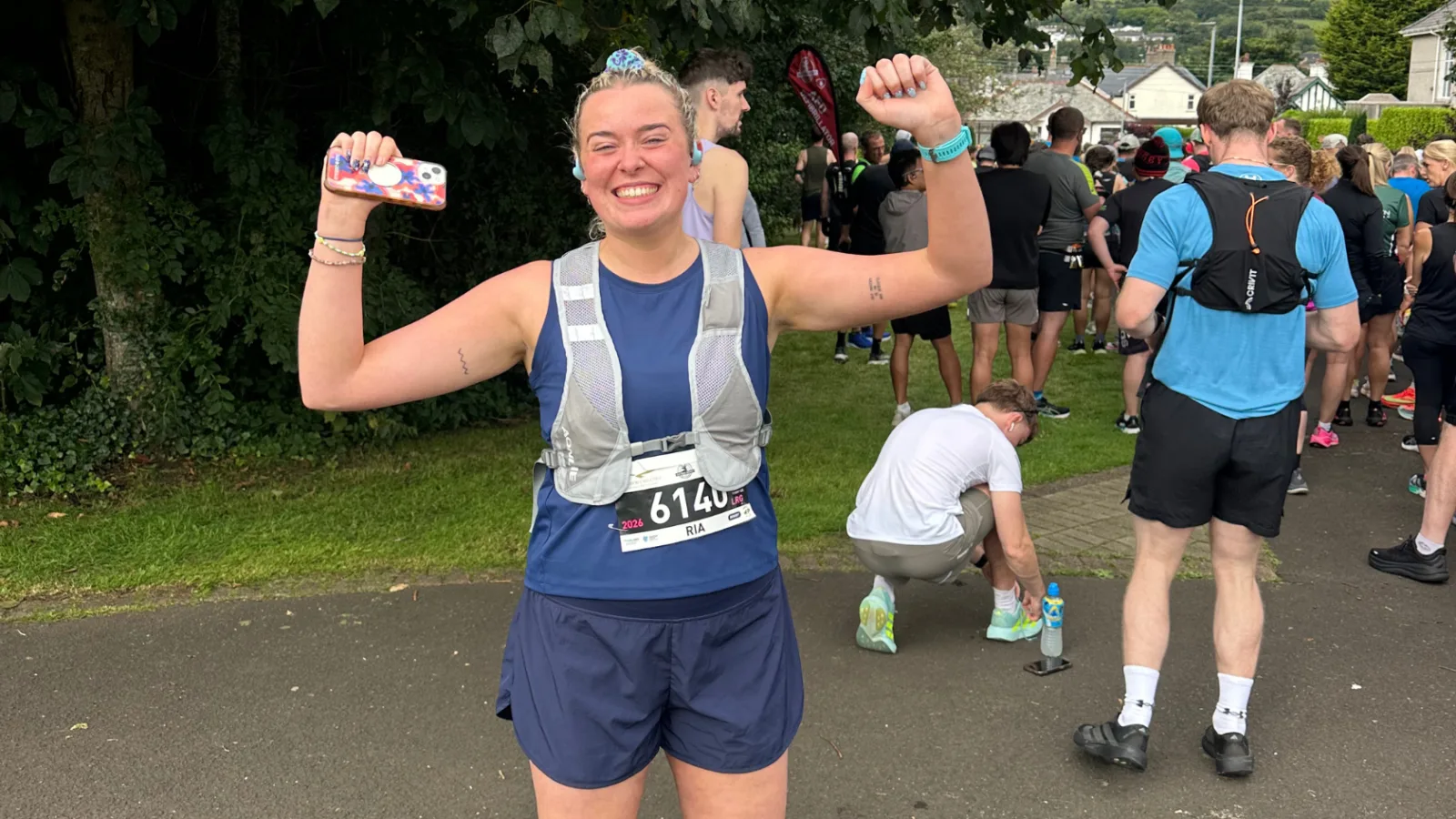
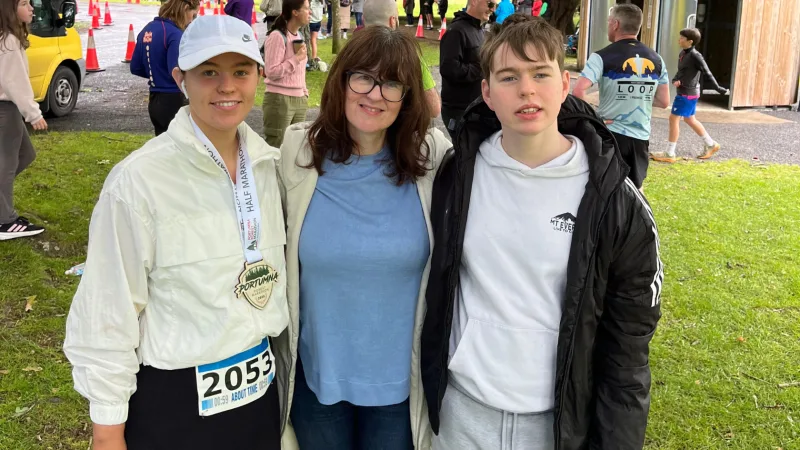
Ria Walls had the time of her life at the Antrim Coast Half Marathon, which was the first big race she had ever run.
She also spent the ten minutes before the gun going round in circles looking for a sanitary product, and could not find one anywhere.
"I actually got my period on the starting line, and there was no, like, in the portaloos, there was nothing. No one had any."
She asked at the bib collection table and was sent to the medical tent. She could not find the medical tent. She went into the crowd and started asking strangers while the countdown ran.
"Just, like, walking around in circles while the countdown is on for the race. I was like, there's no choice. I'm actually just gonna have to run and risk it."
Somebody in the crowd, a complete stranger, eventually sorted her out.
"I go into the bathroom and I cried for about ten seconds, and then I was like, you know, build a bridge. It's, you have to go and do this."
She went out and ran it, and loved it, and cried for most of the second half for entirely different reasons.
On the last Sunday in October she runs her first marathon in Dublin for Her Sport.
Coleraine, Dublin, Belfast
Ria is 26 and from Coleraine, though she has worked in Portrush every time she has been home.
She graduated from Trinity College Dublin three years ago with a degree in classics and religion, which she says, cheerfully, she has never used since. She has worked as a journalist in Dublin and as a classroom assistant at Ulster University in marine science at home. She has just started a master's at Queen's and moved to Belfast for it, and works in a café alongside the studying.
Her hobbies, besides running, are writing and anything outdoors. Living on the coast means surfing and anything else on the water.
She grew up playing team sport, mainly hockey and volleyball, and only really got into running in the last year.
The Hardest Part Was Being on Her Own
The move from team sport to running was harder than she expected, and for a specific reason.
"I'm definitely someone who thrives off team sport and community. So going from that to something that was so solitude, I found it so hard."
The irony is that solitude was the point.
"One of the main reasons I wanted to get into running was to challenge myself and spend time on my own. I find it really, really hard to do things alone."
Now it is the thing she reaches for.
"The other day I was working, just a really long day at work, and I was like, right, I'm just gonna go and run for an hour so no one can contact me. Put my phone on do not disturb, and I'm incognito for an hour. And then I come back and can just resume again."
A Comment on an Instagram Post
Ria already followed Her Sport before any of this, for reasons that go back to her degree.
Her undergraduate thesis was on the underrepresentation of women in ancient literature, and the social effects of that across history. Her master's will focus on gender bias and female representation in healthcare and medicine.
"I did a lot of stuff in my thesis on the type of stuff that Her Sport represent. All about female representation, giving women a voice, a platform."
So when they posted looking for runners, she commented without much thought about what she was volunteering for.
"I just commented, thought nothing of it. And then three days later they emailed back to be like, you've got a space, and I was like, oh no. What have I done."
By then she had already run the Antrim Coast half. The Belfast half followed a month later.
"That was a real motivation to be like, right, this is something I'm gonna take really seriously, and be able to do it for a charity that aligns with so much of what I stand for."
Why This Is the Thing She Cares About
Ria connects what she studies to what she is running for without any prompting, and she does it through history.
"From studying the classics, and with the religion side of my degree as well, you see societies and frameworks that have systematically excluded women. And from a modern perspective, people are looking back over these things and saying, these are where women should have been inserted, and this is where things could have been different."
She was genuinely shaken to learn how recent the exclusion is in her own sport. She had assumed that the story of the first woman to run a marathon being physically held back on the course was centuries old. It is not, and the woman is still alive.
"So when I first saw that, I was like, that can't have been. I thought that would have been hundreds of years ago."
She also points out, with some pleasure, that the whole thing started in her own subject.
"The history of the marathon actually is from classics. It was the battle of Marathon."
What she wants out of running in public is straightforward.
"I wanna challenge those opinions and show that it's a very normal thing for a woman to be involved in sport, and it's not something that should be considered lesser, considered sexualised."
"Even the whole language surrounding, like, throw like a girl, run like a girl. All these things that are built into our society still need to be challenged, because they're the underlying framework of why there has been this massive difference over time."
A Sanitary Station Beside the Portaloos
The idea Ria had on the start line at the Antrim Coast, and then forgot to send, is simple enough that it is slightly startling nobody has done it.
"I was gonna email and suggest something. I didn't wanna sound condescending, though."
"A sanitary station. You know, like, with the big rows of portaloos, just having a wee station with pads."
The second half of the idea is better again, because it solves the funding and the awareness in one move.
"Or else the same way they have, like, boost drinks and they have all their sponsors, having people there representing a female charity or a period charity who are giving out free sanitary products."
Her argument for it is arithmetic.
"Say 50% of the people racing were women. Say 40% of them have periods. Statistically, it means there's quite a lot of people on their period while they're running."
And then the part that most race organisers will not have thought about at all.
"Your body can start your period early when you're stressed out. So the amount of women who probably that day got their periods and had nothing."
She is clear about why this does not get raised.
"People don't talk about their periods. And I am probably too open about stuff, and I feel that whenever you do start opening up about stuff, people then say, oh, me too."
Her only hesitation is a characteristically fair one. She wonders whether the provision already exists at some races and she simply did not find it.
Belfast, and a Café Called Drip
Belfast has turned out to suit her, and the reason is geography rather than scenery.
At home in the countryside she would have had to drive somewhere to run.
"If I've had a really bad day and I had to go home and then drive fifteen minutes to go for a run, the likelihood of me actually going for a run is quite low. I'll probably just go to the pub instead."
"But the fact that I just leave the house and start running is amazing."
She has been going to run clubs, including one that meets at a café called Drip, where the deal is a five-kilometre run and then free lemonade and cookies.
"Like, I moved here by myself. You go to these run clubs and just meet like-minded people who can give you advice on running."
One of her flatmates turned out to be a serious runner training for a marathon too, so the two of them run together constantly, and have started a series on TikTok where they run to a café they have never been to before.
"Combining the two best things in my life. Go out for coffee and go for a run."
There is one habit of hers that deserves wider adoption.
"We always have a laugh. We run past other runners and we see if we smile at them, will they smile back? So we're running along and then out of breath and these big terrifying smiles at people."
"Because everyone smiles back. Everyone who runs, you're running for a reason, and other people are running for a reason, and I think you recognise that in someone, subconsciously."
The Plan She Has Not Been Able to Follow
Ria is in a full-time job, full-time in a master's, and honest about what that has done to her training.
"I have notes all over, printouts of what my training should be, and I have found it really, really hard to stick to."
The shape of the week has been two 5K runs and one longer one, and she has been trying to build on that. She did the 26K. She missed the 32K, and did the 26 a week later than the plan said.
"I just started a master's, and I'm working full time. And I have literally about half an hour free every day for myself."
What made it worse was the phones.
"When you go on to places like TikTok and Instagram, it's people being like, a day in my life, and they're running influencers whose life is to run. And when you're comparing yourself to that, it's like, I'm beating myself up all the time."
She found the 26K harder than either half marathon, and the doubt arrived with it. What got her out of it was a friend who runs a lot, and a shift in what she was measuring.
"He was like, you know, it's grand. This is about what feels good for you, and about how many miles spent on your feet. It's not necessarily sticking to the strict plan."
She is also still learning the vocabulary, and says so.
"Everyone talks about doing easy runs and stuff, and I find that hard to keep on top of. I think you're just pushing yourself all the time."
Another friend, who has run the Belfast marathon, gave her the line she is holding onto.
"She was like, you've done your 26km training, and whatever is left after that will be from the crowds. You'll gain the energy you need from the crowds."
Gels, Jelly Babies and a Blister
Breakfast is usually a black Americano and a banana, which she knows is not enough for a long run, and anything more than that upsets her stomach, so she has been getting up earlier to eat more.
On the run it is SiS gels every five kilometres, roughly every half an hour, with energy gummies and jelly babies in between, and an electrolyte drink beforehand. She has it all timed out in her head.
For the marathon she is planning to add Jaffa Cakes, on the recommendation that they are soft, easy to eat on the move and good for carbohydrates.
The current problem is a blister, which arrived after a 10K in the same shoes she walked the Camino in last year without a single one.
"Everyone else I did it with got blisters on blisters on blisters, and I didn't get a single blister. Yesterday I did a 10K and I came back to have the worst blister ever."
She has a taping technique involving individual toes and two or three blister plasters, which she did not use that day, which she suspects is the whole story. New shoes are needed and will be waiting until after the race.
A Voice Note to Herself
Ria saw something on TikTok a few minutes before this interview and had to stop and cry in her kitchen about it.
It was an app where people can leave you voice messages to listen to while you are running. The man using it had left the final message for himself, and recorded himself crossing the finish line while listening to it.
"I literally started crying in the kitchen like ten minutes before this. I was like, I'm totally gonna do that for myself."
Her reasoning about why a finish line does that to people is the best thing she says.
"Everyone's running for a reason. Maybe some people just run for the sheer craic, but most people are running because they have a lot going on in their head."
"That was the main thing with running for me. It's brought me out of some really, really dark places, and it's a constant reminder that I can do hard things, and I'm bigger than the problems that I have."
"And I think all of that just comes together when you're doing something like a race. When you finally get to the finish line, it's gonna be like, another hard thing I've done, hooray, and then just burst into tears."
Her family are travelling down. So are friends from her Trinity years, including one who is flying to Sri Lanka at seven that evening and is coming to watch the marathon with all her luggage before going straight to the airport.
"Just Go for a Run"
Ria's advice is the shortest in this series and it comes from a woman who was doing her first 5K about a year ago.
"The first time I recently went for a five k, I was so scared that I was gonna be judged, and everyone's so good, and they're posting their Strava, and their pace is amazing."
"It doesn't matter how fast you are or how slow you are. No one cares. Everyone's just doing it for themselves. No one's thinking about you. Everyone's just trying to make it through each step."
"Anyone who feels like life gets a bit too much, I would just say get on your trainers and a good playlist and go for a run."
You can support Ria's fundraising for Her Sport ahead of the Dublin Marathon here.