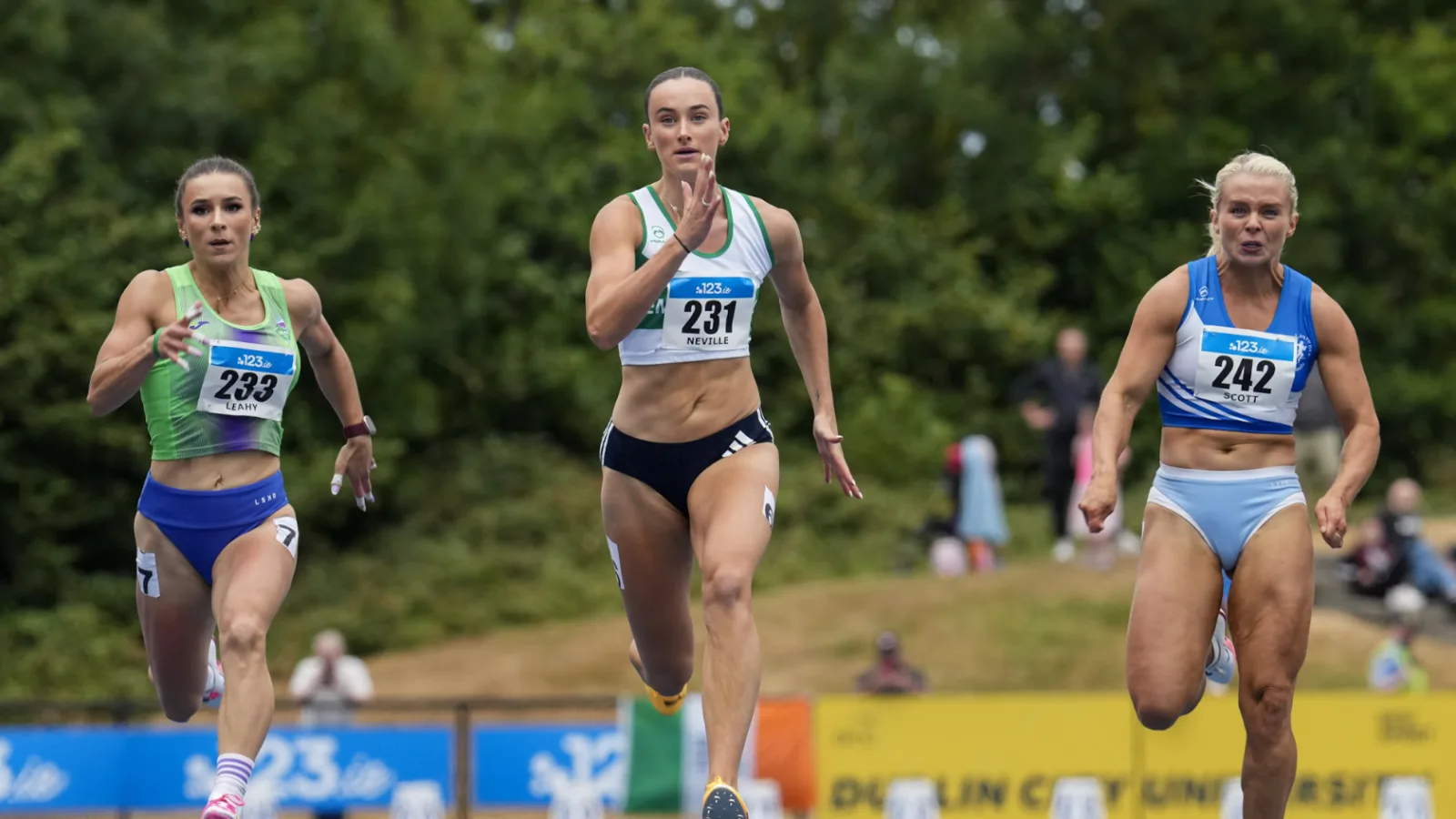
Ciara Neville ran a personal best in her second 100m race of the outdoor season. It is the sort of stat that usually sits at the bottom of a report and gets forgotten by the weekend. But that is not the case with Ciara, because the fastest she had ever run before this year was set before an injury that arrived in June 2021 and took nearly everything with it.
Five years sit between the two numbers. A surgery, eight weeks on crutches, two years without a race, and a comeback time she had already bettered as a fifteen year old.
"We're in 2026 now and only now have I broken my PB from before the injury, which is crazy."
There is a phrase familiar to generations of Limerick children, and it belongs to the rugby team rather than the athletics club. Stand up and fight. Ciara's father grew up across the road from Thomond Park and the family went to Munster games more often than they went anywhere else, so it is fair enough to borrow it here. That is exactly what the last five years have asked of her, and she has done it without ever really losing the run of herself.
She races at the European Championships in Birmingham on Monday. It is her first major senior outdoor championship as an individual, and she is twenty six years old.
It Started in Monaleen
When Ciara was in primary school in Monaleen, just outside Limerick city, one of her school friends had a mother who coached at Emerald AC. That woman was Noelle Morrissey. Ciara was five or six and was encouraged to tag along and give it a go the way half the class did, and she never stopped. Noelle saw the potential in her early, backed it and stayed with her through all of it. Twenty one years later she is still the woman standing at the side of the track.
It helped that Ciara grew up where she did. Monaleen sits beside the University of Limerick, and the pitches and facilities there are where an awful lot of Limerick childhoods happen.
"It's really like a big sporting area. Everyone who kind of lives in Monaleen grew up in UL playing sports in those pitches."
Gaelic football, soccer and hockey all got a go, but by fifteen athletics was taking up enough days in the week that something had to give. Nobody forced the issue. She simply liked athletics most.
The One Who Was Not Winning
There is a version of Ciara Neville where she was always the fastest girl in the room, and it is worth saying early that it is not the true one.
She won a community games national title at eight or nine, but club competition was a different matter. Athletes had to come through county and Munster rounds to reach a national final. For years, Ciara did not.
"I probably didn't make a nationals in the clubs, which is almost more important than the community games. It's so much more competitive. You have to go through like the counties, the Munsters and so on. Until I was about thirteen, maybe even fourteen."
She is matter of fact about the difference between herself and the women she lines up against now, most of whom were winning everything from the moment they could run.
"People that I race against now, they were winning the whole way up, like every single race. They were always winning from when they were small, whereas it happened a bit later for me."
When it came, it came all at once. In January 2015, as a fifteen year old, she took a medal at the National Senior Indoors behind Kelly Proper, one of the country's top sprinters at the time. A hundredth of a second between them.
"It shocked her and it shocked me. Obviously competing against her and pushing her the whole way to the line would give you so much confidence, which when you're a teenager, you don't really have that much confidence anyway."
That confidence carried her into a summer most Irish teenagers never get. Three weeks before the European Youth Olympic Festival she was sent to the European Under 20s, which is a lot to ask of a fifteen year old and turned out to be exactly the right preparation.
"Obviously I realised there were so many people better than me, bigger than me. Then when I went to the European Youth Olympic Festival I was like, this is a piece of cake, because we're all the same size, we're all the same age."
She won gold. Then 2016 arrived, she did not run as fast, and she got her first taste of what expectation feels like when it goes the other way.
"When I underperformed I was doubly as disappointed. Which is obviously hard when you're only sixteen."
Agents and sponsors came calling after the gold medal, but her coaches and family decided how much of that world a fifteen year old needed to see. They kept her out of the limelight and protected her from the pressure that came with it.
Finland, June 2021
By 2021 Ciara was a national champion with a strong indoor season behind her. Because of the way the Covid Olympic cycle worked, results from 2019 still counted towards Tokyo, and she was sitting inside a qualifying position on the rankings. She was getting into good races across Europe. All she had to do was hold her form and finish top three at the nationals.
In June, in Finland, she went through a warm up exercise she had completed countless times before.
"It just popped. And it wasn't necessarily sore at the time, which people are like, how was it not sore? I don't know."
She ran the race, qualified for the final and then decided not to run it. She should have gone on to another meet. Instead she went home, and she went home on her own.
"It was like complete torture going to the airport. I had two suitcases that I was using as crutches."
Two weeks to the nationals, and the nationals were the Olympic cut off. Because it did not feel like any hamstring tear she had experienced before, the call was made not to scan it, to manage it as best they could and to run. She spent the day sitting on a hot water bottle in the call room trying to keep the tendon warm, then went out and ran a national final on one working leg.
"It was very visible to anyone who was watching me and that knew me that I looked like a completely different person when I was running, because I was like technically running with one leg. One of the legs just wasn't working and the other one was."
She finished fourth. Having been selected for anti doping, she was met by a tester at the finish line.
"God love that poor woman that tested me that day, because all she got was me crying."
Missing an Olympics because you are not good enough is one thing. Missing one because your body went three metres into a warm up is another.
"If you don't qualify for the competition, you kind of just have to accept it. But knowing that I was good enough to go and had to watch it from home was really hard."
The Surgeon and the Eight Weeks After
The scan showed a partial tear of the proximal hamstring tendons. Several opinions came back saying take the conservative route, so they rehabbed it for ten months. She could run. She could train in the gym. The last piece would not come.
"It was just that last like ten per cent, ninety per cent speed to a hundred per cent speed, that we just couldn't get. And the more I pushed it, it would just be achy."
That was the pattern for the guts of a year. Two steps forward, then a few days knocked back because she had asked too much of it, even though every progression had been mapped out and taken gradually. A second MRI went to one of the top surgeons in the UK. He told her the tendon might reattach on its own, that he did not think it would reattach strongly enough, and that she would be back in front of him at some stage of her career. At twenty two, with ten months already gone, she was not prepared to gamble the rest of it on a maybe.
She had never had a major operation before, and the injury is rare enough in sprinting that there was almost nobody to ask. So she went looking online.
"An article came up that Harry Kane had had the same surgery. Obviously I couldn't get in contact with Harry Kane, but I found some rugby players and a GAA player from Ireland that I was able to talk to."
Talking to them helped, but there was a limit to how much comfort a sprinter can take from a rugby player's recovery.
"It never dawned on me that if they only got back to ninety per cent speed, no one would really notice. Whereas if I only got back to ninety per cent speed, it was going to be very apparent."
The surgeon, who had not operated on a sprinter before, told her straight that she might never get her old top speed back. She went into theatre anyway, expecting to wake up fixed.
"I thought it would be like, oh perfect, it's going to be healed when I wake up. Which was not the case."
Eight weeks on crutches followed, with tablets to keep the blood clots away. She could not put her own socks on or sit down comfortably, because the injury sits right at the top of the hamstring underneath the glute and you use that part of your body for everything. Months of gym work and hours on the bike followed before she was allowed near a track, and it took two full years before she stood on a start line again.
The group around her saw her nearly every day. Noelle, her physios and a new strength and conditioning coach called Tommy Cummins, whom she joined after surgery because she could no longer drive to Dublin. Physio Kathryn Fahy, who is also a triathlete, stood at the side of the pool while she swam lengths, on the basis that she is a sprinter rather than a swimmer and somebody ought to keep an eye on her.
11.90
Her first race back came in August 2023, two years and two months after that warm up in Finland. She ran 11.90, a time she had already bettered as a fifteen year old. In 2015, the season she won European Youth Olympic Festival gold, her personal best was 11.64.
That, more than the crutches, is the part she describes as the hardest.
"When you're a twenty three year old and you're looking at the times and you're putting in so much effort, like I was putting in probably more effort than I ever had before. It was almost harder than the injury itself."
Plenty would have walked away. Ask her about the mental side of it and she will not dress it up for you.
"It was a really hard time, but I wouldn't have said I ever majorly struggled mentally at all. I never would have been in a dark place."
She credits that to the people around her and to being competitive to the point of stubbornness.
"I had put in so much work just to get to the start line that I was going to keep going until whatever it took to do a personal best."
And then the line that explains the whole five years.
"I never lost faith that I would get back to being better than I was before. That was a really big thing for me, that I wanted to be able to say I'm better now than I was before the injury."
Two National Titles, Six Years Apart
Progress after that first race back was slow and it was not linear. In 2024 she got down into the high 11.60s and finished sixth or seventh at the nationals. In 2025 she opened with 11.70 into a headwind, worked her way into the 11.40s and 11.50s, and went to the nationals knowing she was capable of winning without being the woman anybody would have backed.
"If you were betting on me, the odds wouldn't have been in your favour, let's just say that."
She won it, six years after her previous national title. She also finished that season hungry rather than satisfied, because the personal best still was not there.
That hunger carried into the winter and into an indoor season that finally gave something back. She nearly broke her 60m personal best, which had stood since 2017, in her first race, broke it a few weeks later and went to the World Indoors. Outdoors, she opened in London in May and equalled her 100m best with her father in the stand, which does not happen as often as you might think.
"A lot of the time you're on your own at these competitions. If it goes well, if it doesn't go well, you're just left on your own."
The next race brought the personal best. Times like that get an Irish sprinter into the highly ranked meets across Europe, and those meets earn the points that put her on the plane to Birmingham.
The nationals this year were a serious day's work. Heats, semifinals and a final inside the same afternoon, relay places on the line and European ranking points for everyone in the field. Ciara went in ranked third on times. There was also a disqualification in the final and an athlete running under protest, which is the sort of thing that can pull a sprinter's head out of a race before the gun goes.
Hers did not move. She won it. And what she says about the disqualification tells you plenty, because a lot of athletes would have quietly taken the gift.
"I just really wanted her to run. If she had not run in the race, people would have said, oh she might have won if she wasn't disqualified. It kind of made me even hungrier to win, because I wouldn't have wanted her to win and then being disqualified and me being upgraded to gold."
She did not want a national title with an asterisk beside it. She wanted to beat everybody in the country on the day, in a straight race, with nobody able to argue about it afterwards.
The Life of an Irish Sprinter
Here is the part that rarely makes it into the coverage. Ciara paid her own way to every competition she entered this summer in pursuit of European qualification. Flights, hotels, transfers and entries all came out of her own pocket. She had physio on the morning of this interview and paid for that too. A meet will occasionally cover an athlete's accommodation, but that support is usually reserved for the headline names.
"I pay for everything myself."
She is not working at the moment, and she is well aware of the irony in that.
"I used to work , but at the moment I'm not working at all and ironically now I'm getting the success."
She also has a sports science degree from UL. Right now she wants athletics to be the career, full stop. She thinks she might remain in high performance sport when she retires, but accepts that she may want nothing to do with it by then.
What she does have is enormous respect for the people doing it the hard way.
"I have such an admiration for people who can work full time and then leave their desk in the evening and go training, because it's so hard."
The contrast is in front of her at every session. Ciara uses the track at UL while Munster train on the pitch in the middle of it. The university has a track, but Emerald AC owns no facility, its coaches are unpaid and Ciara must pay separately to use the gym.
"I see how much support they have and how good all their facilities are, and then I see my coaches coaching me for free and we have no facilities. I pay to go to use the gym and my coaches do it just because they want me to be better."
Enjoying It
Ciara met Jerry Kiernan in an airport in 2017, on her way to her first senior international team. He was coaching athletes on that team at the time and he gave her one line that she has carried ever since.
"He said, you're always going to perform better when you're enjoying it."
It has taken her the guts of a decade to properly understand it. What she enjoys now is the part she never appreciated at nineteen or twenty.
"I'm enjoying the process of putting the pieces together and seeing the positive changes and the performances that come out of it."
"I definitely have such an appreciation of being able to represent Ireland and being able to win a nationals and getting to do what I love, because I didn't get to do that for a while and I had to go through such a traumatic thing to come out the other side. Whereas maybe before the injury I would have been like, okay great, let's move on to the next thing."
Growing up she watched Paul O'Connell and Keith Earls at close quarters and took the same things from both of them: leadership and the work nobody claps for. Derval O'Rourke became the inspiration once athletics took over. Now Ciara is the one younger athletes contact, and she does not treat that lightly.
"I like when athletes reach out to me if they've been injured. I really like helping them, because I know how difficult it is."
Birmingham and Then Los Angeles
She is not travelling to Birmingham to make up the numbers.
"Some people are really excited to just get selected and go, but I'm actually just so excited to get onto the track, because I feel like I have so much more in me to give."
The plan is simple enough. Run the heat like it is the final, because that is what qualification takes. Run a personal best. Get into the semifinals, and once you are among the top twenty four in Europe anything can happen. She is in the relay squad as well, and she is quick to talk up the blend within the Irish team, with medallists alongside athletes pulling on a senior vest for the first time.
Beyond that is Los Angeles in 2028, and the maths on that is not lost on her.
"I would have thought that LA would have been my third Olympics and I haven't been to one yet. Everyone's goal is to be an Olympian, but not everyone gets to be it. It's not realistic for everyone, but I know that it is realistic for me."
Who Keeps Her Grounded
For someone who has been fast since she was fifteen, Ciara Neville is remarkably hard to knock off level, and that is not an accident. She has built a circle that will not let the highs get too high or the lows get too low.
Her family never pushed her into athletics, but they followed her to the meets where she ran slowly and picked her up afterwards. They will be in Birmingham. Her sister was dragged to every competition as a child and ended up a fan, while the whole family now watch Diamond League meets at home. Her mother is from Latteragh in Tipperary, and the cousins out that way handle any notions before they take hold.
"They don't let me get too bigheaded."
Neither does the training group, a gang of lads who will humble her on a Tuesday and become her biggest supporters for the week that counts. They have helped her prepare for Birmingham despite being in their own off season. Noelle still tells her straight when something needs fixing, while Tommy Cummins, an Irish 4x100m runner at the Sydney Olympics, brings a sprinter's eye to the gym work.
"I think it really does take a whole team to get an athlete there."
Away from the track she keeps it simple. Coffee with her friends and her mother, sea swims at Clahane in Liscannor with her boyfriend, walks, shopping and reading. Post Malone goes on during the warm up because he calms her down and hypes her up at the same time. Olivia Dean is reserved for the car.
And then there is Teddy, the cockapoo she got the week after that nationals she ran on one leg, named for looking like a teddy bear. Ciara almost forgot to mention her and then realised she had buried the lead, because the dog is a decent chunk of the reason those years never turned dark.
"It's really hard to come down the stairs in the morning in a bad mood and then be greeted by her wagging her tail. She's kind of my rock, even though she doesn't know it."
Emerald AC trains on a track it does not own, with coaches who are not paid, and it will have athletes at the European Championships in Birmingham. Ciara Neville races on Monday, and she has fought for every metre of it.
Cover Photo: Eric Bellamy