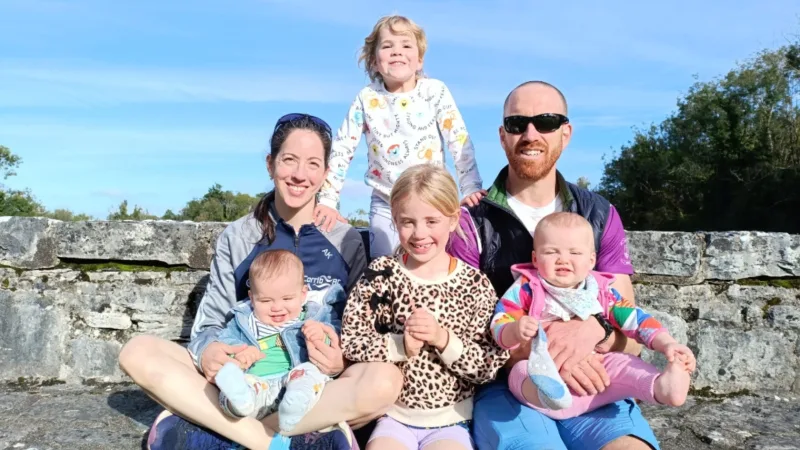
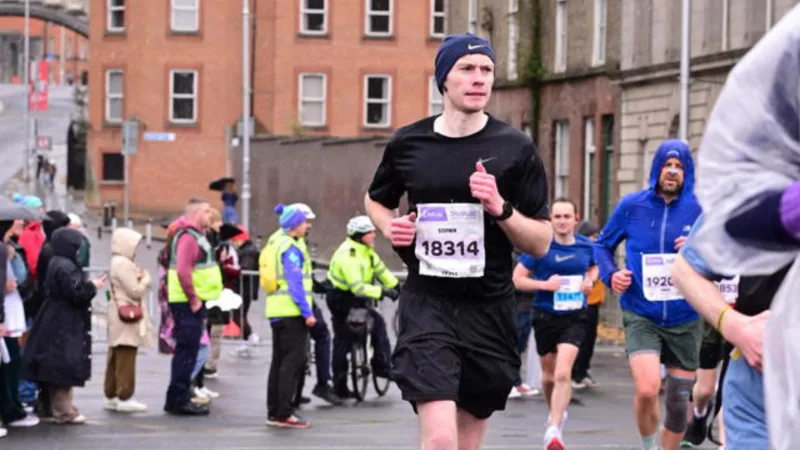
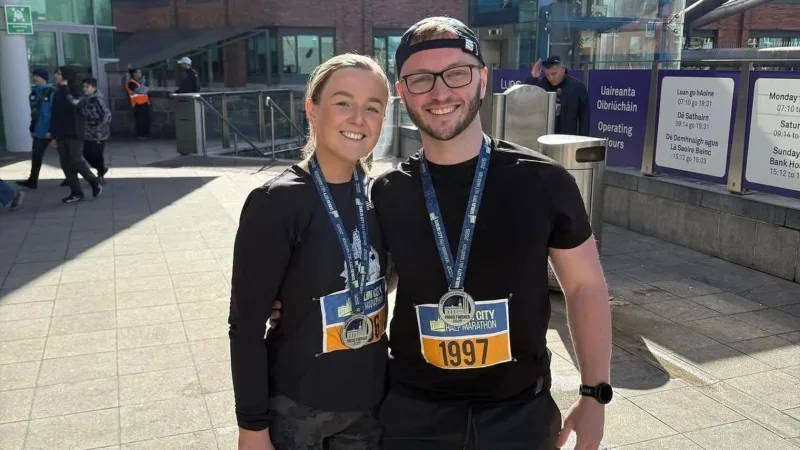
When Noel Gaule crosses the line on Dublin Marathon day, the money he raises will have a direct impact on his local community. It will go into a sensory playground at the school his own children attend in Virginia, Co. Cavan.
During our conversation, Noel is clearly passionate about knowing how the funds he raised would be spent. He had a direct hand in that, as he asked the Keith Duffy Foundation if they could support his local school. He had a place with the Keith Duffy Foundation, and he knew the school's ASD unit was refurbishing its playground specifically for children with autism. So he went back to the Foundation and asked whether the money he raised could be pointed at that project. The Foundation and the school talked it through between them, and they agreed. Every euro Noel raises goes directly to the playground.
It has turned a marathon into something else entirely for him. This is his fourth Dublin and his seventh marathon overall, but he calls it the most personal one he has run.
From the Pool to the Road
Noel is 42, originally from Blanchardstown, and he grew up somewhere fairly unusual for a Dublin childhood, on Abbotstown Farm, where his father worked as a mechanic. He met his wife in college. She's from Cavan, so the two of them landed on Virginia as a halfway house between Dublin and home. Commutable, but with the countryside on the doorstep.
His sporting background isn't running at all. Noel was a competitive swimmer at national level as a teenager, mainly over distance, with national medals to show for it. The training load was enormous, around 15 hours a week, before school, after school, gym at the weekend.
And then it stops. Anyone who has come out the far side of a competitive swimming programme knows what happens next.
"Your appetite doesn't settle for a while," he says. "You're used to being quite athletic, and then you find yourself being not athletic. And it can have an effect on your mental health as well, because you're used to this intense training regime your whole life, and then all of a sudden it stops. I needed something."
Running was the something. It wasn't easy at first, because swimming fitness and running fitness are not the same animal. "I could swim, I couldn't run," is how he puts it. In those early years he was running for one reason, which was to shift weight.
Twenty-odd years and seven marathons later, Rome, Paris, Stockholm and three Dublins among them, with a spell running with a Harriers club along the way, the reason has changed completely.
The Longevity Goal
Alongside the running, Noel has built a career in the pharmaceutical industry. He's a industrial pharmacist by training who moved into industry around twenty years ago, has worked with BMS, Merck and Pfizer, spent a decade with Takeda, and is now two years into a role with a French biopharma company. He also holds an honorary lecturing appointment at the College of Surgeons, which he keeps up partly to stay tethered to the academic side of things.
With three young kids at home, though, the ladder isn't the point any more. "It's more about finding the right balance in life than climbing the corporate ladder," he says. The same thinking has worked its way into how he trains.
"My goal now, I run this year so that I can run next year. It's longevity."
He has a picture in his head of where that leads. "My goal is to be that lad with the sweatband around his head, still running. Maybe it's not the marathon, but if you're doing something at that age, that would be incredible."
Three or Four Runs a Week, and No Guilt
The training plan is straightforward enough. Three or four runs a week, a rough shape of ten, ten, ten and a long one. What's more interesting is what happens when the plan doesn't survive contact with a working week.
"If it doesn't happen, it doesn't happen. I give it a go again next week."
There's no weekly kilometre target he beats himself up over. He might be on his feet all day with the kids at the weekend, or coaching football, or coming back off a work trip. He compares last week's ten-miler to this week's and shrugs at the difference. "The way I try to show up is to give my best on the day that I'm there."
Experience helps. "It's not my first rodeo," he says. Barring injury, he knows he'll finish.
He's also protective of the time itself, and this is one of the nicest things he said in the whole conversation. An hour out running is one of the very few windows left in a week where nobody is looking for you and you're not looking at a phone. "It's my time to have me and my thoughts, and the road ahead of me, and feel like I'm moving forward."
Running by Heart Rate, and Letting the Data Be Data
Noel is an analytical person by profession and he runs like one. He tracks cadence, he tracks pace, he logs his runs in miles rather than kilometres because 20 feels more manageable in his head than 40. But heart rate is what he really runs off.
"I focus very much on my heart rate, because it's almost like my fuel gauge. I know I can hold, let's say, 160, 162. And whatever pace I'm going at that heart rate, that's the best I can do today. That's my marathon pace."
He's honest that he has become a bit addicted to the numbers, and he'll even feed a run into ChatGPT afterwards to get a read on how it went or a predicted race time. But he draws the line firmly at self-criticism.
"Again, it's data. Don't use it to beat yourself up. Use it to motivate yourself."
Where the data does earn its keep is in spotting habits. He noticed he has a tendency to ease off at the top of a hill, having worked hard to get up it. That's exactly the moment, he reckons, when you should be holding your pace, because speed is hard to win back once you've let it go.
Aging with purpose
Two things have moved up Noel's list as he's got older. The first is variety. Hills, speed work, intervals on a treadmill, all of it, partly because your legs move differently at different paces and you want that whole range available to you over 26 miles, and partly because running the same ten-mile loop four times a week will drive you demented.
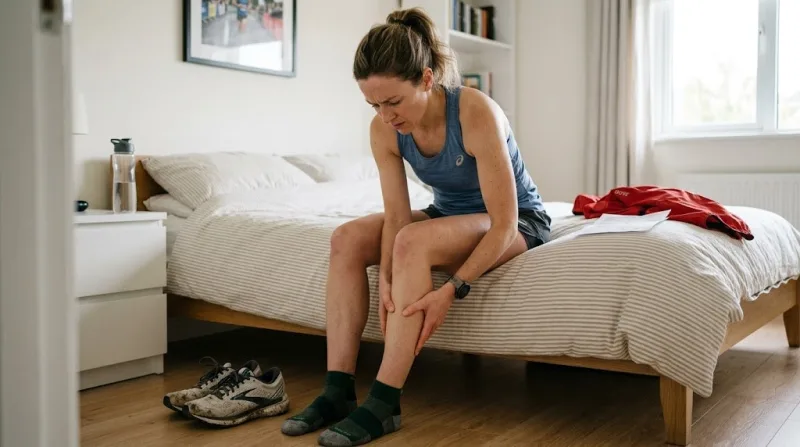
The second is strength work, which he has never done in a marathon build until this one. He's working with a trainer, and he can point to exactly why it matters. "It wasn't my heart and lungs that gave out. It was my legs. The lactic acid buildup, the calves, the ankles."
Recovery gets the same billing as training now, stretching, magnesium, nutrition, a sauna and plunge if he can get to one, and actual days off. "I think that stuff is so important, and something probably that most people don't do enough of."
Fuelling, Without Overcomplicating It
Noel's nutrition philosophy fits in a sentence. Eat as clean as you can, hydrate properly, and don't turn it into a research project.
Hydration is the one he'd underline. He can see it in the numbers, 10 to 15 beats a minute higher when he hasn't enough water on board.
Race week is a big carbohydrate-heavy meal the night before, eaten early rather than late, then something light and easily digestible on the morning. Banana, that sort of thing. Nothing heavy.
On gels, he's refreshingly relaxed. Someone training for a 5k asked him recently when she should be taking one, and his answer was that she doesn't need one at all. "I wouldn't take a gel unless I'm doing more than 10k."
His own plan for Dublin, tested at the Frank Duffy 10 Mile a few weeks back, is one gel about half an hour before the start and then roughly every five miles. Plus handfuls of jellies off the crowd, which is its own Dublin tradition.
And whatever you use, use it before race day. "Different brands of gels sit differently with people. Find the one that suits you. You don't want to find out the day before the marathon that one of them is causing tummy problems."
He's not precious about the rest of it either. "Don't do yourself out of an ice cream. You're burning calories."
Raising Funds for Charity
Like a lot of runners, Noel ended up with a charity place because he left it too late for the ballot. Several charities came back to him, and the Keith Duffy Foundation was the one that resonated, largely because he could see how grassroots the work is.
The fundraising itself scared him more than the marathon did.
"I've never gone fundraising before. I thought, geez, I'll end up just paying this myself, because I'm not going to have to ask anybody for money."
He started with family and friends, and it snowballed from there. Facebook helped. LinkedIn, unexpectedly, helped enormously, because twenty years in the pharmaceutical industry leaves you with a fairly wide network. People he hadn't seen in years were putting €50 in. One person he hadn't spoken to in a decade donated €200.
"Asking somebody to sponsor you isn't as daunting as you might think, once you rip the bandaid off."
The local connection is what really moved it. Once people around Virginia understood that the money was going into the playground at the school down the road, they got behind it properly. "Every penny that gets raised goes to this project."
It has changed his training runs too. He runs a hilly loop near home, and now people beep at him going past, or give him the thumbs up. Teachers ask him how the training is going at the school gate.
Dublin, and What He'd Tell a First Timer
Ask Noel how Dublin compares to Rome, Paris and Stockholm and he doesn't reach for the scenery.
"In Dublin, it's the people that really make the difference. Not just the people they know, strangers. When you're struggling, they catch your eye, you make eye contact for a few seconds, and all of a sudden you feel, okay, I can do this."
His advice for anyone going to the start line in Dublin for the first time comes down to a handful of things.
Get to know the course before you get to it. There are apps and Google Maps and route videos, and knowing where the hills are and roughly where you are on the loop is worth a lot mentally.
Don't catastrophise a bad week. "If you don't get out for a run, it's okay. Get out tomorrow. If you don't get out tomorrow, get out the next day." September is the month to get the miles in, but nobody reading this is a full-time athlete, and life will happen.
Practise the race-day stuff now, from the gels to the breakfast.
And take the headphones out, at least for the first half. Noel wears earphones but doesn't play anything through them.
"There's bands playing, there's people shouting, there's people screaming, enjoy it. Be where your feet are. You can stick your headphones in any day of the week. This is a once-a-year, maybe once-in-a-lifetime experience for some people."
Noel Gaule is running the 2026 Dublin Marathon in aid of the Keith Duffy Foundation, with funds going to the sensory playground project at his children's school in Virginia, Co. Cavan.
You can support Noels's fundraising ahead of the Dublin Marathon by donating here.