Rand Al-Najim grew up in Baghdad and never once saw anybody go for a run.
"I've never seen a single person run. Never ever seen a single person run."
She is fairly sure of her place in the family history.
"I was saying to someone the other day, I think I'm probably the first person to start running in my family. And people cannot believe that."
She puts it down to the heat as much as anything, and is careful to say it has changed since.
"Now you probably would see people going for runs, probably because of social media and the openness to the rest of the world."
But one thing was absolute.
"As a female, I don't think I've ever seen a male or a female run, but absolutely no female running on the streets in Baghdad ever."
She was eighteen when she left, in 2005, and ended up living near Hyde Park in London, watching people do a thing she had never seen anybody do.
"I thought that must be such an amazing thing to do."
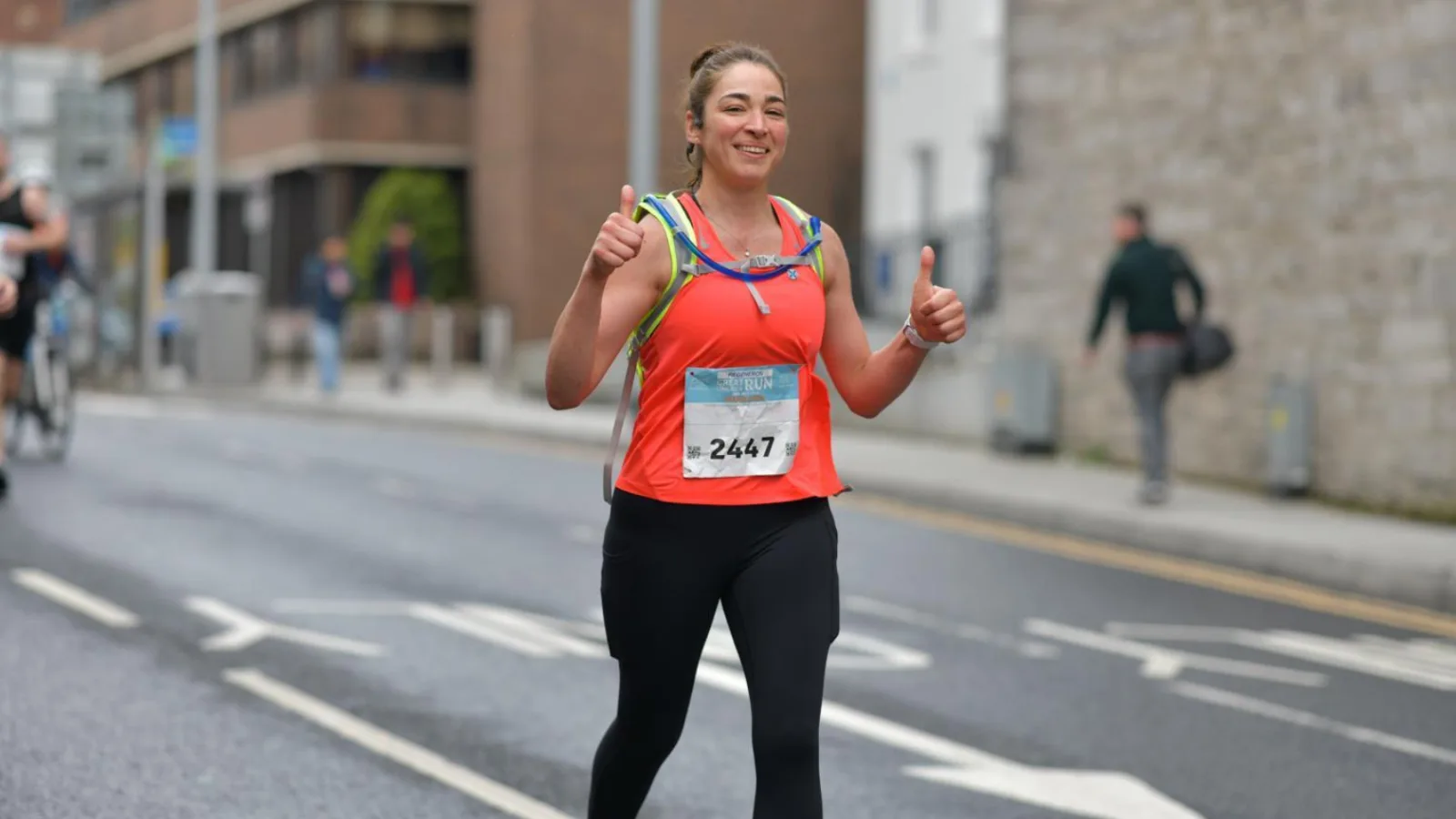
On the last Sunday in October she runs her second marathon of the year, for the Irish Motor Neurone Disease Association, alongside her sister.
Bray
Rand was born in Baghdad, lived in Spain and London as a small child, went back to Iraq at about eight and stayed until she was eighteen. She has been in Ireland about nine years.
She is a physiotherapist and works in Bray.
Running is the hobby, though she is slightly rueful about how much room it takes up.
"I've reached the phase at this point that it's probably not my most interesting hobby, because it's all I do. Work and run at the moment, training for the marathon."
Alongside it there is swimming, and a newer enthusiasm.
"Scuba diving is my new passion."
Two Cases
The reason for the charity came from her working life, and from one night in particular.
In private practice, physiotherapists do not often see motor neurone disease. Rand has seen two cases since she started working in Ireland.
The second diagnosis was confirmed by a neurologist around the middle of March.
"It kept me awake for four weeks in a row."
"I was obviously very, very empathetic towards the patient, and I could only imagine what the family was going through. So I just felt completely helpless."
"And then one of the nights when I couldn't sleep, I thought, what can I do? What can I do to help? How can I possibly help?"
What she could do was run, and there was a marathon in Limerick in May.
That became her first marathon, off five weeks of training, and the fundraiser ran for four or five weeks alongside it.
She raised over €5,000, mostly through her own clients.
"The generosity of people was absolutely incredible. Really appreciated every euro that was coming in."
Rand also wanted to thank Susan and Tony Bohan for their support and donations, which helped her raise €410 for the Irish Motor Neurone Disease Association.
What surprised her was how many people had their own reason to give.
"You get to hear lots of stories when people get to know that you're raising money for motor neurone disease. You realise how many people are actually impacted by it. They would have a friend or family or a neighbour."
The Patients Donated
The detail Rand still finds difficult is who some of the donations came from.
"They donated themselves, even. And I was like, you don't have to."
They wanted to.
"They are so appreciative of the association and the services that they are getting and the support they are getting. They really want to support in every little way they can as well."
Her own view of what the IMNDA provides is from the professional side of the room.
"The essential services, the mental health support, the support they try to provide for these patients is absolutely incredible, and there are no words to describe it."
And she makes the point that explains why charity runners matter to this organisation in particular.
"The Irish Motor Neurone Disease Association is mainly relying on fundraisers, normal people like us, to be able to provide the best services they can for patients who are in desperate need of every little help they can get."
A Privilege She Can Spend
The thing that changed for Rand in March is not about fitness, and she explains it better than anybody else in this series has.
Running had always been her mental health outlet.
"It helps with keeping me sane, dealing with the stresses of life, processing things that happen during the day. From a mental health perspective, it's absolutely been my best therapist."
Then she started thinking about her patients as they were before.
"Those patients used to be normal people like you and me. They would have a job. They had their stresses. I knew them before the diagnosis was made."
"They had their hopes, wishes, wants in life. Travel plans, work stress, an overly booked diary and so on. And then suddenly it just hits them, and their life completely changes."
"I guess that made me realise the privilege we have to be able to use our body to support such a meaningful charity. It made me fall in love with running a lot more."
"I'll have them in mind when I'm crossing that finish line. We're very privileged to be able to do that, but we've also used that energy to do something meaningful for someone else."
A Training Block She Will Not Pretend About
Rand is straightforward about the state of her preparation, and she does not hedge it.
Limerick was done off five weeks, and some people told her she would not finish.
"That kind of made me feel a bit more stubborn."
She finished in 4:27, having set out only wanting to get round without walking.
The story of how is one her sister can tell. Her sister, who is a dietitian, was watching the tracker.
"She said, oh, you're doing absolutely amazing. Four hours and thirty-one minutes estimated finish time. And I thought, no. That's not happening."
"So I took my three gels, and I went for four hours and twenty-seven minutes."
Since then, work has been busy and she has moved house.
"My training, although I would like to say it was perfect, it was absolutely the opposite. I'm going with a mindset rather than physically being prepared this time."
"The determination is really what is going to get me over the finish line, rather than being fit to complete a marathon."
"Life is like that. Things get in the way, and you just deal with it."
Whatever Time Her Sister Runs
There is no target, because the target is a person.
Her sister is running her first full marathon, and Rand intends to stay with her.
"Whatever time she decides to finish it at, that's going to be my time as well. If it's going to be four hours, I'm going to have to push. If it's going to be six hours, then that's what it's going to be."
She suspects she knows which way the help will flow.
"She's been much more disciplined than I have been with her training. I think there's a good chance she might be lifting me."
Rand is not pretending the distance is nothing.
"I'm nervous about it. There's a distance that we do need to respect. I know at 32K things are not going to be easy. You're going to feel pains and aches."
"But if we can just keep smiling and remember the blessings that we have, and the privilege that we have to be able to push our body to do something significant like this."
"It's not a matter of whether we are or are not going to make it to the finish. We will make it to the finish. We're going to take our time to recover afterwards."
A Gel Every Half Hour, No Matter What
The fuelling plan comes directly from a mistake.
"I remember on my first marathon, I thought, oh, I'll be fine, and I decided to skip one of them. But then the legs were definitely reminding me that I'd skipped a gel."
Hence the three caffeine gels in a row, and the sudden acceleration on the tracker.
"So this time, I've learned my lesson. I'm definitely taking a gel every half an hour no matter what."
Electrolytes and glucose water go in a hydration pack. Her sister handles the rest.
"She'll definitely be texting me every day, especially the last three or four days before the marathon, reminding me to keep hydrating and eat my carbs. Lots of pasta."
Heartbreak Hill, Allegedly
A couple of weekends before we spoke, the two sisters ran from Bray out to Roebuck Road, for a specific reason.
"She really wanted to meet the Heartbreak Hill herself in person."
Rand was not impressed.
"I didn't think it was a heartbreaking hill, to be honest."
She has, however, left herself room.
"Now I might change my mind, because apparently we're reaching that point at probably 32 or 35K. So I might change my mind at that stage."
"At the moment I would say it's not the most difficult hill I've done. But we will deal with it when we get there."
She is also planning to be a better patient than she usually is.
"I'm hoping that some of my knowledge as a physiotherapist is going to help me get through some of these hills. I'm going to try and be sensible."
Then, with the weary honesty of everybody in her profession:
"We are the worst."
Ten Halves and Two Marathons
After Dublin there is one more half marathon planned, which would bring the year to ten halves and two marathons.
Afterwards the family are gathering, and there will be a great deal of food.
"We're going to gather together and probably eat lots and celebrate the day. It's going to be a fantastic evening."
What she felt at the end of Limerick was not what she had been told to expect.
"You hear about these stories that you're going to be absolutely emotional at the finish line of a marathon. I wasn't. I was just really grateful."
"I felt a strong sense of feeling really lucky and happy at the same time."
"Respect the Distance, but Do It"
Rand's advice is short and it comes from somebody who went from never having seen a runner to two marathons in a year.
"Just do it. Don't overthink it. Being physically active is absolutely amazing. You'll feel mentally and physically better about it."
"Just start with small steps."
"If you plan to do your first marathon, absolutely do it. Respect the distance, but do it."
"And if you can do it for a charity or a cause that you care about, it's a big bonus. It makes life a lot easier and more meaningful."