"It's a Privilege to Be Able to Decide to Do a Marathon"
A week after Brian Healy's daughter was diagnosed with cancer, Brian stopped being able to walk straight.
His balance went. His right side went. He assumed it was shock, and so did his GP, who checked everything and found nothing.
"Blood pressure, heart rate, all fine. But it was getting worse as the days went on."
His wife and his family kept telling him it could not be the shock, not at this stage. So he paid for a private MRI, and the scan found an arteriovenous malformation, an artery and a vein grown into each other, most likely since birth and never once causing him any trouble.
"And it decided to go worse a week after she was diagnosed."
He had a brain haemorrhage, spent eight nights in hospital, had surgery in Beaumont, and could not travel to his daughter's treatment in Birmingham for four months.
He made a full recovery. Then he got faster than he had ever been.
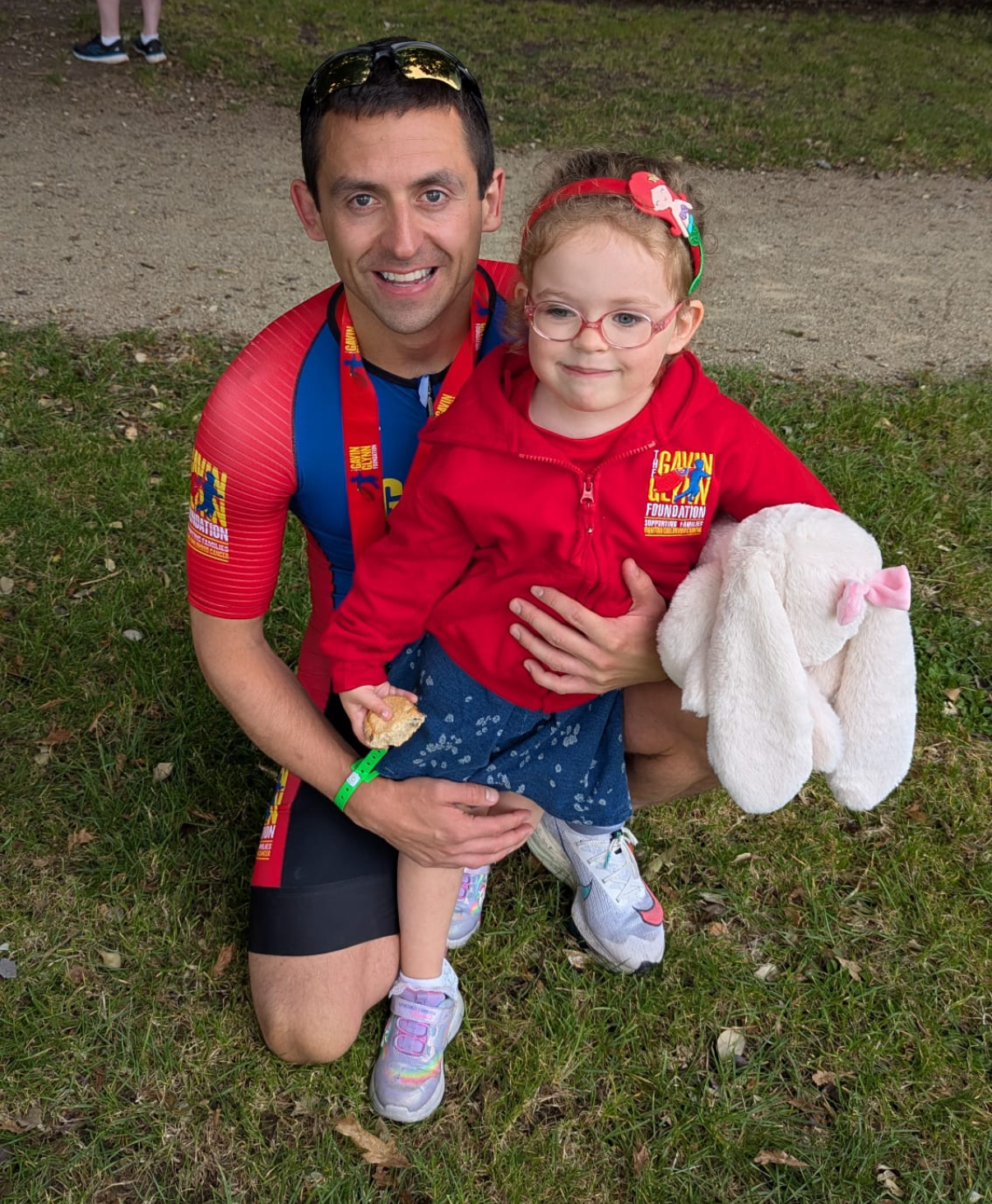
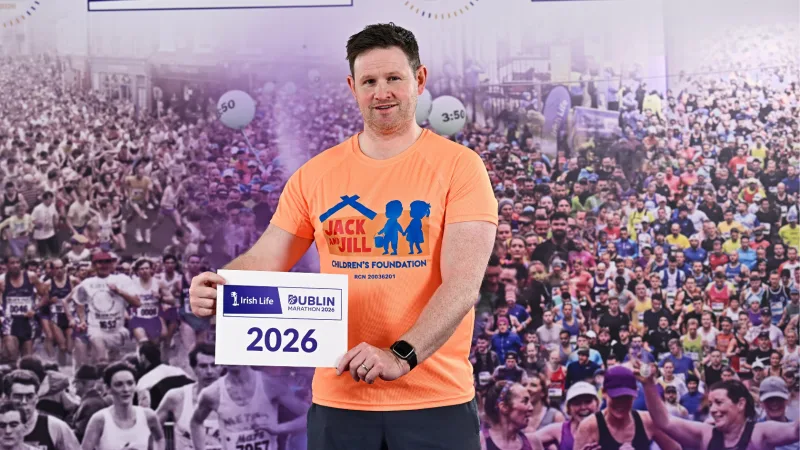
On the last Sunday in October he runs the Dublin Marathon for the Gavin Glynn Foundation.
Royal Canal Park
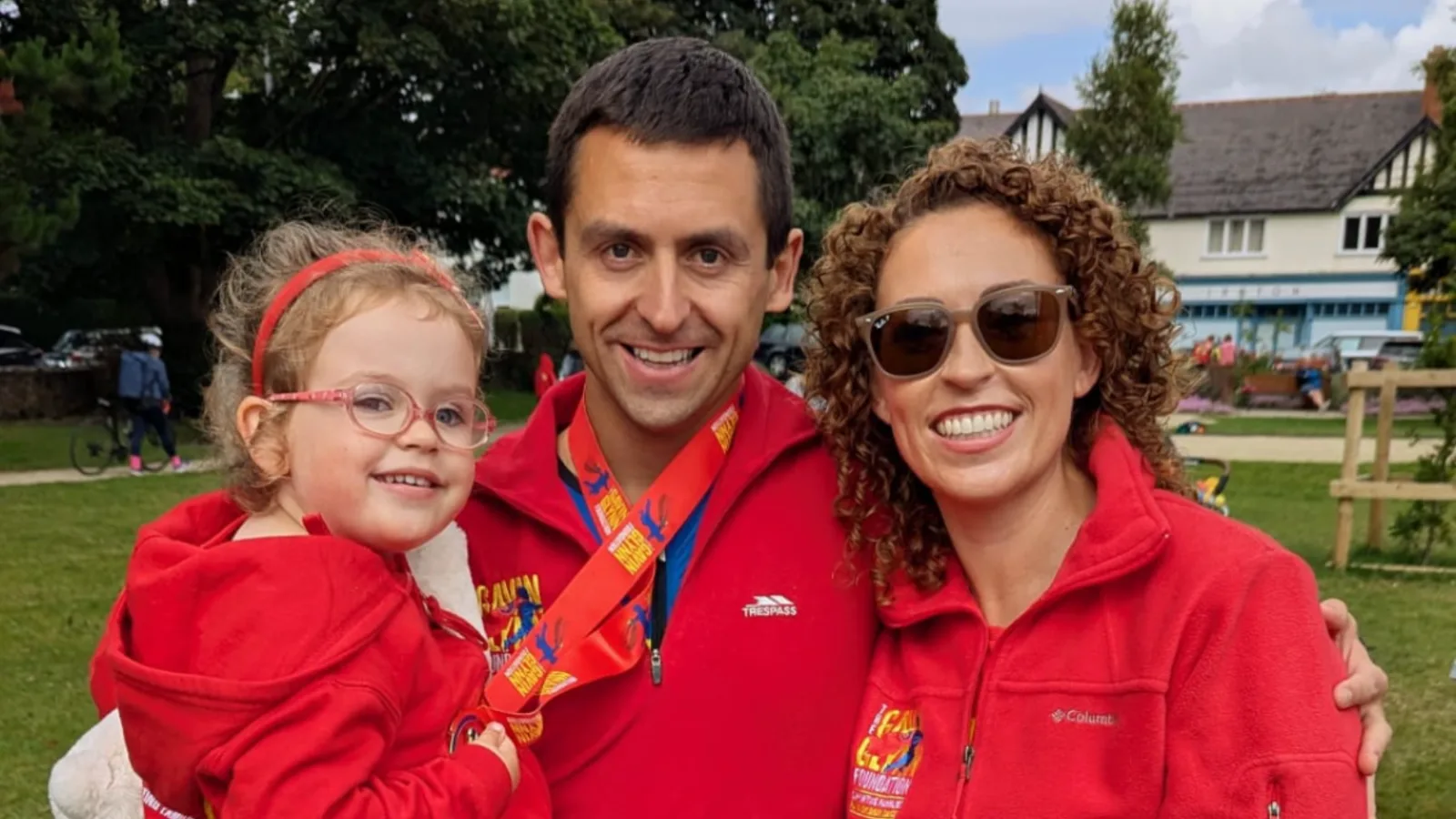
Brian is originally from Dublin city centre and lives in Royal Canal Park with his wife Elaine and their daughter Ailbhe, who is five and a half.
He and Elaine have been together since they were sixteen. He turns 40 in December. She is a teacher.
He has worked at Bank of Ireland for thirteen or fourteen years, after a spell at KBC. He was in the mortgage end of it for a long time, including the arrears and legal side, and is now in asset management.
"Not me personally repossessing them, but going down that route. So that can be challenging."
He is relieved to be off the phones.
He is a Spurs supporter, which he mentions in the tone of a man reporting a long-term condition.
Ailbhe
Ailbhe was diagnosed with retinoblastoma in June 2022, a cancer of the eye that develops in the womb.
"Our world fell apart then."
Brian is very good on how little anybody knows about it until it arrives.
"The day before Ailbhe was diagnosed, if you'd said, your daughter has cancer in her eye, it's like, what? A 95-year-old might get cancer in their eye. What is retinoblastoma?"
She had chemotherapy in Ireland, and travelled to Birmingham every four weeks for laser treatment and checks.
Four and a half years on, the trips are every three months rather than every four weeks.
"Thankfully she's in checkups now. We're grateful for that."
She is visually impaired as a result. She has no sight in her left eye and restricted sight in her right, which shapes the family's days in small practical ways. Her school is five hundred metres from the house and one of them likes to be close by.
What the Charity Actually Does
Brian had never heard of the Gavin Glynn Foundation before the hospital told him about it.
"That charity will help you massively. We suggest you get in contact with John and Jane. And we did."
The foundation pays for flights and accommodation for Irish families whose children need treatment abroad, and gives them spending money on top. There is an Aer Lingus partnership that gets families through the airport without a fuss.
"The girls or the guys would meet us before the flight, just to get us on quicker. Nothing major. But it's brilliant to have that bit of help."
What Brian keeps returning to is the nights when something went wrong.
One flight was cancelled late in the evening, with treatment due the next day. John got them onto the only flight still going out, which was to London. When they landed, there was a car waiting.
"A Mercedes, top of the range kind of taxi service. Bottles of water and all. It just took that stress away."
"Going over at the best of times, the stress is unbelievable. When things like that happen, it magnifies it. And for them to fix that, to sort that for you."
Then the line that half the people in this series have said in one form or another.
"I never knew of the charity. And you wish you never did, in a way."
He is also clear about how little is asked of families in return.
"Nothing. Absolutely nothing. Sometimes you think, at the start of getting involved with a charity, what do you have to do? You have to sign, you have to do certain things. And it wasn't like that at all."
Every single trip, money goes into their account for food, parking and whatever else the day costs.
"I'm like, how, why are we getting this?"
John and Jane
The part Brian finds hardest to get his head round is where the foundation came from.
John and Jane set it up after losing their son.
"Look what they went through. And to turn that sorrow and heartache into a charity to help with that, it's unbelievable."
"Even now I still think, Jesus. If that happened to Ailbhe, I don't know if I could go on. I'd be cursing the world."
"But they actually decided one day that, you know what, we're gonna turn that sorrow into something good. And his memory in there is just unbelievable."
He is equally struck by the unglamorous reality of how it runs. John has a full-time job. The flights get booked and the emails get answered in the evenings.
"I thought maybe that's his job. Then to come home and reply to emails and book stuff, it's just incredible."
Brian also has a theory about why a children's charity lands differently, and it comes from having been through both kinds of thing himself.
"Myself or yourself, we could get something like that, or even my brain haemorrhage. As an adult, these things can happen."
"For children, there's no part of your brain that allows you to go, it can happen."
€1,500, and Then Past It
This is Brian's first time raising money through a marathon.
Until this year he did it through the King of Greystones, the triathlon the foundation runs every July, which he enters despite a profound dislike of one third of it.
"I'm a terrible swimmer. I actually hate swimming, so I only do the sprint version."
That event did not run this year, so he moved the fundraising to the marathon instead.
John set the target at €1,500. Brian is comfortably past it already, and will send one more reminder before race day and another after it.
He is honest about why it gets harder each time, which is a thing almost every repeat fundraiser in this series has said.
"It's hard as the years go on. That initial, when she was diagnosed, it forced people to rally around. And then people get on with their lives, which is what happens."
"You're asking the same people."
He keeps going anyway, for a reason that is not about Ailbhe at all.
"They're still helping us. John may have to send a family to Germany for six weeks, and he pays for accommodation."
Fifteen Years, and Five Days a Week
Brian started running about fifteen years ago, at 24 or 25, having stopped playing football.
"I just found I really enjoyed it, for what it was doing for me physically, but mentally as well."
"At that time, mental health and exercise, it wasn't as big a thing as it is now."
For years it was 5Ks and 10Ks three or four times a week, with no structure at all. Then, as he puts it, the 5K stopped being enough.
"You need to run more to get that rush."
He is not in a club and never has been, which he says without defensiveness and with some openness to changing it.
The week now is five runs, a gym session on Monday, Saturday off, and the long run on Sunday. Most of the running happens at lunchtime, because he works from home three or four days a week and can start early, finish late and take two hours in the middle.
Sunday mornings are the Phoenix Park, and that is the one he talks about differently.
"I don't think I feel at peace more than on a Sunday morning in the Phoenix Park, especially this time of year."
"Everything in your life that you're not in control of, people's health, all this stuff. You get out there and you think, no, I'm out here for an hour or two hours. I'm in complete control for the next couple of hours."
There is one complication, and it is a five-year-old one. Some mornings Ailbhe asks him to stay and watch one more cartoon.
"That can be hard, because you're going, you want to stay with me."
"So I say, the quicker I get out, the quicker I get back."
3:14, and a Lesson in Manchester
Dublin will be Brian's seventh or eighth marathon. The first was in 2017, off a longest training run of a half marathon, and he remembers the night before it with some affection.
"I got a bowl of pasta and garlic bread, and I was like, I'm not gonna eat the garlic bread. I'd only be bloated on the run."
"I knew nothing about carb loading. I wanted to feel light in the morning."
He was starving by 17 kilometres and wobbling all over the place.
"I wouldn't change that, because it's a good story. Sometimes the big mistakes you make, if you keep doing something, you can laugh at them."
His best is 3:14. He went to Manchester in April trained for something closer to 3:05 and blew up at halfway, finishing in 3:30.
"That put manners on me. I'm not a sub-three marathoner. Maybe I never will be. But maybe I will."
So he has reined it in. The target on Sunday is 3:10.
"Marathons can go well, but the wheels can quickly fall off no matter how good you feel and how good the training went. It's a beast of a day."
He has Milan booked for April already, having missed out in the Paris ballot.
Crumlin
There is one stretch of the Dublin course that Brian knows is coming.
"With Crumlin, when we run by Crumlin Hospital, I get a bit emotional."
"The days we were in there, the hours we were in there."
Most of Ailbhe’s treatment was in Birmingham, but it is the Dublin hospital that carries the weight for him.
"I associate that more with the horrible part of the journey."
What the Marathon Is Actually For
Brian has a settled view on times, and it is worth hearing from somebody chasing 3:10 rather than from somebody who has given up on the clock.
"Ultimately you're the only person that worries about your time. No one else cares."
"The proudness of stacking up another marathon is brilliant."
He is also fairly keen to go and pace somebody round one day.
"Imagine that feeling, that you're gonna potentially help someone with their goal. For them, that's them winning the marathon. Being beside that person, all the struggles they're going through."
He already does the amateur version of it at every race his wife runs.
"I get caught up in the crowd. I'm cheering everybody on. I see the name on the shirt and you're shouting, come on Alex. And they're going, how does he know me?"
On the finish line itself he is in no doubt.
"Extremely proud, and emotional. Because I'm not just doing it for myself, I'm doing it for the charity, and that will help me as well. When you hit the wall, when you're struggling, what you're doing it for, that'll push me over."
"My daughter will be there as well."
There will be no pints afterwards. The family fly to Birmingham at eight o'clock that night.
Gels, and Three Days of Carbs
Race day is Precision Fuel gels, a couple of them with caffeine, taken every twenty-five to thirty minutes, plus salt tablets and fluid on the course. In training he uses High5, because they are cheaper, and switches over in the last few weeks so his stomach gets used to the change.
Carb loading starts Thursday and Friday, and he is sensible about it in a way that first-timers usually are not.
"People go too far. You don't even have to have more food. If you had a steak, don't have your steak, have more carbs."
"If your daily allowance is two and a half thousand calories, you can easily carb load within that amount. You're just substituting some of your protein and fats."
"Whatever It Is, Get into Something"
Brian's advice is deliberately not about running, and that is what makes it good.
"It doesn't suit everyone. And that's the same with anything else. I hate swimming. Some people go out and that's their exercise, swimming a couple of hours a day. And that's for them."
"The important thing is to try and get some type of physical activity, whatever that is. Cycling, swimming, dancing, football, rugby. Get into something, you won't regret it."
"I've never come back from a run and said, I regret doing that. Even if it wasn't the best one in the world on the day."
"Your problems are still there, but you can approach them a bit better."
And underneath all of it, the thing he came back to more than once, which is the reason this piece is titled the way it is.
"It's a privilege to be able to decide to do a marathon. The pain you go through, it's by choice. Whereas so many people don't get that choice."
"One day we won't be able to do these things. That choice will be taken from us."