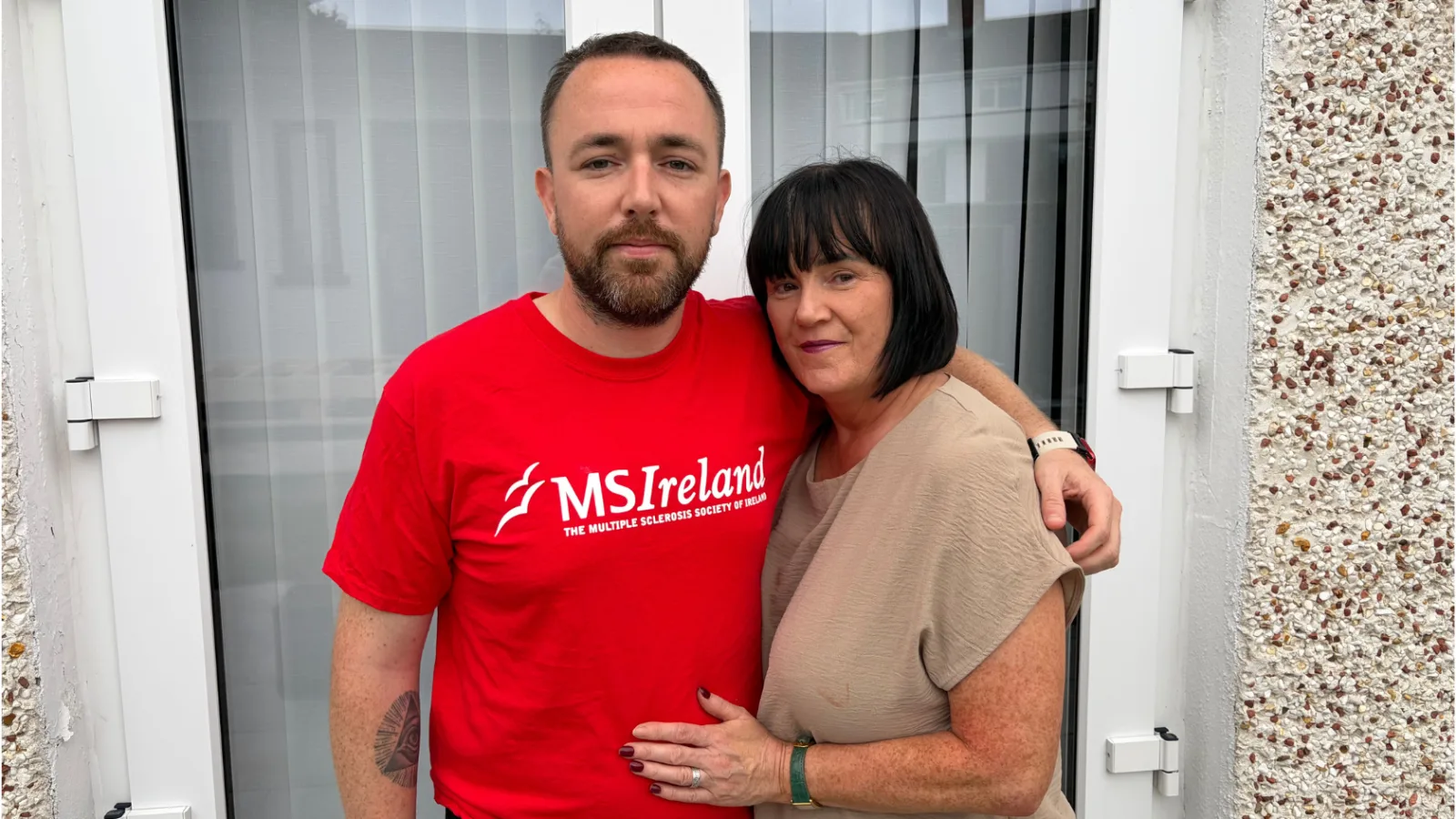
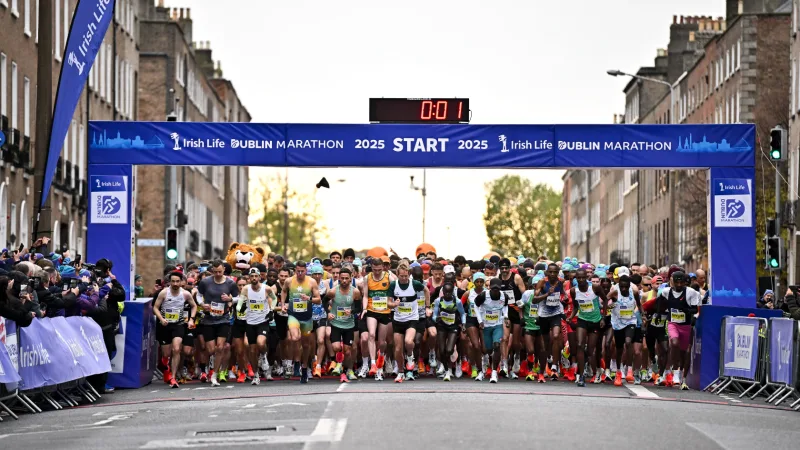
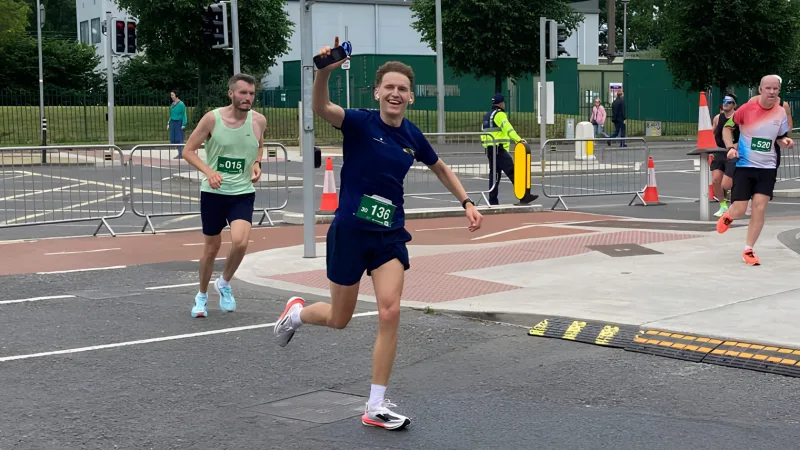
Luke Brophy is 34, from Dublin, and in October he'll run his first marathon. He'll do it for MS Ireland, and he'll do it knowing his mother is at the finish line, watching him do something her own body was never going to let her do.
He's fairly sure he's going to cry. He isn't remotely embarrassed about that.
"I'm quite an emotional person. I feel my emotions as I speak about it. I'm very open like that."
The Regular Dublin Fella
Luke works for Marks and Spencer and has done for 13 years, on the payroll side in head office. It's a family thing. His mother worked for M&S for 25 years herself, starting at 16, until she retired in 2013.
He lives in Glasnevin, and he describes himself with no false modesty whatsoever.
"I'm just a regular Dublin guy. Genuinely. Friends and that, you know. Just a regular guy trying to get by, do my bit at work, and run."
Giving something back has been part of the pattern for a long time. From the age of 15 he spent every Christmas Day volunteering at the homeless shelter in the RDS, and he kept that going into his late twenties. He only stopped when his nephews arrived and he wanted his Christmas mornings back for them before they got too old to care.
"It was one thing every year where I really felt I was doing something for someone else," he says. So he's been looking for a replacement ever since, and this year he found one.
Why MS Ireland
MS Ireland has been part of Luke's family for as long as he can remember. His mother has multiple sclerosis, diagnosed when he was in his teens.
"I even remember there was a DVD in the house, how to tell your kids that you have MS. Stuff like that. MS Ireland has always just kind of been around."
He's been a member for years. The letters come in every few months. His mother has always known they're there if she needs them.
It doesn't stop with her, either. His cousin has MS. So does the mother of one of his best friends.
"It's something that's very prominent. More so as I've gotten older, it's a lot more around me than I thought it was."
He tried the ballot for Dublin first and didn't get in. Then he applied for an MS Ireland charity place, and there was a fundraising target attached to it, which gave him pause.
"I was a little bit worried. I didn't want to hit the target on my own." Then in June an email landed saying there were still places left, and that settled it. "I said, you know what, I'm going to go for this."
"At Worst, I'll Pay for It Myself"
This is the part worth reading twice if you've ever fancied a charity place and talked yourself out of it.
Luke's way past the fundraising fear was to give himself a floor to land on. Worst case, he'd cover the shortfall out of his own pocket. Once he'd decided that, the risk was gone and he could just ask.
"I said, I'll just put it out there and see what can happen."
He posted it on Instagram. He posted it on TikTok. He put the word out at work. The target was around €1,500.
He hit it inside four weeks, and then went past it. Somebody he still can't identify donated €500 anonymously.
"I was absolutely blown away. It really opened my eyes that people may not always say it to you, but the support is always there. It's sometimes hard to see until you go and put yourself out there a little bit."
What the money goes towards matters to him too. MS Ireland support people with the practical things, scans among them, and Luke's rough reckoning is that what he's raised covers something like a year of scans for people who need them.
"Knowing that I've contributed to a community my mam has been part of since we were young, it's just a really good feeling. I can't really explain it. Knowing that she knows I'm running on her behalf, it's a really strong thing."
He's honest that it carries a weight as well. "It puts a lot of pressure on me, I won't lie. I'm feeling the pressure a little bit on my long runs. But in the end it'll be worth it when I cross the line and my family's there."
The Decision He Made in His Bedroom at 27
Luke played soccer his whole life and stopped in his early twenties. Then came the years he describes as a blur. Work, drinking, going out, a relationship, no goals attached to any of it.
"I didn't really feel like I was doing anything. Up, work, this, this, this. No real change."
The turn came at 27, in his own room, on an ordinary day.
"I wasn't happy with myself. I made a decision. I need to do something. Something has to change in my life."
He ran that day. Then he ran every day after it for a solid year without missing one.
There was a wobble in the middle of the story. He went out and did 32k on a whim one day, completely unprepared for it, and the fallout knocked him off running for the guts of a year. What got him back was a cousin buying him a six month subscription to a running app.
"I forgot I had it. I said I might as well use it. I still thank my cousin for it, because it's the reason I got back into running."
By the time marathon training came around he'd been running 5k a day, seven days a week, for about two years.
The Block
The first thing marathon training took off him was the daily 5k, and it hurt.
"I thought going into it I'd still be able to do my 5ks on the days where I'm not doing long runs. I had to stop that after two weeks. There was never going to be a hope."
Rest, he'll tell you now, is the thing he was most wrong about.
"If you think you're going to do a marathon and not be able to rest, recover, make sure your body's right, you're just going to fail it completely. You'll always put the work in to do the runs. But people think you can get up, go to the gym, work around, I don't need to rest my body down. You're so far wrong. You'll go to stand up one day and your whole calf will just go."
The other adjustment was pace. Two years of daily 5ks had conditioned him to run everything hard, and his heart rate went with it. His resting rate is 45, but on the move it was climbing far higher than it needed to.
"My body was literally conditioned to run bang, bang, bang the whole time. So I spent a good few months slowing right down and getting my heart rate under control."
He's up from around 35k a week to 50 or 60. He's not doing intervals and he's straight about that. What he is doing is stacking long runs. Two Saturdays before we spoke he ran 30k in 2 hours 57, and the Saturday just gone he ran 31k. He'd done 10k on the Monday morning of the interview with no aches to report.
The 30k is the one that got him.
"I got in and I just broke down. Completely broke down. I shocked myself. I'd done the run perfectly, way exceeded my expectations." Part of it was the sheer scale of what he'd just done alone, and part of it was the maths. Another 12k on top of that. "I couldn't believe I'd just done three hours of running on my own, job done."
The 31k the following week came and went with no tears at all, which is when the mood changed.
"I'm building into the moment where I'm like, okay, I've got this. I was quite worried up until a month ago. The last two Saturdays have really put me at ease. I'm at the stage now where I'm actually getting excited rather than worried."
He's aiming somewhere between 3:45 and 4:15 and he means it when he says the range is fine. "Finishing is the main goal, but anything between that, I'm delighted."
The Day the Fuelling Went Wrong
About a month and a half before we spoke, Luke went out for 26k along the coast and it fell apart on him.
"My body completely broke down. I was sat at the wall at the coast. I thought I was going to fall into the water. I was getting dizzy and everything."
The cause was straightforward once he looked at it. He'd been taking electrolytes and no carbohydrate at all. So he tried gels on his next run and his stomach rejected them outright.
"I can't stomach the concentration at all. They were making me queasy."
What worked in the end was a carbohydrate drink from an Irish company called Altar, three scoops in a litre of water, which is enough to see him through 30k. He carries the litre in a Camelbak.
"Everyone keeps saying to me, you look way better on the Saturday after your run. I don't look as drained. I don't look as tired."
The difference he noticed most was in his legs late on. "Usually my legs, my toes especially, would feel the drain. The last two runs, I just didn't have that heavy concrete feeling."
The bit of it he thinks is under-discussed is simply whether you can bear to drink the stuff. "If the taste is bad, I'm never going to be able to drink it. Some people say you'll get used to it. I never did."
Thirty Kilometres Across the City
Luke has one firm rule about routes. He won't do loops, and he tries never to run the same road twice.
His 30k is a proper tour of the city. Out of Glasnevin towards Finglas village, down to the Ballyboggan Road, through Cabra and into the Phoenix Park, down past the zoo and out Parkgate Street, across town to Sheriff Street, along the canal, out to East Wall, then the coast road up to St Anne's and home through Killester and Whitehall.
Living where he does, there's no such thing as a flat finish. "Everything is on a hill here. No matter which way I go, if I'm coming home, I'm coming uphill."
He's been deliberate about the Phoenix Park section, because he knows it's on the route, and equally deliberate about not looking at the rest.
"I don't want to see the full route until the day I'm running it."
Percentages, Not Paces
The most useful thing Luke says has nothing to do with training, and it's the thing he tells every friend who starts running.
"When you get into running, you start seeing high level runners more than you see normal level runners. Within a month or two you're looking at running social media and you're hit with 5ks in 17 minutes, 10ks in 40."
His answer is to change what you're measuring yourself against.
"I stopped looking at people's times. I started looking at where I put myself amongst the people in the world, not amongst runners. If you run a 5k, you're already in a very small group. Do a half marathon and you're in a tiny percentage of the population."
He's blunt about who running is actually for.
"You don't have to be a super athlete. You don't have to be super slim. You don't have to be six foot two. Running will always be there as an option for you."
Discipline, Not Motivation
Ask Luke how he fits training around a nine to five and the answer is less about scheduling than about not negotiating with himself.
"I don't give myself the chance to give an excuse. Ask anyone in the house what I do. He comes in, he changes, he leaves. I don't give myself a chance to think about it."
He has an actual rule for the bad mornings. If he can't come up with five proper reasons not to run, and he means proper ones, he goes.
"I'll be trying to think of reasons while I'm putting my shoes on. I'm getting dressed, I'm walking to the door, still trying. I might get one reason, but that's not enough."
The Saturday just gone was a live test of it. He lay in bed at quarter past six talking himself out of a three hour run, and got up and went anyway.
"Motivation will get you out the door. Discipline will get you through to the finish line."
He also names something a lot of male runners never think about, which is that his version of discipline is available to him at four in the morning in a way it isn't for everyone.
"I could run at one o'clock in the morning. If I can't sleep, it's four in the morning, I can just get dressed and go. I know some of my friends who are girls would never do that. As a male, we don't really think about it."
The Person He Was and the Person He Is
Luke is careful about how he frames the years before running, and he doesn't blame anybody for them.
Running gave him somewhere to put all of that.
"It gave me a place to think without any of the noise. Half an hour, 40 minutes every day where all that matters is the work I'm putting in. One step, another step, another step."
He credits David Goggins for the framework, having read the book three times and listened to the same podcast episode nearly as often. The practical version he arrived at was to take one thing he wasn't happy with out onto a run, unpack it properly, and then do something about it in the days after.
"If it was something to do with how I looked, I addressed it. If it was how I was dealing with people, or how I was dealing with things emotionally, I'd address it on my runs and put it into action over the next few days. That constantly became a part of how I built myself to where I am."
He doesn't drink any more. He's content in a way he wasn't.
"I don't even think about the person I was in my twenties any more. I've always been there for people, but now I'm actively there for them."
The two people he most wants to reach are his nephews.
"If I wasn't running, they'd just see their uncle in and out of work playing video games with them, which is great, I'll always be the fun uncle. But I wanted to show them you can do anything." The younger one has decided he wants to run. The older one has been out with them a few times between football.
"Something I missed when I was younger is that I wish I'd been braver. I wish I'd taken more chances on myself. I don't want them to have to grow up worrying about people's perception."
What His Mother Taught Him About Keeping Moving
Luke's mother is in the gym these days, and it's changed things.
"She was quite worried, to be honest. Worried about not being able to lift things, not being able to move. But the guys in the gym have been great with her. She's really enjoying it."
He can see it from the outside. She's looser around the house, less stiff, sore in the ordinary way people are sore after training rather than the other way.
There's a pattern in it he's noticed before. When she retired in 2013 and slowed down, they felt the MS moved faster. When she went back to work, she came back to herself.
"What we thought was stress may actually have been helping. Keeping her busy, keeping her mind off being in the house thinking about it all the time."
Which feeds directly into what he wants for himself at 60 and 70 and beyond. He tells a story about a 5k at a country race a couple of years back and an old man, he'd swear in his nineties, who took an hour to get around it while everyone waited at the line for him.
"I want to be that guy. I want to be able to go until the day my body says you're not allowed to go."
What He'd Tell a First Timer
Two things, and he gives the same two to everyone.
If you're only starting, don't try to run 5k on day one. "You're not going to be able to run it. There's no point." Download a free couch to 5k plan instead and let the voice in your ear tell you when to walk and when to jog. That's exactly what he did at 27, four weeks of it, and he took it from there himself.
If you're already running and eyeing up a marathon, the advice is rest, recovery and taper. He knows the taper is going to test him.
"I'm going to struggle with it, I know I will. But the benefits mean that when it comes to the Sunday, I have a better chance of getting there."
He borrows a line from Roy Keane to describe where his head is.
"Fail to prepare, prepare to fail. My preparation for this has been better than anything I've ever put time into when it comes to sport. I wouldn't say that freely either. I'm quietly confident in the work I'm putting in."
The Last Sunday in October
Race day will be a family day. Luke's cousin is going to follow him on a bike with water. Others in the family are running it themselves. Afterwards there's an MS Ireland event booked with his mother.
He's never even been in town for the marathon before, having generally stayed well out of the way of it, so the whole thing will be new.
"I get to give them a great day out. I get to have a great day. I get to see the city in a different way."
And then, in the way of these things, one marathon is already turning into a plan. He wants a few more, and eventually an ultra.
"Got to get the marathon out of the way first."
He'd like it on the record that he's nothing special, and he's wrong, but it's a good line anyway.
"I would never say I'm inspirational. I'm just a very normal guy. We're all flawed. We're just normal people trying to do extraordinary things. If I can get one person out the door to run, I'd be just as happy as getting a hundred out."
You can support Luke's fundraising for MS Ireland ahead of the Dublin Marathon here.