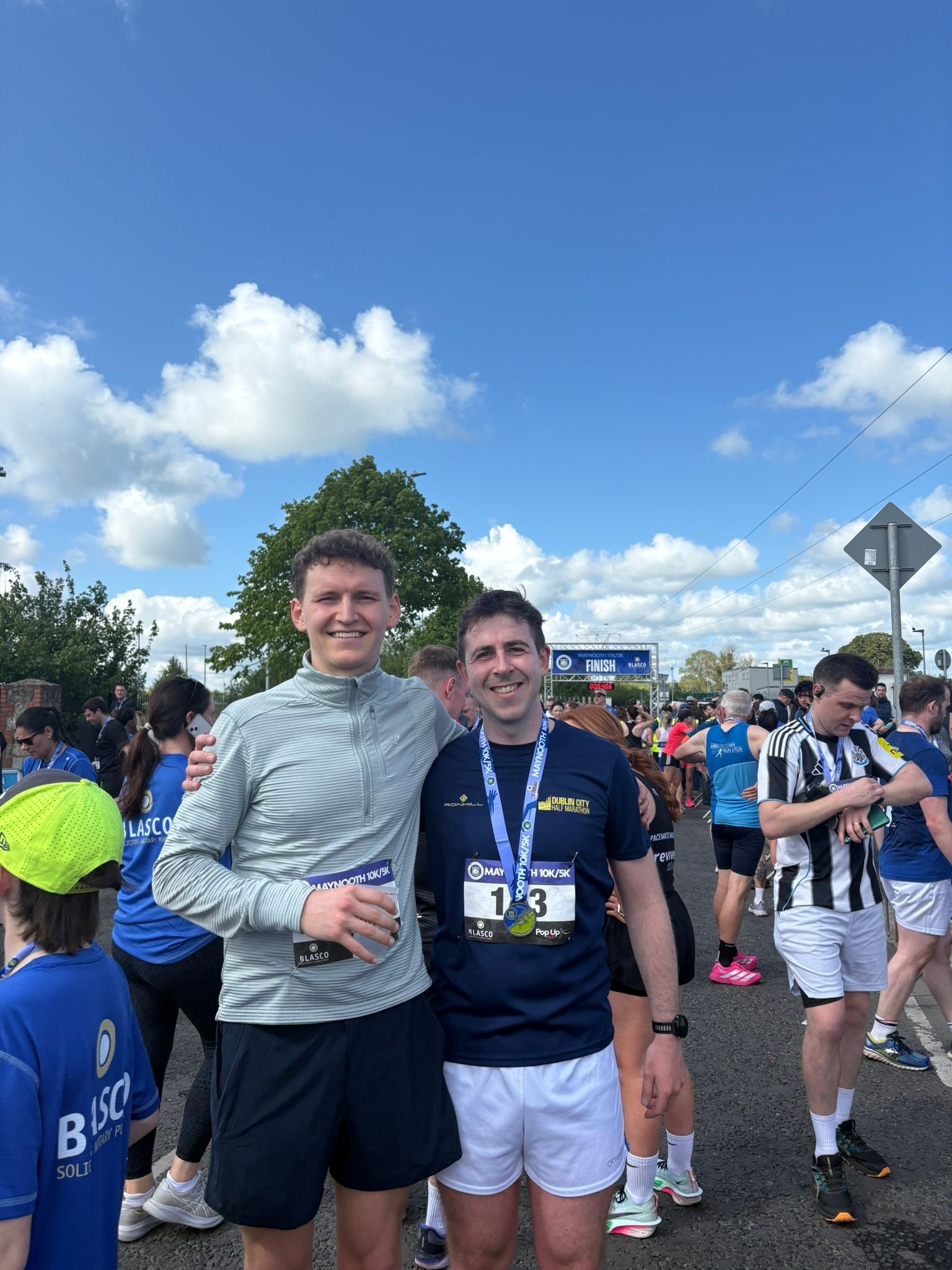
Odhran Cussen has been to a lot of fundraisers. He had never once run in any of them.
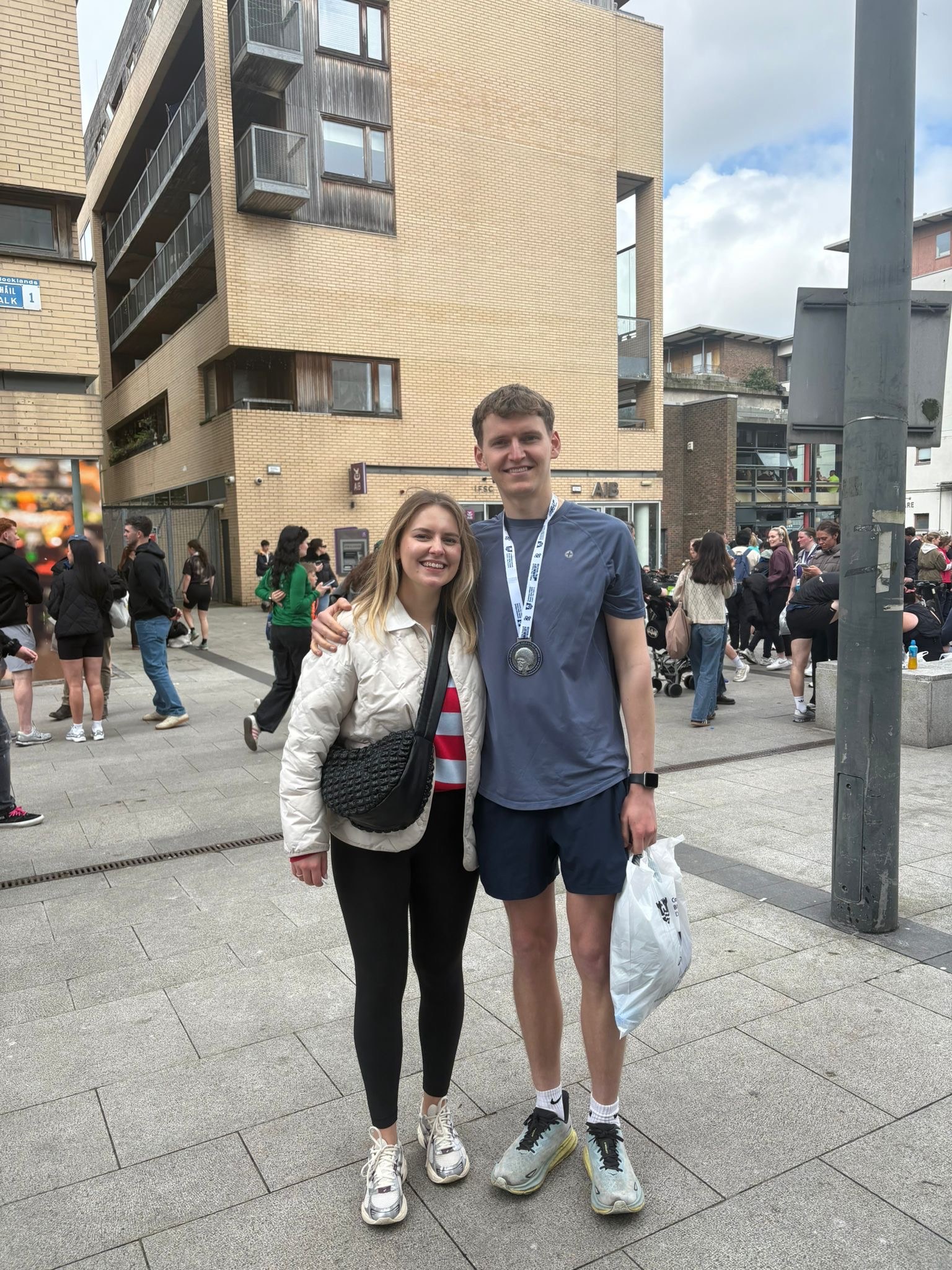
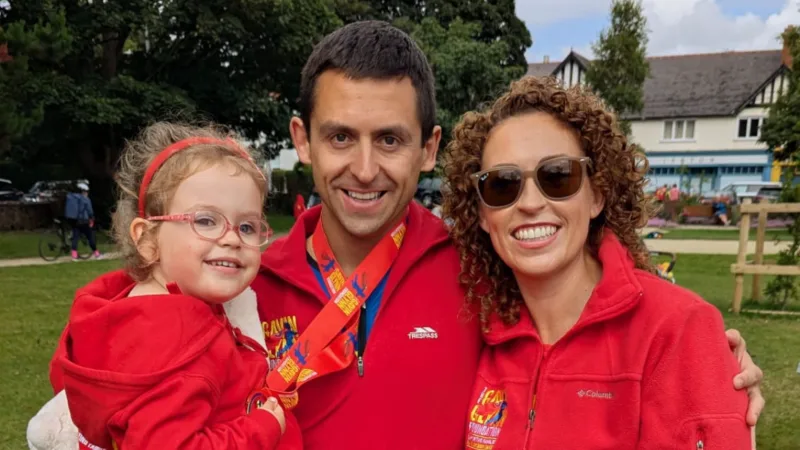
His girlfriend Lucy has raised over €50,000 between Sarcoma Cancer Ireland and Breakthrough Cancer Research, most of it off the back of the mini marathon, and Odhran was there for all of it. On the sideline. Minding the coats.
"I was always at the fundraisers, but I was never doing the running or doing the hard lifting."
"But someone had to hold the bags."
That ends on the last Sunday in October, when he runs his first marathon for the Oesophageal Cancer Fund.
He applied through the marathon's charity route and the charity came back almost immediately.
"They heard my story, and the rest is history."
Eve
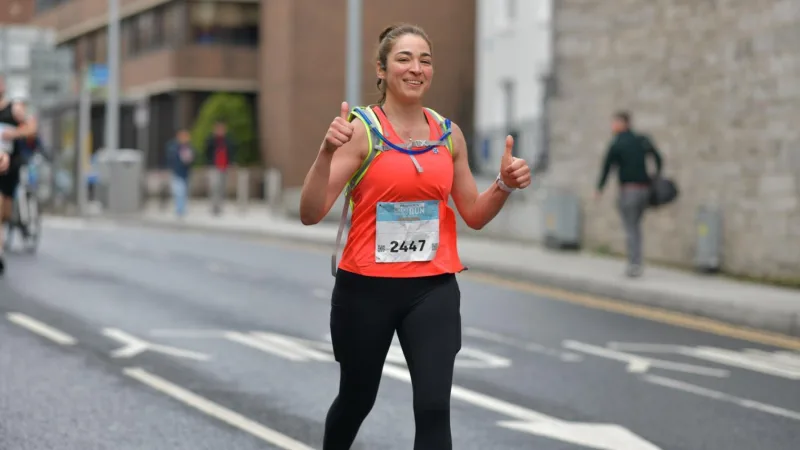
Lucy's sister Eve was, by every account, the social one.
She loved to cook. She had a wide and devoted circle of friends. She was a talented musician. And she was, Odhran says, an amazing sister to Lucy.
Eve was diagnosed with a rare sarcoma in 2021, while she was in London doing her master's, and died in June 2022.
She is remembered in a lot of places for the illness, which is partly why this piece exists. The rest of it is the point.
Pat
A few months after Eve died, Lucy's father Pat was diagnosed with oesophageal cancer. He died in June 2024, the day before Eve's anniversary.
Odhran talks about Pat with enormous affection and no reverence whatsoever, which is probably how Pat would want it.
He was a man who loved the pints, loved the craic, and was a serious foodie.
That last part stuck. Odhran and Lucy still go out for a good meal whenever they get the chance, which is as good a way as any of keeping somebody around.
As Odhran understands it, Pat's own father had died of the same cancer.
Why This Charity
The Oesophageal Cancer Fund is where the money is going, and Odhran is clear that the awareness side of it matters to him as much as the total.
Oesophageal cancer is difficult to treat, which makes research funding matter. Family history is a risk factor, and it is not something most people think to raise with a doctor.
"Awareness is the biggest thing. Early screening and early symptoms, and having it in the back of your mind, is so important."
The same instinct runs through the people he hopes will read this. Lucy studied physiotherapy and is still in touch with a lot of friends who work as physios, and Odhran reckons a story like this lands differently with somebody who spends their week assessing young, fit people with pain they cannot quite explain.
One detail he mentions quietly is that the family never went looking for charity support through either illness. The Irish Cancer Society and Sarcoma Cancer Ireland both reached out to the family after diagnosis.
"They never really looked into supports from anyone, really, even when Eve had sarcoma. It was only after they had passed that they realised they needed to expand awareness."
Nobody had done a fundraiser for Pat since he died. This is it.
Lucy and Ursula
Ask Odhran about the two women at the centre of this and he does not hesitate.
"Lucy and her mam, they're the two strongest people I know."
Ursula is Lucy's mother.
"She comes into a room and you wouldn't know what she's been through. She wouldn't mention it, she wouldn't bring it up. But if you did ask her, she'd talk about it openly."
"Obviously things faze her. But nothing really fazes her to the extent that she won't get up the following morning and play on."
Lucy qualified as a physio in UCD, and then went back to college to study medicine, which Odhran connects directly to what happened to her sister.
"She wasn't going to wallow in pity. Eve's illness pushed her on to go and do medicine, and become a doctor, and try and change people's lives."
Maynooth, Start to Finish
Odhran is 26 and from Maynooth, where he did every single bit of his education, starting in his mother's playschool and finishing with business and law at Maynooth University. He lives in Dublin now.
He should by rights have gone down the law route. Instead he got interested in a couple of modules on ethics and sustainability, chased that as far as a fifteen-month master's in sustainable development at TU Dublin, and now works as a sustainability consultant with KSN Horizon, a spin-out from the construction project management firm KSN Project Management.
There were five or six of them when he joined. There are about twenty now, and the whole office has been donating to the fundraiser and slagging him in roughly equal measure. He has got a few runs in with the lads from work.
Before running there was hurling and Gaelic football mostly, with soccer, swimming, a bit of cross-country, and a genuine soft spot for Olympic handball, which he played at school under one particularly committed parent who ran it.
His Father, and the Hundred-Kilometre Sundays
The running influence in the house was not running at all.
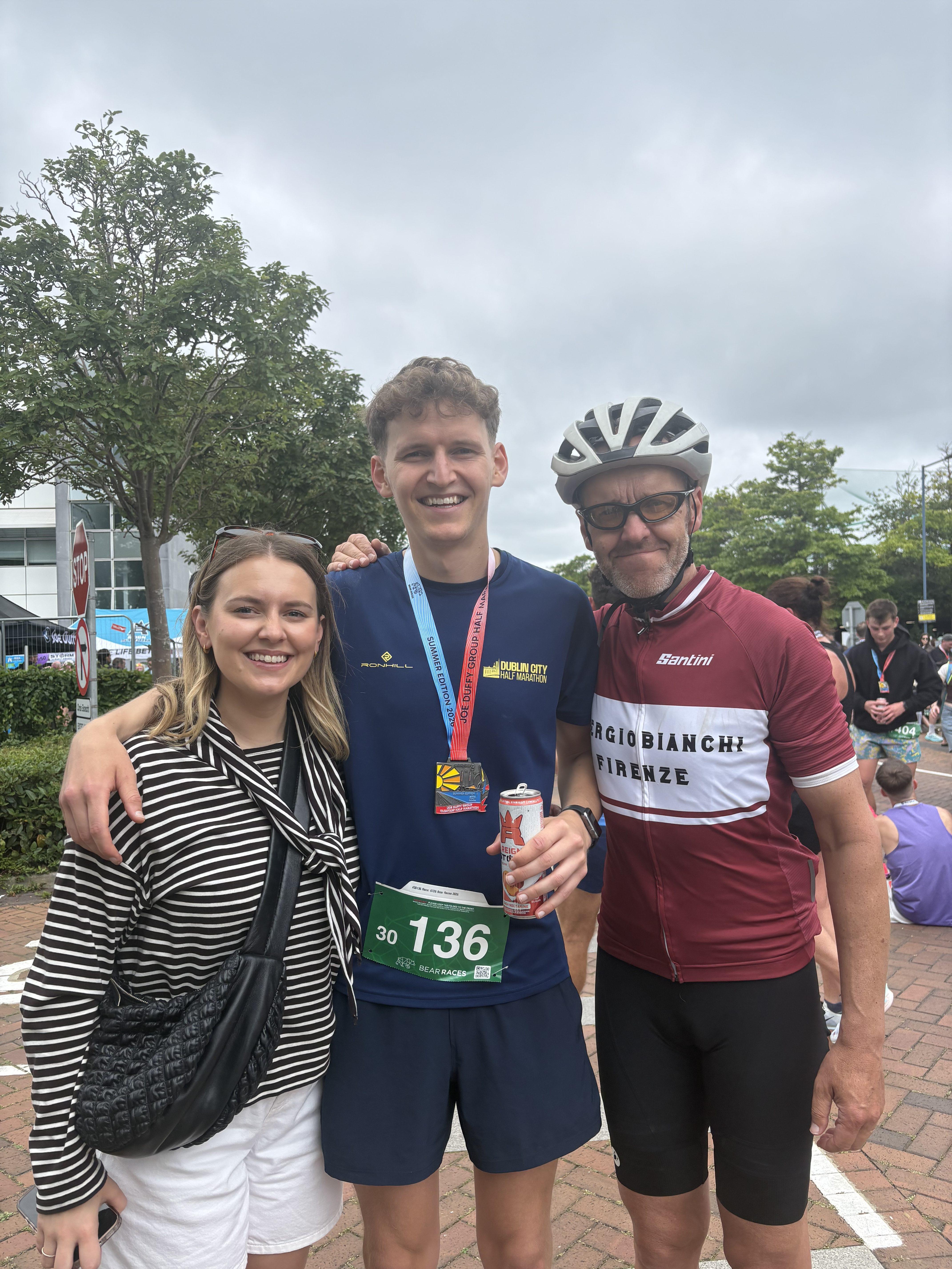
Odhran's father is a cyclist, and still heads off on a Sunday afternoon for four or five hours and a hundred kilometres plus.
"You'd just be looking at him in awe being like, Jesus. I walked to the shops."
"I suppose that influence was big for me."
Odhran describes himself as a failed athlete who came to running to fill the hole left by team sport. He has been at it about two years, and seriously for the last few months.
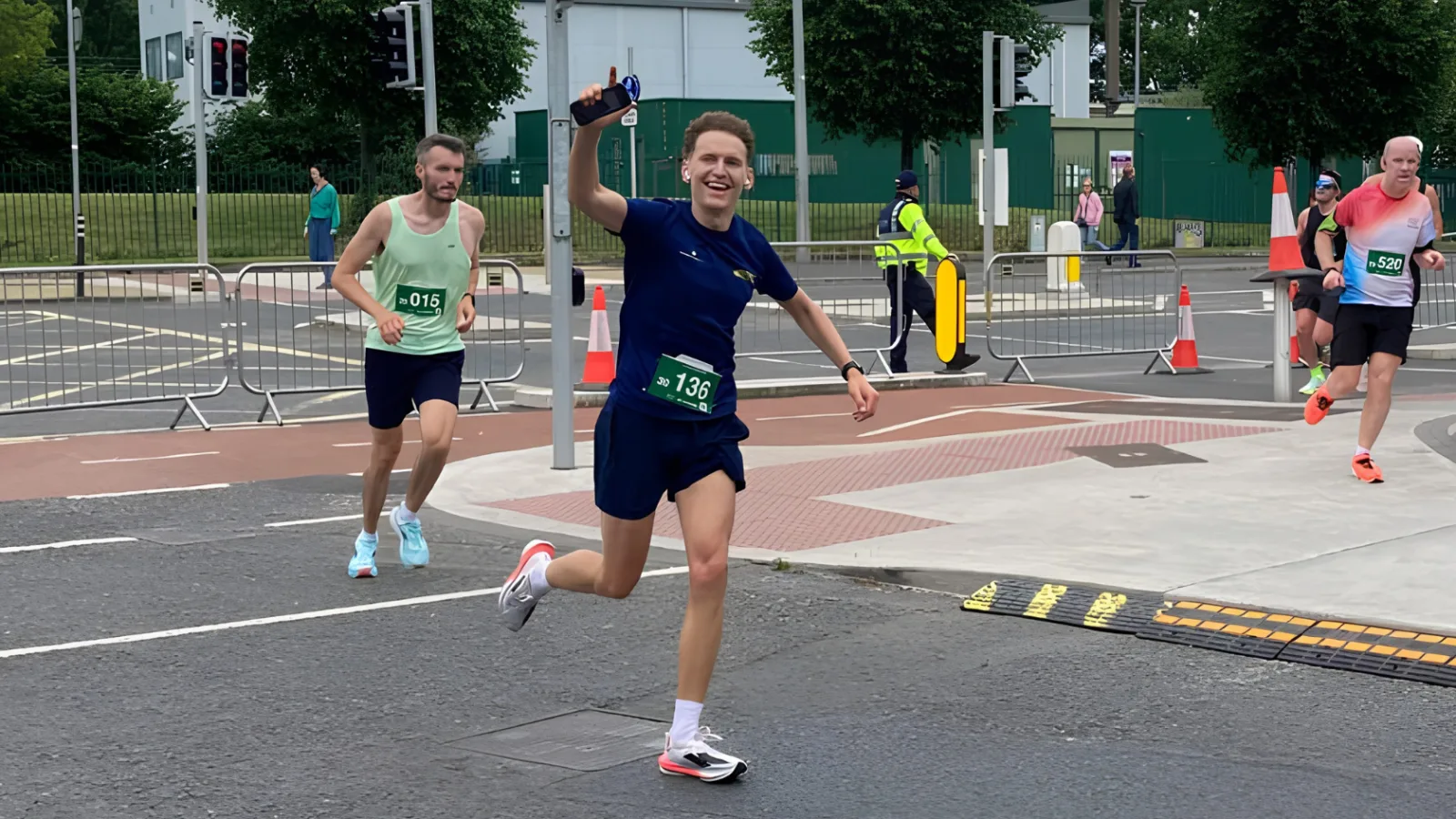
The Dublin City Half was his first proper race, run off nothing more than the fitness he had left over from hurling and football, and the high after it is what turned a habit into a training block.
Lonely Places
He is not in a club, and when asked what he would change about the whole build, he does not have to think about it.
"It's probably the only thing I would have changed. I would have joined a running club. Because the long runs on your own, Jesus. They are lonely, lonely places."
He lives in an estate large enough that getting as far as the shop clocks a kilometre on the watch, and his first run from the new house went straight uphill towards the mountains, which he spent checking his watch and wondering what exactly was wrong with his pace.
Most of his running is done on the UCD trails, along the coast, around the quays, and occasionally on the UCD track.
The block itself has been 60 to 70 kilometres a week, consistently, and he is slightly surprised to report that it has never felt like a chore.
The Muffin
The fuelling took longer to sort out, and there is one story that explains why.
On an early long run he was coming out of a café in Dundrum the evening before, and the girl closing up offered him a muffin they were about to throw out.
"I was like, brilliant, that's great fuel for the long run."
"So I stuffed the muffin down the back of my trousers."
It achieved nothing except sitting in his stomach for the next hour and a half.
"I'm sure it absolutely did nothing. I had indigestion. I just felt awful for the whole run, trying to digest it in the belly."
"That was the wake-up call."
He went asking people who knew better, shifted his focus from protein to carbohydrate around sessions, and got himself onto High5 gels and jellies.
"That was a game changer. You don't get that kind of drop in energy, and you get that little boost when you need it as well."
Hydration remains the weak link, and he is upfront about it.
"I'm like a camel when I'm out running."
The current method is to stop somewhere around 20K, buy a 500ml bottle, carry it for 5K until it is gone, and call it a day. For the marathon the plan is to actually get on the water properly, with housemates and colleagues who live on the route primed to hand bottles across, rather than him carrying eight or nine gels and a litre of fluid.
The stated aim is to get round without, in his words, shrivelling up like a prune.
Six Foot Three, and the Wind
The target is somewhere under 3:30. He would take 3:15 and be delighted with himself.
He ran 1:32 at the Clontarf half and felt there was more left in the back end of it. His biggest week included a 34-kilometre long run with about 26 of those at 3:15 pace, which is the session that gave him the confidence to say the number out loud.
He is also clear that he does not want the clock running the day.
"I don't want to get too bogged down on time. It's my first marathon. It's for a charity, so I need to remind myself of the bigger picture."
What worries him is not the distance and not the hills.
"I'm a big lanky fella. I'm six foot three. The wind holds me up."
Rain does not bother him in the slightest, having done plenty of sessions in the depths of the winter.
For a couple of months after he moved into his current house, one of his housemates was the first Irishman home in last year's Dublin Marathon. The lads in the house went out on bikes to follow him for the last few kilometres and could barely stay with him.
Odhran has managed expectations accordingly.
"I kind of said it clearly to the lads. Boys, there's not going to be a repeat this year."
Who Will Be Out
His mam, his dad and Lucy will be on the course, along with a lot of friends. The housemates will be out. A couple of people from work live on the route and have promised water.
His sister and her boyfriend, who has run Dublin before, are in South America and will miss it.
He already knows what the finish line is going to feel like, and it is not triumph.
"Relief."
Then he earns the word.
"There's so many sessions you don't want to do. There's so many easy sessions that are actually hard. The weather conditions. The sacrifices you have to make in terms of planning, in terms of social gatherings. Even if you have four or five hours sleep, you kind of get up and do your own."
"It's those little things that lead to the relief on the line."
There will, he says, be tears shed.
The charity sent him out a vest, which he has tried on at home, and on which he is not taking questions.
"I've modelled it already, and it looks horrific."
"Comparison Is the Thief of Joy"
Odhran's advice for anybody thinking about starting is about other people, and specifically about ignoring them.
"A good phrase is, comparison is the thief of joy."
He cheerfully admits he robbed that from somewhere.
"You kind of just have to compare yourself against yourself, where you were when you first started running."
The practical half is to stop measuring in kilometres.
"The best advice is just to get out there and run for as long as you can. Don't worry about distance, just for time. If you can run for two minutes, great. If you can run for five minutes, even better."
Running, he points out, pays you back faster than most things, with real gains showing up inside a few weeks.
And then there is the part people skip.
"Loving it is really important. There's really no point running if you really don't like it."
"You need to find an area of running that you do like. Whether that's short distances, or longer distances, or running for something, or for someone. It has to match a purpose and a drive that you have in yourself, or else there's no point."
"It's tough enough as it is. But if you really hate it, it's even tougher."
The Switch
There was a specific moment that turned Odhran from somebody who went for runs into somebody who races, and it happened on a television.
He watched the Irish 4x400 relay come fourth in Paris.
"I actually never felt such, like, in that moment, that it kind of flipped the switch in me."
"I think Irish people are just wired differently, that we love seeing other Irish people do really well."
"I suppose that's another reason why I'm running."
Memories
Near the end of the conversation, Odhran said something about Pat and Eve that puts the whole thing in order.
"If I bring it back to Pat and Eve, that's all we have of them. The memories that they have, and the memories that they made."
"We spend enough time inside, scrolling on phones and watching TVs. To hell with it, we need to go out and experience life. And running is a great way to do that."
The last few years have changed how he operates.
"It's changed my perspective on life. I don't sweat the small things."
"Hopefully other people don't have to go through that to come to that realisation."
When it is done there will be pints, and he has no illusions about how they will go.
"I might be on the floor after two or three."
He went cold turkey three weeks out, bar one lapse for a friend home from Toronto, which he insists he handled impeccably. Five pints, home at midnight, very proud of himself.
And he is finally thinking about joining a club.
You can support Odhran's fundraising for the Oesophageal Cancer Fund ahead of the Dublin Marathon here.
Donate to the cause
This runner is raising funds for charity. Support them by donating.