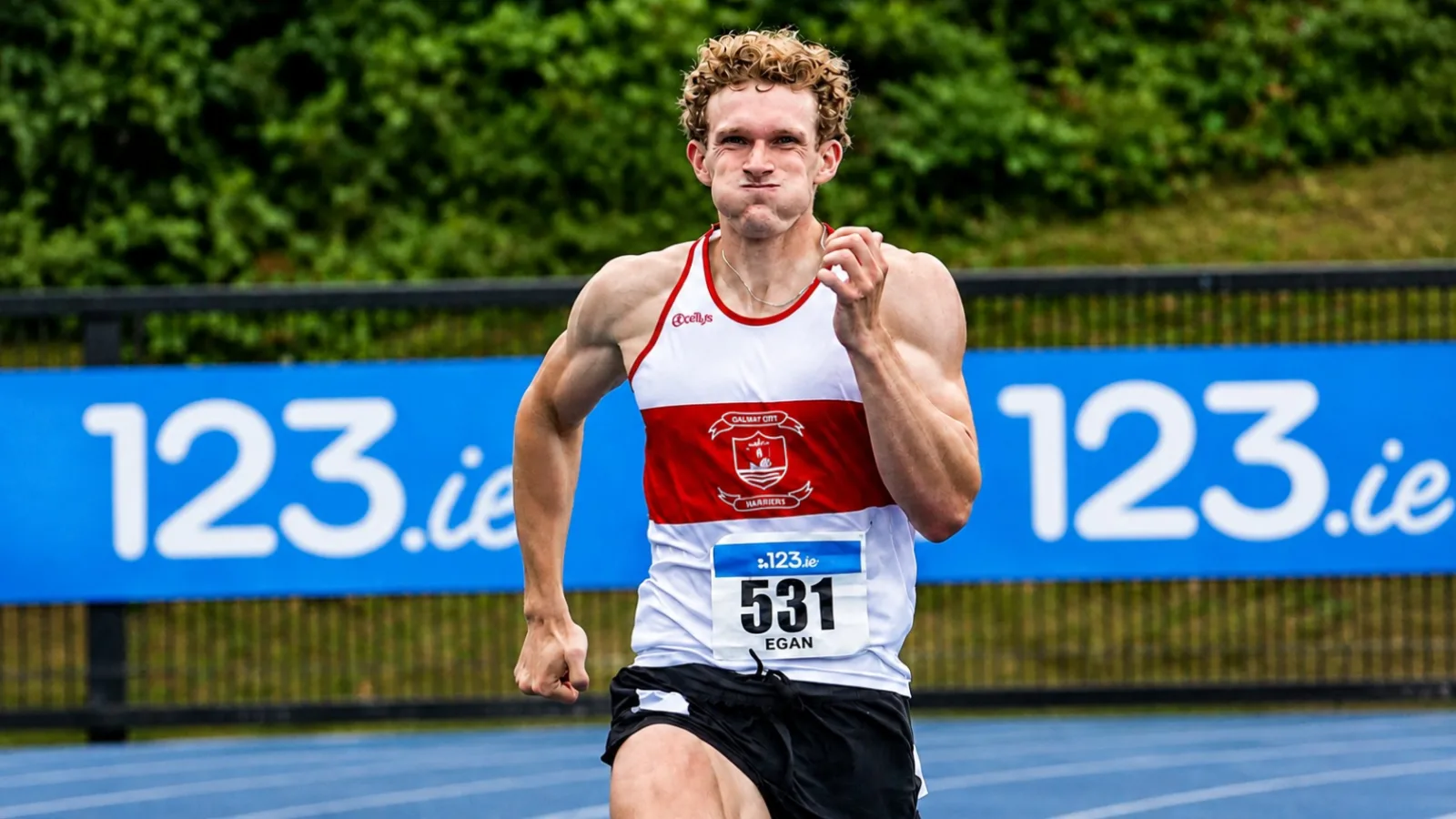
Four hundredths of a second. That was the gap between Andrew Egan and a national 400m title on Sunday night, Jack Raftery home in 46.12 and Egan on his shoulder in 46.16.
He gave himself about an hour of disappointment. Then he watched it back and came to a different conclusion.
"In hindsight it was an amazing time. Jack's an unbelievable runner. He's won three titles in a row for a reason."
That's fairly typical of him, as it turns out. Andrew Egan doesn't do much on instinct. Everything gets examined, written down, worked at and then done again tomorrow, whether it's a 400m or a language nobody outside Switzerland can spell.
Deciding to Be a Sprinter
The origin story is a good one. Egan was fifteen, at French college for a few weeks, and spent most of it challenging people to races.
"I thought, maybe I should do a sport where this is the main thing."
He'd been playing hurling and soccer for his club in Spiddal, and by his own account the team was strong for its size. He enjoyed it too. But something about it never sat right with him, and it's the first hint of how his head works.
"It kind of frustrated me that the winning was out of your hands. I wanted a sport where whatever I put in, I get out."
His first race came at sixteen with Galway City Harriers, 24.95 for the 200m, and he'll tell you with some satisfaction that he has never in his life run 25. The hurling had left him with an engine of sorts, enough that he was permanently stationed at midfield because he could keep going. He's having none of it as an explanation, mind.
"I'm not aerobically strong. Anyone I train with, it's not a joke that I'd be the worst in the group. Considering the girls in the group, everything. I'd be dead last."
Road to 22
Somewhere around then, Egan set up a private Snapchat story for his friends and called it Road to 22. He was running 23 seconds for the 200m, he wanted 22, and he documented everything he did in pursuit of it: sessions with his coach Noel, the extra gym work, the lot.
It took two years, arriving just after the Leaving Cert with a 22.75.
"And then I did the 100 metres after and tore my hamstring for the first time. So it was a mixed day."
He's honest about what he got wrong in that stretch. Bodybuilding had been a serious passion since he was fifteen, and he reckons all that extra lifting on the side probably slowed him down rather than helped.
College came next, in Galway, twenty minutes from home, living in his parents' apartment with his sisters. He agrees it was a devastating cultural upheaval.
"All twenty minutes of it. Moving from family to family."
What he did with the freedom is more revealing than where he lived. Most eighteen-year-olds treat first year as an amnesty.
"A lot of people go to college and they get the freedom and go out. I was more focused, sleeping well, doing everything right. Despite being a 22.7 athlete. In hindsight, who did I think I was?"
He laughs at himself there, but that's the whole thing in a sentence. Egan was training like the athlete he intended to become long before the times gave him any permission to.
The 45 That Rearranged His Head
The 400m didn't enter the picture until he was nineteen, when he ran 48 for third at national juniors. He's never run 49 either, which is becoming a theme.
For a couple of years it stayed in the background while he raced the 100 and 200. Then last summer, having already qualified individually for the 200m for the European U23s in Bergen, he reasoned that he was doing the same training as the lads racing the longer one anyway, so he might as well put down a 400.
He went from 47.7 to 45.8.
"I thought, okay, maybe there's something there."
Most athletes would enjoy that and move on. Egan went and looked up how many Irish athletes had ever run faster at twenty-two years of age, and found there was one.
"I thought, there's no reason I shouldn't eventually be one of the best Irish athletes of all time."
Then he did something that tells you more about him than any time on a clock. He started writing it into his journal.
"I'd write, 44 athlete. Just to get it into my head that it's something I'm capable of. Once you treat yourself like the athlete you want to be, you progress easier, because you more easily make the sacrifices."
The nerves went at roughly the same time, which he suspects isn't a coincidence.
"Until 2025 I'd never describe myself as excited for a race. I was excited for after the race, but never before. Now I can't wait to compete."
One big injury a year
All of which has been assembled on a body that has interrupted him almost every single season.
The list runs 2021, hamstring, season finished. 2022 clear, and not coincidentally the year he made his biggest jump. 2023, hamstring again. 2024, a torn quad in April that kept him out until July. Then 2025, where he ran the 45.8 and tore his groin the following week, arriving at Bergen on about seven days of proper training. This year it's been his Achilles.
The response is entirely in character. Every day, without fail, before every session.
"You'll see me in the Letzigrund before every session on the Smith machine loading up the Achilles. Every day. Otherwise it leads to problems."
Ask him what resilience actually means and there's nothing grandiose in the answer.
"Always coming back. Knowing you're the same person you were, or a stronger person, and you still have the capacity to do what you were doing before."
What he thinks people underestimate is the confidence injuries take with them, because once that's gone the work gets much harder to do. Which is why he grinds through the tedious preventative stuff nobody sees. "It can save you a lot of time down the line."
Sunday
The build-up to the nationals involved a decision that says plenty about his priorities. He'd been entered for a race in Italy that could have helped his European ranking, but after talking it through with his coach he binned it in favour of two weeks of training, flying back to Zurich for a week of work before landing into Galway on the Wednesday.
He has an unusual quirk about championship weekends, too.
"In a final you just have to give it everything. In a heat you don't know what to reserve, who's going to push you to the line, who might steal the automatic spot."
The heat turned out to be comfortable, third fastest time of his life while easing down over the last 50. He spent the night at a friend's in Westmeath rather than driving the guts of five hours back and forth to Galway, got fed, and came back for Sunday evening with no nerves at all.
"Seniors always has the best crowd, the Sunday evening. I was excited for friends back home to see it. People who normally wouldn't be involved in the sport at all."
The lane draw was kind, with Raftery in seven and Sean Doggett in eight, both his main rivals sitting outside him in plain view for the whole race. His own pattern is well established by now: quick first 200, then a hard kick from 200 to 300. Coming off the bend he was fractionally ahead.
Ask what was going through his head over the last 100 and, for once, the analysis stops dead.
"I can't remember. I don't think much goes through. It's pure emotion, fighting."
There's a moment on the video where it nearly falls apart.
"I kind of missed a step. There's so much lactic that your legs are panicking. They don't know what to do."
He held it together. He lost by four hundredths.
Choosing Zurich the Hard Way
Egan now lives in Zurich, studying quantitative finance at ETH, taking it part-time at half credits so he can train properly. He says even that is difficult to balance.
The way he picked the city is the most Egan thing in the entire conversation. Deciding between London and Zurich, he worked out that the only question that mattered was which was better for athletics, so he texted every Swiss athlete he'd ever heard of and asked them who to train with.
"They all said the same name. Flavio. Nobody had a bad word to say about him."
He kept his prospective coach updated through that summer. When the 45.8 landed, the reply was a single head-exploding emoji.
The setup he landed in would turn most Irish athletes green. He trains in the Letzigrund, home of the Diamond League final, with a gym and an indoor straight on site, in a group containing European medallists and Olympians, and lives a ten-minute walk from the gate.
"Everything kind of worked out."
The plan runs to the end of 2028 at least. He hasn't thought past it.
The Languages
Here's where the whole picture comes together, though I'm not sure Andrew has noticed he's doing the same thing twice.
He speaks Irish, English and French. He grew up in the Gaeltacht, though his parents are from Mayo and Roscommon and the house itself was English-speaking, so the Irish came from neighbours and friends and school. Then he moved to Switzerland and learned German. Then, not content with that, he learned Swiss German, a dialect with no standardised spelling and no formal grammar, and that's what he now speaks with his training group.
The method was pure immersion, and it was patient in a way most people couldn't manage. From September to March he consumed it constantly, podcasts and YouTube and anything he could get, without really speaking it, waiting until somebody asked him how the German was going so he had a natural opening.
"At the start you're going to be terrible."
He's sitting his C1 German exam in September, which means finally learning grammar formally, a prospect he finds mildly irritating after doing the whole thing by absorption.
He also loves that the Swiss understand what Irish means to him.
"They speak their own dialect, not standard German. So they understand how a language can be unique to where you're from. Part of your identity."
Road to 22 and the Swiss German are the same project in different alphabets. Show up daily, tolerate being useless at the start, trust that consumption compounds, and don't expect it inside a year.
Five Eggs and a Raw Carrot
The discipline extends to a literal checklist, kept in Apple Notes since 2022, where he ticks off supplements, collagen, vitamin D and fish oil daily, and there's yoga most nights before bed.
The diet is where his friends draw the line.
"I sent a picture one day. Pasta, chicken, and a raw carrot stuck in the middle as my vegetable. With a ketchup love heart around it."
Breakfast is oats and honey, every single day. Dinner is something with a vegetable, occasionally just raw carrots because he can buy them and eat them without further effort. Supper is five eggs. He's aware of how this sounds and reckons his personality happens to suit it.
What he won't accept is the framing of it all as sacrifice.
"People frame the sport in terms of sacrifice. The better mindset is how much I get from it rather than how much I give up."
He can't go out much. He can't go hiking in Switzerland as often as people keep telling him he should.
"But what I get from the sport is unmatched."
Galway City Harriers
For all the Zurich infrastructure, Egan is unambiguous about where this actually started.
"I would not be doing athletics if it wasn't for Galway City Harriers."
When he joined he knew he wanted to sprint and genuinely wasn't sure a club could even offer that, which sounds strange now but wasn't then. What he found was Noel, who kept him in the sport through Covid at a point when he was nowhere near national standard, and later Brendan, who he describes as the ideal 200 and 400 coach and who guided him through his college years.
Neither was paid a penny.
"The whole sport is driven by volunteers. Those grassroots clubs who keep athletes having fun."
He's evangelical about Galway more broadly, and he has a case: himself and Doggett, Cillian Greene who was on the 2021 Olympic team, and Rob McDonald, his own clubmate and the athlete he grew up trying to be.
On the sprint boom nationally, his read is that certain performances drag whole events forward. Israel Olatunde in that European final in 2022. Rhasidat Adeleke's silver. The mixed relay gold in Rome and the final in Tokyo.
"A lot of athletes who wouldn't have done the 400 before, including me, thought okay, maybe there's a path to the Olympics through the 400."
Birmingham
He flies out on 12 August, with a relay session in Morton beforehand, three or four hours of handovers and sorting out who is likely to be passing to who.
Having been on the 4x100 last year, he's fairly relaxed about the mechanics of this one.
"The 4x4 handovers are relatively simple. I won't say impossible to mess up, because I have at one point messed it up."
What matters more, in his view, is that the four of them actually get on, and they do. The plan for the heat needs no whiteboard.
"There's no messing about. Just as hard as you can."
What His Parents Got Right
Asked what he'd say to parents, Egan's answer comes straight from his own, who were not a sports family and had no idea what any of his times meant.
He thinks that was a gift.
"All of the pressure was coming from internally. It was never you have to run so-and-so time, because they had no idea what so-and-so time was."
So the advice is to support fully and then step back.
"If your kid tells you they want to do athletics, help them in any way. Bring them to training. But I wouldn't be getting involved with their coaching, or looking for extra things for them to do."
He's equally clear about who is bankrolling the Zurich chapter.
"I would not be able to live over there without my parents' support. I try to pay them back in running and performances."
And when the question arrives that hangs over every athlete, the one about what's left if the body finally refuses, he has already done the sums on that too.
"Even if athletics was taken away from me, at the end of this I got to live in another country, study in a great school, learn another language. That's still an amazing life."
Four hundredths on Sunday, then. For most people that's a wound. For Andrew Egan it's just data, and there's another block of work in it somewhere.
Cover Image: Jimmy English