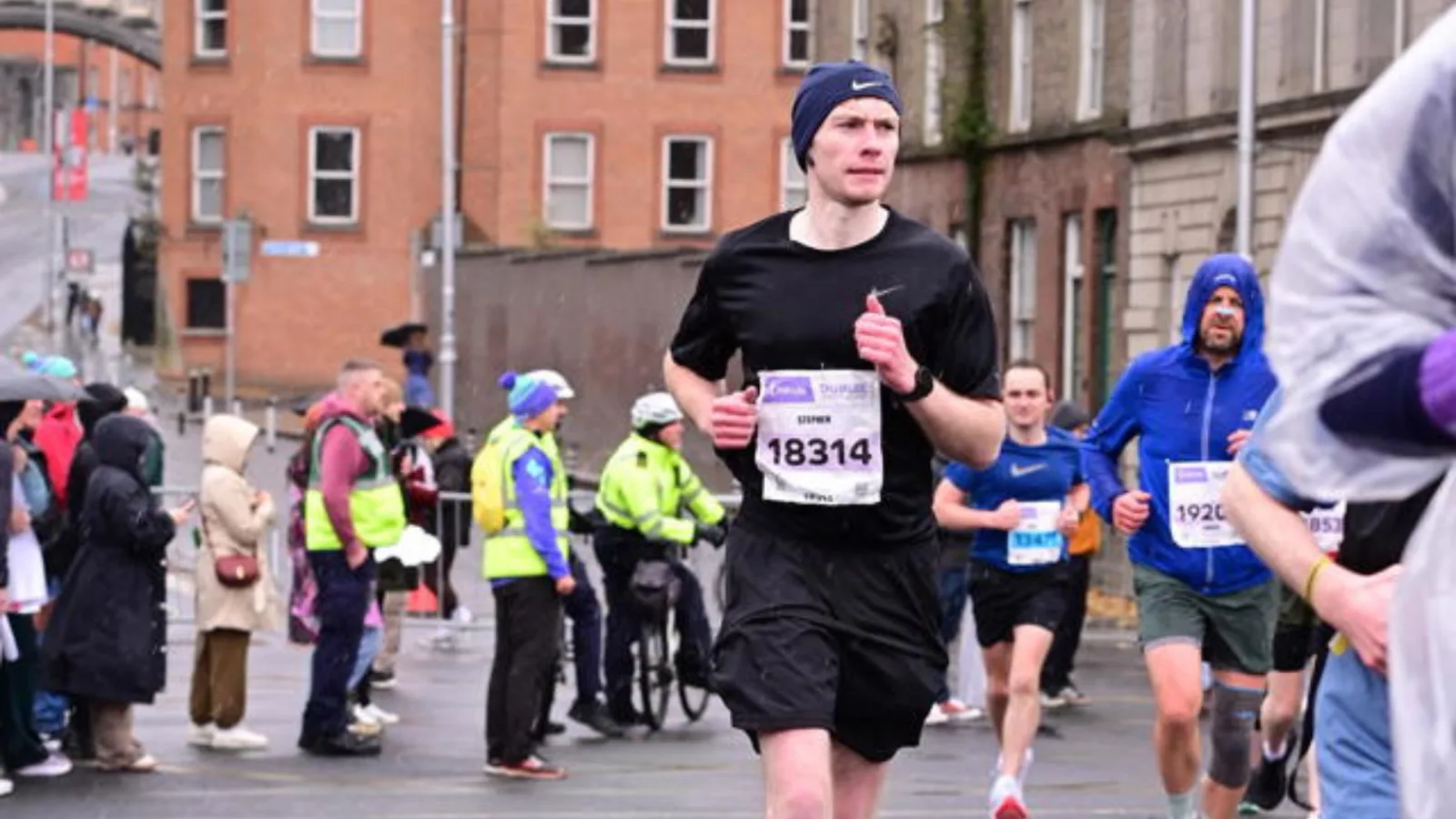
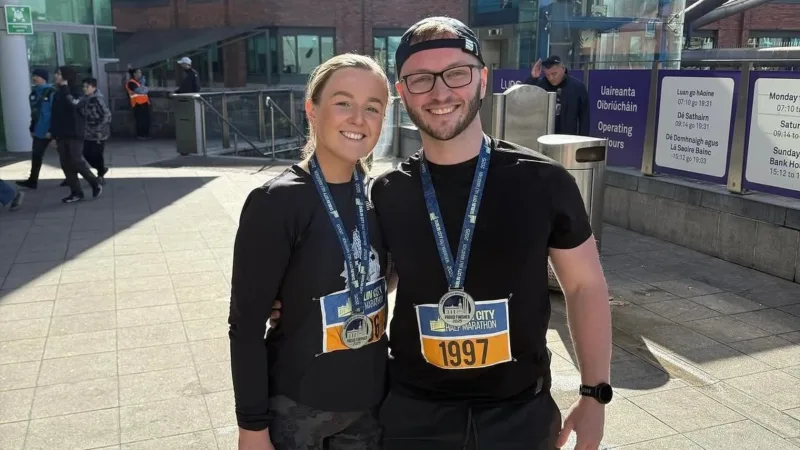
Stephen Doherty ran the Dublin Marathon for Cancer Care West last year, and he will tell you himself that he did not really know what Cancer Care West did.
"I would have driven past previously, and you see the sign, but you never really take it in as to what. You assume that it's some sort of charity or support group."
"Even last year, when I was running for them, I still didn't really have a full grasp of everything that they provide."
He knows now.
Cancer Care West came back to him this year and asked whether he would take a charity place again. Not long afterwards his wife Nikita was diagnosed with cancer.
"On the day that we got the diagnosis, the very first support that was mentioned was Cancer Care West."
"It's only the way it kind of came full circle."
So he is running it again this year, for the same charity, for an entirely different reason.
Twenty-Five Minutes West of Letterkenny
Stephen is 34, born and bred in west Donegal, about twenty-five minutes west of Letterkenny and roughly midway between Letterkenny and Gweedore.
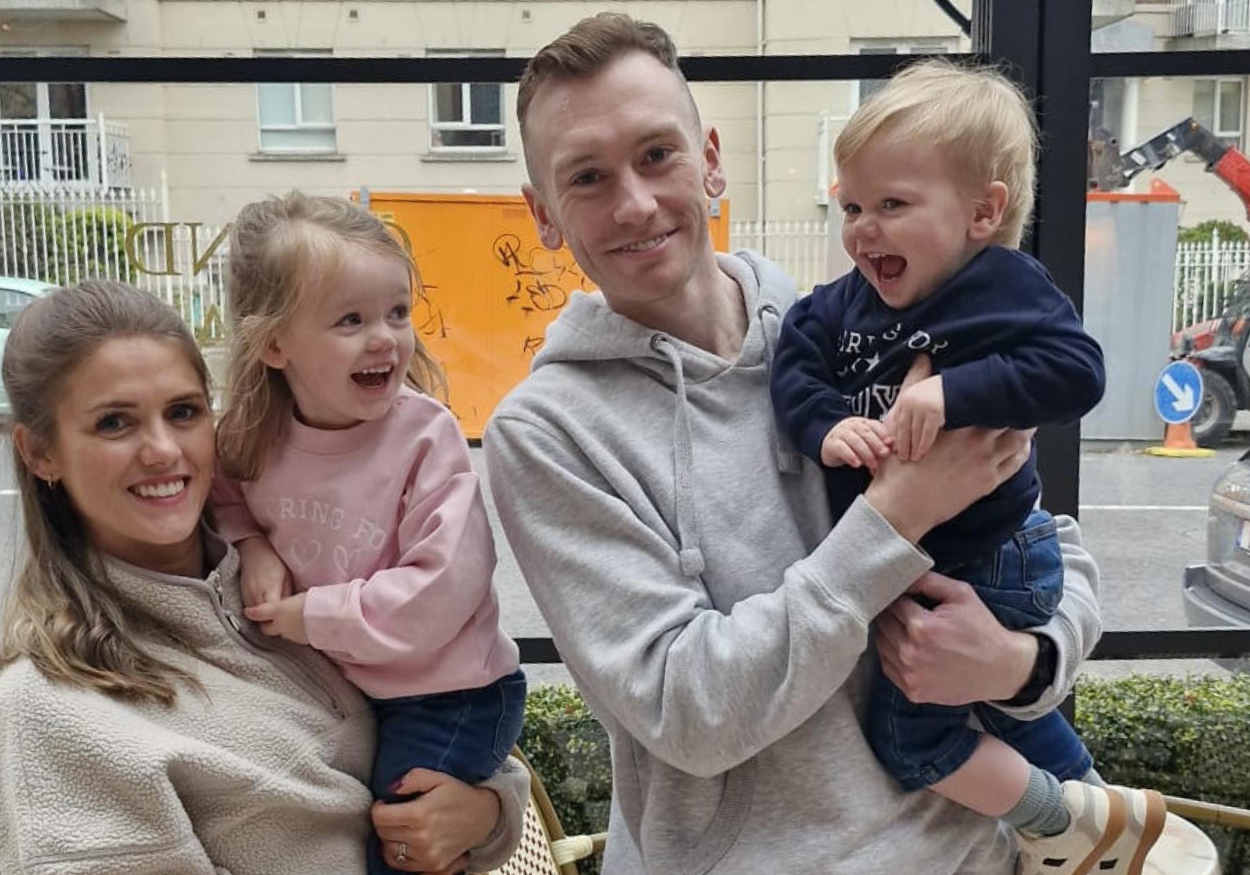
He and Nikita have two children. Kate is four, and Senan is a two-year-old behind her, so the house is busy.
His background is in med tech, mostly on the sales and marketing side, including a spell with Johnson and Johnson, and he is a qualified financial adviser as well. Earlier this year he stepped back from work completely to be at home.
A Cup of Tea and a Sandwich
The way the two of them handled diagnosis day tells you most of what you need to know about how they have handled everything since, and it was planned in advance.
"That was one of the things that we got right. When we went out to receive the diagnosis, between us we were saying, right, not expecting to hear the worst, but if it comes, we know what we're doing for the rest of the day."
"We weren't going to be sat in the car sort of numb, be it good news or be it difficult news. We were going to get back in the car, go and have a cup of tea and a sandwich somewhere, and just chat about how we were going to do it going forward."
Stephen is in no doubt about who set the tone.
"If I was to say one thing that's made the difference so far, it's been her mentality."
"From the moment that Nikita received the diagnosis, she didn't seek to pretend that it wasn't there. She was very proactive about everything. About research, about different things around nutrition, and finding what supports and resources were available."
In the hour before this interview, Nikita was on a Cancer Care West webinar about nutrition after treatment.
That is the pattern of the year, as Stephen describes it. She has gone at every part of this with a plan, and he has spent the year alongside her, which is why he stepped back from work in the first place. Treatment has not been entirely straightforward, and she is getting through it.
What the Money Actually Does
Cancer Care West has an office in Letterkenny as well as its base in Galway, and for a family in Donegal that combination is the point.
"It's great to have that sort of dedicated service up this neck of the woods, because a lot of the time people up here will kind of feel a bit forgotten about. So it's brilliant to have that support so close to home."
The Galway end matters because a great deal of treatment for people in the northwest means travelling there.
"For people in Donegal, a whole lot have to travel to Galway. And that's massive effort and expense on top of an already difficult situation."
"Cancer Care West have accommodation down there. I know in other parts of the region they have a transport service."
While this isn't something Stephen and Nikita needed themselves, it is a vital service for so many across the region. It is the difference between a treatment plan being manageable and not.
Closer to home there are the webinars, the counselling, and body treatments including lymphatic drainage and chemo massage. All of it free.
"For them to be available on our doorstep, completely free of any charge, it's amazing, really."
And then there is the part nobody thinks about until they are in it, which is the sheer administrative weight of a diagnosis.
"They do a lot of the heavy lifting in terms of research and organisation that you would have to do yourself otherwise."
Stephen is honest that he only understood any of this when the family needed it.
"It was only this year, when we found ourselves in the eye of the storm, that you really got a full handle on what they do provide."
Whether to Run at All
When the diagnosis came, the marathon was genuinely in doubt, and the two of them sat down and discussed whether it could stay in the year.
"When we got the diagnosis, we sort of knew that we were in for a challenging time, and we were actually discussing amongst ourselves. Can we really give up the time this year? Can I put the effort into it?"
"And I'm glad that we did, because the response has been fantastic."
The fundraising has run away from them in the best possible way, with the target going up every time it gets hit. Seven thousand between the interview and race day would do him.
"It keeps moving, because it keeps getting hit, which is brilliant."
"It's all credit to the people that donated. People are so generous."
One of the first things the family did after the diagnosis was go into the Letterkenny centre and have the available supports laid out in front of them, which is the kind of thing the money pays for and which does not show up in any annual report.
How He Started
Stephen came to running sideways, which is how most people come to it.
A few years back he decided to put more focus on his general health and fitness and got back into the gym. A friend who has done a few Ironmans and endurance events suggested he aim at something bigger.
"He was sort of up to, you know, you should set yourself some kind of challenge. Maybe a marathon or something like that."
What appealed was that the work is not confined to the day.
"It's not only obviously on the day, but you have to put the work in before as well."
There was football when he was younger, but not for long.
"The sporting days were well in the rearview at that stage when I decided to pick up the running."
A Forest Across the Road
He is not in a club, and he does not particularly need one, because of where the house is.
"It's literally a hop over the fence, and I'm down in the middle of that. Miles and miles of forest."
A parkrun has started up in the same forest park recently and pulls a serious crowd, which he rates as another hub within the community, and which did not exist when he started running.
He is also fairly honest about what he used to think of people like himself.
He would pass runners out in all weathers and wonder what on earth was enjoyable about it, right up until he started doing it.
His case for the sport as a whole is one of the better ones in this series, mostly because of how he builds it.
"Whatever you're looking for, running has it. If you're looking to get out and get a bit of peace to yourself, running has it. If you want to get out and be social, running has it."
"You feel like going fast, you go fast. Feel like going slow, you can go slow. It ticks almost every box."
The Sunday Long Run
The training block this year has been patchy, and Stephen says so without any dressing up. Hospital appointments, two small children, treatment that has not always been straightforward.
Training had to take a back seat for long stretches of it.
What survived was Sunday.
"Seeing that Sunday long run and waiting for it to come around was just. There was nothing like it."
"Because whatever was going on that week, whether we were having a challenging week or a good week, whatever it was, the road was still there."
"It was almost like a reset. Once that Sunday run came around and you got it done, you're reset, you're fresh, everything was ready to go then for the following week."
Where He Puts the Word Hard
A lot of time in hospitals this year has recalibrated Stephen's sense of what counts as difficult, and he makes the point without a shred of self-pity.
"People go on about how hard or difficult a marathon is, and the training that goes into it."
"Unfortunately, because parts of the treatment haven't been straightforward, we spent a good bit of time in the hospital this year. And when you're up around there and you're watching the patients and even the staff and the nurses, that's difficult."
"Going out and running around Dublin, that's a privilege to be able to do that."
Two Kinds of Week
What the Sunday run gave him, beyond the mileage, was a fixed point in a year that did not have many.
Everything else in the week moved. Appointments moved. Treatment moved. Two small children do not keep to a schedule at the best of times, and this was not the best of times.
The forest across the road did not move, and neither did the road.
The Handbrake Comes Off
Last year was his first Dublin, and he went around it cautiously, which he describes better than most.
"For me, you're sort of going around with the handbrake on almost. Because you just weren't sure of your surroundings, where you could let the throttle out a bit. You had to play it safe the whole way around."
"With everything that's going on this year, I'm just going to go out and empty the tank as best I can."
He also did a coaching call with a runner before last year's race, and the advice that stuck was about the early miles, where the course climbs up towards the Phoenix Park with the wind in your face and takes more out of a first-timer than they expect.
Three fifty would do him nicely this year, and anything under four hours would be grand, which given the block he has had would be a decent return.
"I know it's going to be a stretch, but I certainly wouldn't want to be going around any slower."
He is also realistic about where he is in the sport.
"In terms of running, I'm still fairly new to it. The only real structured training is around the marathon. Other than that, I'm just doing the odd 5k here and there. I know for some people that would be a glorified walk."
Gels, a Hotel and Dolly Parton
Race preparation is deliberately uncomplicated.
Fuelling is gels, with chews added this year to break up the monotony, after a good experience with a carbohydrate drink last year that he also used for carb loading beforehand.
Being from Donegal, Football Special came up as a fuelling option as well, and he was not entirely joking.
He stays in the same hotel as last year and walks up to the start line, which doubles as the warm-up. There is no elaborate routine beyond that, and after last year he knows where everything is, which takes a layer of nerves out of the morning.
And there is music the whole way round, in training and in races both. Dolly Parton, Christy Moore, Bruce Springsteen, and U2, who he is happy to listen to without ever buying a ticket.
Watching the Tracker
Nikita and the children will not be making it to Dublin this year. They will be following the tracker at home, and the television coverage.
Stephen is flying down out of Donegal Airport, which he has never used, and which he has been told is worth seeing from the air.
"Just Do It, and Then Stop Reading About It"
Stephen's advice for anybody weighing up a first marathon starts with the obvious and then gets more useful.
"Just do it."
Then comes the part that is actually the advice.
"The amount of information out there can be a bit much, and the way that it's presented makes the whole thing a lot more complicated than what it should be."
"For your first marathon, just concentrate and get your training done. Don't be too invested in finish times or anything else."
Get round, he says, and then you have a benchmark to work from.
What he rates about the whole business is not the thing people assume.
"That's the greatest part of the marathon, to be honest. It's not actually the end of it or the medal that you get."
"For me, it's the structure that it gives you. It's the good habits that come along with it. It's the reason to get out into the fresh air."
"Whether you run with a club and have the camaraderie of that, or you like the solitude of going away and doing it on your own, all of that is probably the best part of it."
And his final piece of advice is the one that explains this entire series.
"If you are thinking about taking one on for the first time, when it is so difficult to get a general entry, maybe look at raising a few bob as well."
"Because when you don't feel like going out and doing the training, or you have that 32k mark and it gets hard, it's that reason that might get you across the line."
The Why
Ask Stephen what this year's finish line is going to feel like and he goes straight past the time.
"It'll be special this year. Definitely, considering what's been going on and who I'm actually running for."
"Even though the training block hasn't gone that well, that's the thing that has given me that bit of confidence."
"That's the why this year. I know the why is big enough, and the how will take care of itself."
There was one last thing he wanted to sort out at the end of the conversation, and it is the right instinct.
"I talked a good bit about herself. So I better make sure I run it by the boss first."
In closing, Stephen and I chat about their journey in a post-interview setting. They have approached this challenge head-on, but are also humbled by the support that they have received. While Stephen is taking on this marathon challenge to raise much-needed funds for Cancer Care West, the final word was that of thanks to everyone who has been there for them on their journey so far.
"Just a final word, Nikita and I would like to take this opportunity to thank everyone for their support and well wishes, the team at Letterkenny University Hospital and of course Cancer Care West. Every bit of support means the world, and we'd like to share our appreciation with everyone who has been with us on this journey."
You can support Stephen's fundraising for Cancer Care West ahead of the Dublin Marathon [LINK].