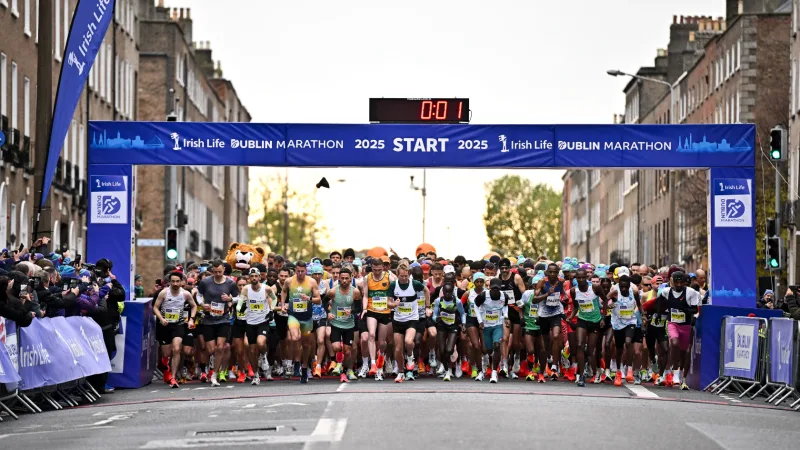
Amy Harrington ran her first Dublin Marathon yesterday, raising funds for Brighter Communities Worldwide. Ahead of the race, the 18-year-old from Tallaght spoke to Paddy Ryan about discovering running in 2024, balancing marathon training with her Leaving Cert and part-time job, and why she chose to support a charity helping communities in Kenya.
Amy Harrington's school offered a free place in a 5K in the Phoenix Park, and asked whether anybody fancied it.
She had only just started going out for short runs at that point, and she had no particular reason to put her hand up.
"My school was like, does anyone want to do this? And I'd just gotten into going for those short runs, and I was like, I'll do it. And then I did it, and that was my first race."
That was around April 2024.
"And then I just continued training solo after. Like, there was never a week where I didn't do a five K, even up until now."
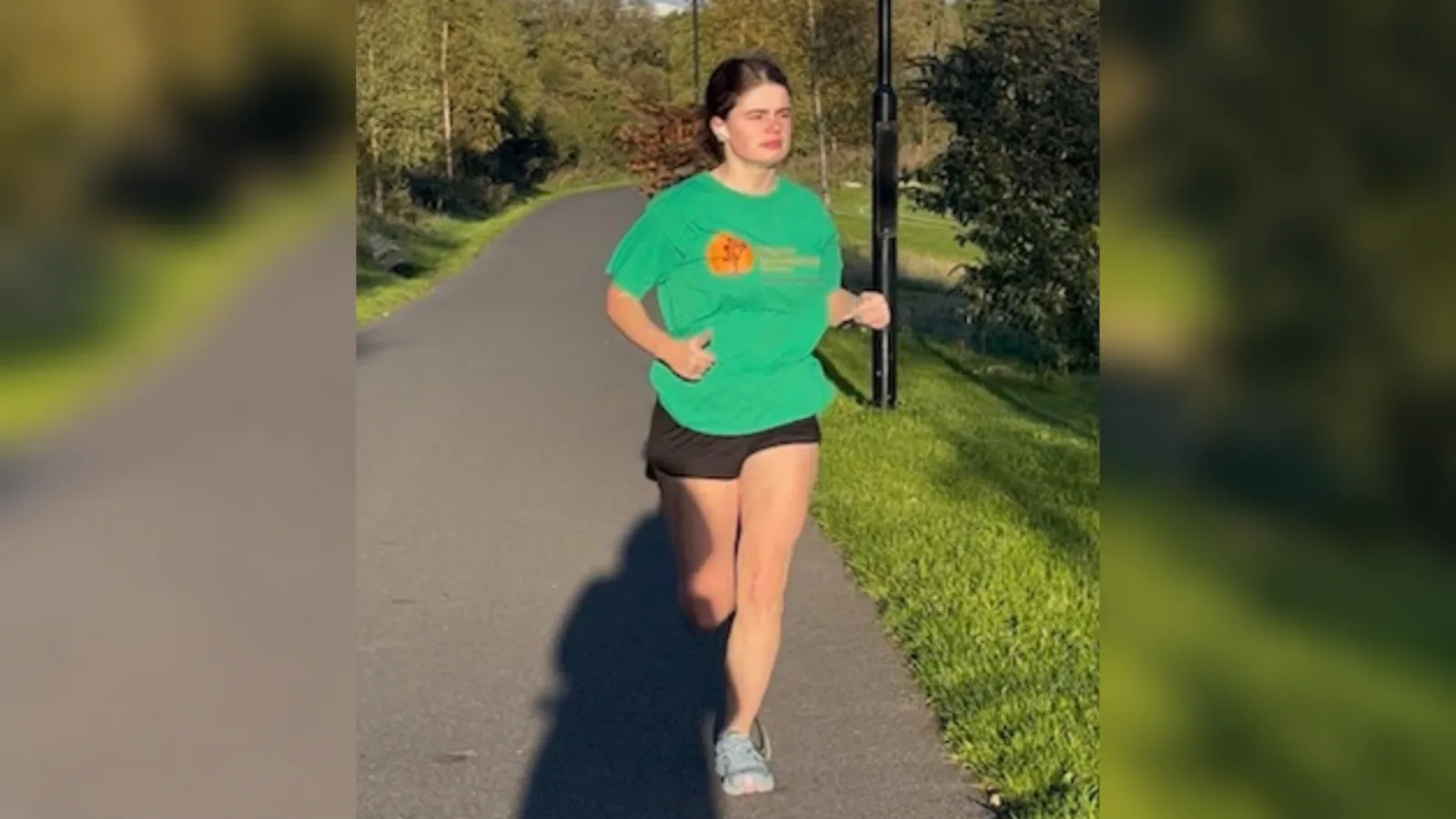
Amy is 18, in sixth year, and from Tallaght. Yesterday she ran her first Dublin Marathon for Brighter Communities Worldwide.
Sixth Year, a Job, and a Marathon
The thing to understand about Amy's year is how much of it is already spoken for before any running happens.
She is sitting her Leaving Cert. She works three or four days a week on top of school. And since April she has been training for a marathon.
Asked how she manages the three of them, her answer is both vague and completely convincing.
"I work three or four days a week, so I just don't, I don't really know. I just try to use all of my time to do everything."
Pushed on it, she lands on the line that could serve as a summary of the whole interview.
"You'll always, if there's a will, there's a way. Like, you'll always find the time somewhere."
She hopes to go on to study something in the area of physical or patient therapy, which, given how much of this story is about her own education, is worth holding onto for a moment.
Running is more or less the only sport she has stuck with. The exception is rowing, which she genuinely enjoys and almost never gets to do, since that would mean getting herself over to Islandbridge.
Why This Charity
In April, Amy decided she did not want to let another Dublin Marathon go by without being in it. She knew a general entry was unlikely, so she went looking at charity places.
What she did next is the part worth reading, because it is not what most people do. She did not pick the first available place. She went and read what each organisation actually did.
"When you look through for charity spaces, you kind of look at what the charities actually are, which is how I found them."
Brighter Communities Worldwide is Irish, based in Cork, and works in Kenya.
"I saw that they were helping young people in Kenya. So they're Irish based, but they actually help people in Kenya. But they were helping even young girls and women, with equality and access to education."
And then she gives the reason, which is the single best thing said in this interview and the reason this piece exists.
"I thought that was something that was super important because without the education that I do have, I wouldn't have been in this specific situation to be able to achieve such a dream, so young."
An eighteen-year-old in sixth year, running her first marathon, raising money so that girls her own age somewhere else get to stay in school. She does not labour the point. She says it once, plainly, and moves on.
Rose
Amy emailed the charity to ask about a place, and dealt with a woman called Rose, who she cannot speak highly enough of.
"The people from the charity are so wonderful and helpful when I was inquiring about all of the lovely, great bits of running Dublin Marathon."
Rose offered her a spot.
"I can't explain how grateful I was."
Rose is not a runner herself, which makes the amount of help she gave all the more striking.
Amy has still never been near the charity's office, and has done the whole thing remotely from Dublin.
How the Money Gets Spent
Amy is better informed about where the money goes than a lot of charity runners twice her age, largely because she asked.
The organisation sends skilled volunteers out to Kenya, people with specific professional skills who can use them on the ground. One of the other women running for the charity this year volunteered out there herself, in a medical role, which is how Amy knows about it.
"So people with specific skills can go over and use their skills to help other people."
It is not only medical people either. Her understanding is that there are volunteers going out with IT skills, and others working on infrastructure.
Beyond the volunteering, the money goes into building work done in partnership with the communities themselves. Hospitals and clinics. Schools and education. And clean water supplies, which she mentions almost in passing and which is probably the single biggest thing on the list.
The part she thinks matters most is how the projects get chosen, and she explains it the way Rose explained it to her.
"They kind of ask what they need. So the people will tell them what they need, and then the charity will go raise the money and help fund what specifically they need in that area."
Nobody arrives and announces what a community is getting. The community says first.
The Running Does the Asking
Amy has raised somewhere in the region of a thousand euro, a bit more, and she is putting a chunk of her own wages into the total herself.
Her observation about fundraising is sharper than most, and it is the one a lot of nervous first-timers need.
"The part about asking people for money for fundraising is more of a thing of they're willing as soon as you bring it up."
The reason, she reckons, is the distances.
"If you tell someone, oh yeah, I went around thirty kilometres yesterday, they're very intrigued by it. It's very unusual activity, so they're more inclined to be more interested in it."
Once people are interested, they ask her where the link is rather than waiting to be asked.
And she is firm about the limits of it.
"It's not a major pressure, because I don't want to put pressure on people to fundraise."
Training on Her Own
Amy is not in a club and never has been. Everything she has done, from that first 5K onwards, she has done on her own off a training app, which she rates highly and recommends without reservation.
The week has a long run in it, speed work, and rest days, built around school and work. School is Monday to Friday, so the longer run goes midweek where it fits, and the rest falls into whatever the job leaves her.
The app is Runna, and she is unreserved about it.
"Nothing that I would recommend spending money on more."
The one place she does run with other people is Dodder Valley parkrun on a Saturday, which is her favourite thing in the running week and which she describes with real warmth.
"It's actually really fun. The volunteers, they just sound wonderful."
She has turned up and run through without going through the official process on occasion, and found nobody minded in the slightest.
"Even the volunteers, they don't really mind. They'll just cheer you on anyways."
"It's such a lovely environment to be in, because it's all people who are very like-minded."
Out, and the Bus Home
The long runs are built the way a lot of people's are once they get bored of circling the same park.
"I don't actually really like doing loops, but I do have a ten kilometre loop that I'll often do."
What she prefers is going somewhere.
"I usually actually prefer to run out and then run back, or I'll run out fully and then get the bus back."
A typical long one takes her out through Dundrum, down towards Dún Laoghaire, back in through Blackrock and UCD, and then the bus from UCD.
She has firm views about the bus route that used to connect her side of the city to the coast, and which went about two years ago.
"It was such a good buzz."
The Hardest Part of Marathon Training
Asked for the hardest moment of the whole block, Amy does not say the long runs, or the dark mornings, or fitting it around the Leaving Cert.
She says her phone battery.
On the longer runs it gives out, and then there is no music and nothing in her ears for the rest of it.
"I'll just have to use no Wi-Fi, no music, no nothing, and just kind of run in silence, because otherwise my phone's going to die on the run."
For somebody who trains entirely alone, that is not a small thing. It is a couple of hours with nothing but her own company.
Gels
Amy has used gels, ran out of them, and has bought more specially for the marathon.
Her review of the category is about as fair as it gets.
"I can't imagine what it's like to take more than one or two on a run, because they can be a bit of a mouthful."
"Some of them are really nice and some of them are rank."
She has heard that jellies work nearly as well, as long as they are sugary enough, and is open to the idea.
"Love a good fruit pastille here and there."
The Crowd
The thing Amy was genuinely nervous about was not the distance.
It was the people.
"I'm a little bit nervous to run around crowds. I've done a few things, but I haven't really run with people around."
She had trained alone since 2024 and raced very little, so the idea of being in among twenty thousand others was the unknown.
She was also talking herself round, which was a good sign.
"I'm sure that's going to affect it in a positive way."
By the end of the conversation she had got there.
"I'm feeling less nervous. I just couldn't really know what I'd do with so many people around."
Related to that, there was a practical thing she had not worked out until this conversation, which was how spectating actually works on marathon day.
"I just haven't figured out how to be like, oh, you can go there, you can go there. I don't actually know what way it works about where you meet people."
She had assumed the road closures made it impossible for family to see her more than once. Learning that the Luas runs across the course, and that her family could catch her early, catch her again later and still make the finish, was news to her.
"Luas is the best. We've got to look into that."
The Business Teacher
Asked what she thought crossing the line would feel like, Amy did the honest thing, which was admit she had no idea and borrow somebody else's version.
Her business teacher has run a marathon.
"He's just like, the first one's always the best. Like, you're never going to know how good it is to feel that."
"And I was like, okay. I don't really know what you're going to feel when you finish, but I'm sure it'll be as wonderful as he depicted it."
Then, because she is 18 and in sixth year:
"I'm a bit nervous too."
She would have been happy enough for her friends to be out on the course. Her teachers she was less sure about.
"I would kind of hope not my teachers. I'd feel very awkward."
"We Can All Do It Together"
Amy was not chasing a time. She had said from the start that she was not the fastest and that finishing was the goal, and for a first marathon at 18 while sitting the Leaving Cert, that was exactly the right target.
What stayed with her at the end of the conversation was the reassurance that everybody else on that start line was in the same state she was, including the ones who looked like they had done ten of them.
Her answer to that was four words long, and it is as good a place as any to leave her.
"We can all do it together."
You can support Amy's fundraising for Brighter Communities Worldwide following the Dublin Marathon on her EventMaster page.