Lucy Kinsella was in Thailand on holiday with her friends when her brother Simon fell.
He was away with friends of his own in Amsterdam in 2019. He fell backwards as he was going up the stairs, and this fall caused a traumatic brain injury.
Her sister rang her and told her what had happened but didn't go into details or the full severity of the injuries, which she understands completely.
"I flew home probably a few days after it happened. I had woken up that morning and just decided I needed to be there. I don't think my family wanted to scare me too much with how Simon was, which I completely understand. It's scary news to share over the phone with someone."
He was unconscious for about two or three weeks.
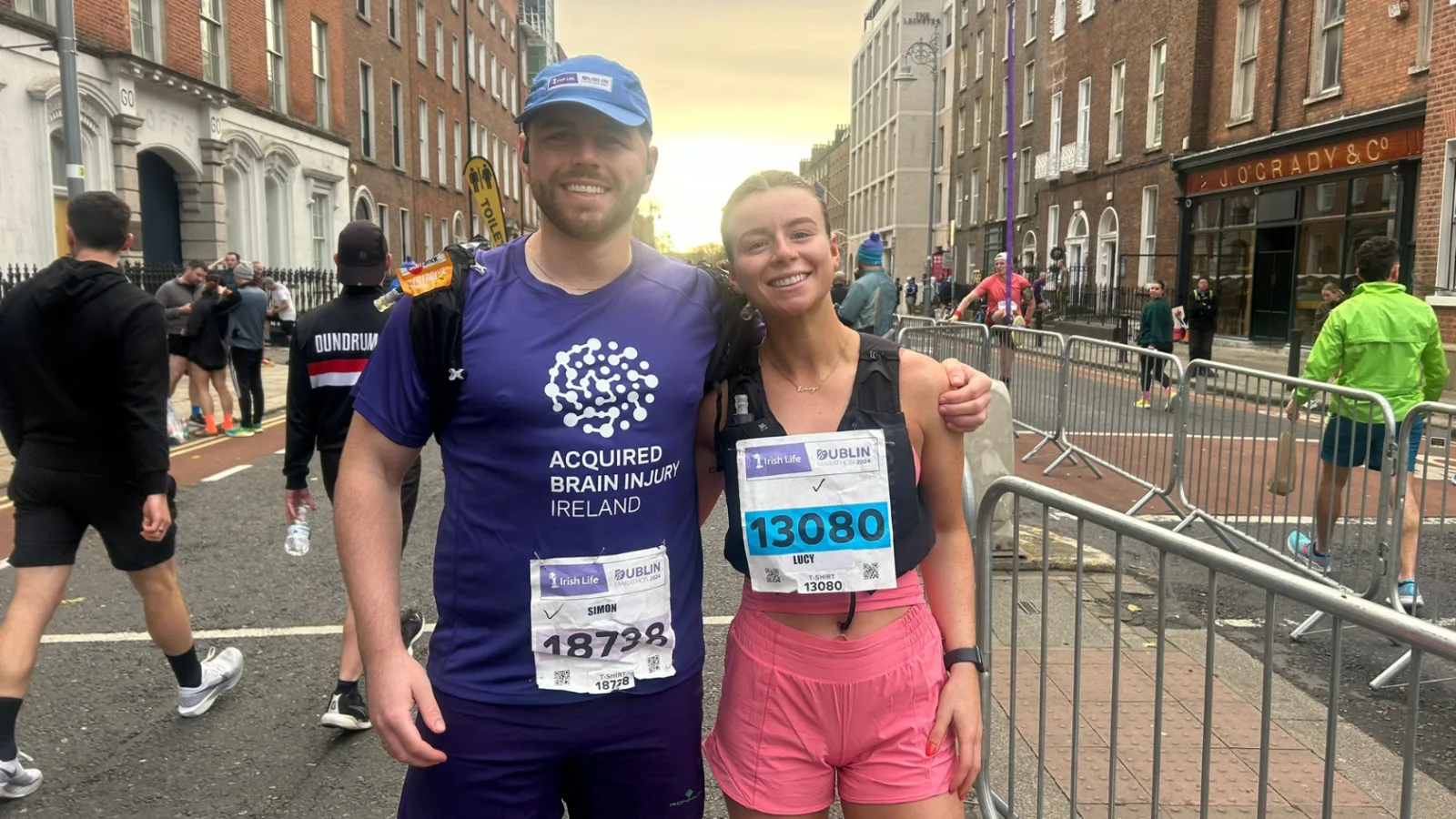
Six years on, Lucy runs her third Dublin Marathon for Acquired Brain Injury Ireland, the charity that helped her family through it, and her brother James runs it alongside her.
Simon ran the same marathon for the same charity three years ago.
Malahide
Lucy is 27 and lives in Malahide. She has a twin sister, Anne, who lives in Melbourne, and two older brothers, James and Simon.
She works as a contract manager for Optum, the American health services company, at their Spencer Dock office, going in twice a week. She will be three years there in January.
Before that she was a finance analyst at Ryanair, in the offices out in Swords rather than anywhere near a plane, working on pilot sector pay. Michael O'Leary she saw walking up and down the office, and no more than that.
Outside work she coaches fitness classes part-time at a studio near Kinsealy, some evenings and some mornings, and has done for three or four years.
"It's something that I really, really love to do outside of work."
Simon
The detail Lucy keeps coming back to is how little she knew about any of this before it happened to her own family.
"Before it happened to my brother and my family, it's not really something that I was aware of, or that you kind of heard about."
What followed the fall was months rather than weeks.
He was transferred home to Beaumont Hospital, where he spent several weeks, and then to the rehabilitation hospital in Dún Laoghaire, where he spent about five months before coming home and continuing as an outpatient.
Lucy describes the recovery in increments, because that is how the family lived it.
"He was probably unconscious for about two or three weeks, and then when he came around, there's still that grogginess. There's still that fear of how he actually will be, mentally and physically."
"As the weeks went on, every day you could see improvements, even from basic things like his physio work, his speech."
By the time he got to Beaumont he was walking around. By the time he got to Dún Laoghaire he was asking for more to do.
"I think they all loved him there, because he was actually willing to work on it and put in that work."
She also makes an observation that will be useful to anybody sitting in a hospital with somebody they love, watching for change and not seeing it.
"People who might not have seen as much would come in, and then come back a month later, and they'd be like, Jesus, there's so much progress there."
"Whereas we're there every day, so we're not seeing it as much."
"There's small progress, which I think you can take as wins sometimes, especially at the start."
"I Don't Want to Speak on His Behalf"
Lucy is careful throughout, and says more than once that Simon's experience is his own to describe.
"I don't want to speak on his behalf, because he's the one that's gone through it, it's very hard for him, and I don't fully know how he's thinking about it."
What she will say is what the family can see.
"There's obviously some challenges, but he's working. He's recently started coaching some rugby. He's doing Hyrox in November and is in the process of completing some accounting exams. He did the marathon three years ago."
He is also sitting accountancy exams, which she mentions without specifying, because that is his business too.
"With brain injuries, there's always going to be some long-term effects, and maybe hidden stuff that people don't think about. Because as you recover, you seem fine, you look fine."
"But from our perspective, he's doing amazing. He's come back so, so well from it."
"He's working. He goes out with his friends. He goes on holidays with them. There's nothing holding him back is what I would say."
And then the thing she is proudest of, which has nothing to do with any of the milestones.
"He's enjoying his life, which is really important."
"It's easy to forget what the achievement of coming through all that actually is."
Where the Charity Came In
Acquired Brain Injury Ireland and Headway both became involved around the time Simon moved to the rehabilitation hospital, roughly two months after the accident.
The timing is not a coincidence, and Lucy explains why.
"Because they are a rehabilitation centre, they are in connection with these charities, and were able to give us that support, or tell us where to turn at that time."
What the charities did for Simon was practical. Getting him back driving. Getting him back to work. Building his confidence.
What they did for the family was different, and Lucy is unusually clear about it.
"Before that, it's very easy to forget about you, and forget about what you're going through right now, because you're so focused on the person in front of you and them getting better."
"You're not really prioritising yourself there."
"Once Simon was in the right place, you're able to reflect on it a little bit more, and then think about, okay, how are we going to get through this?"
The other thing it gave them was other people.
"A big help also was that there were other families around at that time who had gone through the same situation, and we were able to compare notes."
"It gives you a bit of hope as well when you see other people around, and what they've gone through, and who to reach out to."
"It's such a big adjustment. And it's not something that is overnight. It takes time. It's something where you need to be quite patient with."
She is also conscious that the family were lucky on a point that has nothing to do with medicine.
Places in the rehabilitation hospital are in high demand, and Simon got one quickly.
"We were lucky as well to get him in there so quickly, and I think that made a huge difference."
How She Ended Up Doing Three of These
Lucy came to running sideways, through a friend who was already into it.
"I was like, I might do a half marathon, and that's probably how it started. And then we were running together. And from that, I just wanted to set myself a challenge. So I signed up for the Dublin Marathon."
She has always been into fitness, in the gym since she was sixteen, so the base was there. What hooked her was the specific shape of the challenge, and then the fact that it kept moving.
"I did the marathon the first year, and I was like, okay, I know I can do better. And then last year I was like, that was really hard, but I think I still have a little bit more to give."
"And then this year I'm like, okay, this is my last one. I say it every year."
She is not fooling anybody, least of all herself. She has already entered the ballots for Sydney and Chicago.
"If I get it, I have to do it."
What actually keeps bringing her back is the day itself.
"The support on the streets is so amazing. I'm very lucky, I have friends coming in, my family come in and watch, and then we all go for drinks after."
"It's up there with one of my favourite days of the year, probably."
Then, with the honesty that runs through the whole interview:
"I think I just block out the actual marathon when I look back on it."
Three Runs, Three Strength Sessions
Lucy is not in a club. What she has instead is a Wednesday evening running class she only started this year, and which she credits for most of this year's progress.
"There's a couple of sessions that I probably wouldn't do myself, or I wouldn't push myself the way I do in a class setting."
The week is three runs and three strength sessions, and the strength is non-negotiable.
"That's a priority that I've tried to keep up, just because I don't want to get injured. I also love to include a bikerowski class if I have the time as it's low impact but a great aerobic session."
Intervals go in at Malahide Castle. The easy run is eight to twelve kilometres. The long run is at the weekend, out along the coast through Portmarnock and Baldoyle, out as far as Raheny and Fairview and back along Clontarf, and on towards Sutton if she needs a few more kilometres.
"I love that route. It gives you 30 kilometres for your long run. If you get a nice crisp morning, it's lovely."
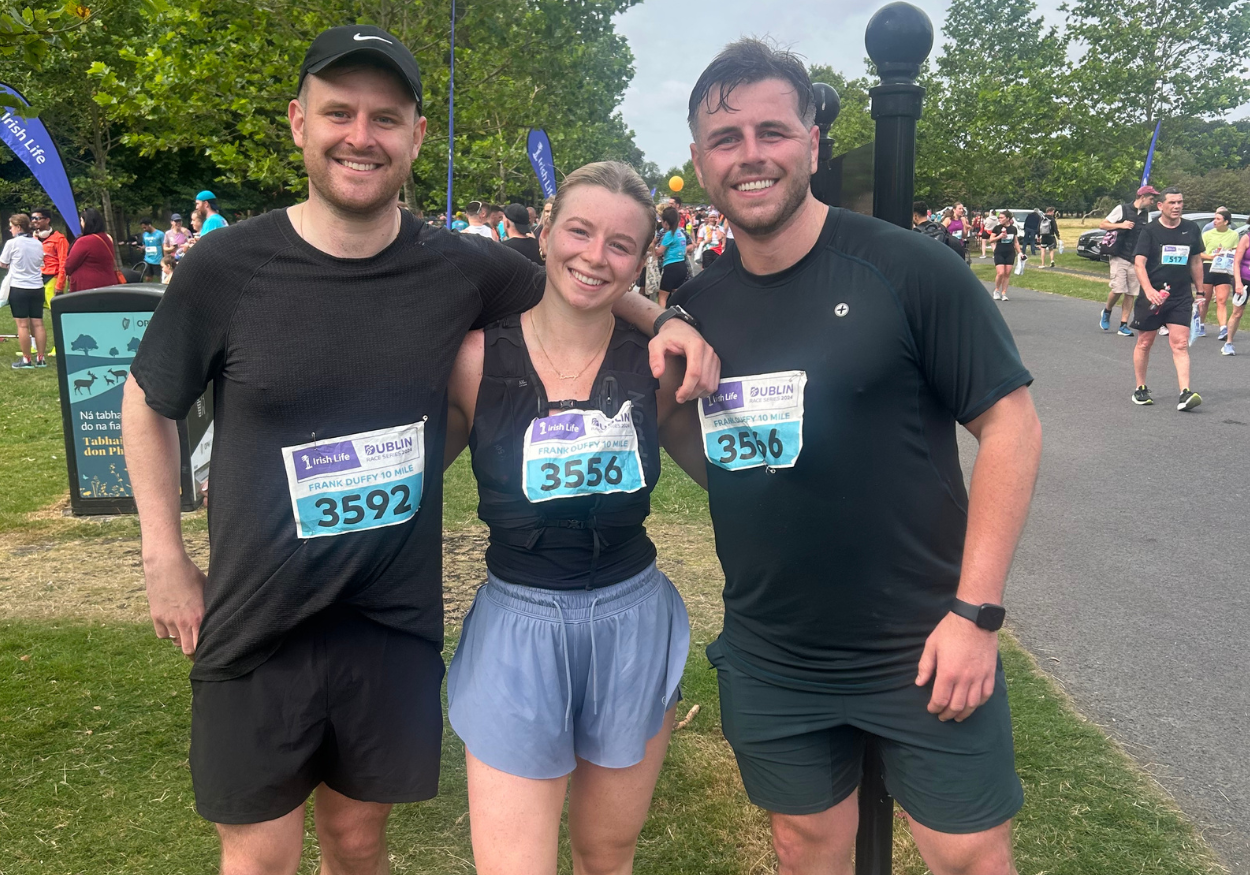
She has had company for a lot of it. Her friend Ciara Kira has joined her for large chunks of the long runs. Her friend Oisín is running Dublin too and did a 32-kilometre run with her. And James is in it as well, which has turned into a weekly check-in between the two of them about what the other one is doing.
She is under no illusions about how that will go on the day.
"He'll be running away ahead of me."
She also makes a point about what running has turned into that a lot of people will recognise.
"It's a social thing now. There's so many people running. So it's like, let's go for a run and a coffee on a Sunday morning."
Nothing New in Race Week
The fuelling is gels, jellies when her stomach wants a change, salt tablets, and a 500ml bottle.
"That's what I've done the past years. That's what I'll do this year again. I keep it basic enough. I'm not going to be changing it now anyway."
She learned that one the hard way.
"I did a three-quarter marathon two years ago. I took a new gel and I was like, this is hell, the whole race. Oh my god, why have I done this to myself?"
Her times so far are 4:08 and then 3:52. The target this year is 3:40, which she immediately revises to 3:45 when she hears herself say it.
A sore hip had kept her from running at all in the week before we spoke, which she was trying not to think about too much.
She and James will start together and she expects him to pull away.
And her one rule for the day is the right one.
"I think the worst thing you can do is be looking at your watch the whole time."
What She'd Tell Someone Starting
Lucy's advice is aimed squarely at the phone in your hand.
"There's so much stuff online, and pressure with running, and times and everything. If you were to start running, I wouldn't even worry about timing. I wouldn't worry about putting that pressure on yourself."
"That's when you go out and you hate it, and you're like, that was so hard. And it's because you've probably seen online someone saying that was their easy run, when they might have been running for years before that. Or else it might not have actually been easy and they're just saying that it was."
Her actual recipe is unglamorous and correct.
"Go at your own pace. Start easy enough, something that's achievable for you."
"Most people will be able to do a marathon if they put the training in, if they give themselves the time to build towards it, and don't rush into it."
"It's also about thinking about other things with running, like your strength training to help stop getting injured. Your food, your nutrition. They're just as important."
And then the part that is rarer, and better, than the standard encouragement.
"Think about some other things that might suit you better as well. It doesn't have to be running."
"Find a fun way to do it that suits you and that is achievable for you. If you set too big targets at the start, it just gets a bit scary and a bit daunting, and you're not going to enjoy it if all the pressure is there."
Her own boyfriend has no interest in running whatsoever, and she is entirely relaxed about it.
"He has his own things that he enjoys, and that's fine."
The Finish Line
Lucy has crossed this line twice and still expects it to get her.
"You don't think about getting emotional, but then when you pass it, you're like, Jesus, I've just done that. That's amazing."
This year there is a layer on it that was not there before.
"To have that extra layer where we are fundraising and being able to give back to a charity that we feel have done so much, it's just going to be really amazing."
"We did what we said we were going to do."
And underneath all of it, the thing she comes back to about her brother, applied to herself.
"Just being grateful to be able to give back, and to be able to run a marathon. It's a lot of stress on your body and it's a lot of pressure, but grateful to be able to do it, and to be able to move my body that way."
Anne will be watching from Melbourne, as she did last year, with instructions about which camera to look at as Lucy comes down the finishing straight.
"I was like, I don't care."
You can support Lucy's fundraising for Acquired Brain Injury Ireland ahead of the Dublin Marathon here.