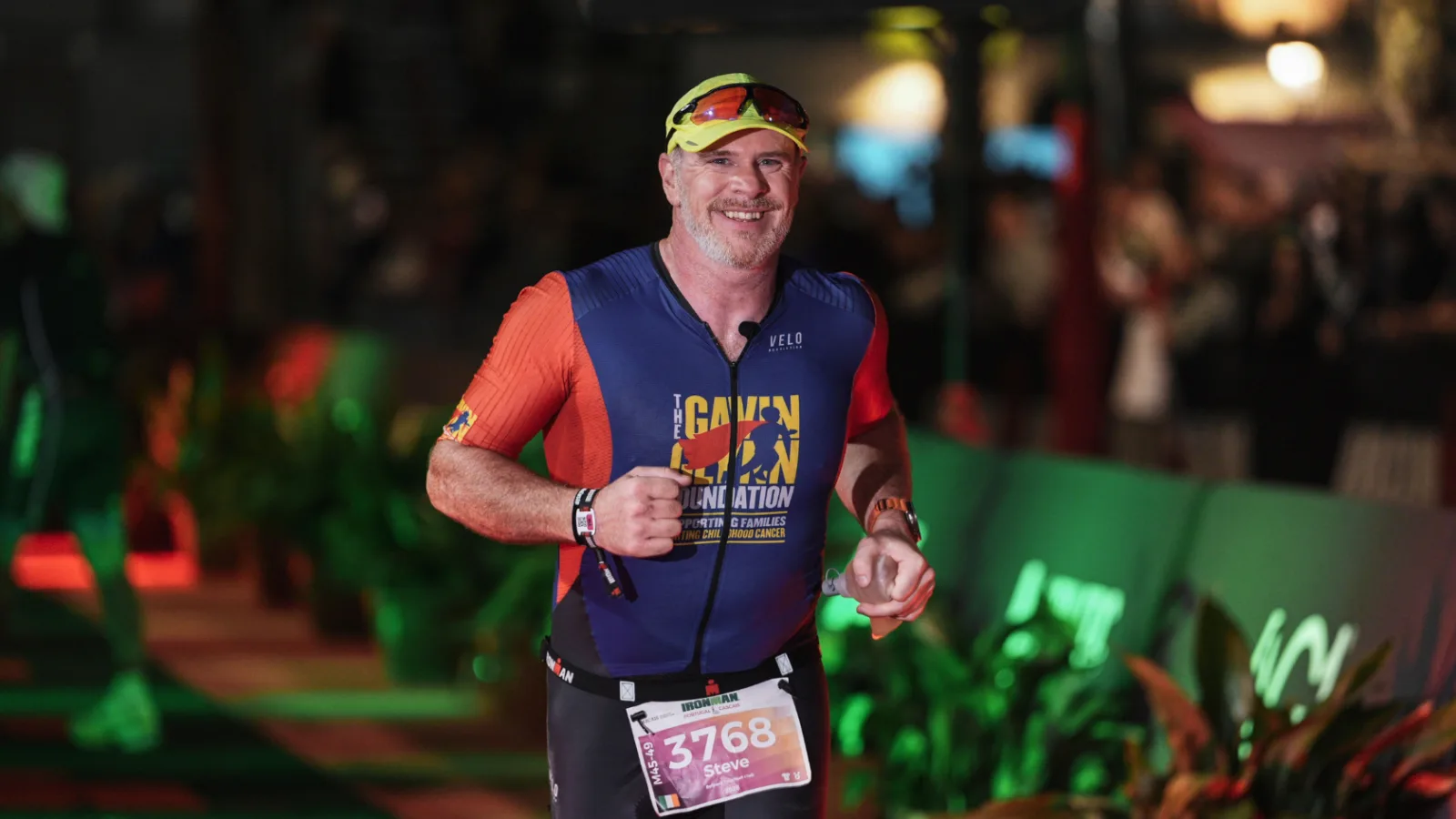
When we spoke ahead of Ironman Cascais, Steve Flanagan's bike had already gone to Portugal. He was flying out the following morning, racing a full Ironman on the Saturday, and then running the Dublin Marathon the following weekend.
He has been calling it two finish lines in one week, which is a good line for a fundraising page and a slightly alarming one for a training plan.
Three days out from the first of them, he hurt his ankle.
"With the ankle now, I don't know if I'll even make it to the finish line. I'll probably be walking portions of the run if it stays the way it is."
He is doing both of them for the Gavin Glynn Foundation, and the reason is two families he knows.
Dalkey, Stepaside, and a job in AI
Steve grew up in Dalkey and has lived in Stepaside for the last eight years with his wife and their three children, who are nine, seven and five.
He works for Optum, the US healthcare company, on an automation and analytics team building AI agents, out of their Dublin office in the docklands. His background is engineering and data. He started out building websites, moved into back-end database design and analytics, spent years as a data architect, and at one point was head of analytics at the Central Bank.
He also coaches rugby at Wesley, and ferries the children to rugby and swimming. The two older ones train with his triathlon club, doing swimming and the rest of it, and all three of them have raced triathlons.
The problem is finding events that will take them.
"I just can't find enough events that are suitable for their ages. They all seem to target more 11 or 12 year olds plus."
On shorter runs, one of them will sometimes come along on a bike, though the hills around Stepaside tend to settle that fairly quickly.
From windsurfing to a bike in the garage
None of this started with running. Running was a long way down the list.
"My actual sporting background was windsurfing. I windsurfed since I was about eight or nine. I used to compete internationally."
That took him all over the place as a teenager. There was rugby at school up to third year, and then essentially nothing for a long stretch.
What dragged him into endurance sport was a friend short of a team mate for Gaelforce West, about fifteen years ago, and a bike that was sitting unused in the garage.
"I got the bike a couple of years before, in the bike to work thing. Hardly ever used it. So I had the bike there. Didn't run. I hadn't run since rugby in third year in school."
Somebody had pulled out of a team and he got roped in.
He hated the running part and was entirely open about treating it as the price of admission.
"I absolutely hated the running to begin with. I quite enjoyed the cycling. So I was like, okay, the running is a means to an end here. You have to do it to get to these races."
Then something else took over.
"I think it was just the challenge of it. The training leading into it, and then the sheer sense of delight crossing that finish line."
He kept entering them, and by his own account did the full Gaelforce series one year. There was also a practical reason underneath it.
"I put on a fair bit of weight back then. So it was more a case of, right, the running and doing these events will give me a target to try and keep the weight down."
Then a torn tendon at a Quest event cost him about eighteen months. He moved out to Stepaside around the same time and, ironically given the trail running on his doorstep, stopped again for a couple of years after that.
What brought it back was COVID and a neighbour two doors up, who talked him into entering the half Ironman in Cork. He got a coach and started from close to nothing, with road walks of two or three kilometres that left him needing an hour's sleep when he got home.
He did the 70.3 in Cork in 2023. Then the event was not coming back to Ireland, so the two of them made a joke about upping their game and signed up for the full Ironman in Portugal in 2024.
He is keen to put that step up in perspective for anybody considering it.
"It's not doubly as hard. It's probably about ten times harder in terms of what you need to do to get around them."
There is one detail about that first full Ironman that is worth knowing.
"Up until doing that Ireland event, I'd never run more than a half marathon. In all my training, 21k was the max that I ever did."
That was deliberate, a way of managing the quad injury and the knees rather than a lack of ambition.
He is also entirely without illusions about his own running, and describes himself as still not a good runner.
"I have a coach there, and he still looks at me and he's like, what are you doing? You'd look ridiculous."
What keeps him entering things is the target rather than the sport. Having a race in the diary is what keeps the weight off and the training honest, and he is open that without one he would not be out the door at all.
Eighteen hours a week
The scale of what Steve was doing before the ankle went is the thing that stops you, and he states it as a simple fact rather than a boast.
"Up until about two weeks ago, I would have been training about eighteen hours a week. On top of work, on top of the kids, on top of the coaching and whatever else."
The shape of a normal day went like this.
"Getting up at about quarter past five, being in the pool for six, getting about two and a half to three kilometres of a swim done. Come back, get the kids, bring them to school, and then either cycle into the office or start working here."
A run at lunchtime, anywhere from six to twelve kilometres depending on the gaps between meetings. An hour to an hour and a half on the bike mid-evening, every other day.
Saturday was a four to six hour ride, out the door at six in the morning. Sunday was a two hour run, fitted around rugby.
His wife is training for the Dublin Marathon too, which creates its own logistical problem, and when both long runs land on the same morning they get a babysitter or family in.
That is the part people underestimate about endurance sport in a house with three children. The hours are hard to find, but the harder thing is finding them twice.
The cup of Coke that started a research project
Fuelling, for Steve, is mostly drinks rather than gels. Tailwind and Maurten, somewhere in the 60 to 80 grams of carbohydrate range.
He takes nothing at all on runs of 10 to 14 kilometres, and brings a soft flask in his pocket from about 18 or 20 kilometres up. For the long sessions he swears by a Maurten 480 mix in a 350ml flask, which carries around 120 grams of carbs.
The interesting part is how he arrived at his race day plan.
At the Lost Sheep triathlon in late August he was stuck at 5:50 per kilometre on the run, despite taking on 120 to 130 grams of carbs an hour, which should have been plenty.
Then somebody at an aid station handed him a cup of Coke.
"Someone handed me a cup of Coke, and I said, great, knock that back. And I ran the last six kilometres at four forty five. And a lot of that was up quite a steep hill."
"So when everyone else was slowing down and walking, I ended up sprinting for the last six kilometres of the race."
He went home convinced it was the caffeine rather than the sugar, and being a data architect by trade, he did not leave it there. He fed his own run data into ChatGPT and Claude, went back and forth on it, and came out with a caffeine protocol for the Dublin Half.
A caffeine gel 45 minutes before the start. Another at six kilometres. A normal gel at 14.
He took seven minutes off his personal best.
The reason
Steve had never heard of the Gavin Glynn Foundation until two or three years ago, and the way he came to it was through a child in his son's class.
The family were on a flight to Disneyland Paris for a birthday trip when the boy became seriously ill. He developed pneumonia and a collapsed lung, and ended up spending roughly eight weeks in a hospital in Paris.
What followed was everything that happens around a sick child when you are in the wrong country.
His mother was stuck in Paris with a baby as well. The family moved between hotels and burned through credit cards and savings. There were visa complications. There was no safe way to get him home, not by plane, not through the UK, not by ferry.
Steve and others rallied the school around them, raising money, and Steve used what he knew from working in health insurance to go at the coverage and the paperwork.
It was a couple of months later, doing the King of Greystones event, that he found out what the Gavin Glynn Foundation actually does, which is get children abroad for treatment they cannot access in Ireland and look after the families while they are there.
"Their case wasn't cancer related. But seeing what the family went through to try and get the treatment that their son needed really resonated with me."
Then it got closer again.
A colleague of his had a baby born with tumours in his eyes, who could not get the treatment he needed here, and who now travels regularly to the UK for it. The visa and logistics problems were much the same.
"The Gavin Glynn Foundation have been helping the family ever since. He's going over regularly to get the treatments that he needs, and he's doing okay."
Steve's own logic for backing them is the clearest donor argument in this whole series.
"I never wanted to see myself or my friends in a situation where they would need to benefit from a charity like that. But knowing that there's a charity there that can do that, it seemed like a good cause to back."
The other one
There is one more charity Steve mentions, and it comes with a family connection of its own.
"LauraLynn is another one that I massively support."
His wife works for Microsoft, who have done substantial fundraising for the children's hospice, and she has taken part in their big cycle event herself.
The pattern is not accidental, and he knows it.
Why children
There is one more thing behind it, and Steve raised it himself.
The day before this interview, his father was diagnosed with Parkinson's. He is 70.
Steve's way of holding that up against the families he has just described says a lot about him.
"We'll figure this out. He's 70. He's lived his life. He's had a great life. Parkinson's is a degenerative condition, but he's had a good life."
"It's when it impacts kids."
He thinks about his own three, and he does not finish the thought so much as circle it.
"I would just never want to see them go through something like that. The trauma that goes with it. Having to grow up too soon."
"Or never even getting the option."
€750, then €1,500, then €2,000
Last year Steve ran Dublin for the Gavin Glynn Foundation and raised €750.
This year, when entries opened, he did not even bother with the general ballot.
"I just went down the charity route."
Last year's target was €750. This year it was set at €1,500. Three days out from the Ironman he was at about €2,000, and planning one more push before the week ran out.
"I was kind of hoping to get to two and a half, three if I could."
He is modest about the scale of it, and realistic about where the limit is.
"It's not a huge amount in the grand scheme of what you'd love to be able to do for the guys. There's only so many resources that I can tap to try and get the backing for them."
The school parents have been the backbone of it, partly because they know the story, and partly, he says, because they are enjoying giving him abuse about the whole enterprise.
The two finish lines framing has done its job, which is to give people a reason to click, and he had three days left to make a final push when we spoke.
It is worth saying what that money does, in his own understanding of it. It gets a child out of Ireland to treatment that does not exist here, and it keeps the family standing while that happens. Flights, accommodation, the paperwork, the parts nobody budgets for. The exact set of problems he watched a family in his son's school run into head first.
Two races, one week, one ankle
The Ironman target was twelve and a half hours, which would already have been a big improvement on the fourteen he took in Portugal in 2024. Before the ankle he had been on track for something closer to eleven and a half.
The last fortnight has been swimming and three quarters of an hour on the turbo trainer, and a lot of hoping. He was planning to test the ankle properly on the turbo at lunchtime the day we spoke, which is about as scientific as it gets this close to a start line.
Dublin, a week later, is not about his own time at all.
He will run it with his wife and his sister in law. The three of them did 4:09 together last year, and the plan this time is to get them under four hours, assuming the ankle allows him to be any use to anybody.
An update from Cascais
Since the interview, Steve has crossed the first of those two finish lines. Cascais brought more heat and wind than expected, with gusts he put at 50 to 60 kilometres per hour making his deep wheels difficult to handle. The ankle held up well after rest, physio and dry needling, but nausea from the start of the marathon forced him into a mixture of walking and jogging. His stomach finally began to settle around 30 kilometres, allowing him to run most of the closing section.
Thinking about the children he was fundraising for helped him keep going, as did his fellow competitors. One offered a hand to get him back on his feet and walked alongside him until he could jog again.
"The sense of sheer joy getting to the finish line is something else, knowing you've conquered a challenge as tough as that is crazy!"
Bruised soles and sore quads made steps and slopes difficult afterwards. By his update, his legs felt back to normal, although he was trying to shake a head cold ahead of Dublin.
"Don't be ashamed of them"
Steve's advice for beginners is the most practical in the series, and it starts with having something in the diary.
"Set a goal. Pick a target race." Then work backwards from it to what you actually need to do.
The mistake he sees most often is the obvious one.
"The biggest challenge that everyone faces is they try to go too long or too fast too soon."
His fix is run-walk intervals, and he is emphatic about the second half of this.
"Do a three kilometre, one minute running, one minute walking, or something like that. Go do those for the first couple of weeks. Don't be ashamed of them. There's nothing wrong with them."
He has watched that embarrassment up close at home.
"My wife refused to do them, because she's like, oh no, I can't, people will see it on Strava."
"But you can hide it on Strava. And then she's like, oh, people won't know that I went for a run."
Couch to 5k and parkrun are where he would send anybody starting from zero. Not serious, good craic, and a matter of getting yourself round the course.
Quieting the mind
The part of all this Steve found hardest has nothing to do with legs or lungs.
His nine year old son has been diagnosed with ADHD. Going through the tests and evaluations with him, Steve recognised many of the same difficulties in himself. He has not had a formal diagnosis, but the experience helped him understand his own struggles with a busy mind.
"It was really quite a struggle to just switch off and accept that I'm going whatever this distance is."
He manages it with headphones, by varying his routes, and by running familiar ones in reverse.
And the proof that it has worked is a sentence that will make sense to anybody who has ever been stuck inside their own head for three hours.
"Not that I was blacking out, but I genuinely was blanking certain parts of the runs. I just don't really remember them."
"Whereas before, I would have been able to tell you where every lump and bump and crack was in the pavement on the routes I was doing, because I was overanalysing everything."
"You can make the time"
There is one more story that explains Steve Flanagan better than any of the training numbers.
Years ago he started an electronic engineering degree at DIT in Kevin Street and never finished it. Much later, he missed out on moving into a role he wanted because the post required a degree or a master's.
So he started a remote degree in applied data technologies. He started it two months before his first full Ironman.
"I was literally there at the Ironman, sitting in a hotel with a laptop out, doing several hours of lectures before going off and doing a test swim, and then going off to race the next day."
Which brings him to the thing he would say to anybody who has told themselves they do not have time to train for something.
"If people say they don't have the time for it, you can make the time. You won't get any sleep, but you can make the time."