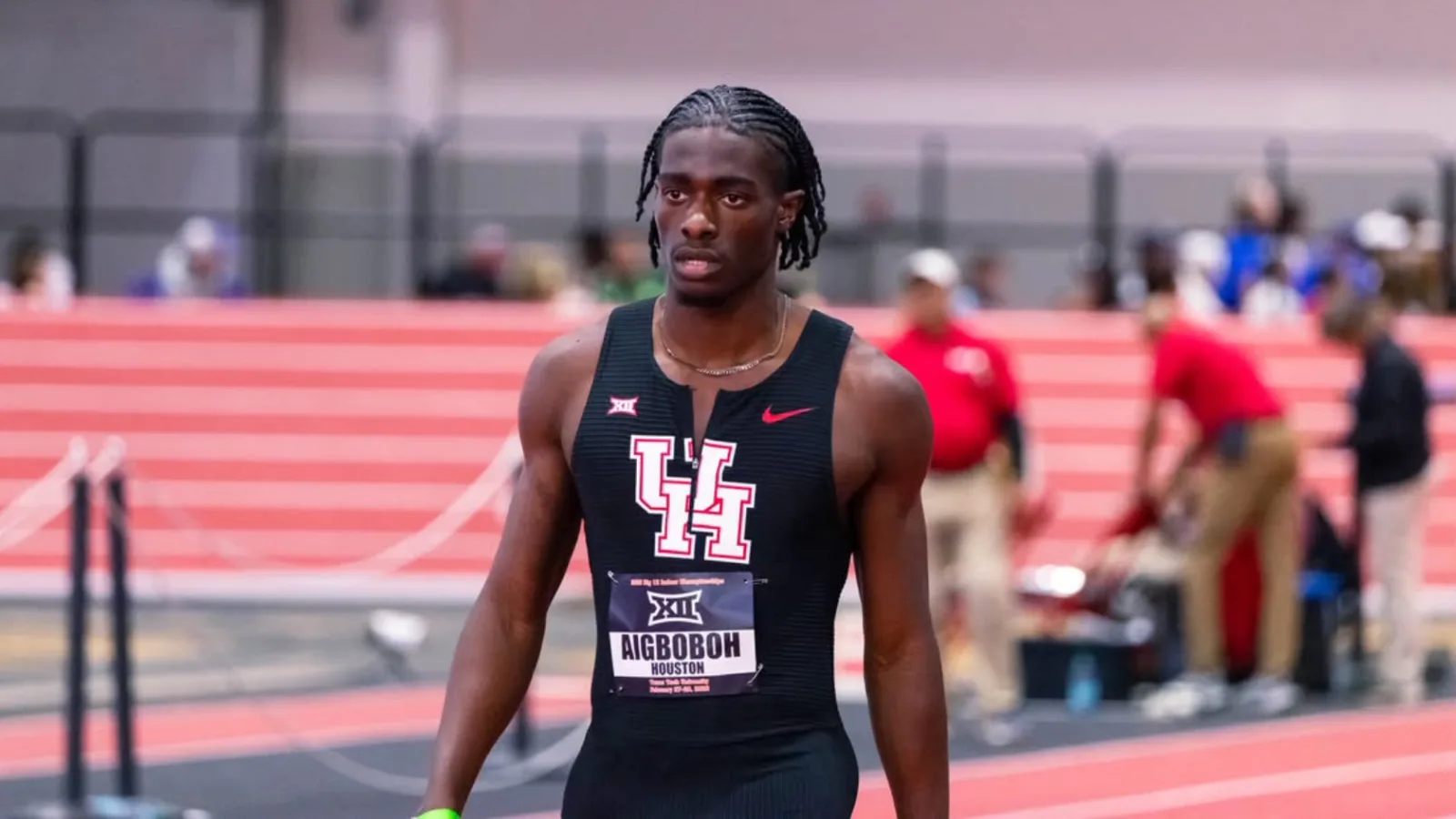
Seán Aigboboh believes he can reach the very very top. There is no hesitation when he says it, but that conviction has not come from nowhere.
Before he had run a competitive race, the late Tony Byrne told him he had the talent to achieve something significant. Carl Lewis now believes he can break 10 seconds for 100m and 20 seconds for 200m.
“I believe it too, firmly,” Aigboboh says. “When someone like Carl Lewis says that to you, he’s not just saying it for the sake of it.”
He is only twenty and took up athletics as recently as 2022. Spend an hour in his company and the confidence does not read as empty bravado. It is the product of what others first saw in him, what he has since seen for himself, and a refusal to decide where his limits might be.
Finding His Way to the Track
The origin is a lot less grand than the ambition. Aigboboh got into athletics in 2022 because his older brother was doing it and everything else was shut.
"During Covid I wasn't really doing any sports, so I was like, let me just do something to stay fit."
He joined Tallaght AC where his brother trained. He was, by his own cheerful admission, not a model recruit.
"I didn't really like it at first. I was dossing around with my mates in training. I was talking a lot and I wasn't really focused, and my coach Tony would tell us to start running and stop picking our noses."
That coach was the late Tony Byrne, and it's the first of two things that changed Aigboboh's sense of what he was. Before he'd run a single competitive race, Byrne told him he was a world-class talent and that he'd go on to do very big things.
"I didn't take it too seriously at the time. But at the same time it kind of made me think. If he thinks this, then, you know. I kind of had to lock in after that."
The second change was a target. Tallaght has, as Aigboboh describes it, a conveyor belt with a very deliberate design. The development group trains at the same time as the elite group, in full view of it.
"You'd see Daniel's group. Israel, Joseph Ojewumi, Rhasidat. All these national champions and record holders. And they all look so big and serious and fast and intimidating. I'd always tell my mate Chris, I want to get into that group. I don't know how, but I'm going to get into that group."
He reckons the visibility is intentional, and he's probably right.
"They put them in front of us so we could look at them and aspire to be like them."
Eventually Daniel Kilgallon gave him a set of times. Hit these and I'll look at bringing you in. He hit them. By August he was training with the seniors.
Learning by Watching
He arrived into that group at sixteen, off the back of a hamstring injury, and felt every inch of the gap.
"I felt almost a bit like an imposter."
Israel Olatunde was in there, an athlete Aigboboh had idolised from a distance and now warmed up beside. He talks about it with no embarrassment at all.
"I always said it to everyone. I was like, I train with Israel all the time."
Seán comes across as measured, analytical, pragmatic. Getting to train with his heroes was one thing. He wanted more. He studied how they carried themselves.
"Simon, how intricate and intentional he was with his warm-up. Joseph, how intentional he was with his movements. Israel, how he carried himself, his lifestyle on and off the track, his recovery. I was taking little bits from all of them and putting them into practice for myself."
He still does it, except the sample has improved considerably.
"Now I'm around Louie Hinchliffe, who runs 9.8. Shemaiah Masangani, who runs 9.9. All these people I can take stuff off. I'm always going to keep doing it. It's just how the sport should be."
As for why Tallaght keeps producing sprinters, he has a straightforward theory, it's the biggest and most densely populated suburb in Dublin, so the talent pool is enormous, and one person joining drags in half their mates.
"There's always one guy who goes to the club. For me it was my brother. For my other friends it was me. For their friends it was them."
And underneath that, a culture he clearly likes being from.
"Tallaght people are just very competitive. Hardworking people."
Houston, and Being Battered into Shape
Then he went to the University of Houston, where the sprint programme is run by Carl Lewis, and everything scaled up at once.
The heat took two weeks to get used to. The training took considerably longer.
He'd gone from three days on the track and a gym session or two, to five days on the track and three gym sessions in the autumn.
"My body took a huge battering. I was almost a walking zombie. Sometimes by Tuesday I'd feel dead and I still had a whole week to go."
What baffled him wasn't the volume, it was the structure. In Ireland, a hard day is followed by an easy one.
"Carl would tell us to do a big session on a Monday, high intensity, maximum effort. Then on Tuesday he'd come back and tell us to do more. It made no sense to me. Houston is five days in a row of straight intensity, then the weekend off, then you go again every single week."
The point of it emerged after a month or two.
"You get so used to being sore that you don't feel the soreness anymore. It forces your body to recover quicker."
That, he says, is exactly why he could run two rounds of the 100m on a Friday, come back on the Saturday and run a fast 200m and a fast 4x100.
"Last year, I probably wouldn't have made it past the first day doing all of that."
He's blunt about why. Before Houston he was on a gap year, largely self-funded, training wherever he could and getting into the Sport Ireland gym through his coach's contacts.
"There's only so much I could do here. When I went there, I get to just focus on being an athlete."
He describes the American set-up as essentially a nine to five in one building. Breakfast at the facility, meetings upstairs, treatment in the training room, session on the track, recovery shake, gym, back into the training room for whatever needs working on, then home to recover.
Home, by contrast, is a driving job.
"Some days I'm in Tallaght training. Other days Morton. Then lifting in the institute, physio in the institute, physio in Newbridge, a chiropractor in town. When I'm supposed to be recovering from a session, I'm busy commuting."
He's not bitter about it, he's practical, and he has a fix in mind.
"The Sport Ireland campus could be that. It's almost there. If there was an outdoor track on the campus, I wouldn't have to go anywhere else."
Being Coached by Carl Lewis
On the man himself, Aigboboh is admiring and very funny about it.
"He's very outspoken. He's not afraid to tell you what you need to hear, because he knows who he is and he knows you can't say no to him. If he tells you to put your feet down and you say no, he's a nine-time Olympic gold medallist. What do you mean, no?"
So he decided, early, not to argue.
"I like to think I'm quite coachable. I came in and I was like, I'm just going to do everything he says."
That was harder than it sounds, because Lewis changed nearly everything about the way he ran, and a rebuild that late brings niggles, inflammation and a period where nothing makes sense.
"The way I was taught to run was opposite. Not wrong, but opposite to what I'm being taught now. I was like, jeez, I don't know how this is going to work."
Then it clicked.
"I felt like I could run fast on command. It felt very natural again."
Lewis had also told him something in the first days that he's carried since.
"One of the first things Carl said to me was that he wants to make me a national record holder. He said he knew I could do it."
One of those has landed already, over 200m. The other is pending.
“We’re still waiting on that 100 record to come through. It might take a couple more business days. I think it might be stuck in transit.”
Lewis believes he can be a sub-10 and sub-20 athlete. Aigboboh doesn't treat that as flattery.
The 200m wasn't an accident either. He knew before he arrived that he'd have to double up.
"You can't come to the team only able to run one event when we're trying to win a conference title. You have to score points in multiple events."
He opened his season with 20.7 and knew immediately what was coming.
As a freshman he scored in all three of his events at the Big 12 championships and came away with a conference title in the 4x100. Next year's team will be almost entirely new, which he sees as his job.
"I can come in with that experience and bring it to the rest of the team."
Confidence, Out Loud
Aigboboh can put a date on the change in how openly he carries his confidence.
“Before Houston I had a quiet confidence.”
Then he entered a training group where ambition was expressed openly and competitiveness formed part of the daily routine.
“We’re all talking our stuff, bigging ourselves up, being competitive in training, trying to beat the other guy. I was quite shy at first. I didn’t engage. Then as the year went by I started engaging more.”
The change was not that he suddenly began believing in himself. It was that he stopped feeling the need to keep that belief quiet. To Aigboboh, confidence in his own ability does not mean disrespecting the athletes alongside him. In fact, he believes that placing a competitor too far above you can quietly impose a limit of its own.
“I respect everyone I race against. But in showing them too much respect, you do yourself a lot of disrespect. You’re talking up this person and that person, and you’re sort of telling yourself you can’t beat them.”
His aim is not to diminish anyone else. It is to avoid diminishing himself.
“You’ll never openly hear me limit myself. You’ll never hear me in my head limiting myself either. The furthest you can go is the furthest your mind lets you go. So I prefer to leave that as a blank cheque.”
Birmingham
The whole season was built backwards from these Europeans. His racing schedule in Europe was deliberately thin because the target was fixed long before he qualified.
"It was never a doubt in my mind I was going to be in Birmingham."
It's his first individual senior selection for Ireland.
"I'm excited. Go put on a show, and go attack those top spots."
Piano, Philosophy and Dancing at Meets
For all the killer instinct, the off-track version is disarming. He's been playing piano for thirteen years, started in classical and branched into everything. He's reading Marcus Aurelius. He listens to Kendrick and Drake, Irish and UK rap, and a lot of Nigerian music at the moment because he's going to see Asake in September.
Carl Lewis has banned music once drills start, which he's fine about, but he refuses to be solemn about any of this.
"You'll still see me at meets dancing around and vibing. I honestly just like to have fun with the sport. You'll see me at national seniors just smiling. I'm literally just having fun."
His family are the anchor. His parents were at the nationals, his mother makes most of his races, and the brother who dragged him to Tallaght AC in the first place started all of it.
"It keeps you grounded. It reminds me why I started this in the first place, and who I'm doing it for every time I step on the line."
Asked what he would like people to take from all this, his answer brings the two sides together: respect for his rivals and complete belief in himself.
"I want to bring some flair to this sport. Bring the fun, bring the games, bring the flair. But also that mentality of, I don't have a problem with you and I respect you, but I'll never respect you too much to the point where I start disrespecting myself."
"That lack of fear. That's what I want to come across."
That much has certainly come across.
Cover Photo: University of Heuston Track