Nutty Corner · Published 68 days ago on 5 Aug 2026
Written by Martin Nutty
Breaking down Ireland's 34 individual qualifiers for Birmingham by event group, there is an obvious weak spot. Out of a possible 48 field event slots, two throwers made the team. Out of a possible 24 jumping slots, zero.
Zero looks like an absence of talent. It isn't. Looking at the women's long jump specifically, the real story is one of talent that got stopped unnecessarily at the door. In a way, what happened is counterproductive to the health of the sport, where Irish field events need encouragement, not an extra hurdle.
Ireland will send no woman to the long jump runway at the European Athletics Championships in Birmingham this August. Zero, out of a 30-athlete field. Here's what's painful: if Irish selection procedure had simply followed the European championship standard, Lauren Callaghan would be jumping in Birmingham.
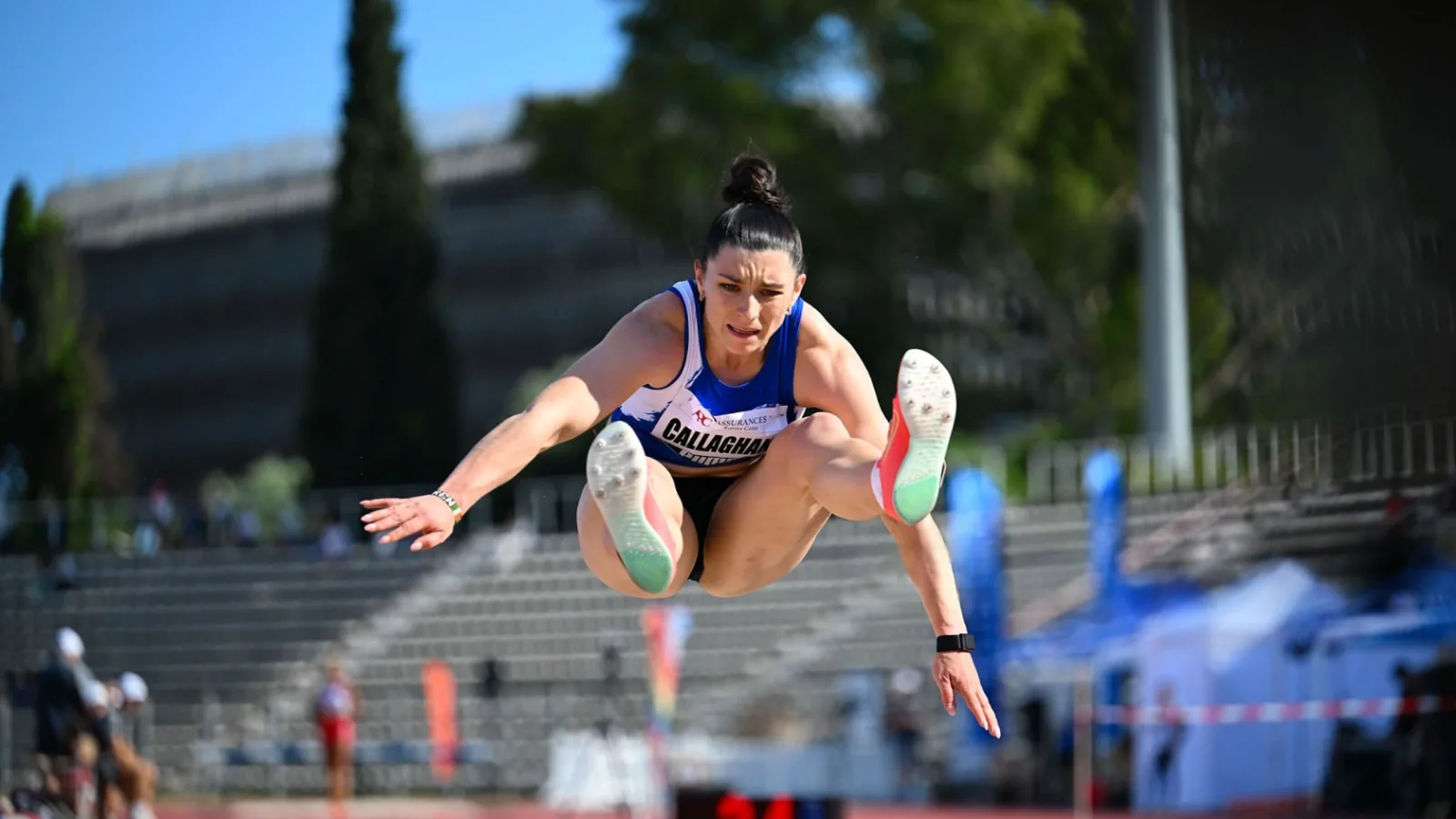
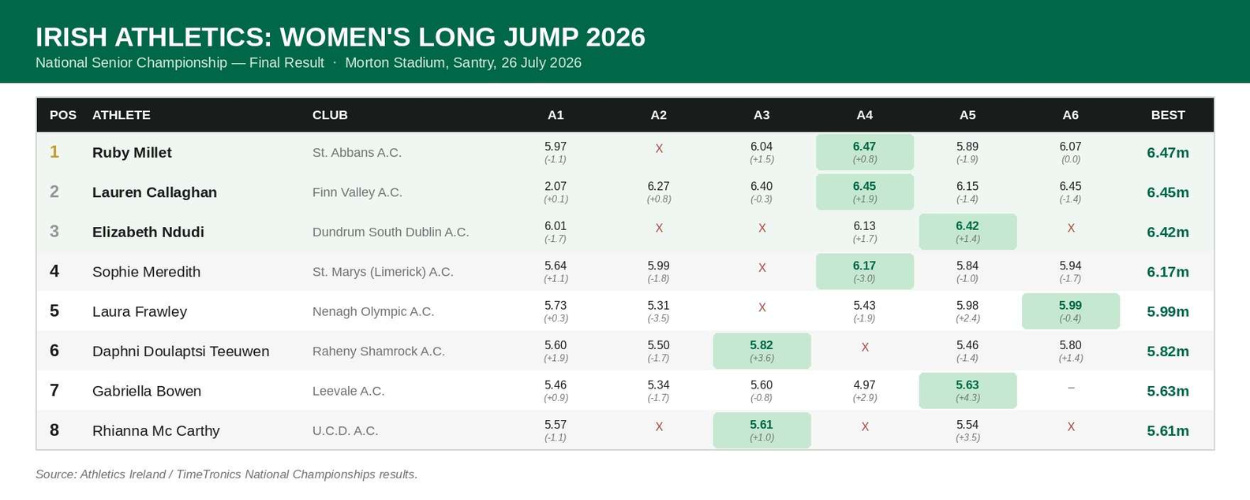
At the recent national championships, the event was highly competitive, with the medal colors decided by just five centimeters. Ruby Millet, in a feel-good comeback story from three years of injury, took gold with a 6.47m leap. She was followed by Lauren Callaghan, who produced two 6.45m jumps, leaving her two centimeters short of the top podium spot. Irish record holder Elizabeth Ndudi was close behind with a 6.42m jump.
National Senior Championship — Final Result, Morton Stadium, Santry, July 26th, 2026
The Irish Qualification Wrinkle
Getting to a European Championship usually comes down to one of two routes. Clear the European long jump standard of 6.77m outright, and you're in: 15 women managed that this cycle. The remaining 15 slots in the 30-woman field went to the next-highest-ranked women by World Athletics points, excluding anyone who'd already qualified on the standard.
That's a straightforward and stringent process on its own. But Athletics Ireland has added a wrinkle: a domestic B standard of 6.55m, required before the federation will even put an athlete forward to compete for one of those ranking-based slots. Frankly, this seems unnecessary to me, and it produced a disappointing consequence for the event in Ireland.
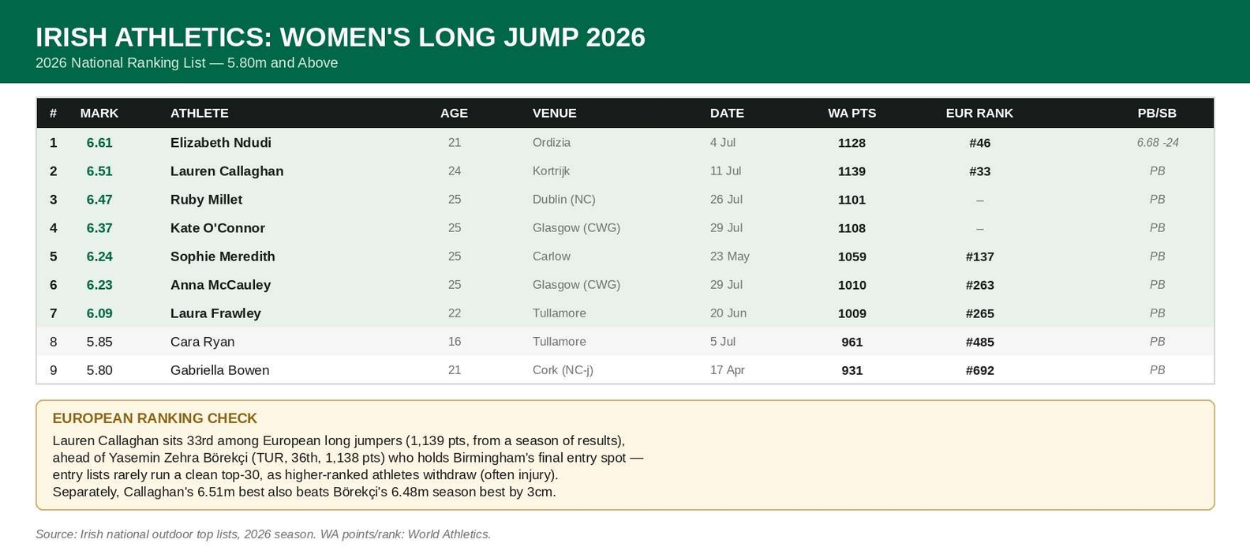
Lauren Callaghan's season best was 6.51m, a lifetime best set in Kortrijk in July. That's four centimeters short of the 6.55m gate, so she was never put forward to test her ranking points at all and her ranking points would have held up. Callaghan sits 33rd among European long jumpers with 1,139 points, a season-long points total built from her string of performances, not any single jump. Yasemin Zehra Börekçi of Turkey, who occupies the actual final entry spot in Birmingham's 30-athlete field, sits 36th with 1,138 points. That raises an obvious question: if there are only 30 slots, how does a 36th-ranked athlete get one while a 33rd-ranked athlete supposedly had a case? The answer is that entry lists never work out to a clean top-30 by rank. Not every higher-ranked athlete who's eligible actually takes up their place, injury being the most common reason, and withdrawals like that shift the effective cutoff further down the list than the raw rankings suggest. Börekçi's presence at 36th is itself evidence the field reached past 33rd this cycle, which only strengthens the case that Callaghan, ranked higher and never even in the pool of nominated candidates, would have had a real shot had Ireland put her forward. It's a separate, almost incidental fact that Börekçi's season's best of 6.48m also happens to be three centimeters shorter than Callaghan's 6.51m, the ranking gap and the jump gap are two different calculations that simply point the same direction. Either way you measure it, Callaghan outranks the athlete who is going. She was stopped by four centimeters on a domestic gate, not by anything Europe asked of her.
Elizabeth Ndudi's season best was 6.61m, jumped in Ordizia in July, comfortably clear of that same 6.55m gate. Her case is the mirror image of Callaghan's: she cleared the mark, but her ranking points, 1,128, sit below Callaghan's despite the longer jump, since that calculation rewards a full season of high- value results and not a single standout distance. One big meet may not be enough to out-point athletes who competed at a higher tier all season.
2026 National Ranking List — 5.80m and Above, with European Ranking Check
What That Actually Tells You
Put those two together and the picture sharpens. Callaghan clears the points side of the composite bar with room to spare, ahead of an athlete who is actually competing in Birmingham, but never got to prove it because the mark side stopped her first. Ndudi clears the mark side comfortably, but her points, built primarily on one outstanding meet rather than a season of them, come in just under Callaghan's. Between them, they clear the entire bar. Neither individually gets to
The Barrier Isn't Europe's
Worth sitting with plainly: the 6.55m gate that stopped Callaghan is not a European rule. It's Athletics Ireland's own addition; a domestic standard layered on top of what the continent actually requires. Europe's real cutline, the mark held by the athlete occupying Birmingham's final spot, is 6.48m. Callaghan beat that by three centimeters. The federation's own bar, not the continent's, is what kept her home.
That matters because zero jumpers on the Birmingham team was never going to read as a nuanced story. It reads as an event with nothing in it, precisely the framing that then shapes funding conversations, coaching investment, and the message every emerging young jumper gets about where her event sits in the sport's pecking order. A federation-imposed standard that sits above what Europe itself asks for is actively working against an emerging pool of talent at the exact moment that pool needs the opposite: exposure, experience, and the chance to be seen.
Why the Exposure Argument Still Matters
There's a real case that competing at a major championship is a developmental milestone in its own right, not just something handed out once every box is ticked. Standing next to Iapichino or Mihambo in a call room, absorbing what a European final actually feels like under real pressure, that experience tends to pay forward. Athletes who get an early look at that stage often carry it into the next one calmer and more focused on the job.
Callaghan is 24 and just produced a lifetime best that clears Europe's own bar. Ndudi is 21, already holds the Irish record at 6.68m, and cleared the domestic gate comfortably, her shortfall was on ranking points, a competitive gap rather than a federation-imposed one. Neither has finished climbing. The argument for getting athletes like this into a major championship early isn't sentiment, it's development. For Callaghan specifically, that development gets undercut by a domestic standard doing work Europe's own selectors weren't asking anyone to do.
There's a wider payoff too, beyond any one athlete's career. Having an Irish woman on the long jump runway in Birmingham would have been good for the event back home: a visible marker for the teenagers already coming up through the ranks, a stronger case for coaching investment, a reason for the sport's profile in Ireland to rise rather than sit flat. That's not a hypothetical benefit. It lands at exactly the moment the numbers say the event can use it.
The Base Underneath It
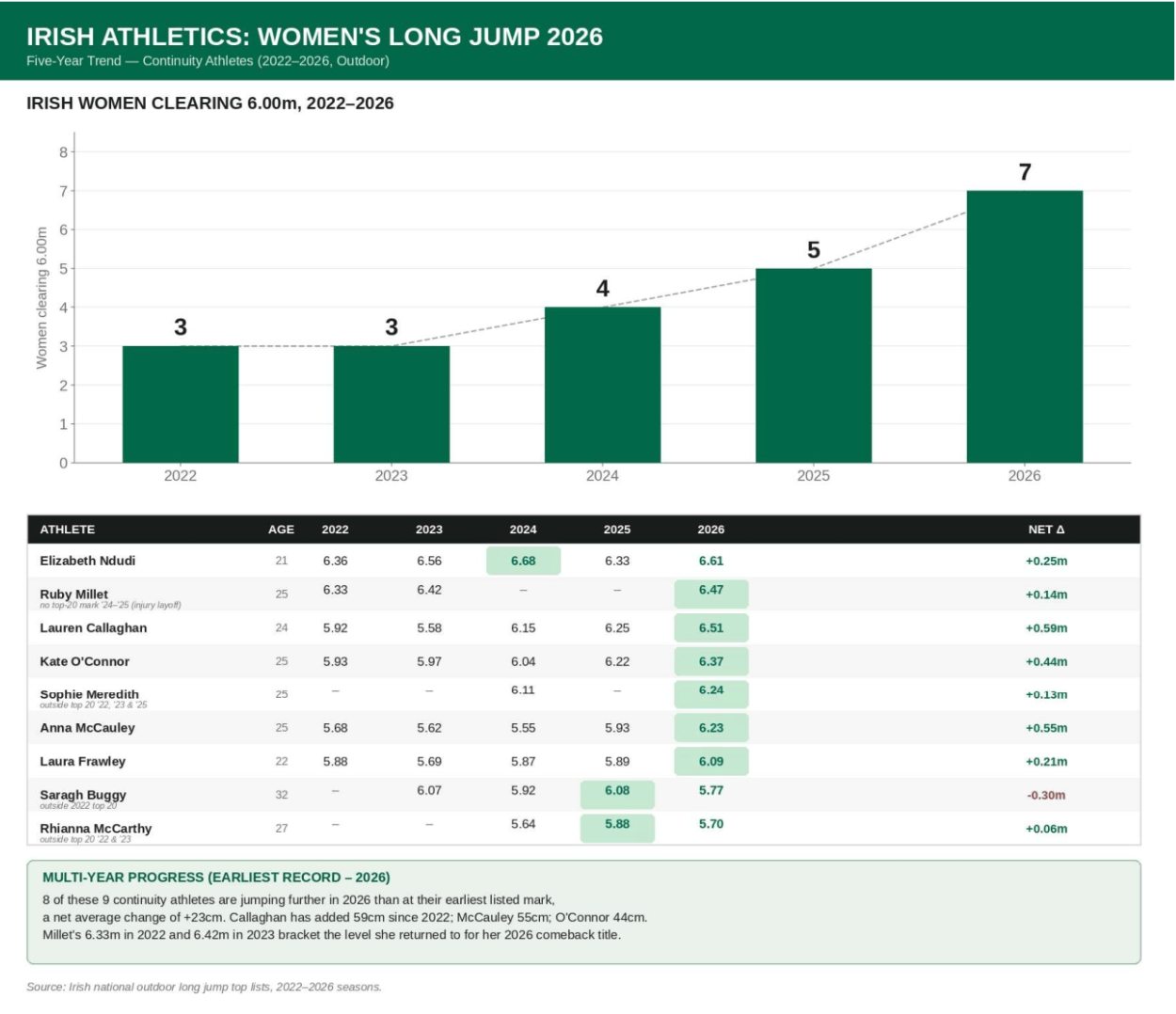
Widen the lens past those two names and the depth argument holds up on its own, and it's not a one-season blip. The number of Irish women clearing six meters has grown every year for five years running: three in 2022, three in 2023, four in 2024, five in 2025, seven in 2026. The list below six meters runs eighteen deep to 5.50m, spanning athletes born in 1994 through 2012, with several teenagers posting lifetime bests along the way, including a 14-year-old who added the better part of a meter to her personal best in a single year. That's real, sustained progress, not a single good season, and it's exactly the kind of momentum an Irish presence in Birmingham could have reinforced rather than gone unseen behind. It's also the pool that a standard set above Europe's own line is most likely to discourage first.
Five-Year Trend, Continuity Athletes (2022–2026, Outdoor) and Irish Women Clearing 6.00m
The Honest Reckoning
None of this guarantees European Champs next time or an Olympic final down the line. A domestic standard can be revisited whenever a federation decides it's worth revisiting, but that decision has to actually get made. Nothing here promises that it will.
What the numbers do show is an event with real material to work with, and one specific, nameable reason at least one Irish woman isn't walking into Alexander Stadium this month. Callaghan is legitimately above the continent's own cutline on ranking points, which is all that should be needed, and stayed home anyway because of a bar Ireland set for itself. Ndudi is a national record holder still with real room to grow, and a teenage cohort is adding significant distance year over year behind both of them. Zero jumpers on the team sheet isn't a verdict on the talent. For at least one of the athletes closest to it, it's a verdict on a standard Ireland set for itself, higher than the one Europe actually asked for, at the exact moment an emerging generation needed the door held open rather than raised.
In my view, Athletics Ireland should dispense with the B standard entirely. The existing qualification process, an outright European standard for automatic entry, backed by a World Rankings system that already accounts for the level of competition an athlete has faced, is robust enough on its own. It doesn't need a domestic layer bolted on top, and as this season shows, that extra layer is costing the sport a major championship opportunity it can't afford to pass up.