Nutty Corner · Published 40 days ago on 3 Sept 2026
By Martin Nutty
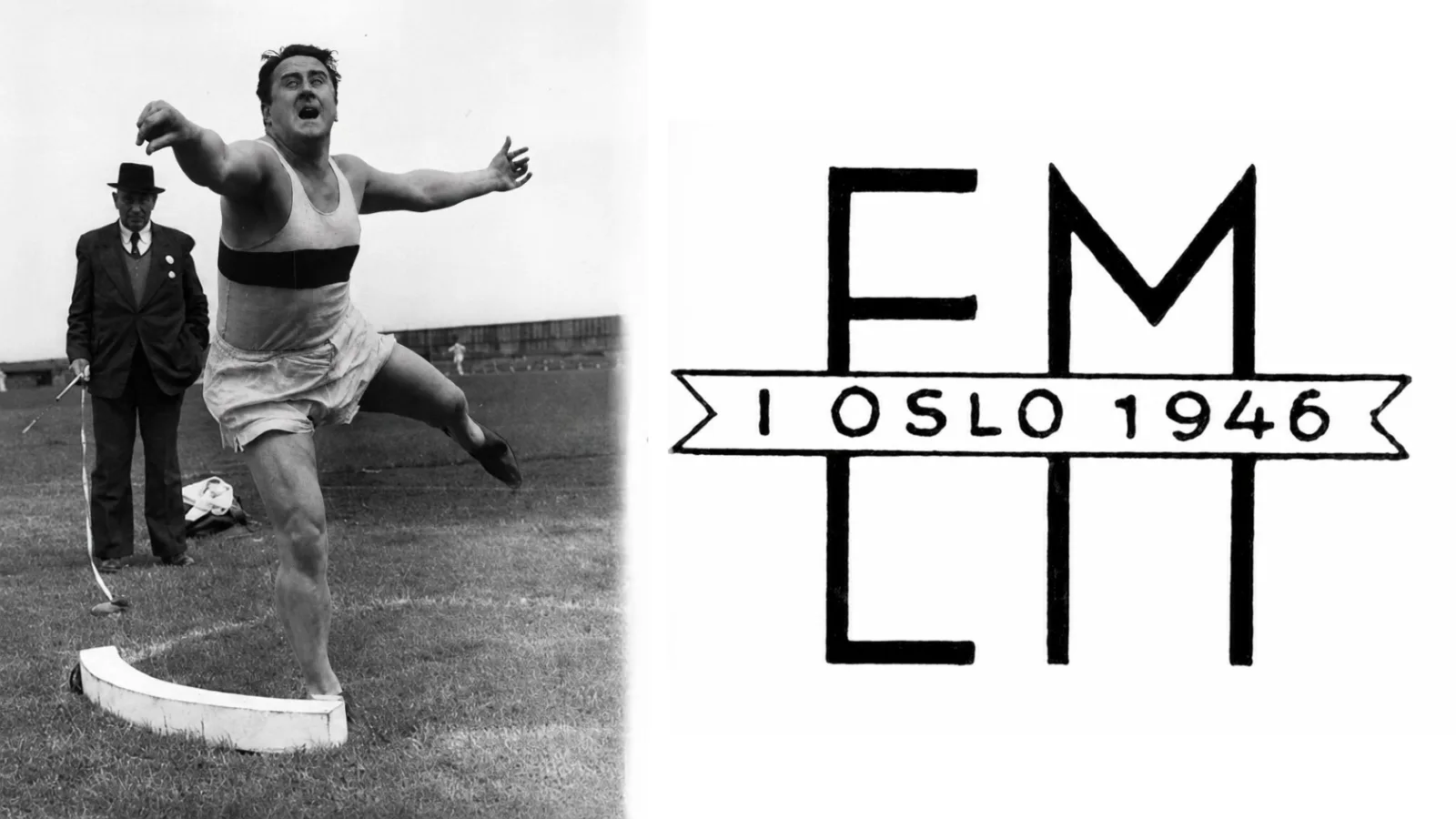
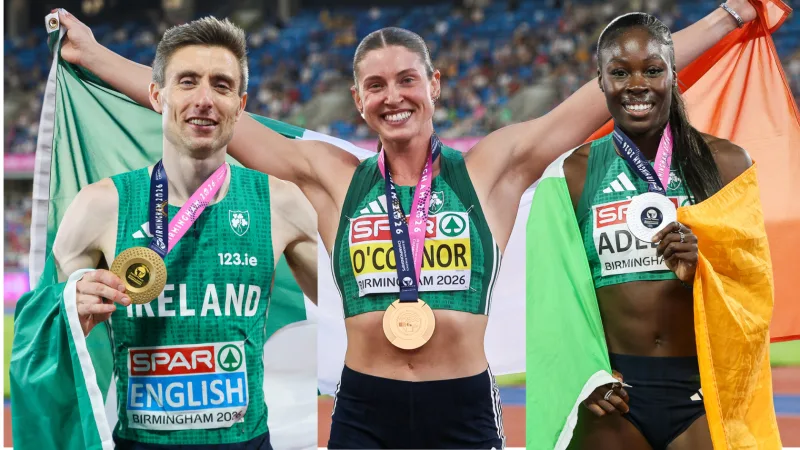
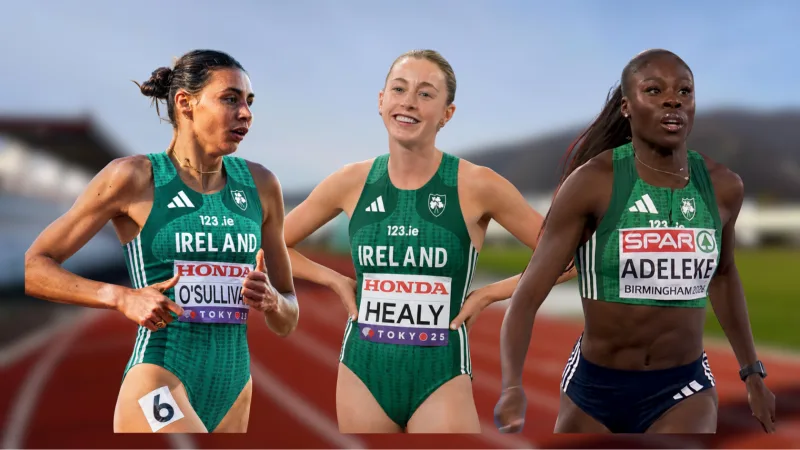
I’ve found myself thinking about Dave Guiney over the past few weeks while I researched and wrote about Ireland’s recent successes at the European Championships. Dave came to front of mind when I discovered he was Ireland’s first ever representative at the European Championships.
When writing about championship athletics, history is always present as we compare the current moment with the past and sometimes that research reveals odd factoids. When I compared the record size of this year’s 52 member Irish team to those of the past, I discovered the first team Ireland fielded was a team of one at the 1946 Oslo Championship. Dave was that team and his lonely participation points to the deeply troubled history of Irish athletics which preceded those games and persisted long afterwards. That complicated and often bitter history played out for many decades over the 20th century, and the ghost of those problems can still be encountered today.
Championships Missed and Lost
The 1946 Oslo Championships was the third edition of the continental championship. The original championship had been held in Turin in 1934, but Ireland didn’t participate. This was just two years after Ireland achieved its most notable Olympic success yielding two gold medals at the 1932 Los Angeles Games. In what has commonly been referred to as Ireland’s “Golden Hour”, Bob Tisdall won the 400m Hurdles gold and Pat O’Callaghan defended his Olympic Hammer title. So why no team in Turin two years later?
In July 1934, Irish athletics governing body, the NACA, named a six-man team for Turin:
Dr. P. O'Callaghan (Duhallow AC): Hammer, the 1928/'32 Olympic champion
M. Curtin (Fr. O'Leary AC, Cork): Hammer, 1934 Irish champion
E. Fitzgerald (UCD AC): Hop, Step and Jump, 1934 Irish champion
P. Anglim (Clonmel Garda AC): Broad Jump, 1934 Irish champion
T.D. Phelan (Milocarian AC): 110m Hurdles, 1934 Irish champion
R.H. Wallace (Dublin University H & AC): 400m Hurdles, AAA Championships runner-up
None of these men competed at the September 7 – 9 Championships. The Irish absence at Turin can be explained by an intervening IAAF meeting which took place in August at Stockholm. The IAAF, precursor to today’s World Athletics organization, ruled that Northern Ireland was to be considered part of Great Britain athletically. This decision stood in stark contrast to the NACA, the Irish athletics association’s perspective who asserted all-island control of the sport. In response to this decision, the NACA refused to send a team to Turin.
The following year, the NACA held their annual congress on the 3rd of February at Wynn’s Hotel in Dublin. By a vote of 27 to 24, the NACA rejected the IAAF’s Northern Ireland ruling. That vote triggered an IAAF letter suspending the NACA from international competition. There would be no 1936 Olympics for Ireland. Pat O’Callaghan did not get to defend his Olympic title. In 1937 O’Callaghan threw 59.54m in Fermoy, eclipsing the 1913 world record set by Paddy Ryan. The Fermoy performance was not recognized as a world record because of the IAAF ban. Ireland was shut out of international athletics and missed the subsequent 1938 European championships.
It comes as no surprise that certain members of the Irish athletics community found international isolation intolerable and a split emerged resulting in the creation of the Irish Amateur Athletic Union (IAAU) in 1937. This organization morphed into the Amateur Athletic Union of Éire (AAUE). The new name, by some accounts, was adopted to reflect the newly passed 1937 Irish constitution. Other accounts report that the name was adopted to overcome British objections to use of “Ireland” in the association’s name during the formal readmission to the IAAF.
While the precise details surrounding the readmission to the IAAF may remain unclear, there is little doubt that Irish athletics was deeply divided. The initial split was limited to a small number of primarily Dublin clubs. Author Tom Hunt notes in his Little Book of Irish Athletics, that in 1956 AAUE membership was limited to eight clubs comprising 300 members dwarfed by the NACA’s 380 clubs and 4,500 members. Reading the press surrounding this schism is painful. The words secession and traitor are not uncommon.
The fragmentation and isolation of Irish athletics was further exacerbated by World War II. The great global cataclysm damaged athletics across all geographies. A comparison of performances at the 1948 London Olympics with those of 1936 Berlin games reveals the damage, with winning marks dropping off across multiple events. While Ireland remained neutral in WWII, it’s hard to argue against the severity of impact on the sport in Ireland by these events. Worse still, a legacy of bitterness suffused the Irish athletics community and that wound has only healed in recent decades.
Dave Guiney was aware of all these details when he left for the Oslo European Championships in August 1946. He had been dealing with his own professional drama. His request for leave to participate in Oslo from the Irish Civil Service was denied. Dave opted to resign his post so he could travel. Did Irish athletics politics play a role in that resignation or was it more the case of an unhelpful supervisor? I imagine all of this weighed on Dave and unsurprisingly his performance was subpar. At something close to his best, he should have made the final, perhaps been in the hunt for a medal, but he could only muster 13.57m in the qualifying round. A throw of 14.02 meters was needed to make the final, a mark he had exceeded at least three times that Summer.
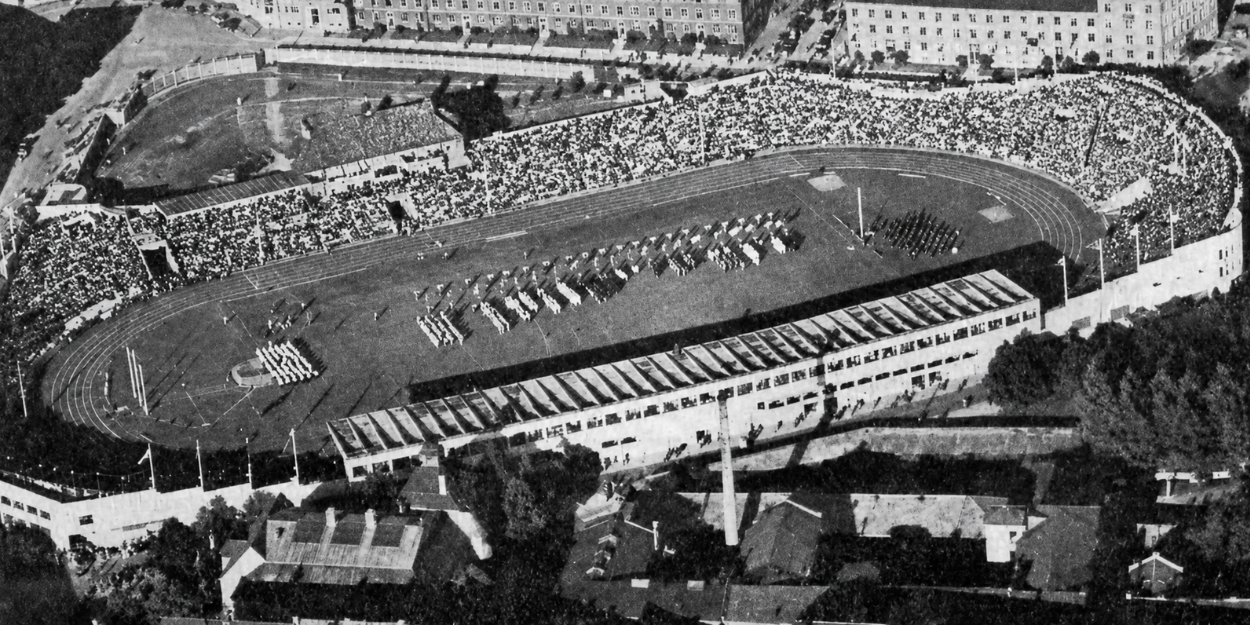
1946 European Championships Opening Ceremony at Bislett Stadium, Oslo
Meeting Dave
Dave never mentioned any of this the day I first encountered him at Belfield House more than thirty years later. I knew none of this history then. It was a bitter winter day, and together with other young throwers I was warming myself in one of the house's formerly grand rooms overlooking the UCD track. We were there for the conclusion of the Hammerama, an annual hammer throwing event organized by my coach Philip Conway. The competition was frequently held in suboptimal conditions, but it broke up the long months of winter training and gave an excuse to congregate around the holiday season.
Philip Conway was mindful of the history of Irish throwing and had invited Dave to speak. I knew nothing of the older trenchcoat clad, 60-something man who addressed us. He was imposingly short and stocky, not a giant of a man which was surprising for an athlete that had held the Irish Shot Put record and competed in the 1948 Olympics in London. In truth I don’t remember much of what he said that day. That’s surprising because he was a gifted speaker. I imagine Pat O’Callaghan’s name was invoked, Dave had come from Kanturk in Cork, the same hometown for Ireland’s only double Olympic gold athletics medalist. Oddly, I do remember when drinks were offered, Dave asking for a Coca Cola. To my teenage brain, that was an odd choice for a grown man. I thought no more of it and that chilly day was soon forgotten.
An Afternoon in Sutton
Some years later in 1985, Philip Conway suggested we pay a visit to Dave’s Sutton home on Dublin’s North Side. I was back from my second year of college in America where I was studying Sports Administration at St John’s University in New York. Philip likely thought that Dave could be helpful to me should I make a permanent return to Ireland after my studies. Dave was one of the most connected men in Irish sports, a product of a long career in Irish journalism which had begun after he returned from the 1946 Oslo Championships. No doubt he could have helped ease my way should I have called on him for assistance.
It was a wet day when we paid our visit and Phyl, Dave’s wife, ushered us to his study, a converted garage at the back of his property. It was a dimly lit cozy space and tea was had. Dave asked about my recent athletic accomplishments. My performances were unremarkable, and I had no idea I had already peaked. That Summer I won my first and only Irish cap in addition to finishing second at Irish Nationals. I was looking forward to greater things on my return to New York, unaware that a lingering injury would end any ambition for greater things.
Dave regaled us with tales of how he and his athletically accomplished brothers had traveled the length and breadth of Ireland competing in the many local sporting events held during his active years. This was an era where athletes couldn’t earn money, but there were plenty of good prizes made available at local meetings.
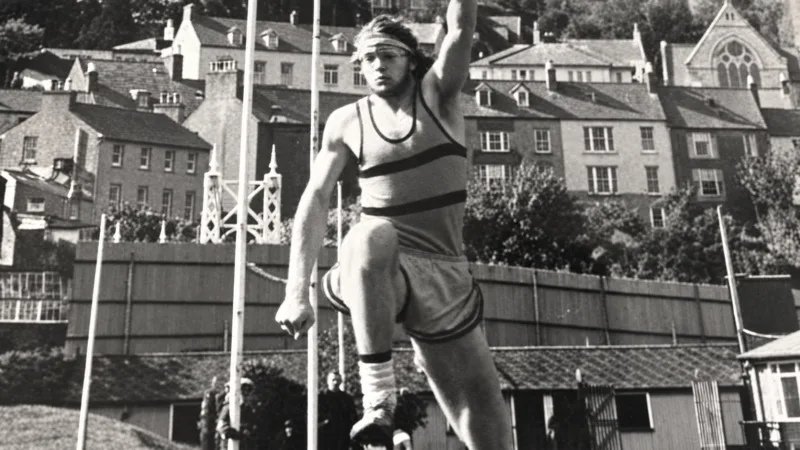
While the Shot Put proved to be Dave’s preferred event, he had started out as a jumper. His first Irish title came in the Long Jump in 1941; however an injury limited him in the event and so he switched to the Shot Put. Twelve Irish titles followed in that event between 1944 and 1956.
Like many of the men that came from the barony of Duhallow, Dave had come of age at the end of an athletic tradition where weight throwers could frequently be found jumping and sprinting. Pat O’Callaghan won three Irish High Jump titles in the early 1930s jumping 1.83m on each occasion. This was in an era before the Fosbury Flop and foam landing pits revolutionized the event. The Doc was reputed to have jumped 1.93m. Many contemporary world class hammer throwers would likely be unable to match that performance under modern conditions.
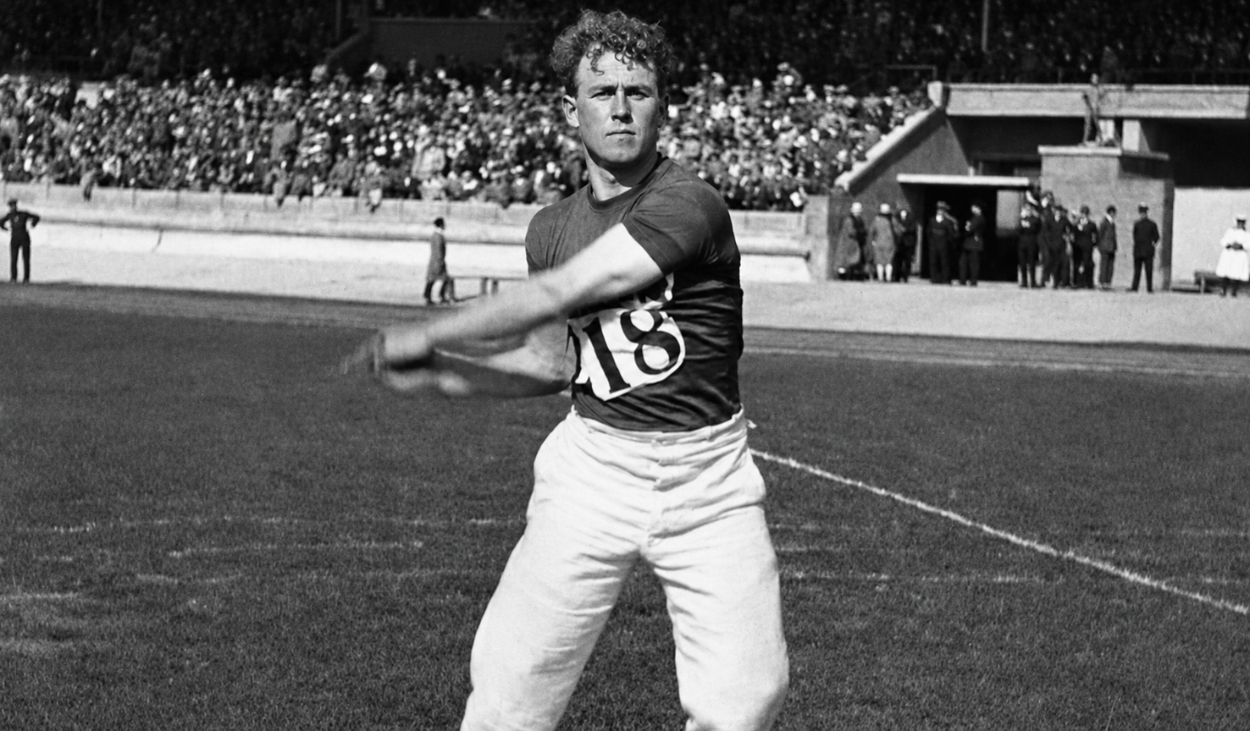
Pat O’Callaghan at the 1928 Amsterdam Olympics
Duhallow, the name Dave attached to his house, seems to have been a hotbed of extraordinary athletic talent. Many of the Irish Whales who dominated the throwing events in the first quarter of the 20th century originated from the place. What was it about that locale, the lifestyle and the tradition that created so many world class athletes? Is that wellspring of talent still there waiting to be tapped with the right combination of coaching and facilities in the more demanding world of present-day athletics?
Philip and I spent hours with Dave that day. He talked about his life as a journalist and how he’d become an authority on Olympic history, particularly the men he encountered in his home region. He also reflected on darker things, his struggles with alcoholism, a reminder of that cold winter day when he’d asked for a Coca-Cola.
Before I left that day, Dave gave me a copy of his book, The Friendly Olympics which told the story of the 1932 Los Angeles Olympics. I remember opening it casually on my return flight to New York. I finished it before I landed having been swept back to the 1930s by Dave’s elegant prose. While the stories of O’Callaghan and Tisdall were central to the book, he also wrote movingly about other competitors and events. A double podium and world record for Japan in the Triple Jump, how the Steeplechase went one lap too long, and how Eddie Tolan became the first black man to win the Olympic 100m title.
A Kindred Spirit
I never saw Dave again. My life became rooted in New York and athletics faded somewhat into my past. Dave died in October of 2000. I wasn’t aware of his passing. Now I think of him as something of a kindred spirit. As time has passed, like Dave, I’ve become interested in the history of athletics. I do so with the understanding that history often presages many of our current difficulties. Unless we come to terms with the past, we are condemned, as Santayana would say, to repeat its mistakes.
If I had the chance now, I’d quiz Dave in more detail about his career. What happened on that day in Oslo, was he injured, was the weather difficult, was the circle not to his liking, did the loss of his job press on him? How heavily did the poisonous Irish athletics split weigh on him? Was he called a traitor, soft on the Brits, or worse? Those would have been painful questions, but I would find a way to ask them if the opportunity was available now. Most importantly, I would ask how the toxic atmosphere that suffused Irish athletics led to the diminishment of a great field events tradition. I imagine there would have been well-informed wisdom in the answer.
A Faded Tradition
In some ways, Dave was the exclamation point on an Irish throwing tradition that faded away. No Irish Shot Putter would compete in the European Championships until Eric Favors did so in Munich in 2022, an astonishing gap of 76 years. This year we celebrated Eric making a final and finishing in 10th place. Dave Guiney should have made his final as well, but he was swimming upstream against problems most of us have forgotten.
Only 13 throwers have represented Ireland across 27 editions of the European Championships, more than half of whom were connected to Philip Conway who joined me that day in Dave’s snug study. Philip patiently coached me and many others and did so out of a love for the sport and a desire to see Irish throwers return to an internationally competitive level. His work is a reminder of the great work many volunteer Irish coaches have done over the years.
I wonder what Dave would make of this current Irish athletics juncture. No doubt he would be delighted to see the recent successes in Birmingham. I imagine he would be asking, “what about the throws?” It’s a question that needs answering.