Watch charged. Route planned. Shoes on. First kilometre comfortable.
Then you look down.
One shoe has come undone.
Again.
There are few things in running capable of producing such disproportionate fury. You stop, bend down, tie it, start running again and spend the next kilometre wondering how an activity humans have managed since childhood has suddenly become beyond you.
The particularly irritating part is that it is not necessarily because you tied your shoes badly.
There is actual science behind why running shoes come undone.
And, thankfully, there are some very simple ways of stopping it.
Your Shoes Are Being Beaten Into Submission
Running creates almost ideal conditions for a knot to work itself loose.
Researchers at the University of California, Berkeley studied exactly how this happens using high speed footage of a runner on a treadmill.
They found that two forces work together.
First, each foot strike repeatedly loads and unloads the knot. That gradually loosens it.
At the same time, your leg is swinging forwards and backwards. The loose ends and loops move with it, creating forces that pull at the knot.
Everything can appear completely secure for quite some time. Then, once the knot loosens beyond a certain point, it can unravel remarkably quickly.
So you were not imagining it.
Your shoes really can go from absolutely fine to flapping around your ankles within a handful of strides.
Running has enough genuine problems without your footwear quietly plotting against you.
You Might Be Tying The Wrong Knot
Here is where things become slightly embarrassing.
A lot of adults are apparently walking around tying their shoes incorrectly.
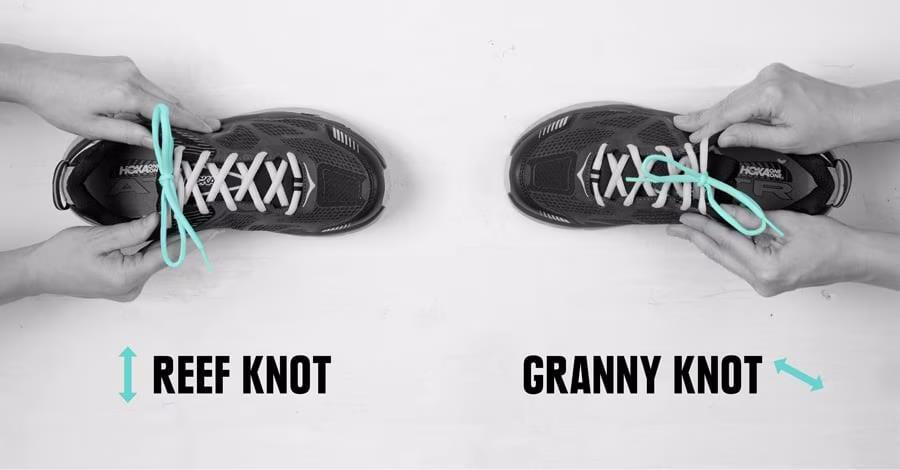
There are two very similar looking versions of the ordinary bow most of us learned as children.
One is called a reef knot.
The other is called a granny knot.
The reef knot is considerably more stable. Movement tends to tighten it.
A granny knot is less stable and more inclined to work itself loose.
The annoying thing is that they look almost identical when you tie them.
There is, however, an easy clue.
Look at the finished bow.
If the loops sit neatly across the width of your shoe, you have probably tied the more secure version.
If the bow sits crooked or points more towards your toes and ankle, there is a decent chance you are tying a granny knot.
Which means you may have spent your entire adult life blaming your shoes for something you learned incorrectly when you were five.
A humbling afternoon for everyone involved.
The Fix Can Be Ridiculously Simple
If your bow constantly sits crooked, you do not need to relearn the entire process.
Try reversing the direction of the very first crossing you make before forming the bow.
That small change can turn a granny knot into the more stable reef knot.
Tie your shoes as normal afterwards and look at the finished bow again.
If it now sits neatly across the shoe instead of pointing along it, you have probably solved the problem.
Years of irritation potentially fixed in about three seconds.
You are welcome to send an apology to every pair of running shoes you previously accused of being rubbish.
The Double Knot Remains Undefeated
There is also the solution known to primary school children everywhere.
Tie another knot.
Once you have formed your normal bow, pass the two loops around one another once more and tighten them.
That extra knot makes it much harder for the bow to come apart accidentally.
It is not glamorous.
There will never be a £200 carbon plated solution to rival it.
But if your shoes repeatedly come undone during races, the double knot is wonderfully effective.
Just do not pull everything so brutally tight that the top of your foot feels as though it has been placed in a vice.
Secure is good.
Cutting off communication with your toes is unnecessary.
Leave Enough Cord To Work With
Very short ends can make tying a secure bow difficult.
Very long ones create another problem entirely.
If the loops and loose ends are enormous, they have more opportunity to swing around as you run. They can also catch against the opposite shoe or anything else unfortunate enough to get in their way.
You want enough length to form a proper secure knot without two enormous loops bouncing around like decorative ears.
If the cords are absurdly long, tucking the loose portions underneath the crossed sections on top of the shoe can help keep things tidy.
Just make sure nothing is positioned somewhere that creates uncomfortable pressure against your foot.
Do Not Assume Tighter Means Better
One understandable reaction to shoes repeatedly coming undone is simply to pull everything harder.
That can solve one problem and create another.
Running shoes need to remain secure on the foot, but crushing the top of your foot is not the goal.
The knot itself needs to be stable.
The entire shoe does not need to be tightened until your toes begin making hostage negotiations.
If your heel feels secure and the shoe is comfortably held in place, concentrate on tying a better knot rather than simply applying more force.
Check Them Before The Start
This sounds painfully obvious.
That is because it is.
Yet runners routinely spend months preparing for races and then arrive on the start line with one shoe tied differently from the other because they were putting them on while eating a banana and looking for their safety pins.
Before a race, tie both shoes properly.
Walk around.
Jog for a few seconds if there is room.
Then check them again.
If you regularly have trouble with them coming undone, use the double knot before the gun goes rather than waiting until kilometre seven to remember that this happens every single time.
There are plenty of legitimate reasons to stop during a race.
Having to redo something you learned in junior infants should not really be one of them.
Why Does It Always Happen Without Warning?
This may be the most irritating part.
You rarely feel a knot gradually giving up.
One moment everything is normal.
The next, something is slapping against the side of your shoe and you are debating the consequences of simply continuing for another five kilometres.
The research from Berkeley helps explain why.
The knot can withstand repeated impacts for some time while becoming progressively less stable. Once enough movement occurs, failure can happen very quickly.
That is why you can run comfortably for half an hour before suddenly finding one shoe completely undone.
There was a process.
Your shoe simply chose not to involve you in it.
Should You Stop And Retie It?
Yes.
Obviously.
There will always be one runner who thinks stopping for ten seconds will destroy their race and decides to continue with an open shoe instead.
This person is usually the same person who spends £250 on racing shoes to save tiny amounts of time.
Stop.
Move safely out of the path of other runners if you are in an event.
Tie the shoe properly.
Continue.
The seconds lost will be considerably less inconvenient than standing on a loose cord, stumbling forward and becoming the most dramatic photograph of the race.
One Tiny Change Can End Years Of Annoyance
Running shoes coming undone feels like one of those irritating things you simply have to accept.
It is not.
Start by looking at how your bow sits.
If it points forwards rather than neatly across your shoe, try reversing that first crossing and see what happens.
For races and long runs, a double knot provides an extra layer of security.
Keep the ends reasonably tidy, avoid excessive tightening and give both shoes a quick check before you start running.
It is an absurdly small detail.
But running is full of absurdly small details.
And once you have spent three minutes of a personal best attempt crouched beside the road tying the same bloody shoe for the second time, it suddenly does not feel quite so small.