harging your running watch halfway through an ultra is one problem most runners would rather avoid.
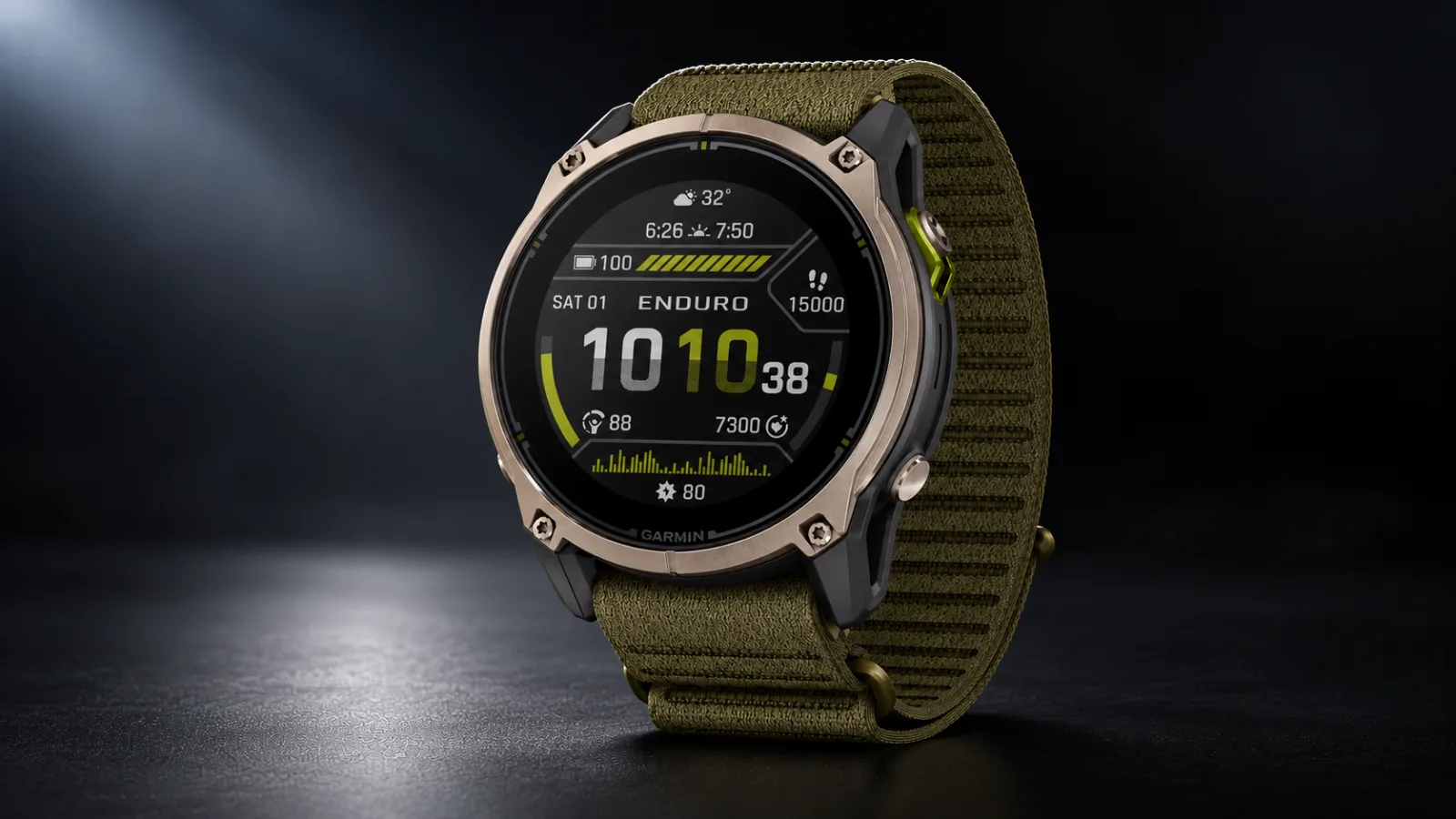
Garmin's answer is the new Enduro 4, announced on October 6th and built specifically for ultra runners, trail runners and athletes whose idea of a long session can extend well beyond a Sunday morning.
The headline figure is difficult to ignore.
Garmin says the Enduro 4 can provide up to 320 hours of activity tracking with solar charging when its extended battery settings are used.
That is more than 13 days.
The watch can also reach up to 90 days in smartwatch mode with solar charging, making battery life the central selling point of a device designed for runners heading into events where finding a charger is unlikely to be high on the priority list.
But this is not simply an Enduro 3 with another enormous battery claim attached.
Garmin has introduced new pacing tools, upgraded its mapping system, doubled the storage and added features specifically aimed at athletes tackling long races and multi day adventures.
320 Hours Comes With A Catch
First, some context around that extraordinary battery figure.
The Enduro 4 does not provide 320 hours under every GPS setting.
Garmin says the maximum figure requires solar charging, sufficient sunlight and the extended battery activity mode. Its calculation assumes continuous use in conditions of 50,000 lux.
Under normal GPS use, the watch is rated for up to 120 hours, which is still five days of continuous tracking.
Smartwatch battery life is rated at up to 36 days without solar assistance, rising to as much as 90 days when Garmin's solar assumptions are met.
For most road runners, those numbers are frankly excessive.
For an ultra runner spending a day, two days or considerably longer on a course, they start to make much more sense.
Garmin has introduced several power modes to manage that battery. Max Accuracy prioritises tracking quality, while Max Battery sacrifices some functionality when keeping the activity running for as long as possible becomes the priority.
Garmin Is Thinking About Hills
Some of the more interesting changes concern pacing.
The Enduro 4 introduces grade adjusted pace based workout targets, allowing training targets to account for changes in elevation rather than expecting a runner to maintain exactly the same pace climbing a hill as they would on flat ground.
There is also grade adjusted rolling pace, which gives runners a live indication of pace while taking the surrounding terrain into account.
That could be much more useful for trail runners than simply staring at conventional pace.
Anyone who has tried following a strict pace target on a steep climb will know how quickly the number on the watch can stop telling the full story.
The watch also includes new Stamina Zones and a Stamina Curve.
Garmin's existing stamina technology estimates how much physical capacity remains during an activity. The new tools are designed to give runners a clearer picture of how that endurance changes over time using their fitness and previous training data.
In a marathon, that information might be interesting.
In a 100 mile ultra, knowing how aggressively you are eating into your available resources becomes rather more important.
Faster Maps For When The Route Gets Complicated
Navigation has received a substantial upgrade too.
The Enduro 4 has 50 per cent more RAM than the Enduro 3, alongside an updated mapping engine that Garmin says delivers 30 per cent faster map panning.
There is also a new Perspective View intended to make the terrain ahead easier to interpret.
The watch includes routable maps and Garmin's established navigation tools, including ClimbPro, NextFork and Up Ahead.
Storage has doubled from 32GB on the Enduro 3 to 64GB, leaving considerably more room for maps, music and other data stored directly on the watch.
Again, that matters far more when somebody is several hours into a trail event than it does during a familiar 5K around the local park.
Garmin Epic Is Made For The Really Long Stuff
One of the more unusual additions is Garmin Epic.
It allows several activities completed over days, weeks or even months to be grouped together inside Garmin Connect.
Health and performance information from those activities can then be viewed together, while photographs can also be added.
For somebody completing a multi stage ultra, long distance hiking route or another extended endurance challenge, that allows the entire undertaking to be recorded as one larger activity rather than a collection of unrelated sessions.
It is a relatively simple idea, but one that fits the Enduro audience particularly well.
Big Watch, Surprisingly Low Weight
The Enduro 4 is not small.
There is only one 51mm case size, surrounding a 1.4 inch colour MIP display.
Garmin has stuck with its memory in pixel display rather than moving the Enduro across to the increasingly common AMOLED screens found elsewhere in its range.
That is a deliberate decision.
MIP screens consume considerably less power, particularly when displaying largely static information, which helps make those extreme battery figures possible.
Despite its size, the Enduro 4 weighs around 66g with its fabric strap.
The construction combines a lightweight fibre reinforced polymer case with a titanium bezel and Garmin's Power Sapphire solar lens.
There is also an integrated LED torch with white and red light settings and a 10 ATM water resistance rating.
The new ComfortFit fabric strap replaces the previous UltraFit design and uses Garmin's QuickFit system, making it easier to remove or change.
The Enduro 3 Complicates Things
There is one fairly significant argument against rushing out to buy the new model.
The Enduro 3 already offers the same headline battery figures.
Both watches are rated for up to 36 days in smartwatch mode, 90 days with solar assistance, 120 hours of GPS use and as much as 320 hours under the maximum solar battery configuration.
That means Enduro 3 owners are not getting a dramatic battery upgrade by moving to the Enduro 4.
Instead, the new watch is about improved software, quicker maps, twice the storage, the new ComfortFit strap and the latest endurance tools.
That makes this much more of an evolutionary upgrade than a complete rethink of the Enduro.
For somebody already wearing an Enduro 3, the case for upgrading is therefore not particularly compelling unless those new training and mapping features solve a specific problem.
For somebody buying into the Enduro range for the first time, the calculation is different.
It Costs £799.99
The Garmin Enduro 4 is priced at £799.99 in the UK, with European pricing set at €899.99.
Garmin has created product pages for both the UK and Irish markets, with UK orders due to open on Friday October 9th.
That makes it a serious investment.
It is also considerably more watch than the average runner needs.
Someone training for a 5K, 10K or road marathon is unlikely to come remotely close to exhausting its battery, and Garmin already sells considerably cheaper watches capable of handling those distances comfortably.
That is not really the point of the Enduro 4.
This is Garmin building for the other end of the running spectrum.
It is designed for the athlete who measures an event in hours or days, needs mapping when the route disappears into the mountains and does not want battery percentage becoming another problem to manage.
There is something faintly ridiculous about a running watch capable of recording activity for up to 320 hours.
For the small group of runners the Enduro 4 is actually aimed at, that ridiculous figure might be precisely the point.