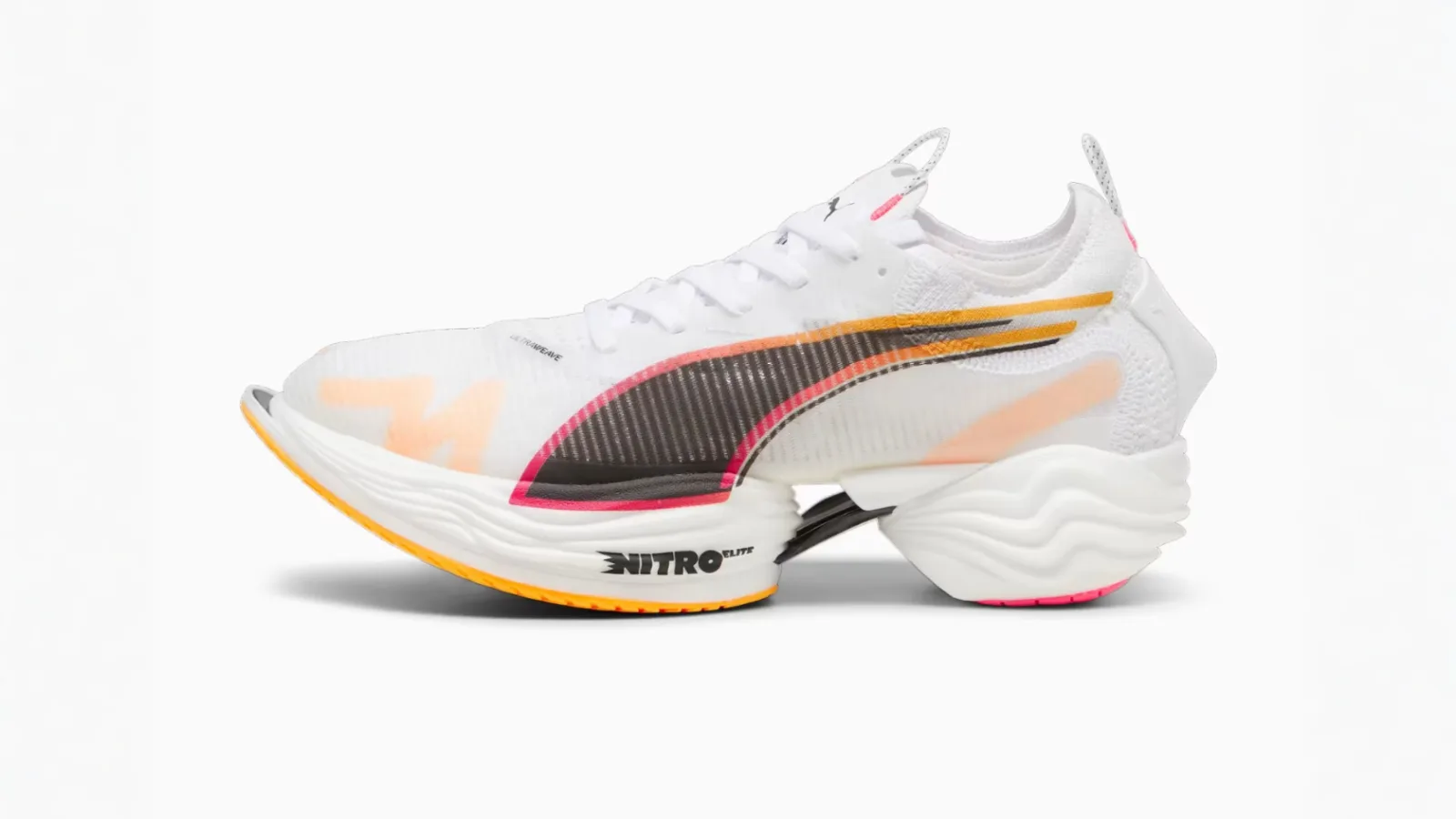
Spend €350 on a running shoe and you might reasonably expect to wear it in your next big race.
PUMA’s latest release comes with a catch.
The FAST RB NITRO Elite 2 launches on Wednesday October 28th, and PUMA explicitly describes it as not race legal. It also claims that internal testing makes this the most efficient shoe in its road running range.
That is an unusual sales pitch: a shoe built around speed, with a restriction that complicates one of the obvious reasons to buy it.
So who is it actually for?
What Has PUMA Built?
The most striking feature is a pair of fused carbon fibre plates, arranged in what PUMA describes as a springboard structure.
Around that sits NITROFOAM Elite cushioning. According to the UK product listing, a softer foam core is surrounded by a firmer layer. The shoe also features an ULTRAWEAVE upper and PUMAGRIP rubber outsole.
PUMA lists the men’s model at 250g in a UK size 8, with an 8mm drop. The UK price is £310, alongside the €350 launch price.
The design gives this release its talking point. For anyone interested in how far running footwear can be pushed, a shoe developed outside racing restrictions is an intriguing prospect.
For someone simply looking for their next reliable pair, the case is less straightforward.
What Does “Not Race Legal” Mean for Buyers?
The key point is that PUMA itself makes that declaration. This is not a shoe that has quietly attracted questions about its eligibility after launch.
Anyone considering it for a particular event should check the organiser’s footwear rules before buying. Permission to use it should not be assumed simply because it is sold as a running shoe, or because the buyer has no intention of troubling the podium.
For this preview, the sensible starting point is to consider its appeal for training and recreational running.
That changes the value question considerably. Would you spend this much on the experience of running in an unusual shoe, even if you needed a different pair for your target race?
The Performance Claim Needs Context
PUMA says its internal studies found improvements in running economy that make the FAST RB NITRO Elite 2 its most efficient road running shoe.
That is a manufacturer’s claim. The launch announcement does not provide a detailed testing protocol, participant breakdown or numerical improvement that would allow readers to assess it properly.
It certainly does not tell an individual runner how many seconds they will gain.
We have not tested the shoe. Its fit, stability, comfort and performance across different paces therefore remain open questions for a future review.
An impressive laboratory result would be interesting. So would knowing how the shoe behaves on a damp corner halfway through a club session.
There Is Also a Durability Question
PUMA’s launch announcement lists a product lifespan of 320km, or 200 miles. However, its UK product page gives an average distance figure of 150km.
Those figures do not agree, and the published information does not explain the difference.
Neither should be presented as a precise countdown to the shoe wearing out. However, buyers deserve a clearer indication of expected use when the asking price is €350.
Until PUMA clarifies the discrepancy, durability remains a question rather than a selling point.
So Who Is It For?
The clearest audience appears to be runners who enjoy trying unusual footwear and have the budget to buy a specialist pair for the experience.
There may also be appeal for someone curious about training in a design unconstrained by race approval. That is an interpretation of the product’s positioning, rather than a tested recommendation.
For the average club runner seeking good value across training and racing, it is harder to make the case. The price is substantial, race eligibility is restricted, and the durability information needs clarification.
PUMA has produced a shoe worth talking about. Proving it is worth buying is the next job.