Neil Rooney's legs are bolted together, and he mentions it about twenty minutes into the conversation, somewhere after the toenails and the magnesium gel.
The car accident was in 2005. He was wearing steel toe cap boots that day, and the toe caps came back into his feet and broke his toes. Both thighs went on the steering wheel. The legs were pinned, and they are still pinned.
Twenty years on, the hardware has started setting off the scanners at airports, which he travels through about one week in every four for work.
"These new security checks are picking them up now where they never ever picked them up before. So I'm getting good searches every time I go through the airport now."
In a fortnight he runs the Dublin Marathon.
Ten months ago he did not run at all.
A Glass of Wine and a LinkedIn Post
The decision got made at the dining room table over the Christmas break.
"We were sitting at the dining room table, myself and my wife, having a glass of wine, and we were just chitchatting. The thought of New Year's resolutions or whatever was coming up, and I said, jeez, I'd love to do something."
Neil is 44 and lives at Sheepbridge, just outside Newry in County Down. He is a mechanical engineer by trade. His wife Amy is a composer and doctor of music. They have two children, Juliet, who is 12, and Joe, who is nine.
Sport was a thing he did and then stopped doing, in the way it goes for a lot of people.
"I was GAA. Very low level, up until minor, probably minor football. And after that I learned how to play the guitar, and started chasing after a guitar instead of a football."
A couple of days after that conversation, a post came up looking for runners for Evora Hospice (formerly Newry Hospice). On LinkedIn, of all places, which he still finds funny.
"There you are," he said. "That's all set."
He had not run a step. He did not work up through a 5k or a 10k or a half first. He went straight at the marathon from a standing start, with ten months on the clock.
"Ten months out, Jesus, I should be fit to do it."
Ten Years
What sat behind it was his mother.
This year is the tenth anniversary of her death, and the anniversary fell the week before we spoke.
Her illness moved at a speed that still seems to trouble him more than anything else about it. She could not shake what she thought was a flu, and was otherwise feeling completely fine, so she went to the doctor.
It was breast cancer, and it had already spread.
She was 59. She was in the gym every day. She was minding Juliet, who was a baby at the time.
The prognosis was six months. She had five months.
"She had a very, very rapid illness."
Neil is honest about why it has taken a decade to do something like this, and the way he puts it is the truest thing in the interview.
"It has always been my intention to honour her. But in reality, it's probably taken ten years to get to that place where you could face it. Or get over it. Not over it. You know what I mean?"
The Hospice She Never Reached
At the end she was in hospital, and arrangements had been made to move her to the hospice in Newry for her final days.
She wanted a night or two at home first. So they brought her home, and that is where she died.
"So the hospice directly never really did anything for us. But the point is they were there ready to receive, ready to look after, ready to do whatever it took."
"She never actually made it to the hospice. But they were there for her, and I wanted to be there for everybody else."
He has thought about whether he picked the right cause, and he is straightforward about the reasoning.
"You could say I should be doing it for breast cancer, or I should be doing it for that. Breast cancer has a great ability to raise the money. So I said, I'll maybe focus on this side."
"It's a Funny Thing to Talk About How They Helped"
Ask Neil what the hospice actually does and he does something most people interviewed about charities will not do, which is admit the question is awkward.
"It's a funny thing to talk about how they helped, because there's only one way out of the hospice."
"It's very hard to measure the success of a hospice, by its nature."
What it does, in his reckoning, is take an unbearable job off a family and do it properly.
"It's just taking that burden off the family of watching somebody pass away in the house. Giving them a wee bit more comfort, more access to medicine, keeping them with their dignity."
He also makes a point about what it means to a town to have one at all, in a part of the country that has been watching services drain away. He mentions the talk about Daisy Hill in the same breath.
"Not every town has a hospice with dedicated nursing staff and medical staff. When you do have something like that, you don't want to lose it."
And he puts the scale of it in local terms.
"I don't think there's a family in County Down who doesn't have some family member who was in the hospice. Everybody has somebody who has had the benefit of it."
Twenty Years to Get to the Start Line
The accident is the part Neil almost does not mention, and it reframes everything around it.
"I got in a car accident in 2005, and I broke my legs, and I broke my toes. I was wearing steel toe cap boots at the time, and the two toe caps came back and broke my toes. My two thighs were broken on the steering wheel, so my legs were pinned."
Asked how long it took to trust those legs enough to go running on them, the answer comes without hesitation.
"Oh, it's twenty years. Twenty years really, to build up that courage. I never ever would have dreamt about doing something like this until this year."
His thirties went by in the way most people's do, with a career taking off and two small children in the house, and almost no exercise anywhere in it.
Everything He Did Not Know
The first run went exactly as you would expect.
"I completely unprepared, just went out in a pair of shorts and a pair of runners. Came back. My feet were destroyed. My legs were destroyed."
So he did what engineers do, which is go looking for the specification.
Correct shorts. Correct trainers. Proper socks. Nutrition the day before and on the morning. Hydration packs, gels, and crucially when to take them. He started following Ben Parkes on YouTube and bought a pair of his socks, which he now recommends to anybody who will stand still long enough.
And he learned the one nobody tells you, which is to cut your toenails before a long run. His toes are oddly shaped and bow in towards each other, so a nail left slightly too long will open up the toe beside it.
"Even down to the simplest things like cutting your toenails before a big run. These are things that I never knew or considered. There's an awful learning curve of literally how do you actually get the mechanics of a good run."
The only thing still giving him trouble is his shins, for which he uses a magnesium gel that he cheerfully suspects is a placebo.
Alone, on the Country Roads
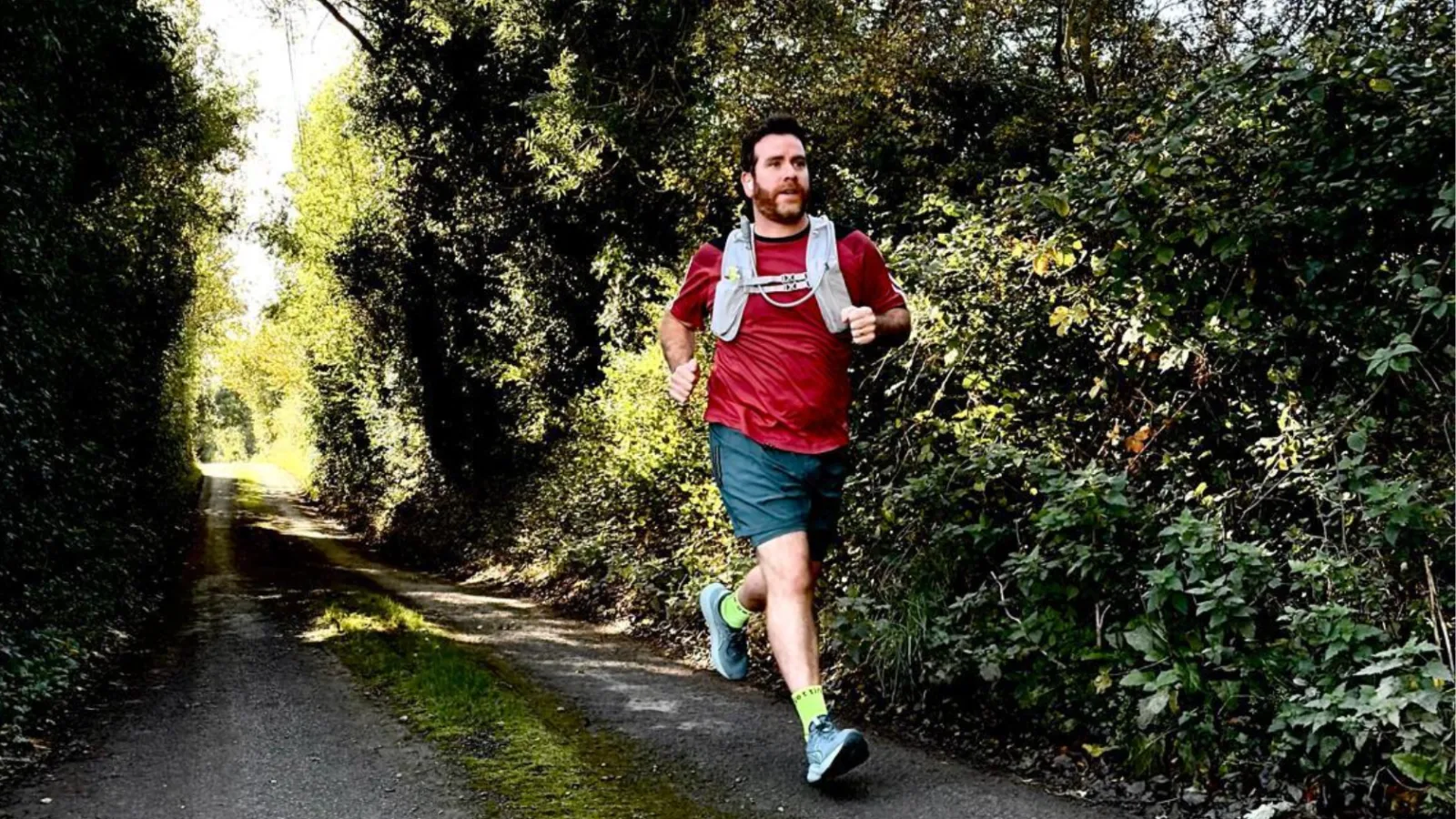
There is no club. Neil does all of it on his own.
He runs loops of the quiet country roads around Sheepbridge, where he can go the whole way round without meeting a car, or he heads up towards Loughbrickland to go part of the way round the lake and back.
He is not looking for company, and he knows exactly why.
"If I had to talk to somebody, I don't think I could run. I have to focus very much on my breathing."
The headphones go in for the first hour, to get him out to 10 kilometres. After that he takes them out and runs on the sound of whatever is around him.
A Plan Worked Backwards From One Number
There is no formal programme either. Somebody told Neil that 32 kilometres is as far as anybody needs to go in training, so he took that number, worked backwards from it, and that became the plan.
The week is a couple of 5ks and a long run.
The 5ks happen at five in the morning, a quick half hour before the shower and the car, which has worked fine all summer and is about to get considerably harder as the mornings go.
Friday is the big one. He works from home and finishes at one, and then he is geared up, fuelled up and out on the road for the afternoon.
On the days he does not run, he gets down on a mat and does lunges and squats and stretching and nothing more exciting than that.
"A couple of 5ks and a long run at the weekend. That's literally all I've done the whole time. And I'm not going to break any records. I'm not going to impress anybody. But to get that distance in is result enough for me."
The evenings are otherwise accounted for. Joe plays Gaelic football twice a week with Neil standing at the side of it, and there is soccer on top of that, where Neil trains a young team himself. Juliet has gymnastics. And Neil travels roughly a week a month with work, designing the tailored static installations for Astec, the American crushing and screening manufacturer that has recently set up in Ireland out of Omagh. Last week he was in Reims, the week before that it was Italy.
The travel is part of the job rather than a bolt-on. The static installations are the tailored end of the business rather than a machine off a shelf, which means going out to customers and standing in quarries working out how you would even get the equipment onto the site.
"It's more of a project than just a machinery sale. I'm there for that very tailored solution side of the business."
One of the quieter benefits of the year has nothing to do with the marathon at all.
"It's just the difference in me over the course of the year, running about, sprinting about with these kids, playing football. It's fantastic, and that's all coming off the back of the training."
From Crippled to a Warm Up
Neil ran the Newry half in May and could barely move afterwards.
"I remember after the Newry half, I was basically crippled for thirty six hours. My legs just completely seized up."
"And now a 21k is nothing."
He ran 30 kilometres the day before we spoke, with another 30 planned for the Sunday, and then the taper.
"I'm very proud of myself. I can run 30 kilometres now and not faint. And I can get up the next day and go to work. I'm at work now. No aches or pains. So ten months out, it has been transformational."
The before and after that he reaches for himself is the one every beginner will recognise.
"There's no feeling like setting a target and hitting it. I remember hitting my first 10k and going, freaking hell, I can't believe it. And now I do 10k as a warm up."
Dublin will be the longest run of his life by a clear ten kilometres.
He is aiming for 6:59 per kilometre, which he can hold comfortably, and anything under five hours will do him nicely.
With a fortnight to go he expected to be nervous and simply is not.
"I'm actually buzzing. I'm very, very excited to do it, just to get in amongst the crowd and hear people."
"Hopefully my name will be printed on my badge at the front. It's something like the Newry half, people egging you on."
That, more than the clock, is what he is going for.
The Money
Neil set out thinking £500 would be a stretch, and has gone well past what he expected.
His explanation for why is worth passing on to anybody sitting on a fundraising page they have not shared yet.
"When you tell people that you're doing something, you're pushing yourself out of your comfort zone, and it's for a very good cause, you find people are more than happy to dig deep."
Race Day, and a Pumpkin Patch
The family are travelling down the night before. They will see him off in the fourth wave, disappear for the day to find a cinema or something to fill the hours, and come back for the finish.
They are not staying Sunday night. There is a pumpkin patch booked for the Monday morning, and Neil likes Halloween.
What He'd Tell a Beginner
Neil's advice is practical and it is pitched as a minimum rather than an ideal, which is probably why it is useful.
Build in small increments.
"You're trying to go 10, 12, 14. You're not shocking the body too much. You're building up to it."
You do not have to be out every day.
"The days you aren't running, just try and get down on a mat, stretch the legs out, do some lunges and squats. Nothing crazy."
Get the gear right, because he learned that one the hard way on his first attempt. And accept that you will have to work out the mechanics for yourself, the nutrition and the hydration and when exactly to take a gel to get through the bad patch.
The First of Many
Asked what crossing the line will mean, Neil does not talk about the finish at all. He talks about the Friday after it, and the Friday after that.
"I actually want this to be my first marathon of many. I want to keep at it, because I want to keep my Friday routine and getting out for a good long run."
"If I didn't have that target, I don't think I'd have the same impetus."
Which, for a man who was told what his legs would and would not do twenty years ago, and who spent the following two decades believing it, is a reasonable place to have arrived.
You can support Neil's fundraising for the hospice in Newry ahead of the Dublin Marathon here.