Clinical Nurse Manager Antoinette Fenlon Carroll shares her journey through nursing, raising children with autism and ADHD, and the hidden emotional cost of masking, as she prepares to take on the Dublin Marathon for the Keith Duffy Foundation.
Antoinette Fenlon Carroll turned 50 in August. She has osteoarthritis, runs in two knee splints, and was told by the consultant who operated on her knee eighteen months ago that she would never run again. A knee replacement, she was advised, was what she really needed.
She has not mentioned the marathon to him.
“I just thought, no. I actually feel I can do this. It's a temporary fix. I know I'm running bone on bone, but you know what, there's worse out there.”
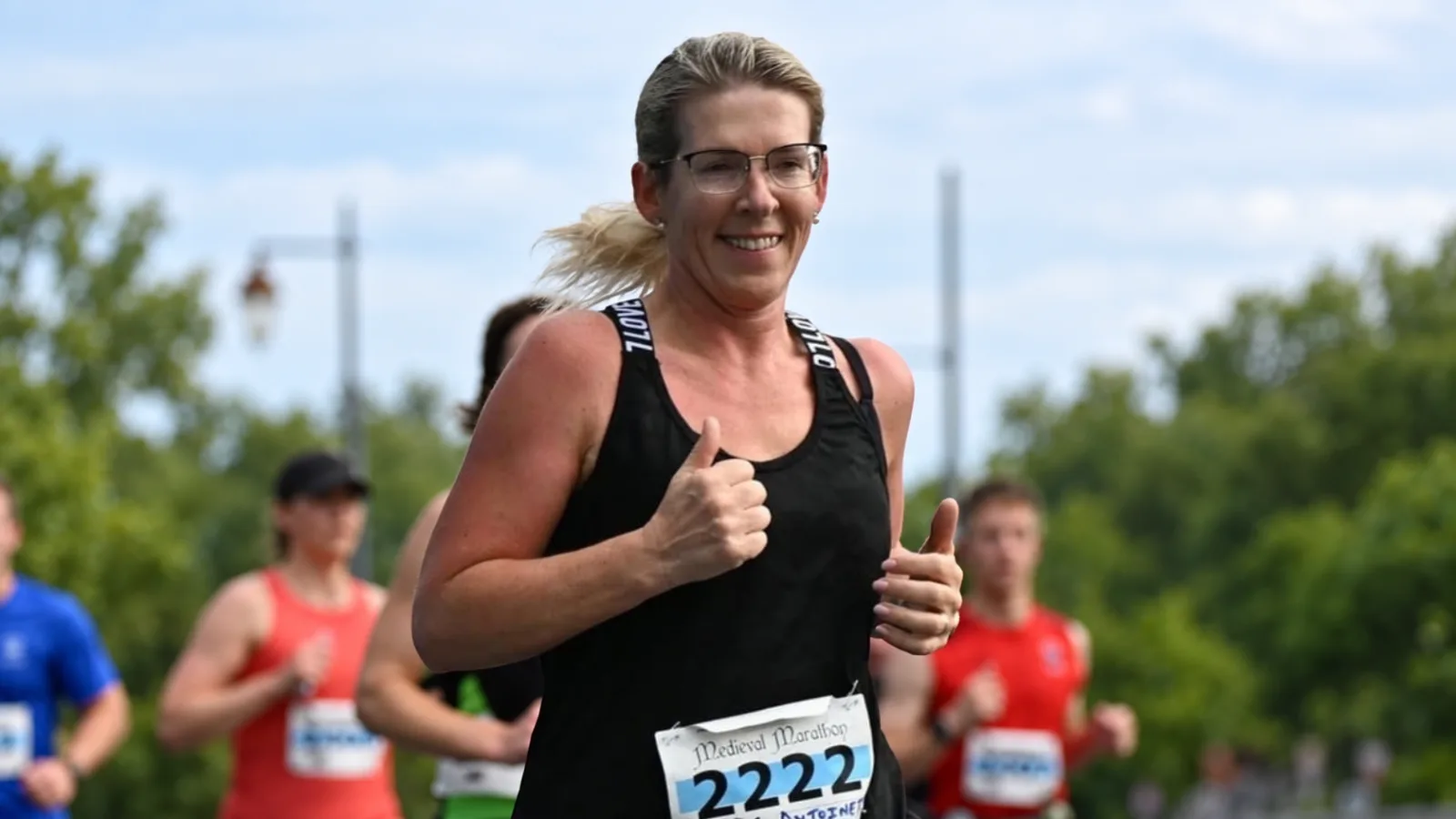
In October, Antoinette will take on her first Dublin Marathon alongside her husband, Joe, fundraising for the Keith Duffy Foundation. For her, however, this challenge is about much more than running 42 kilometres. It brings together her professional life as a nurse, her experiences as a mother of four, and her determination to raise awareness of autism, ADHD and the often invisible struggles that can lie beneath an outward appearance of coping.
When asked what she hopes people will take from her story, Antoinette returns to a simple idea.
“Starting the Couch to 5K, it's one small step at a time. And I think that's very similar to life for families like ours. You don't always know what the next day is going to bring you. You're pushing one foot in front of the other.”
A Career Dedicated to Recovery and Independence
Antoinette lives outside Ballybrittas in County Laois and works full-time as a Clinical Nurse Manager. Her nursing career spans more than two decades, with extensive experience in neurorehabilitation, brain injury, stroke and dementia care.
She spent ten years working in neurorehabilitation and brain injury rehabilitation in London before returning to Ireland, where she worked for fourteen years in stroke and dementia care at Naas General Hospital.
Three years ago, she took on the challenge of establishing a Transitional Care Unit in Abbeyleix for the Dublin Midlands hospital group. The service provides rehabilitation and recovery-focused care for patients who need additional support following illness, injury or a hospital admission before returning home.
For Antoinette, the philosophy behind the unit is about much more than medical care. Rehabilitation can be challenging and demanding for patients, many of whom arrive feeling vulnerable after a significant illness, injury or prolonged hospital admission. The goal is to support each person to regain their independence, dignity, confidence and quality of life, at a pace that is appropriate for them.
“One of the most rewarding parts of my job is seeing the progression patients make. They might arrive with us on a stretcher or in a wheelchair, feeling that they have a long road ahead of them, and gradually regain their strength, mobility and confidence. To see someone progress to walking out our door and returning home is just wonderful. It makes all the hard work worthwhile.”
An important part of the unit's philosophy is encouraging patients to have their meals in the dining room rather than at their bedside, whenever they are clinically able to do so. This simple but purposeful approach helps create a more social environment and encourages patients to become actively involved in their own recovery.
Coming together for meals provides opportunities for social interaction, reduces isolation and helps restore the everyday routines that can be lost during a hospital admission. Sitting out of bed and moving to the dining room can also encourage mobility, support the maintenance of functional ability and help patients rebuild confidence in their daily activities, with assistance where required.
For Antoinette, rehabilitation is not simply about treating an illness or helping someone become physically stronger. It is about encouraging people to participate in everyday life again, recognising their potential and supporting them towards the greatest possible level of independence.
The ultimate goal is to help patients return to their own homes, with the confidence and support they need to continue their recovery.
Over the first three years of the service, more than 1,000 patients passed through the unit. Antoinette reports that approximately 95 per cent returned to their own homes rather than moving into long-term care, with around 11,500 bed days released back to the hospital system.
She has also retained all members of her team since the unit opened.
One patient who remains particularly memorable was a former motorbike racer diagnosed with Guillain-Barré syndrome, who had been paralysed from the neck down. After four months of intensive rehabilitation, he walked out of the unit.
Another story came to Antoinette through a message from a family whose father had received care there. They sent her a photograph of him walking his daughter up the aisle.
“They said, this man was end of life before he came to you, and he managed to walk his daughter up the aisle.”
For Antoinette, moments like these demonstrate why rehabilitation matters. Recovery is not always measured simply by a clinical outcome. Sometimes it is measured by a person returning home, regaining independence or being able to take part in a moment they and their family thought might never happen.
Her professional life has taught her the importance of looking beyond a diagnosis or a person's immediate circumstances. At home, she has learned just how important that same principle can be in understanding neurodivergence.
Why the Keith Duffy Foundation?
Antoinette and Joe have four children. Two of their children are autistic and have ADHD, and the family has experienced the additional challenges associated with dyslexia, anxiety, sensory overload and emotional regulation.
Their decision to support the Keith Duffy Foundation is therefore deeply personal.
“It isn't just a cause I care about from a distance. I'm a mam, and I'm actually living this reality every day. I know the challenges, and I also know the joy, the love, and the incredible strength that our children have.”
When Antoinette began looking for an autism charity through which to participate in the Dublin Marathon, the Keith Duffy Foundation was the one she found with places available.
She knew that she wanted the marathon to mean something beyond the personal achievement of reaching the finish line.
For her, fundraising is an opportunity to help raise awareness, promote understanding and highlight the importance of recognising the needs of neurodivergent people and their families.
It is a message shaped by the experiences of her own children, particularly the impact of masking.
The Hidden Cost of Masking
Masking is a term used to describe the ways some neurodivergent people hide, suppress or compensate for aspects of their differences in order to meet social expectations or avoid being judged.
For an autistic person, this might mean copying the behaviour of peers, rehearsing conversations, suppressing natural behaviours or trying to appear comfortable in situations that feel overwhelming.
People with ADHD may also mask difficulties, for example by working hard to conceal problems with attention, organisation, impulsivity or emotional regulation. The experiences of autistic people and people with ADHD are not identical, and masking varies considerably from person to person. Some people experience both.
For those who mask, the effort can be exhausting. A person may appear calm, sociable, capable or successful to the outside world while experiencing significant anxiety, sensory overload or emotional distress internally.
As a Clinical Nurse Manager, Antoinette understands the importance of looking beyond what is immediately visible. As a mother of children with autism and ADHD, she has also experienced first-hand how easily a person's internal struggles can go unnoticed when they appear to be coping on the outside.
A person with ADHD may work hard to conceal difficulties with attention, organisation, impulsivity or emotional regulation, particularly in environments where they fear being judged or misunderstood. For some neurodivergent people, masking becomes a way of navigating school, work and social situations. However, maintaining that appearance can require considerable emotional and mental effort.
For Antoinette's son Dylan, masking became increasingly difficult to sustain during secondary school. Having managed to get through his first year, he reached a point in second year when the pressure became overwhelming.
“He was masking so well. And he did it brilliantly.”
On a morning soon after his fourteenth birthday, he sent his mother a message asking for help. What followed was a crisis that changed their family's lives.
“He said, ‘I just can't go in there anymore and try to be normal. I can't do it.’”
For Antoinette, those words revealed the extent of the distress that had remained hidden from the people around him.
His experience is why she wants greater awareness of the difference between how a person appears to be functioning and how they are actually feeling. A young person may attend school, complete tasks, socialise or seem outwardly successful while privately struggling with anxiety, exhaustion, sensory overload or the pressure to conform.
Masking does not inevitably lead to a mental health crisis, and every neurodivergent person's experience is different. But when distress remains hidden, the need for understanding and support may be missed.
Antoinette's message is not that neurodivergent people should have to work harder to fit into the world around them. It is that the world needs to become more understanding of them.
Children and adults should be able to communicate their needs, seek support and be accepted without feeling that they must conceal who they are to be valued or included.
The family sought help from their GP, who supported Dylan through a particularly difficult period. Antoinette recalls that the GP met with him three times a week for approximately. three months, giving him time to talk and reassurance that things could improve.
At 15, Dylan left school. It was a decision Antoinette had to defend, even to members of her own family.
“When I said I actually have to take my child out of school, my own parents said, you can't do that to him. And I went, no, I can. Because if I don't do it, he won't be here.”
It was an incredibly difficult decision, made at a time when her priority was her son's safety and wellbeing.
Today, Dylan is developing his career and building his own business. His journey is a reminder that a young person's future cannot always be measured by how well they fit into a conventional educational environment.
Antoinette is careful to recognise that every neurodivergent person's experience is different. Masking does not inevitably lead to a mental health crisis, but when a person's distress remains hidden, the opportunity to recognise their needs and offer support can be missed.
“Masking is dangerous. It's really, really dangerous.”
Her concern is that too many children and young people may be struggling without those around them realising the extent of what they are experiencing.
“There are lots of young lads and girls that don't make it. No one knows what that man or woman or child is suffering inside, if they're doing so well at masking.”
For Antoinette, the message is clear: appearing to cope does not necessarily mean that someone is coping well.
The responsibility should not rest solely on neurodivergent people to work harder at fitting in. Schools, workplaces, healthcare professionals, families and communities all have a role in creating environments where people can communicate their needs without fear of judgement.
Seeing the World Through Annabelle's Eyes
Antoinette's daughter Annabelle is 13, ASD and ADHD and lives with severe social anxiety and sensory overload.
For the family, school mornings can be particularly challenging. Preparation can begin at six o'clock, with up to two hours needed before Annabelle is regulated to leave the house. Some mornings, despite every effort, getting out the door is simply not possible.
Annabelle attends a school that better suits her needs, rather than the local school. The family undertakes an 80-kilometre round trip each day to make this possible.
This year, they finally secured a school transport place for her after a prolonged effort. Yet having transport available has not automatically made using it physically possible for Annabelle.
She is afraid that being seen getting on the bus will cause others to view her differently.
“Annabelle is very embarrassed by her disability.”
It is a difficult thing for any parent to hear their child say negative things about herself. Antoinette wants Annabelle to understand that being autistic is not something to be ashamed of, but she also recognises that reassurance alone cannot remove the anxiety or social pressures her daughter experiences.
One conversation has stayed with her.
Antoinette had told Annabelle that she could not see what was wrong with using the school transport, prompting her daughter to explain something that has since become central to her mother's understanding.
“She goes, no. Because you're not in my head, Mammy. You can't see it. You don't know.”
For Antoinette, those words are a reminder that another person's distress cannot always be understood simply by looking at them or comparing their experience with our own.
What may appear manageable to one person can feel overwhelming to another. What looks like refusal or embarrassment may be connected to anxiety, sensory overload or a fear of being judged.
Her experience has reinforced the importance of listening to children when they describe their own difficulties, even when those difficulties are not immediately apparent to the adults around them.
It has also highlighted how much energy families can expend trying to secure appropriate education, transport and support.
When Parents Feel They Must Mask Too
The impact of masking does not stop with the children.
Antoinette recognises that parents can also feel under pressure to conceal their own distress, particularly when they are trying to balance employment, family responsibilities and the practical challenges of securing support.
As a full-time Clinical Nurse Manager, she has professional responsibilities to her patients and staff. At home, there are school mornings, difficult conversations, anxiety, appointments and the continuing effort to make sure her children have what they need.
Once the immediate challenges have been managed, the expectation can be to carry on with the working day as though nothing has happened.
“You put on a brave face and walk into work pretending everything is fine, when in reality you might have had very little sleep and spent the morning trying to regulate a distressed child from six o’clock onwards. You take a deep breath, put a smile on your face, and get on with your day. And then you get her to school, and you carry on as though nothing has happened.”
It is a reality that many parents will recognise: the ability to continue functioning does not mean that the emotional strain has disappeared.
For Antoinette, greater awareness must mean more than understanding a diagnosis. It must include recognising the lived experience of neurodivergent individuals, listening to families and ensuring that people are not left to navigate complex support systems without adequate help.
Her message is not one of sympathy alone. It is a call for understanding, acceptance and practical support.
Children and adults should be able to ask for help without feeling that they must hide their difficulties. Families should not have to reach crisis point before their concerns are taken seriously.
And a person should never have to pretend to be someone else in order to feel accepted.
Finding Something for Herself Through Running
Running entered Antoinette's life just over three years ago, when she decided to try Couch to 5K.
At the time, she felt she needed to get out of the house and find something that belonged to her, away from the constant demands of work and family life.
She had no idea where it would lead.
Now, running has become part of family life. Joe took it up around two and a half years ago after Antoinette encouraged him to give it a go. Their eldest daughter, Claudia, is also doing Couch to 5K while training in Templemore for An Garda Síochána.
Friends have joined them along the way, and Antoinette has found a community through her local running group and Vicarstown parkrun.
Her usual running route takes her along the canal near Vicarstown, approximately eight kilometres from home.
She joined parkrun two and a half years ago and says it opened up a social world that she had not previously experienced.
“Our life was kids, kids, kids, work, kids, work, kids, paying bills. And now it's, oh no, I'm going for a run. Oh no, we're going to Vicarstown on Saturday morning. There'll be a group of us down there. We'll go for a coffee afterwards.”
For Antoinette, the benefits have extended beyond fitness. Running has given her time to herself, a sense of achievement and friendships that have become an important part of her life.
It has also shown her what can happen when people take things one step at a time.
Three years ago, running five kilometres was a challenge. The idea of completing a marathon would have seemed far removed from her everyday reality. Now, she is preparing to take on 42 kilometres.
The Road to Dublin Has Not Been Straightforward
The journey towards the Dublin Marathon has presented its own challenges.
A car crash before the Limerick Half Marathon left Antoinette with three bulging discs. Achilles tendonitis subsequently kept her from running for approximately ten weeks, followed by a lengthy period of physiotherapy before she could return.
Her training has therefore required patience, adjustment and a willingness to work around setbacks.
She has been building her running alongside strength and conditioning sessions and Pilates, while continuing to work full-time.
Her longest run so far has been 25 kilometres, completed in two knee splints.
She knows that the marathon will be a significant physical challenge, particularly given her osteoarthritis and previous injuries. Nevertheless, she is determined to reach the start line prepared to give it her best.
Joe could run considerably faster than Antoinette, but he intends to run alongside her at her pace.
For him, the significance of the day goes beyond a finishing time. It is an opportunity to support his wife and the cause that matters so much to their family.
Antoinette is aiming for approximately four hours and thirty minutes, with the goal of finishing within five hours.
Her approach to the challenge reflects the lesson she first learned through Couch to 5K: progress is not always quick, and the journey rarely goes exactly to plan. Sometimes, the important thing is simply to keep moving forward.
From the Finish Line to the Start Line
The decision to enter the Dublin Marathon came after Antoinette volunteered at the RDS last year giving the runners out their DCM goodie bags after collecting their numbers for the marathon.
Among them was a large group running for the Keith Duffy Foundation, wearing their distinctive yellow shirts.
She remembers watching people of different ages and abilities cross the finish line and feeling inspired.
“I saw people of all ages, sizes, abilities, disabilities, and I just thought, Jesus Christ, if they can do this, I can do it.”
That moment helped turn an idea into a commitment.
This October, she will move from volunteering at the finish line to standing on the start line herself, with Joe beside her.
The marathon represents a personal challenge, but it also gives her an opportunity to raise funds and awareness for a cause that is part of her family's everyday life.
She hopes people who read her story will think differently about what they see when they look at a child, a colleague, a patient or a stranger.
Someone who appears confident may be struggling. Someone who seems to be coping may be expending enormous energy to get through the day. A family that looks as though it is managing may be working tirelessly behind the scenes to secure the support its children need.
Understanding begins when we stop assuming that what we see tells us everything we need to know.
One Small Step at a Time
Antoinette's advice to anyone considering running is straightforward: start where you are, do what you can and do not measure your progress against somebody else's.
“It doesn't matter how fast you go. Parkrun is still 5k however you do it.”
For her, the people are just as important as the running itself. The friendships, the shared experiences and the coffee afterwards have become part of the reward.
The same principle, she believes, applies to families navigating neurodivergence. There is no single path that works for everyone, and progress may involve difficult decisions, unexpected setbacks and a great deal of patience.
What matters is that people are supported along the way.
Antoinette began running because she needed something for herself. She is now preparing to take on a marathon while raising awareness of an issue that has shaped her family's life and her understanding of the importance of looking beyond appearances.
She has spent much of her nursing career helping people recover, regain independence and move towards a life that is meaningful to them. As a mother, she has learned that supporting a person also means listening to what they cannot always express and recognising distress that may not be visible.
Her hope is that greater understanding of autism, ADHD and masking will help more people feel seen, heard and accepted.
Beyond the Mask
At the beginning of the interview, Antoinette admitted that she was not someone who usually did interviews. By the end, she had spent the best part of an hour and a half talking about her work, her children, running and the realities of family life.
Reflecting on the experience, she said:
“I wasn't expecting it to pull at the heartstrings as it has done. But on reflection, that is the reality of our lives. Like everybody, we put on this lovely smiley face that we're all okay. But actually inside, we're hurt. We're struggling.”
It is a powerful reflection on the difference between what people see and what they may never know.
For Antoinette, the Dublin Marathon is an opportunity to turn that understanding into action: to raise funds for the Keith Duffy Foundation, to encourage greater acceptance of neurodivergent people and to remind families facing similar challenges that they are not alone.
In October, she will stand on the start line with Joe, ready to take on the distance she once could not have imagined running.
It will be a journey measured in kilometres, but its meaning reaches much further.
One step at a time. Beyond the mask.
Support Antoinette's fundraising for the Keith Duffy Foundation ahead of the Dublin Marathon:
https://eventmaster.ie/fundraising/pages/AF60362057
If you or someone you know is struggling, Samaritans can be contacted free, 24 hours a day, on 116 123. Pieta can be contacted on 1800 247 247 or by texting HELP to 51444. Text About It is available by texting HELLO to 50808.