Maria Dempsey was 18 and halfway through a recreation management course when she was diagnosed with psoriatic arthritis and told she would never play sport again.
On the last Sunday in October she will run the Dublin Marathon.
The two facts are not unrelated. If you want a single sentence that explains the twenty years in between, Maria supplies it herself.
"Tell me I can't do it, and I'll try and see how hard I can push it."
She is running for South Tipperary Hospice, and she is running for her mother.
Two for the Price of One
Maria explains her condition with the gallows humour of somebody who has been living with it a long time.
"Psoriatic arthritis. Psoriasis and arthritis combined. So there are two autoimmune diseases. You get two for the price of one."
The diagnosis came in the middle of a course that was supposed to lead to a career in sport, which it duly did for a few years. She worked in leisure centres and ran her own fitness classes, until her body made that impossible and she had to give it up.
The medication took a long time to get right. There was trial and error, there were flare ups, and there were her parents driving her to appointments and doing whatever needed doing.
The turn came when she finished college and changed rheumatologist. First an infusion up in Dublin, a full day of it every eight weeks. Then self injections, which she still takes.
She has not had a flare up in nine years.
"I went into remission nine years ago. And ever since, every year, I've been kind of pushing and pushing and seeing, what else can I take off that bucket list? What else can I do? How hard can I push myself?"
She also understands the mechanics of her own condition well enough to have built her training around it.
"It affects your tendons more than the joints itself. So if you can keep the muscles strong, you'll actually protect the joints."
So she keeps them strong. The gym three or four times a week, reformer pilates a couple of times a week, and a serious amount of walking.
"I'm a bit of an addict when it comes to exercise."
She is not boasting when she says that. She is explaining.
"I've always been into sports, and I actually studied recreation management. But in the middle of my course I got diagnosed and was told I'd never play sports again. So I suppose that's why I'm probably so much of a fanatic."
What It Took to Get Here
It is worth pausing on what the years between the diagnosis and the remission actually looked like, because Maria moves through them quickly when she talks.
There was a career she had trained for and had to let go of. There were the years of trying one medication and then another, waiting to see whether this one would be the one that worked. There were flare ups in between. And there were her parents, driving her to appointments and doing whatever needed doing, for as long as it took.
The change came after college, when she switched rheumatologist and finally landed on something that held.
That is the context for the exercise, and for the bucket list, and for a woman in her late thirties deciding that a marathon is a reasonable thing to attempt.
The One She Circled for Years
Running was the thing Maria kept coming back to and kept not committing to.
She had always liked it. She had dipped in and out of it for years, mostly on a treadmill, and she had a half marathon in the diary before COVID arrived and took the point out of it.
What held her back was the impact. Roads are hard, and hard surfaces meant the risk of a flare up, or at least the fear of one.
She is also, by her own description, not somebody who finds moderation easy, which is part of why the roads took so long to talk herself into.
What she got out of running, though, was never really about fitness.
"I've always found it helps my head, just clears it. It's the only way I deal with stress. I like to just push myself and forget the stress."
After two good years of remission she decided to give the roads a proper go.
The Pact in the Pub
The marathon itself came out of a conversation between two sisters.
"Two years ago, myself and my sister were sitting in the pub having the chats, and she said to me that she had a goal before her forty fifth. And I said to her, well, I have a goal before my fortieth."
Her sister's goal was unfinished business. Back in 2015 the pair of them had attempted a 50 mile walking challenge together and got as far as 38 miles before it stopped. She wanted to go back and do it properly.
Maria had already completed that route herself in 2019, with her boyfriend. She agreed anyway, on one condition.
"I said, my other goal is a marathon. She goes, right. We'll do the two."
"So we shook on it, and we did the 50 mile walk."
That was last year. Then last October, Maria started hitting the roads properly, and the year since has gone the John Treacy 10 Mile in Dungarvan, a half marathon in Wexford, and then her first full marathon in Waterford.
Somewhere in the middle of the Waterford block, a colleague sent her a link for a Dublin place with South Tipperary Hospice.
"I'm easily swayed when it comes to a challenge. But I suppose when she sent it to me, she knew why she was sending it to me."
Her Mother
Maria's mother was diagnosed with cancer in early July 2013 and died in mid September. The family were told there was no treatment.
Maria is the youngest of six, with fourteen years between her and the eldest. One of her brothers was living in Trinidad at the time.
"When mam got sick, it was all hands on deck. Everyone came home."
There was a second front to it as well. While all of that was going on, her father's mother was in hospital with a heart condition, so the family were stretched across two sides at once.
There is one part of this the family decided between them, and Maria is clear-eyed about it.
"We actually hid it from her that she had cancer. A stroke or cancer was one of the two things she said to us she never wanted to happen. So when she got diagnosed, we told her she had a stomach ulcer, because they told us there was no treatment."
They told her she would be grand, and that she would get home.
"But I think deep down, she knew. And within the last week, she asked us why she's still sick, and she wanted to talk to dad."
They could not keep it from her after that.
Maria does not present the decision as the right one or the wrong one. What she says is what it bought them.
"It gave us the chance to be upbeat. We got to see her have some very happy moments. We got to sit and watch movies with her. We got to dance around the sitting room while she danced in the bed."
What the Hospice Actually Did
This is the part of Maria's story that should be read by anybody who has ever wondered what a hospice charity does with the money, because she draws the line precisely.
The hospital supplied the bed and the commode.
"In order for hospice to come in, it was the morphine drip. It was the night nurses. They provide all that for you."
"And I know myself that they provide drivers to bring people to treatment if they need it. There are volunteer drivers there. Hospice pay for all of that."
What that meant in practice was that her mother got to be at home for her last weeks, and that the family got to be there with her.
"They offered my mam the opportunity to spend her last few weeks at home. They offered us as a family the time to be together."
It also meant Maria got to sleep.
She was living at home with her father at the time, and before the night nurses started coming she was spending her nights listening.
"I was kind of waiting. Always on edge."
Then the nurses arrived, and something lifted.
"When the night nurse was there, it wasn't that you'd fully relax, but you knew she's in good hands. I can relax a little. I won't have to get up and maybe ring the care doc or ring the ambulance."
And then there is the detail that makes the case better than any brochure could.
The night nurse arrived just as her mother died.
"They didn't just walk away. They stayed with us. They consoled us. They helped make us a cup of tea. They were just a comfort. They went above and beyond for us."
That, for Maria, is the bit people miss about what the money buys.
"They just go above and beyond for people. And not just the people. It's the families."
Which is the whole reason she is doing this.
"For me, it's really important to give another family that opportunity, that time with their loved one. If I can raise any money to help anyone get through this, I'm willing to do it."
The Hard Part
Maria is close to €900 against a target of €1,200, with a few family members still to come good, and she is entirely honest about how much she dislikes this bit.
"Oh, we hate it. It's been tough."
Part of the problem is that she did a fundraiser last year as well, and going back to the same people twelve months later does not sit easily with her.
"I find it hard year on year to ask people again. It has warmed my heart, people giving. But at the same time, I know times are tough for people."
It has not been helped by the fact that the easiest route was closed off. An all staff email where she works was not an option this year, so the appeal went on the intranet instead, which far fewer people read. Last year, when the people around her knew about it, they gave generously.
So it has mostly been social media, and asking, and asking again.
She is hopeful of getting there.
"I still have a few people to give to me, close family and stuff. So I'm very hopeful that I'll get near it and raise as much as I can for them."
Five in the Morning, on Her Own
Maria trains entirely alone. No club, no group, no training partner.
"I get up at five in the morning every morning, and I go for my runs before work. I do all my gym and everything before work. I've always trained on my own."
In the spring and summer she uses the blueway along the Suir, out from Clonmel towards Carrick, running beside the river and meeting walkers and cyclists and nobody else.
There are no lights on it. So once the mornings go dark, she drives into Clonmel instead and does laps of the town, which she does not particularly enjoy, and which she does anyway.
The block itself has been imperfect, and she is relaxed about saying so.
She was out sick in August and missed the Clonmel half marathon, too wiped out to run it. Then a niggle in her hip meant her longest run topped out at 29 kilometres instead of the 33 she had planned. The physio told her it was a niggle rather than an injury, to rest it for a week and to drop the load.
"I wasn't happy about it. But we got over it. We're back. We're flying it again."
The thing that is going better than last time is fuelling. She has her gels sorted, she knows what she is eating, and she is not standing on a start line guessing at what 42 kilometres does to a person.
The weather is helping too. Waterford was warm, and she had trained through the heat for it. She is enjoying the cold.
She is hoping for somewhere between five hours and five and a half.
"I know I'm a slow runner, and I'm just happy to keep the pace and just keep plodding."
Anything quicker than Waterford and she will take it. She had a run done the morning we spoke and 14 kilometres lined up for the Saturday, and after that it is just a matter of getting to the start line in one piece.
Gary Finds Out
Maria's partner Gary is coming up for the race, along with two sisters, a niece and a nephew. They have an apartment off Leeson Street, up on the Saturday and home on the Monday. She does not drink, so the celebration is a long sit down somewhere.
Gary, in fairness to him, found out about the marathon in stages.
Maria was over at the athletics in Birmingham when she signed up, and she handled the news in a manner many partners will recognise.
"I texted him and I said, do you fancy a weekend away in Dublin in October?"
He said yes, whatever you want to do.
She told him the rest when she got home.
"He did kill me when I signed up to Dublin, because of the text he got."
"Nothing Is Impossible"
Maria's advice for anybody thinking about a first marathon is short, and it carries more weight from her than it would from most people.
"Just go enjoy it. Don't be afraid of it. Nothing is impossible."
"I suppose we face things every day that we think are impossible, and we do it. So just keep going no matter what the pace. Just keep going and just put one foot in front of the other."
And the one thing she wishes somebody had warned her about before she started, which she delivers as a complaint rather than a compliment.
"That it's addictive."
"If someone had warned me of that, I'd be like, maybe don't do it."
Doing It for Her
Maria has run a marathon before, in Waterford, and she expects this one to feel like something else entirely.
"This one will mean a bit more."
She is doing it in her mother's memory, for the charity that let her mother come home, and her reason for it is as plain as everything else she says.
"She always believed in me. So I just want to go there and give my all for her."
You can support Maria's fundraising for South Tipperary Hospice ahead of the Dublin Marathon here.
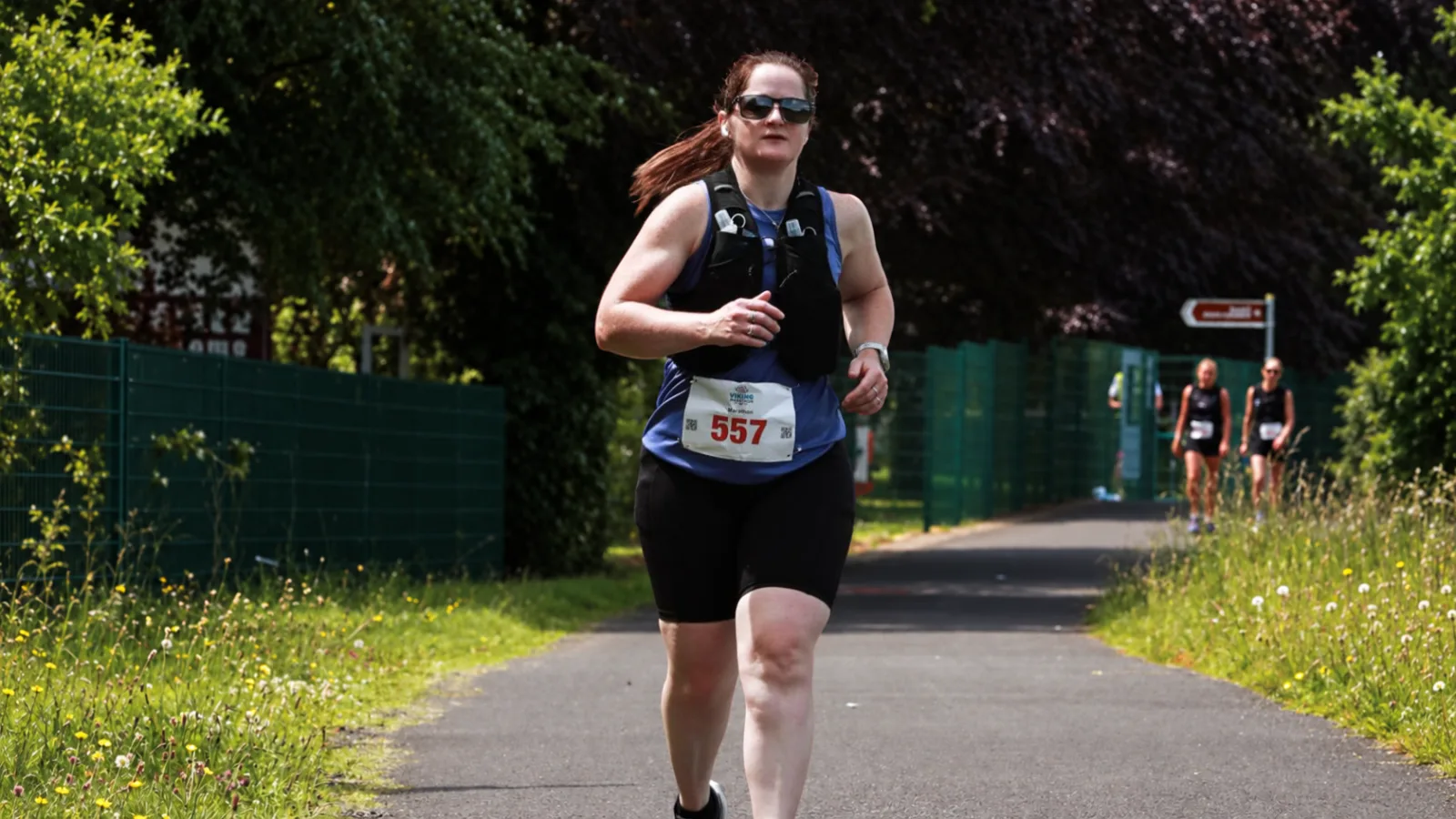
Image: myrunphotos.ie