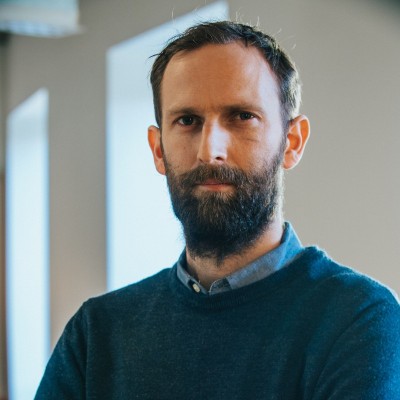
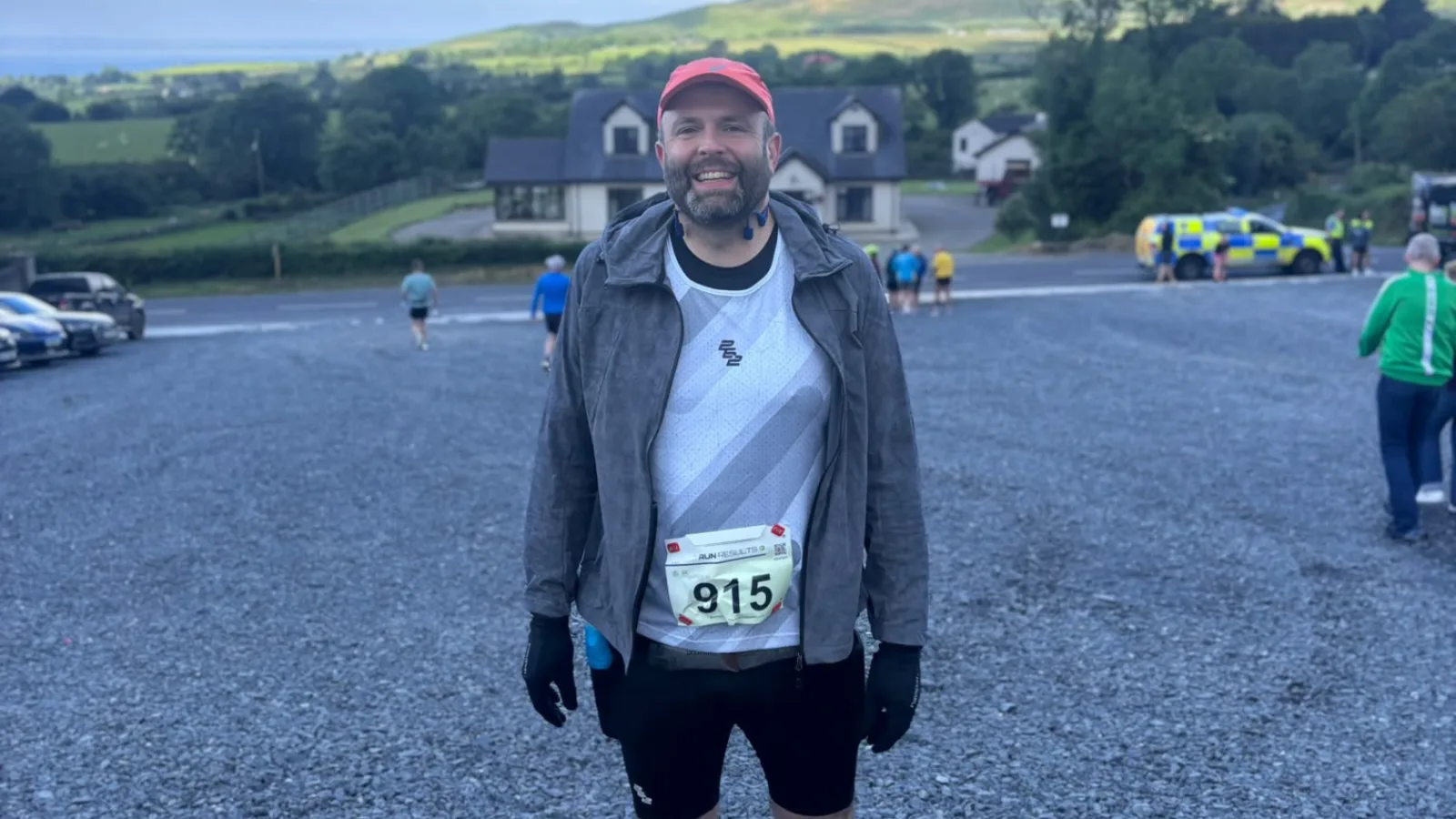
Last year Kieran Anderson ran the Edinburgh Marathon and cramped so badly he hobbled the last stretch, crossing in five hours and twenty odd minutes with his wife waiting three hours at the finish line.
This year he has a coach, a fuelling plan he's actually tested, and a personal best from more than a decade ago that he intends to take down. Dublin will be his first time on that course, and he's running it for the Keith Duffy Foundation.
Portadown, Two Boys, and a Job That Gets Him Home
Kieran is from Portadown and has lived there most of his life. He and his wife bought their house nearly ten years ago and they have two sons.
The job change tells you most of what you need to know about how the household runs. He moved into a role with set hours specifically so the week would stop shifting under him.
"There's no change in my hours, so I know what I'm working every week."
Which means he's home for bedtime, which was the whole point.
The School
Both of Kieran's boys attend a special school in Lurgan, and getting there was not straightforward.
The eldest started off in mainstream, and Kieran does not soften how that went.
"It was a total nightmare. We had about five weeks of it and it was just an absolute nightmare."
Then a unit opened up nearby and everything changed.
"Since then it's just been a dream."
He measures the whole thing by one very simple standard, and it's the standard most parents would recognise instantly.
"They go in happy and they come home happy. That's all you ask for."
He's watched the staff work and he's clear that the ceiling on what they can do is set by what they've got.
"The staff at that school are brilliant, and we're both learning what the boys are capable of. The more resources they have, the more they can help the children. That's going to have a direct impact on their lives in the future."
Why the Keith Duffy Foundation
Kieran had originally picked a different charity, and then reconsidered.
"I found it wasn't very relatable to my life and my situation."
So he went and researched the Keith Duffy Foundation properly, and what stood out was that they work directly with schools and organisations rather than only at arm's length.
"I thought that's a more relatable charity to my life. Using them, I'd be able to have a more direct impact on the school."
There is another personal connection too. Two years ago, Kieran received a private autism diagnosis himself. He says it helped him greatly, with many things in his life, particularly socially, beginning to make sense. His wife was incredibly supportive throughout, and the experience has made doing something like this even more meaningful for him.
He was struck too by the story behind the Foundation and how much harder that kind of support was to come by not so long ago.
"Help was hard to come by. They're small, but they're doing a lot of good work."
The school itself is small, and expanding, which makes the arithmetic on any funding fairly stark and fairly motivating.
This isn't his first go at it either. He raised money for the school off his own bat last year around Edinburgh. Right now, alongside the training, he's chasing down raffle prizes to push past his target.
His advice on choosing a cause is worth passing on to anyone weighing up a charity place.
"If you can find a charity that relates to you and you can get behind that cause, it gives you a bit more passion."
Australia, a Farm, and a Running Club
Kieran played football at school and then did essentially nothing for the whole of his twenties.
During that time, he graduated from the University of Ulster at Coleraine with a management degree. The only sport he played was eight ball pool. He also spent two months travelling around Europe with his wee brother, taking in 13 countries. Somehow, they did not fall out once.
Running was something he found while he was travelling in Australia, of all places. He started going out on the roads, entered a few races, and ended up doing his first half marathon on the Great Ocean Road.
The trip itself was a proper one. Sydney, then the Gold Coast, then up the east coast with his sister when she came out for four weeks, all the way to Uluru. New Zealand after that, then Thailand and Cambodia, about two years in total.
Part of it involved working on a farm, which is a visa requirement rather than a lifestyle choice, though he took to it more than he expected.
"I enjoyed working outdoors. Tomato farm, and a kiwi farm as well. Getting out in the good weather."
He also came home with a permanently altered sense of what constitutes cold.
"I was thinking 25 degrees is cold."
An injury put running on the back burner not long after. What brought it back was a friend taking it up, which led Kieran to join a club. He met his wife there.
Then a lot of years passed, and it's only relatively recently that he's picked it up seriously again.
Edinburgh, and the Problem With the App
For Edinburgh, Kieran used one of the AI-driven training apps that a lot of runners have defaulted to. He got through the block. Then his legs went at the wrong end of the race.
Looking back, the block itself was the issue, and his critique of it is one of the sharpest things in this series.
"I just didn't enjoy using the AI programme. It was very restrictive and didn't allow for life, for things happening in your week."
You could shuffle the easy running around, but the hard sessions were rigid, and the feedback loop was punishing rather than useful.
"If you didn't hit your paces in a speed session, it would automatically adjust. It was like, you're too slow, you need to adjust your paces."
Worse, he never understood what any given session was actually for.
"There was no real purpose behind them. You were just doing them for the sake of it, ticking off the miles or the kilometres. Making the quota. You almost just trained for the sake of it."
What a Coach Changed
This time Kieran is working with a coach who writes his plan week to week, and the difference is not subtle.
"Having a proper plan every week has allowed me to see the progression, which I definitely have."
He has the receipts, too, which is exactly the kind of evidence a runner needs when the motivation dips.
He does the same run every Monday. He compared it four weeks apart, run at the same easy effort with his heart rate in the same place, and it came out twelve minutes faster.
The threshold work is telling the same story. The blocks are getting longer and the paces inside them are getting quicker.
"I'm starting to really see my fitness and my speed improve. I didn't see that at all before."
The Hill Marathon in June
There was a B race in the middle of all this, and it sounds punishing.
Roughly 540 metres of elevation across two laps, with five or six miles of continuous climb that he then had to go back and do again. Other events were running alongside it, but they started after the first lap, so his opening loop was largely a solo effort.
"There was nobody around. Very few people out on the course with you. The hills were absolutely brutal."
He ran about 4:20, which took over an hour off Edinburgh, on a far harder course. It also means Dublin holds no fear on the crowd front.
"I'm well used to not having people."
Fuelling, Properly This Time
Kieran has an iron stomach, which he knows is luck rather than skill.
"I can take most gels. I don't get any sort of reaction."
The change he's made is timing. He used to leave it too late, so now the fuel goes in earlier and more regularly, roughly every three miles or so, which for him works out around every 25 minutes. He's added a carbohydrate drink with electrolytes on top, and he's rehearsing the whole strategy in training rather than trusting it on the day.
Which is a long way from where he started.
"On my first few marathons I didn't take any fuel or any gels at all."
Dublin
Kieran's personal best is somewhere around 3:43, and he set it over ten years ago.
That marathon PB is the second part of a two race plan. First, he will try to beat the half marathon best he set in March 2016 when he races in Herne Bay on 13 September. Then comes Dublin.
He went into Edinburgh with big goals and they didn't come off, so this time the framing is different.
"I want to prove to myself that I am a good runner. I'm doing this for a good cause."
The first job is getting comfortably back under four hours. The bigger one is the decade old PB, and he knows what it would mean.
"I think I'll be quite emotional if I do get the goal."
Either way, he isn't planning on stopping there.
"The hard work continues after. I'm not going to stop running. There's a lot more in me."
His longer term dream is to complete all of the World Marathon Majors, ideally while raising money for a charity such as the Keith Duffy Foundation.
What He'd Tell a First Timer
Two things, and the first one comes with a caveat about himself.
"Don't do what I did."
Fuel, in other words. Take something. Practise it beforehand.
The second is about where your head goes on the day, and it's the one he clearly wishes he'd heard earlier.
"Enjoy the experience and soak it up. Every bit of it. Not many people run a marathon. I don't think I enjoyed my first few. I got too focused on the time."
And the thing he most wants said to anyone starting out, having watched people do the opposite in club WhatsApp groups all over the country.
"Don't worry about anybody else's time or the kit they're wearing. People are always comparing themselves to other people, how fast they are. Focus on yourself and your own journey. Everybody starts in the same position. You start from zero. Everybody's going on a different path."
You can support Kieran's fundraising for the Keith Duffy Foundation ahead of the Dublin Marathon here.