Nutty Corner · Published 40 days ago on 10 Sept 2026
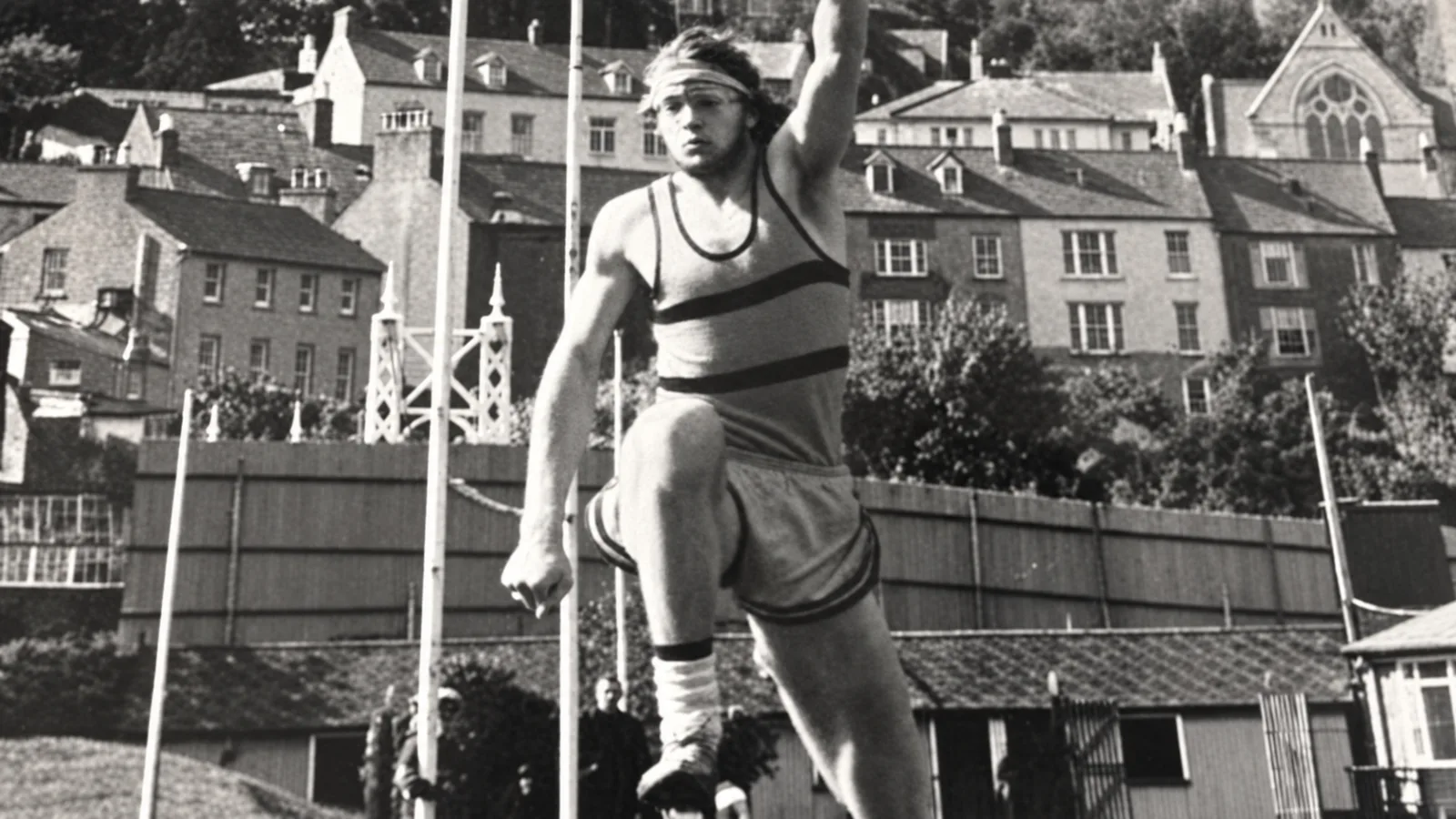
Cover photo: Irish Triple Jump record holder Colm Cronin in action
By: Martin Nutty
The first in a series on Ireland's complicated, hundred-year relationship with the Triple Jump.
On June 26th next year, Colm Cronin’s Irish Outdoor Triple Jump record of 15.89 will have stood unbroken for 50 years. On March 10th, 2028, Cronin’s superior Indoor mark of 16.27 will also reach the half century mark. The smart money says both are all but certain to occur. Those interested in the health of Irish athletics need to ask, can a 60th anniversary be avoided?
While the duration of Cronin’s records might seem remarkable to readers accustomed to relentless improvement in the world of sports, the longevity of these records pales in comparison to that of Peter O’Connor’s Irish Long Jump record of 7.61 meters. O’Connor’s mark set in Ballsbridge, Dublin on August 5th, 1901, remained a world record for a shade under 20 years. Perhaps more remarkably, it stood as the Irish standard for the event for 88 years until decathlete Carlos O’Connell surpassed the mark by 2 centimeters on June 2nd, 1990. In case you're wondering, O'Connor's national record durability is not a global leader: Silvio Cator's 1928 Haitian Long Jump record of 7.93 meters is still unsurpassed.
The longevity of Cronin’s Triple Jump marks, and O’Connor’s record, speaks to the struggles of Irish field events which have failed to keep pace with the recent surging success of their counterpart events on the track. It begs the question, what would it take to produce matching outcomes?
This is the first in a series of articles where I’ll explore what it would take to produce world class field event athletes in Ireland. I’m going to focus specifically on the Triple Jump which I’ve come to understand as the most Irish of events that make up the athletics canon. That might surprise some, but let’s start with some history.
Where Irish Triple Jumping Started
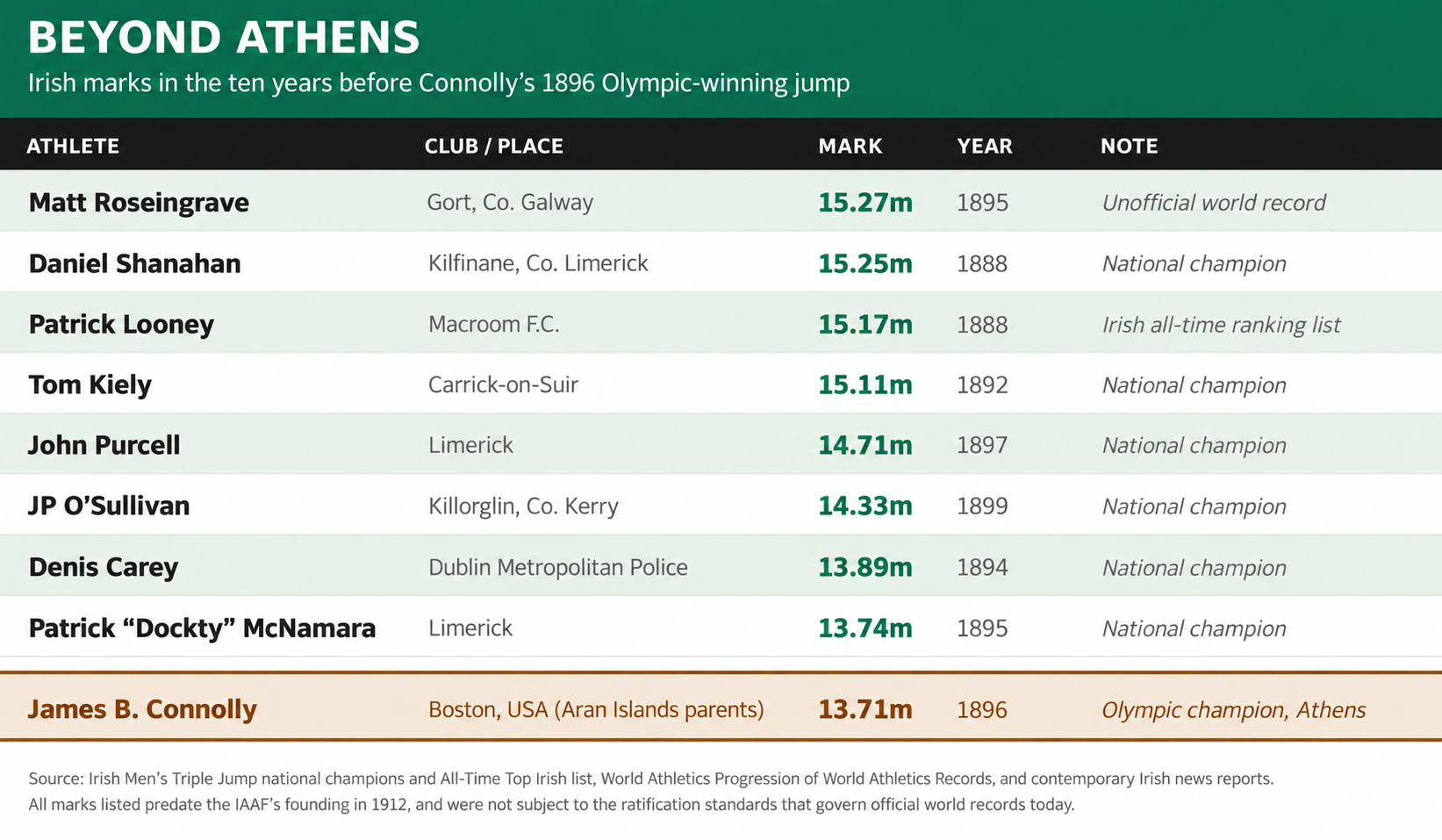
In Athens, on Monday, April 6th, 1896, James Brendan Connolly was crowned the first Olympic champion in more than 1,500 years. The Boston born Connolly received a silver medal for his winning 13.71m effort. Gold medals did not become the standard metal of choice for first place until the 1904 St Louis games. While Connolly might have been American born, his name points to Irish origins. His father John and mother Ann, neé O’Donnell, emigrated to South Boston from the Aran Islands and it’s likely Brendan heard Irish spoken around his family table.
While Connolly won by more than a meter on that Spring Day in Athens, his performance had been exceeded by more than half a dozen Irishmen in the ten years leading up to his win. In truth, Ireland was a hot bed of triple jumping at the time. I’ll explore that history in more detail in a later article, but for now, the table below makes the case that Ireland was producing an inordinate amount of Triple Jump talent at the end of the 19th century.
Where Irish Triple Jumping Stands
While history points to a proud Irish tradition in the Triple Jump, current performance in the event struggles to match the marks of more than a century ago. If the event is to be brought up to an international level, analysis must be grounded in a clear-eyed fact driven understanding of current Irish performance.
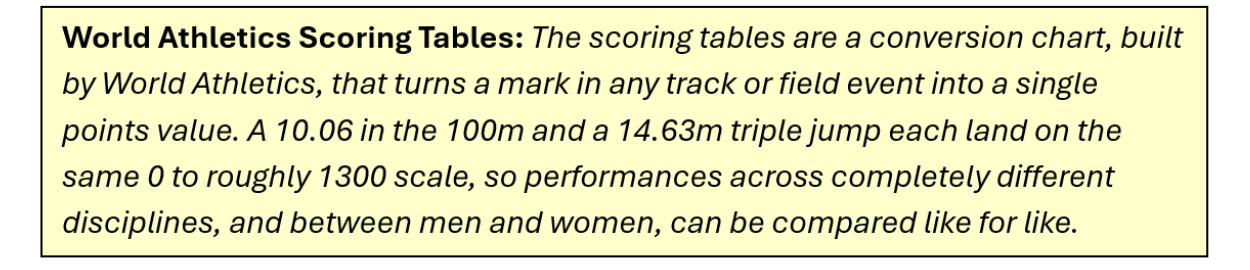
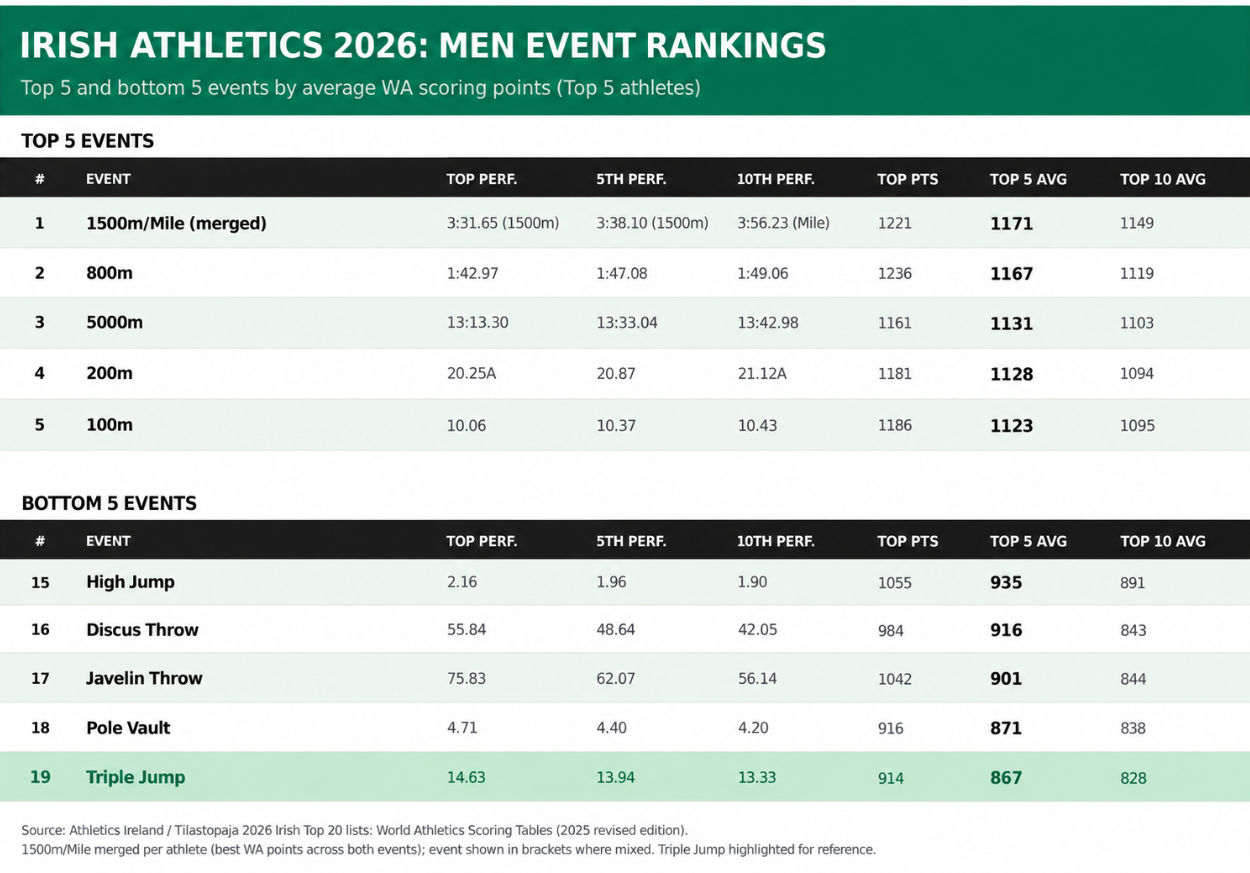
There are multiple ways to determine how Irish Triple Jump ranks. Let’s take a domestic perspective and use World Athletics (WA) event ranking tables to see where Triple Jumping stands when compared to other events within the Irish athletics domain.
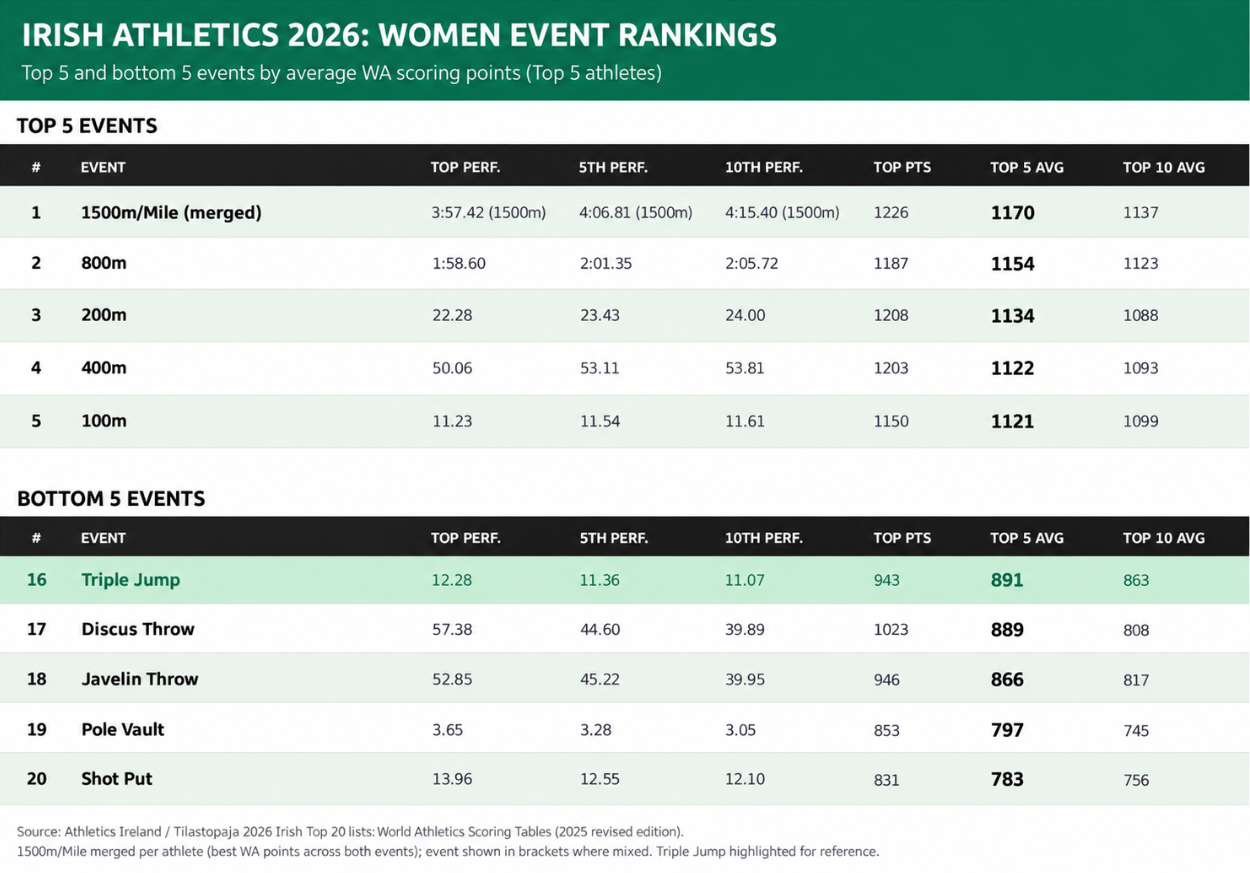
Methodology: I took the top 5 individual performances across each event and computed the associated WA ranking points. Then I generated the average points for those performances. The graphic below shows the top and bottom 5 events for Irish men based on that average computation. I added a Top 10 category for further context.
What jumps out immediately is the stark divide between Track vs. Field events which occupy the top and bottom 5 spots. If you’ve been reading some of my prior columns, this will come as no surprise. I laid out the case in writing about the Euro Team Championships competition last year in Slovenia and when I reviewed the dearth of technical event scoring at the European Championships inBirmingham. Most notably for this article, the Triple Jump sits at the bottom of the table.
If we examine the same table for women, we find a similar story with the Triple Jump ranked 16th out of 20 events.
Five-Year Trend: Men
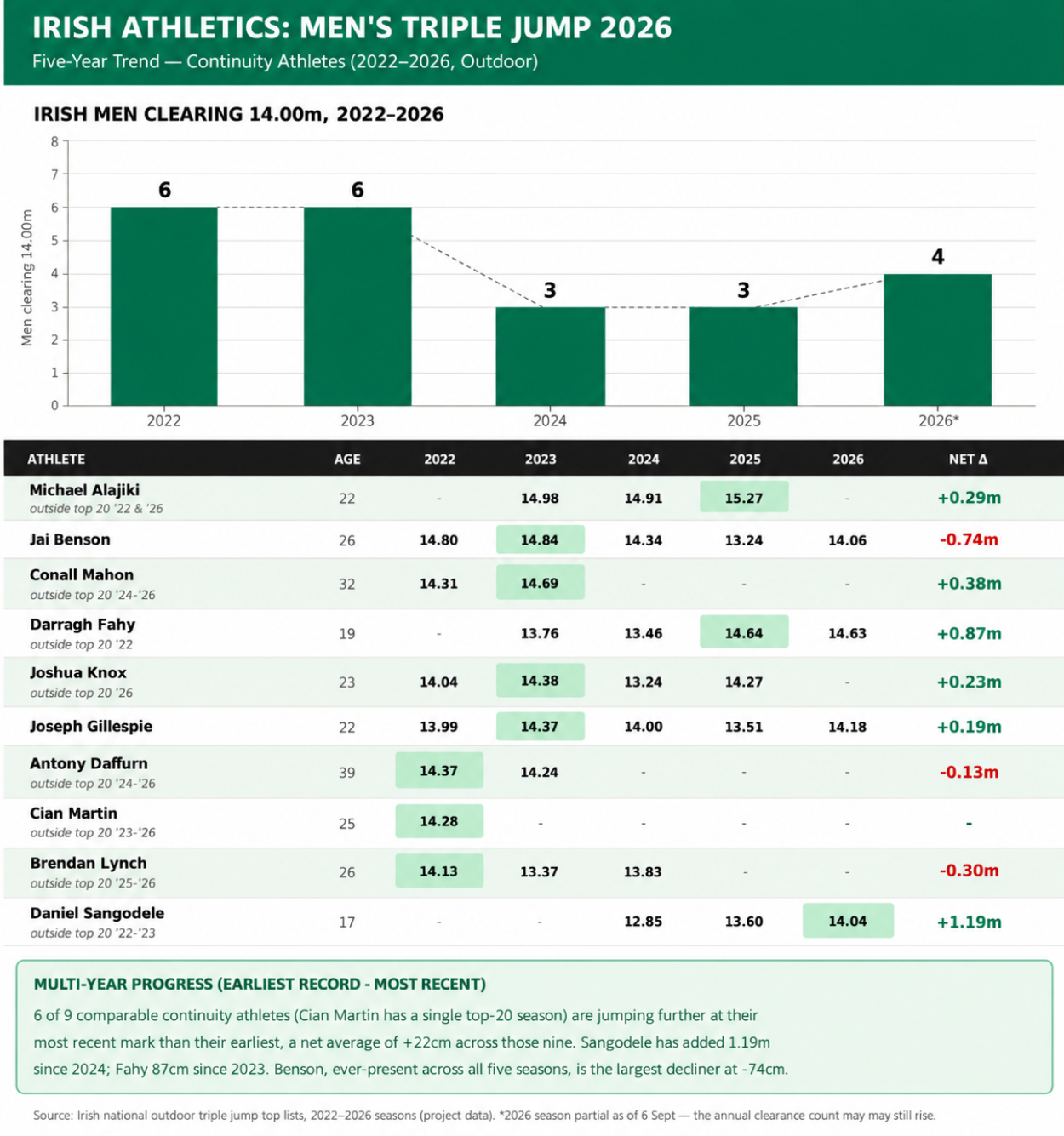
There is a danger of leaning too heavily into the performances for a single year. How do things play out when we take a multi-year perspective? If we focus on the men who jumped further than 14 meters in the past five years, we come up with a list of 10. Of concern is the drop in 14-meter performance over the past three years.
Unsurprisingly some of these men no longer seem to be competing. Age, injury, alternative goals, and other factors lead to attrition in the event. Given Michael Alajiki is only 22, I hope to see him back on the runway next year. Like most technical events, Triple Jumpers reach their peak performance in their mid to late 20s. Looking at this year’s European Championships, the median age was 26. On a side note, 8th place finisher, Dimitrios Tsiamis of Greece is 44 years old. That makes the case that competitors in this event can continue to perform far later in life than their track counterparts. The challenge is keeping these athletes engaged and healthy.
On an optimistic note, the winner of this year’s national championship, Joseph Gillespie, is 22 years of age and the runner-up and national list leader Darragh Fahy is 19. New member of the 14-meter club, Daniel Sangodele is just 17 years old. Keeping these young men active and engaged with well targeted resources will begin paving the way to a more promising future.
Five-Year Trend: Women
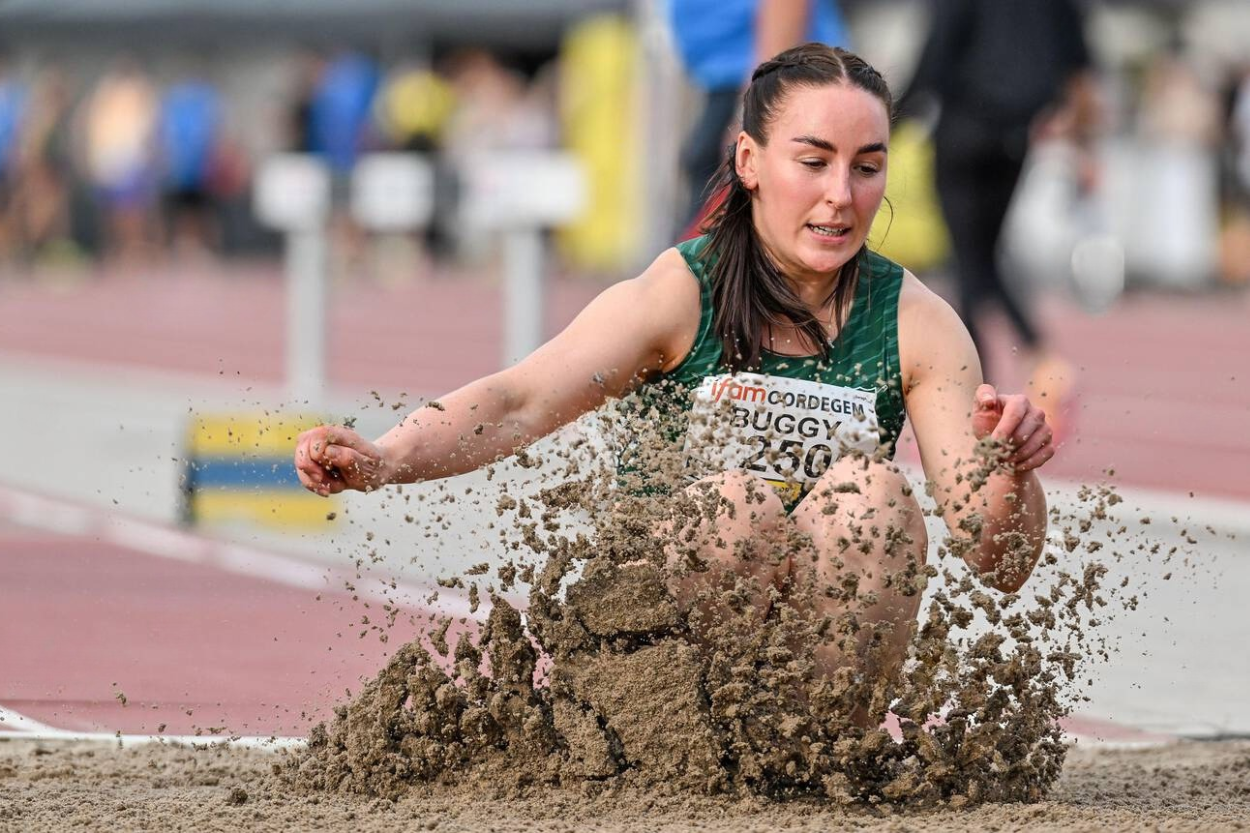
Saragh Buggy competing at the IFAM outdoor Oordegem in August 2026
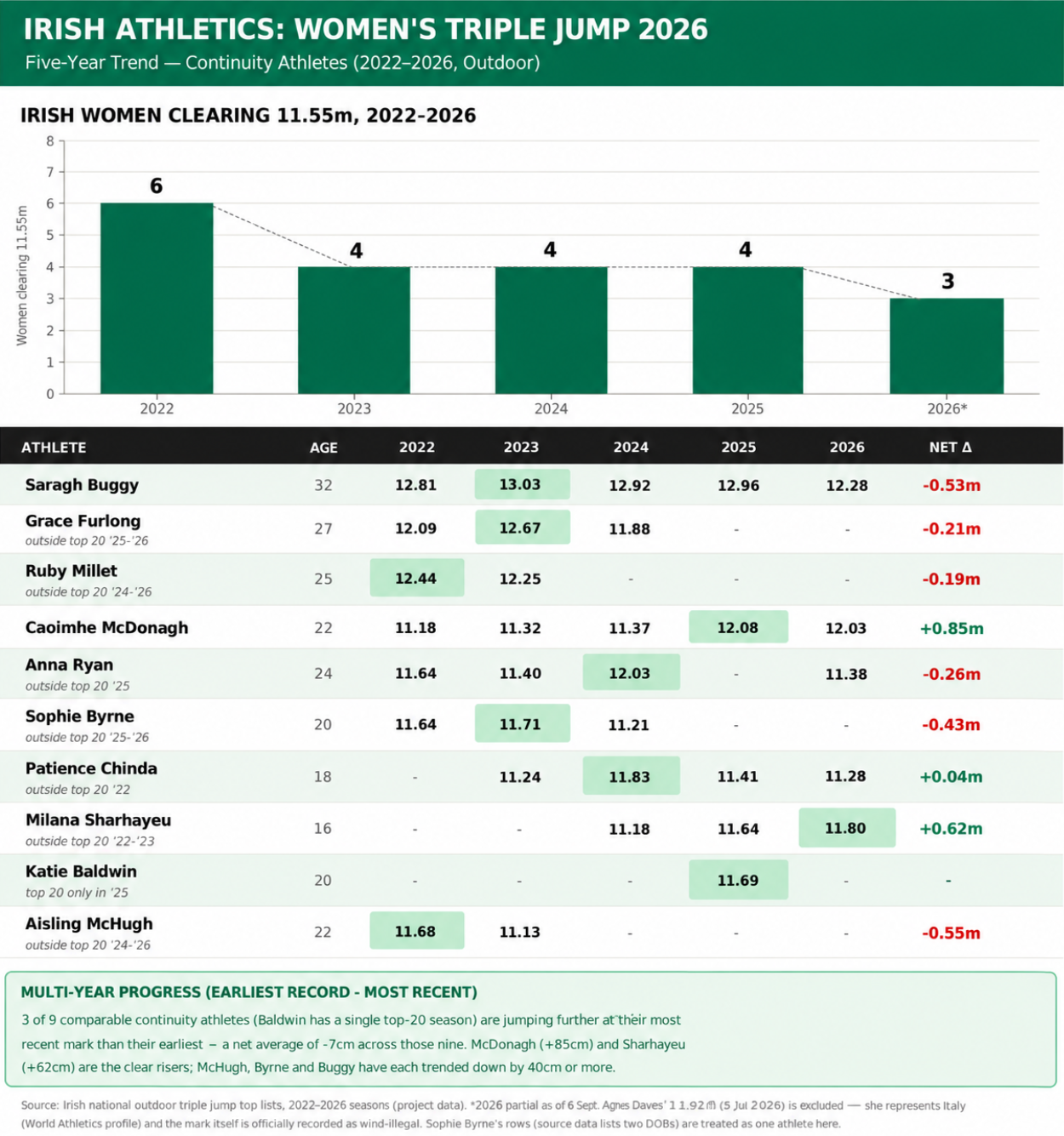
Like the men, the story for the women’s event is equally challenging. In generating the graphic below, I wanted to list the 10 best women across the last 5 years. That cohort was defined by an 11.55-meter cutoff. This year only three women exceeded that modest mark and only one of the 10 women, 16-year-old Milana Sharhayeu, achieved a lifetime best.
Saragh Buggy, the list leader, has been a model of consistency in the event, winning 9 outdoor national titles between 2016 and 2024. Adding her Long Jump titles and Indoor championships in both events, she has accumulated an extraordinary total of 23 national titles. Interviewed at the National Championships this year, she cited recent struggles with injury; hopefully 2027 will prove to be a healthier one, and she will return to jumping beyond the 13-meter mark, perhaps approaching her 13.53m personal best.
Caoimhe McDonagh has shown improvement in the last couple of years and the emerging teenagers Milana Sharhayeu and Patience Chinda point to new opportunities across the event.
An Aging Women’s Record
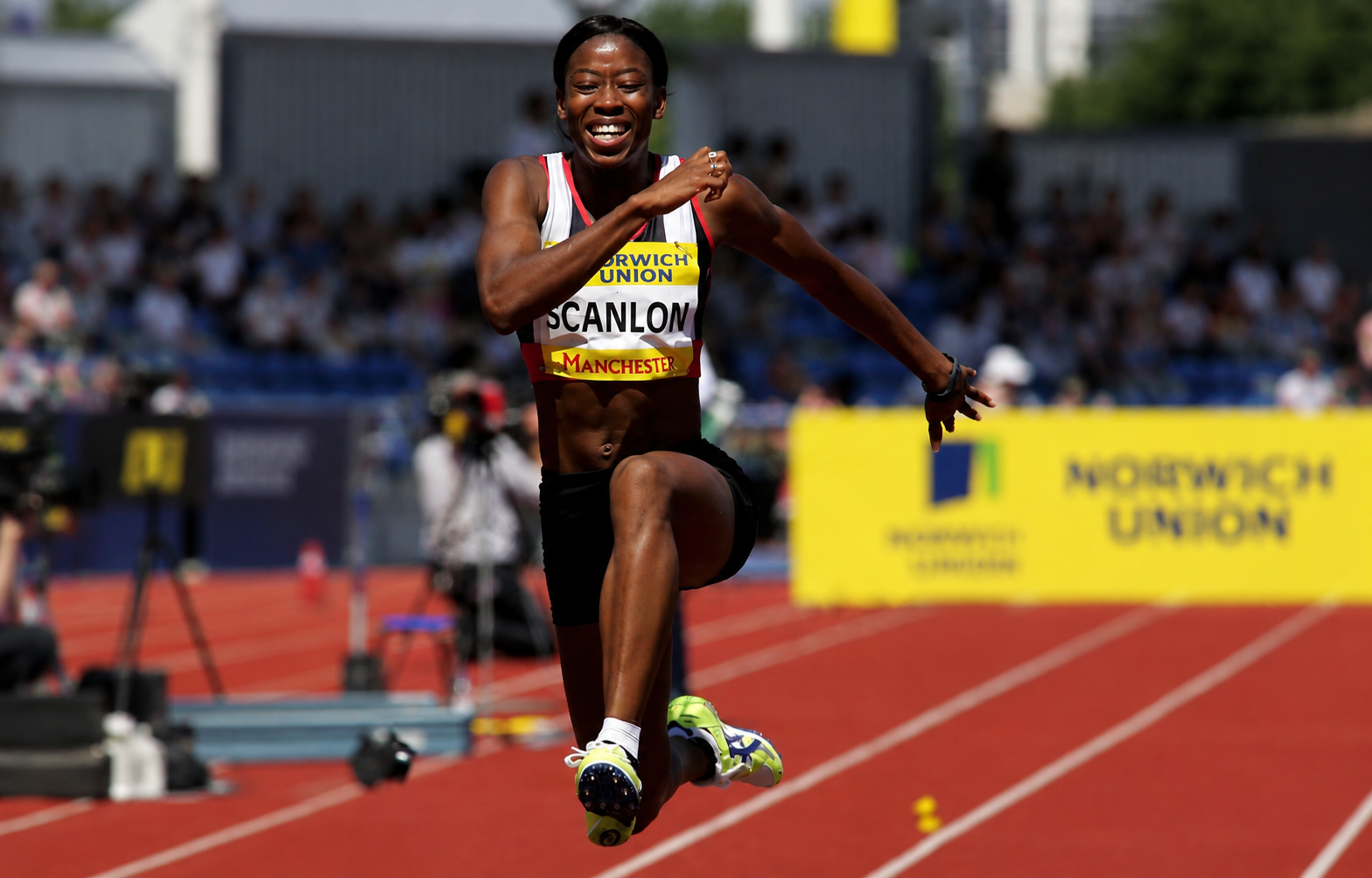
Taniesha Scanlon jumps her way to victory in the Womens Triple Jump at the Norwich Union AAA'S in July 2005
The women’s outdoor Triple Jump record has stood unchanged for quite some time although not as long as Colm Cronin’s marks on the men’s side. On June 7, 2005, Taneisha Scanlon jumped 13.62 meters in Bratislava. That mark has now entered its third decade and survived Saragh Buggy’s challenge in recent years. The same can be said for the indoor mark of 13.28 meters set in Sheffield on February 12, 2005. That mark is also owned by Taneisha Scanlon. Seventeen years to the day, Buggy came within a single centimeter of it.
Looking Forward
The focus of this article is not to criticize the current squad of jumpers, their coaches and the administration of the sport. The question that needs to be asked constructively is why progress in this event has not matched the Irish successes seen on the track in recent years.
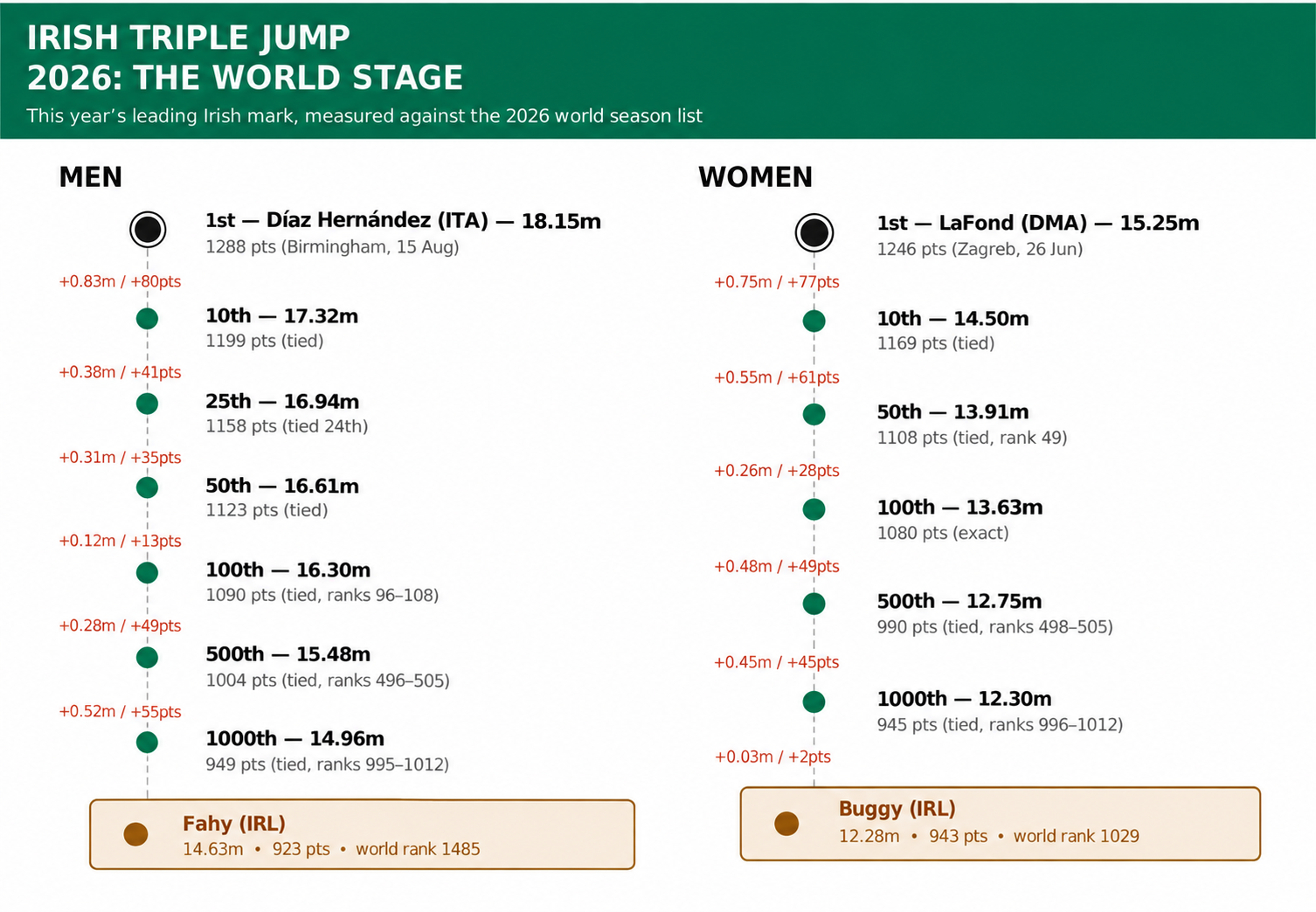
The ladder graphic below shows where the best Irish male and female jumper rank by best performance for 2026. The next question is what would constitute success 5 or 10 years from now.
Underperformance in this event has been lurking for decades and will only be resolved through meaningful planned change and a sustained effort over 10 – 20 years. In my next article I will explore the history of the event in detail and why Ireland started as a dominant force in the event but ultimately disappeared from the world stage.