Nutty Corner · Published 60 days ago on 28 Aug 2026
Ireland fields Europe's fourth most running-biased team. Norway, the Netherlands and Switzerland show it doesn't have to stay that way.
By: Martin Nutty
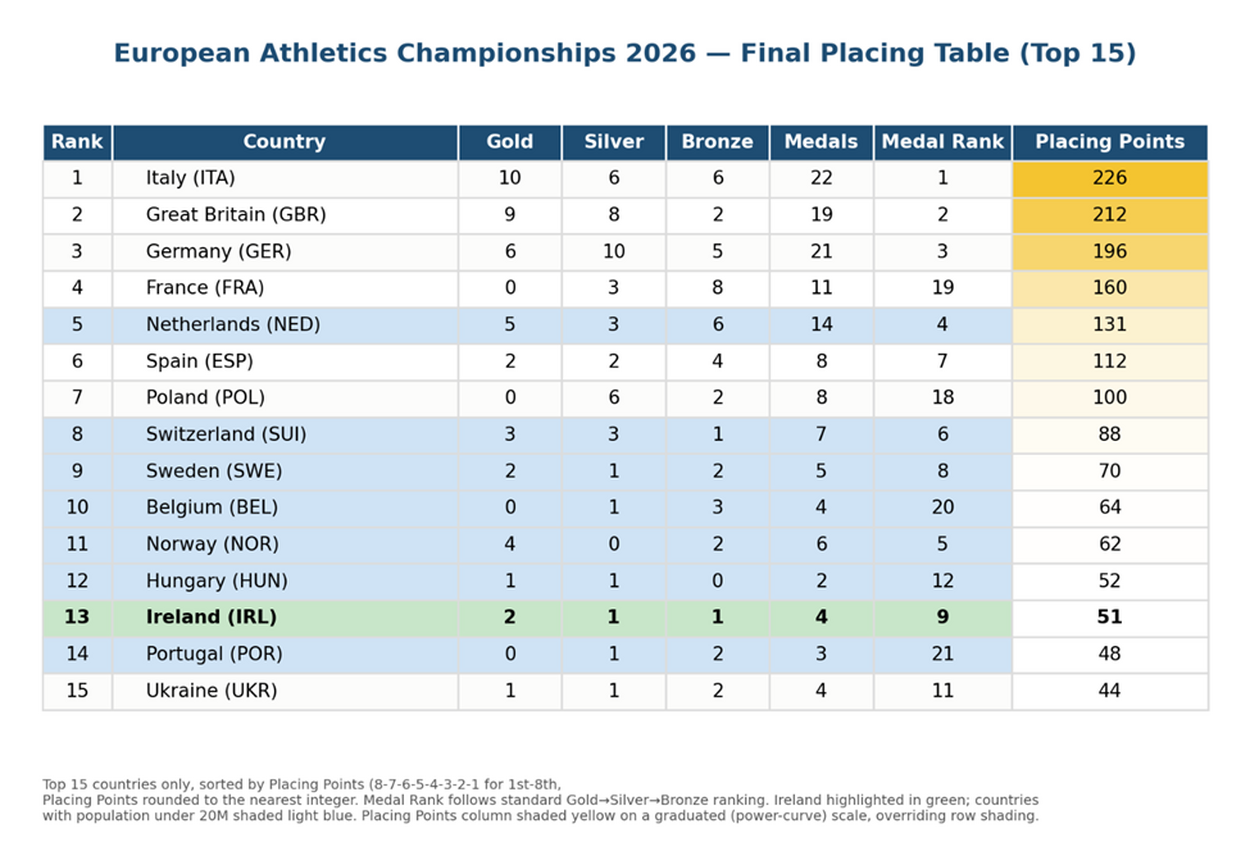
At the 2026 European Championships Ireland finished 9th in the medal table and 13th in the placing table. Those who love Irish athletics should feel justifiable pride in that outcome. With this success, now is a good moment to ask, can Ireland do better? And if so, what is a reasonable goal?
Thoughtful observers understand that Ireland can’t go head-to-head with Italy, France, Germany and the UK who won more than 10 medals each. Their populations provide a far bigger pool of talent to draw from, and they have committed far more money, for far longer to the sport compared to Ireland. That investment, manifested in superior facilities and a deeper tradition of professional coaching, is not easily overcome.
Towards the end of my article last week, I suggested that Ireland should benchmark itself against countries with less than 20 million people. Some of these countries are poorer, some are moderately wealthy like Ireland and two, Switzerland and Norway, could be understood as “super wealthy”.
Three small countries, Netherlands, Norway and Switzerland finished 4th, 5th and 6th in the medal table and 5th, 11th and 8th in the placing table. These are the smaller countries who Ireland should aim to surpass over the next decade. One approach to closing the gap is to address the skew problem in Irish Athletics.
Talking the Skew
The Skew is the performance gap between running/endurance and technically intense events. Traditionally this is the divide between Track vs. Field.
For the purposes of this article, I’ve chosen to split the events into the same categories used when I wrote of the skew or gap in my Weekend in Slovenia article.
Please indulge me here, I’ve no interest in throwing shade on sprinters, walkers and runners by suggesting that those events lack technical accomplishment. There are plenty of such demands within these events. Let’s just say the technical entry point is less daunting. Most everyone can run around a track without coaching. However, ask someone to throw the hammer without coaching and the outcome can be life threatening at worst, or painfully amusing at best.
The Skew at the 2026 European Championships
In the Weekend in Slovenia article, I wrote how the Irish athletics skew or gap manifested in the European Team Championships in 2025. While this skew is understood in Irish athletics, is it something specific to Ireland or does it manifest in other countries?
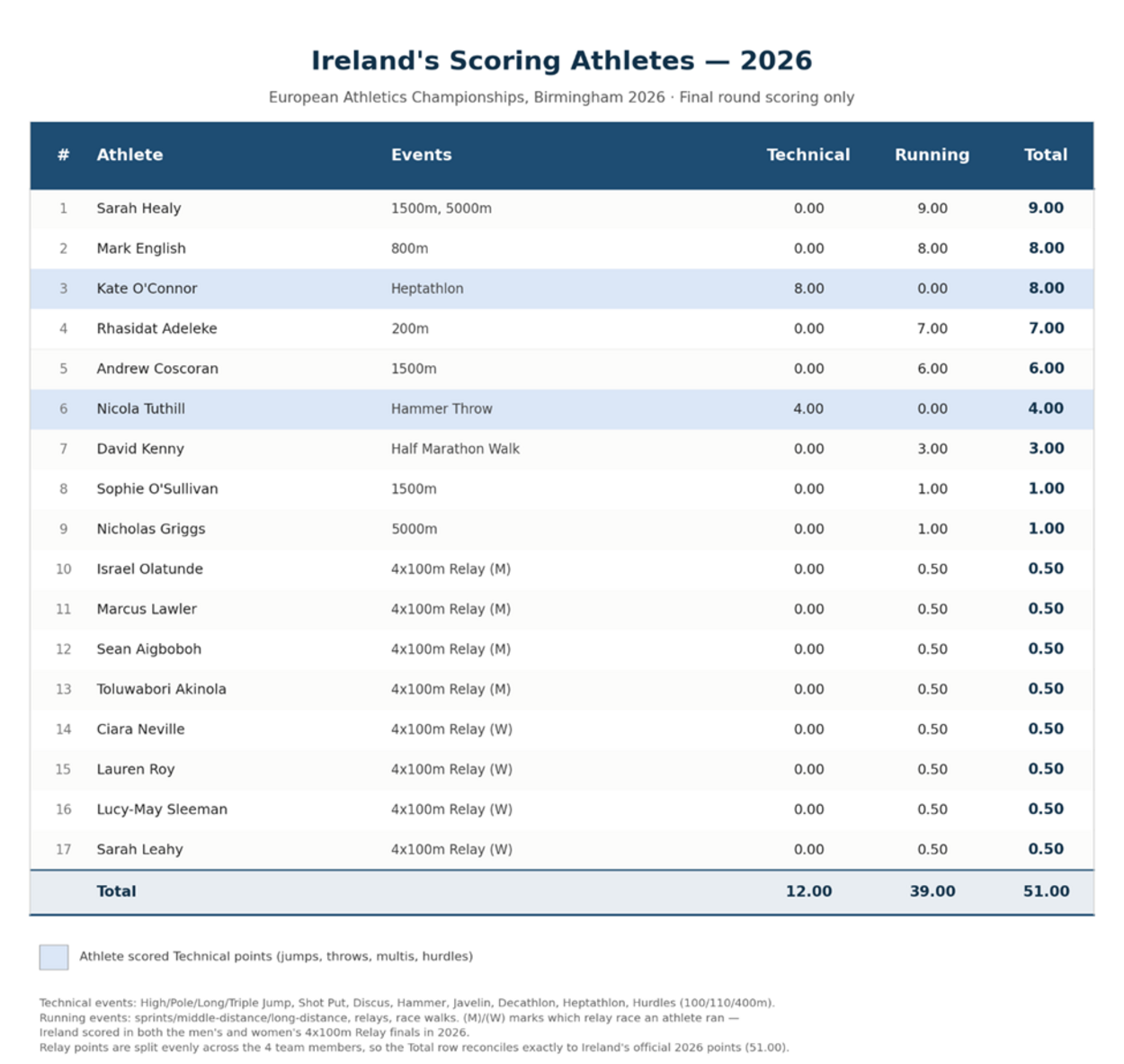
Let’s focus on the Irish picture first at the 2026 European Championships. In all, 17 athletes contributed to scoring 51 placing points as detailed in the following table. Sarah Healy leads the way as the only Irish athlete to both double up and score in individual events. Most noticeably in this table, just 2 athletes scored on the technical side of the equation. Perhaps, the presence of two relay squads exaggerates the point. If we remove relays from consideration only 2 of the 9 individual scoring Irish athletes fall into the technical category.
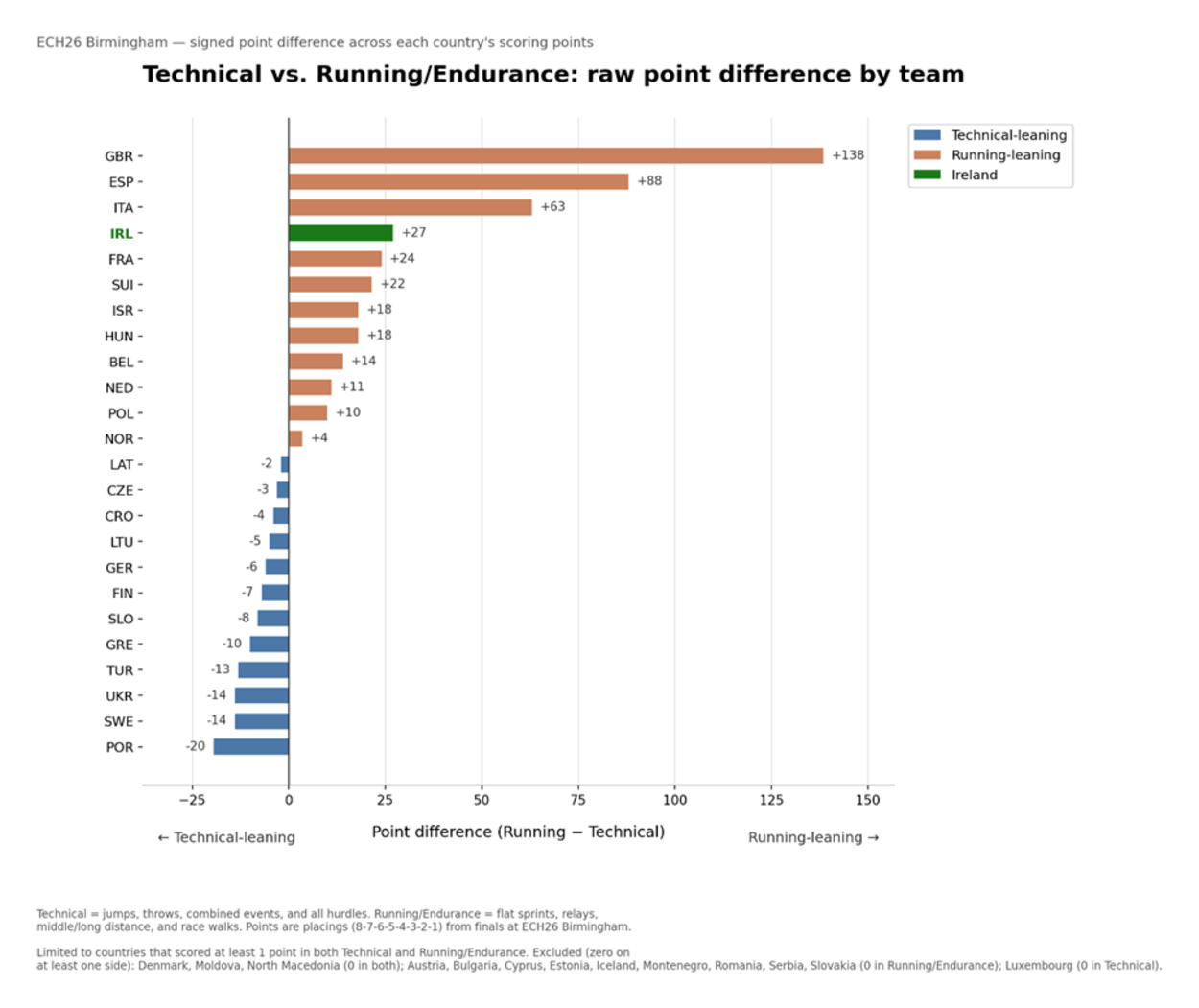
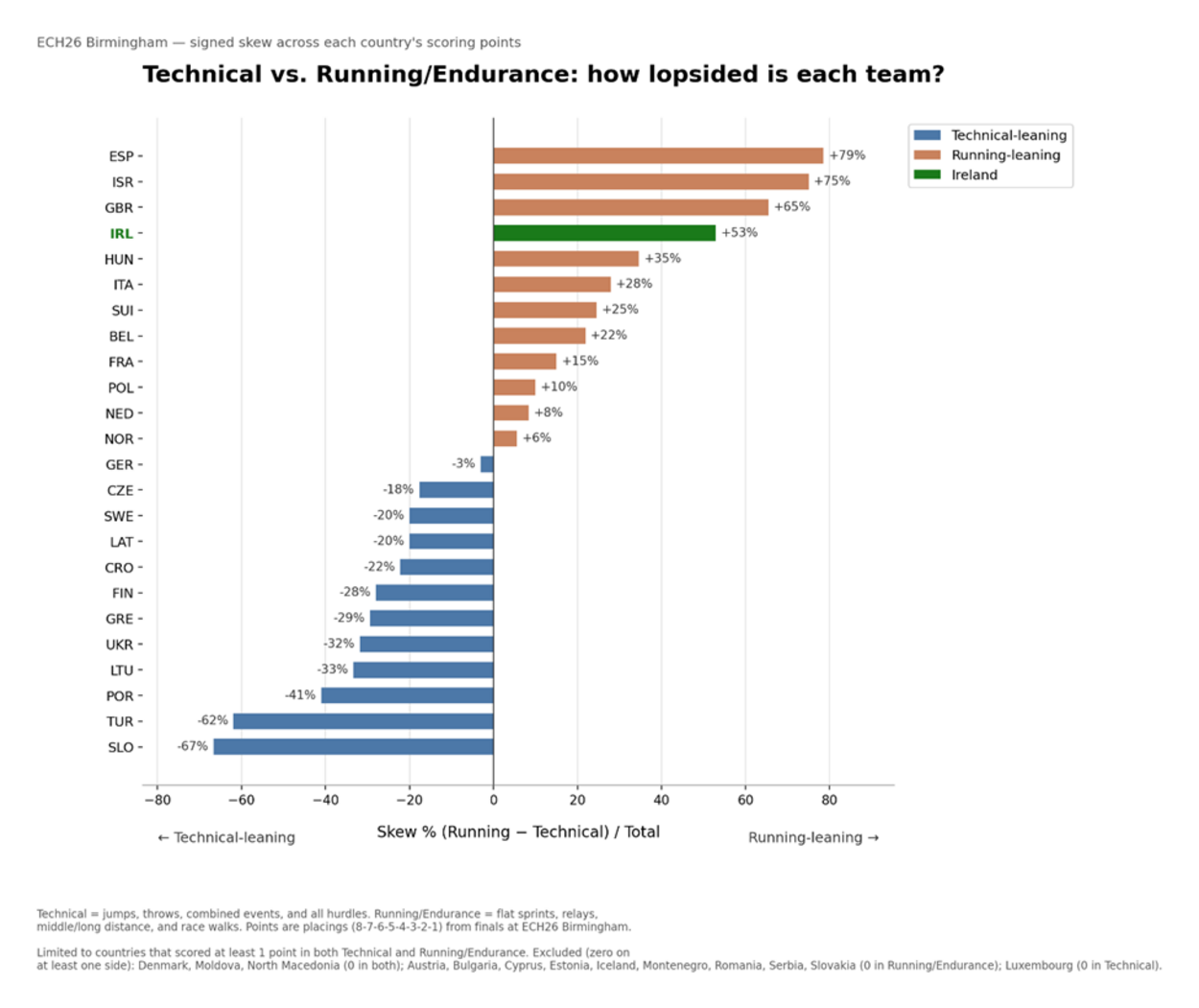
Zooming out, I examined how this skew compared to other countries competing at Birmingham. I graphed the scoring points skew for each country. That revealed Ireland does not have the most extreme bias towards running/endurance events. Great Britain or Spain win that dubious award depending on which way we look at the skew, absolute points or percentage ranking.
In absolute points, Ireland is the fourth most running/endurance biased country with Great Britain being the most extreme case.
The picture for Ireland is no different when standings are recomputed by percentage. Ireland remains the fourth most skewed country with Spain replacing Great Britain at the extremity.
It’s worth measuring Ireland against the three benchmark countries from earlier in this piece. Norway (+6%) and the Netherlands (+8%) are barely tilted towards running/endurance at all, while Switzerland (+25%) is roughly half as skewed as Ireland. All three manage a far more balanced technical-running mix than Ireland does, and all three finished ahead of Ireland in both the medal and placing tables.
Why Eliminate the Skew?
Rather than invest in technical events, Ireland could double down on its current successes on track and road. Britain does it, why can’t Ireland copy that model? I’d suggest that approach decreases the likelihood of success and narrows domestic growth opportunities for the sport.
At Birmingham there were 22 technical events on the schedule. Ireland participated in just four: Sarah Lavin, 100m Hurdles; Nicola Tuthill, Hammer Throw; Eric Favors, Shot Put; and Kate O’Connor in the Heptathlon. That left 18 other event opportunities vacant with zero Irish opportunities to score. The lack of representation at these events means young athletes will not have a role model participating at the highest level of athletics. Consequently, priming the pump with the next generation of talent has become more challenging.
Building up a cohort of Irish athletes who can score in technical events at the highest level is the work of years, perhaps decades. A thoughtful steady effort will yield a broader base of participation across athletics providing opportunities to younger people who do not fit into the running/endurance category. Indeed, that is the beauty of athletics, it caters to all physical types and will be embraced eagerly by a public that is just beginning to understand Irish athletes can achieve greatness at the very highest levels.
Examining the Skew Historically
There is a danger in focusing on just one championship when examining this skew in Irish athletics. How has this played out for Ireland across the last 10 European Championships beginning in Munich in 2002?
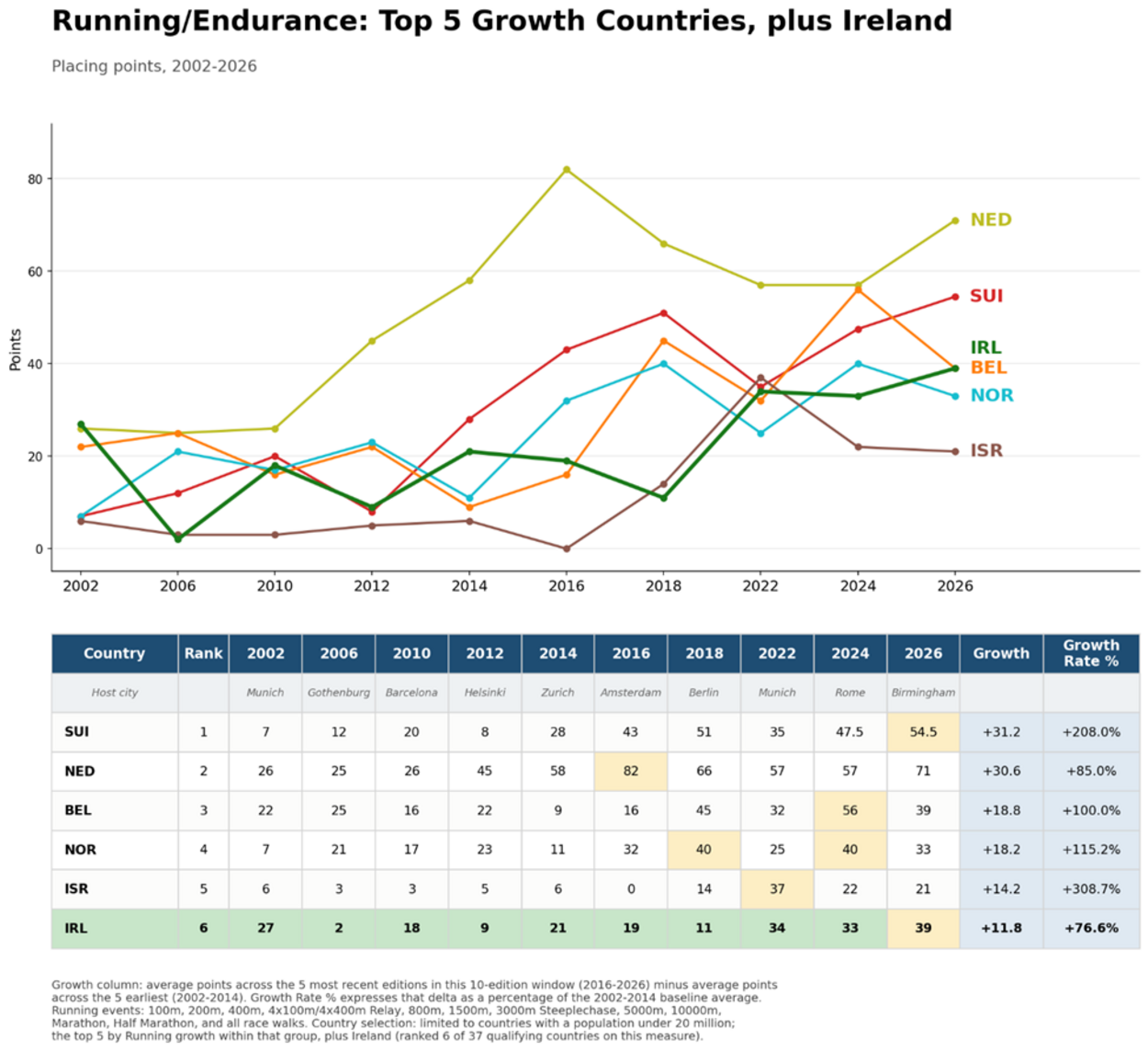
Irish running/endurance has grown steadily off a base led by Sonia O’Sullivan’s two silver medals in Munich 2002. In terms of growth Ireland is ranked a creditable 6th of 37 small population countries. That said, other small countries have grown faster and point to opportunities for the future.
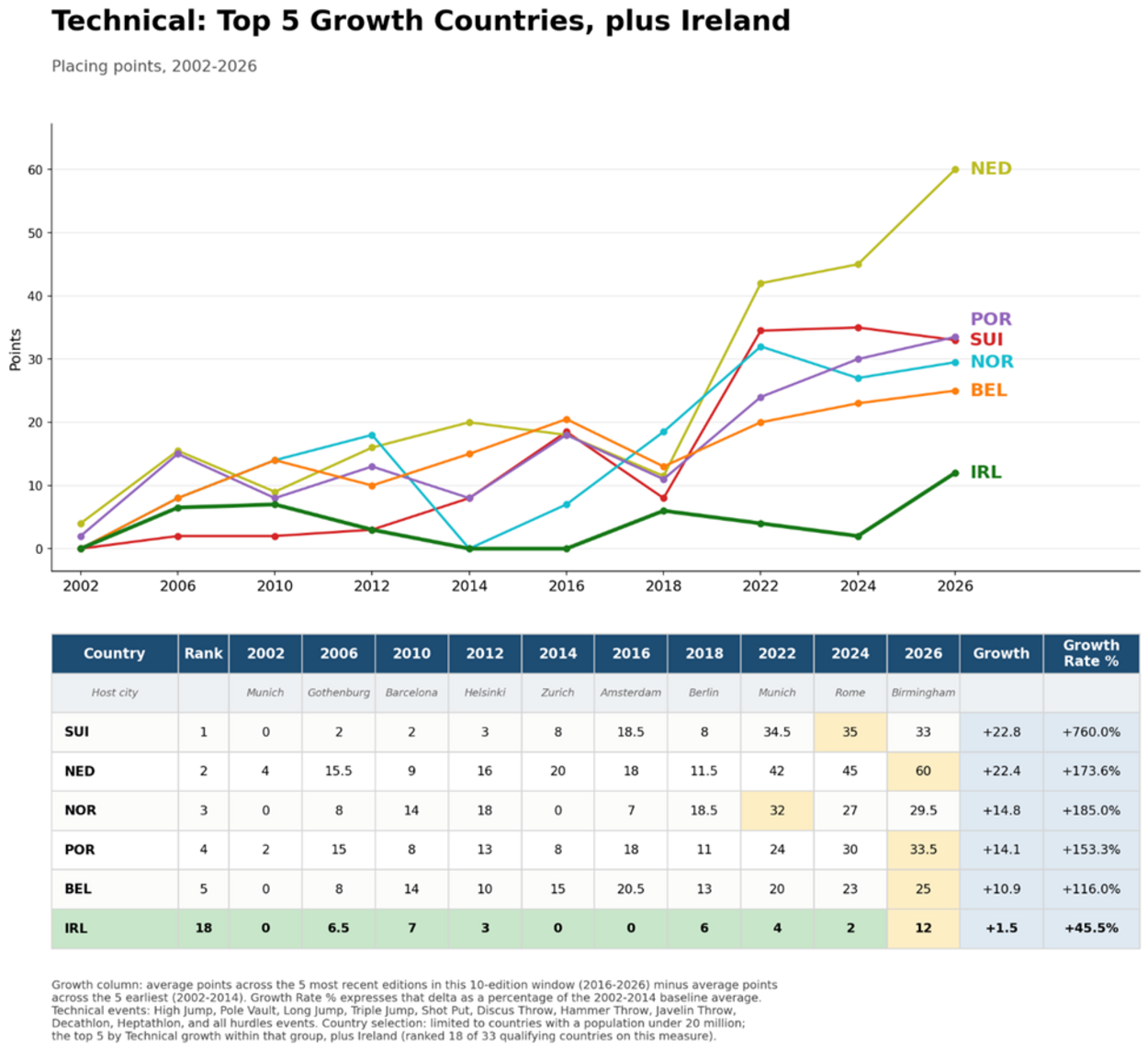
When we look at the technical side of the ledger, the performance is far lumpier. Ireland’s growth ranks 18th out of 33 countries. While 2026 yielded a high watermark of 12 points, Irish progress is dwarfed by the top countries.
There are reasons to be both concerned and optimistic here. Over the past 18 months, Kate O’Connor has put Ireland on the global heptathlon map. Her gold medal is a confirmation of her dedication and extraordinary competitive spirit. Quietly that success is starting to take hold and is reflected in increasing participation in the event across Ireland. A visit to Athletics Ireland statistics reveals 10 women who have scored more than 4,000 points in the event this year. Ten years ago, only four women recorded a score at all, and just three of them broke 4,000. Depth in the event is clearly expanding and is likely to grow with Kate’s expanding media footprint.
There is further reason for optimism with Nicola Tuthill’s 5th place finish the hammer. That’s the first time an Irish thrower has scored at the Europeans since 1994 when Terry McHugh and Nick Sweeney were making their presence felt. Indeed, Nicola’s performance is the first ever for an Irish woman in any throwing event at this championship.
While both these performances are gratifying, the Irish jumps picture is bleak. Over the last 10 editions of the European Championships, just 5 Irish athletes have participated, yielding zero top eight finishes. That’s an outcome that should give pause and demands a deeper analysis.
Taken together, the four technical disciplines tell four different stories:
Multis has arrived, powered by Kate O’Connor’s heptathlon gold
Throws has opened its account, with Nicola Tuthill’s hammer finish
Hurdles carry a long scoring history but went quiet in Birmingham
Jumps haven’t scored recently or ever at the European Championships
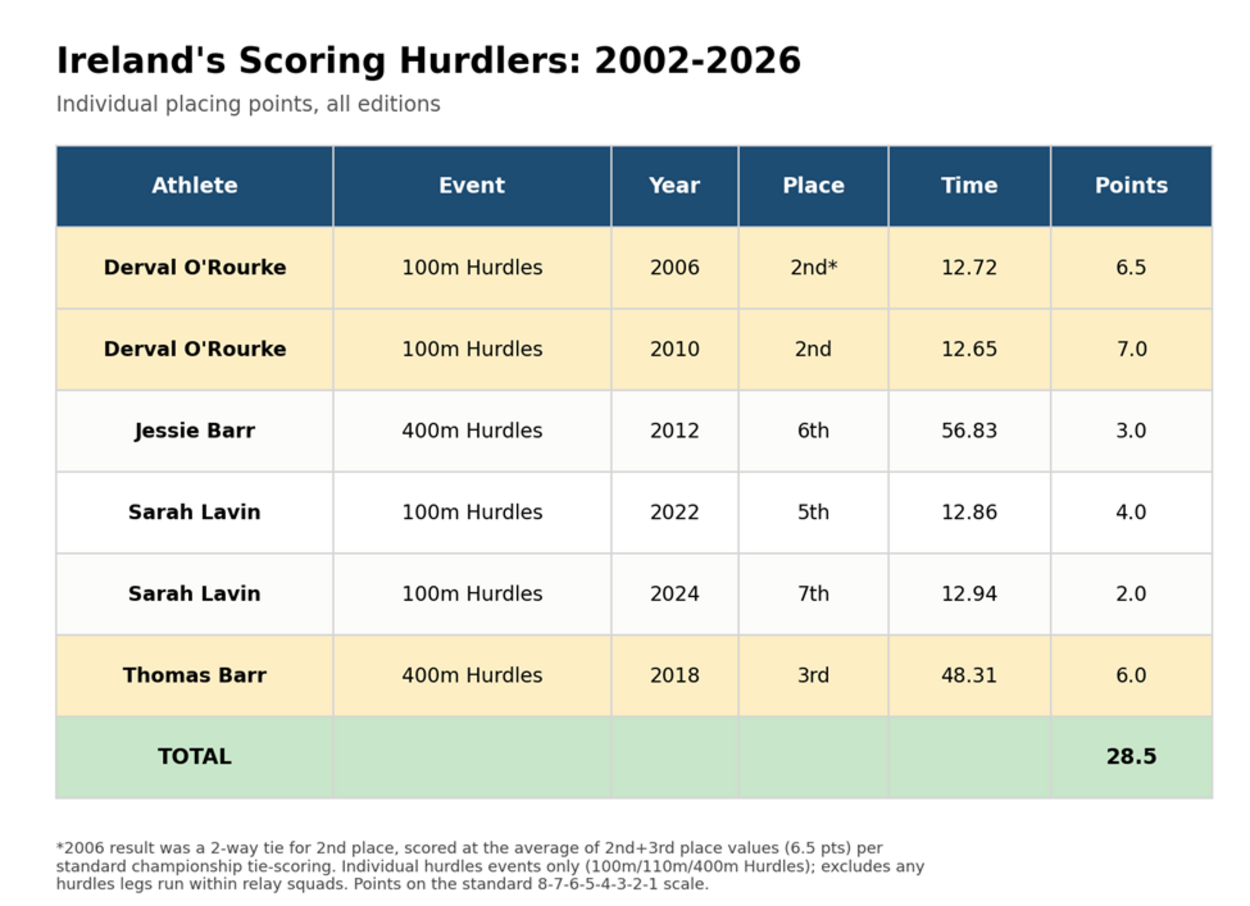
Those who scrutinized the above graphic might wonder where Ireland generated points in recent decades. Until Birmingham, the hurdles has been sole event category where Ireland generated top eight finishes in the 21st century. Derval O’Rourke, Thomas Barr, Jessie Barr and most recently Sarah Lavin concretely attest to Irish success in technical events.
While Birmingham didn’t yield any hurdles points, the emergence of Donegal’s Dewhirst brothers in the 400m hurdles gives reason for optimism. That optimism is counterbalanced by the disturbing lack of 110m hurdlers at the most recent Irish Championships where only two men participated. More positively, 10 women dipped under the 60 second mark in the 400m hurdles this year. That points to a growing depth that was absent 10 years ago when only two women achieved that performance level.
None of this changes the top-line picture from the start of this piece: Ireland finished 9th in the medal table and 13th in the placing table in 2026, while Norway, the Netherlands and Switzerland. These are the small nations Ireland is chasing, all field far more balanced teams. Closing that gap won’t happen by accident. It will take deliberate investment across throws, jumps and hurdles, not just doubling down on the running/endurance base that already works. The payoff isn’t only a few more medals, it’s a broader, more resilient athletics with role models in every event on the program.
Looking Forward
While I’m optimistic that we’ll soon see Irish hurdlers scoring again at the European Championships, the picture across the throws and especially the jumping events is far more challenging. In a future series, I’ll focus on the triple jump as a singular event example of this underperformance. I’ll explore the history of the event in an attempt to reveal broader problems across the technical event category and how Ireland might address this shortcoming.