Twelve months ago, Rob Dunne had never run a race. He'd never run a 5K, never mind thinking about a marathon, and if you'd told him he'd be in the middle of marathon training by the following August he'd have laughed you out of it.
This October he'll be on the start line of the Dublin Marathon in a Purple House vest, running for the charity that's been quietly holding his father up through a cancer diagnosis.
It started, as a lot of these stories do, with a running club and a Couch to 5K. Rob joined Kingswood Running Club last June, jumping in at week four of their beginners' programme. A year on he's the club's men's captain, he's on the committee, and he owns roughly twenty pairs of runners. "Running has taken over," he says, and he doesn't sound remotely bothered about it.
Rob is running the Dublin Marathon this October for Purple House Cancer Support. You can support his fundraiser here:
The crash that stopped everything
Before any of this, Rob was a gym man. Three, four, five days a week. He'd played GAA and hurled through his teens and twenties for Crumlin, and continued to stay active after he stopped.
About seven years ago, a car pulled out in front of him near his work. It wasn't a dramatic crash. There was no ambulance, no surgery, nothing you'd tell a story about in the pub. But the whiplash left him with bulging discs in his neck, and that small collision reshaped an awful lot of his life.
Lifting anything overhead was out. Gym work was out. His youngest child was very young at the time, and he had to ask his wife to lift the baby out of the cot because he couldn't do it himself. He was getting pain injections roughly once a year and seeing a chiropractor regularly.
"It really impacted my mental health, my fitness, my everything," he says. "I was a grumpy man and a grumpy dad, which is the worst part."
Running was the thing that finally worked. He tried it expecting his neck to punish him, and it didn't. No pain overhead, no flare-ups, just a way to get moving again. Since he started, he's needed far fewer injections and far less chiropractic work, because his fitness has come back around him.
Then his dad got sick
The other half of the story arrived last May, when Rob's father, Patrick Dunne, was diagnosed with prostate cancer.
The two of them are very close. They worked in the same company for more than twenty years, Patrick spent 47 years in the motor trade, and Rob grew up going to his matches, at one point as the club mascot while his dad played for Crumlin for almost forty years.
The diagnosis floored the family. Patrick started radiation at the Beacon, and Rob started driving down at six in the morning to collect him and bring him in for his treatment, staying overnight so he could be part of it.
Running became the thing that let him carry it. "I had to have an escape," he says. He'd quit drinking the year before and hasn't touched it since, so the miles became the pressure release valve. Head cleared on the road, then home.
The bit that might save someone reading this
Patrick's diagnosis came about because a GP was paying attention.
He'd been in and out to the doctor with fatigue and just not feeling himself for a good while. His PSA levels were being tracked over time, and while the numbers were never dramatically high, they jumped sharply in a short window, from well under 1 to somewhere around 3.8. It was the speed of the jump, not the size of the number, that set off alarm bells. That's what sent him for further testing at the Beacon.
"My dad's a strong man, a proud man," Rob says. "But he knew something wasn't right. So he got checked, and got checked, and got checked, until something came of it."
What Purple House actually does
Patrick is a private man. Like a lot of Irish dads of that generation, he won't burden his wife and he won't burden his children, so the people closest to him are the last people he'll open up to.
Every second Friday he goes to Purple House Cancer Support in Bray for counselling, and he talks to a stranger instead.
"He gets so much emotion off his chest, so much built-up stuff, that he won't say to any of us," Rob says. "He'll go there and have a complete release with a stranger, and it's helping him out massively."
Ask Rob what that's worth to him and the answer comes quickly. "That's massive. We have peace of mind that he has something. He's not alone."
That's the part people don't always see about services like Purple House. They support and are there for the patient, and by being there for the patient they take a weight off everybody standing around them.
Chasing a 3:17
Rob’s father Patrick was a runner too, a serious cross-country man who ran one marathon in his life and went 3 hours and 17 minutes.
He'd wanted a sub-three, and he never quite forgave himself for missing it. But Rob says his dad only ever talks about the good parts. Never the pain, never how hard it was.
Rob has inherited that. Ask him about a long run and he lights up. "I have a 16K to go on Saturday, and I'll think about it all week."
His own first proper 5K was last September, in 27 minutes, with his dad there to watch and to give him notes on his performance afterwards.
Training, and the plan that had to change
Rob works with Darren, a coach at the club whose own season was ended by a back injury. Rather than disappear, Darren sold his race entries and threw himself into helping other people in the club instead.
The plan is track on a Monday, an easy run Wednesday morning, a faster session Thursday night, parkrun Saturday and a long run Sunday. Darren even loads the sessions onto Rob's watch so he doesn't have to think, the beeps tell him when to lift it and when to back off.
It was going brilliantly until pleurisy arrived three weeks ago and knocked him out completely. He's only back running in the last few days.
The goal has moved with it. He wanted a sub-four, 3:59:58 would have done nicely. Now the target is simpler, get to the finish line healthy and happy, and enjoy it enough to want to do it again.
Since February he's done six half marathons, the first of them paced by a friend who brought him round in about 2:07 at his first in Dundalk.
The ripple
That friend is part of the story too. He'd fallen out of love with running after seven or eight marathons, and watching Rob start from scratch pulled him back in. He's out every week again now and meets Rob for parkrun.
Then there's Rob's wife, Kelly. She'd tried running last year and struggled with it. Fifteen or sixteen weeks ago she had a hysterectomy, and nine weeks ago she couldn't walk properly. Since then she's finished a Couch to 5K, run her first 5K, followed it with a 6.5K.
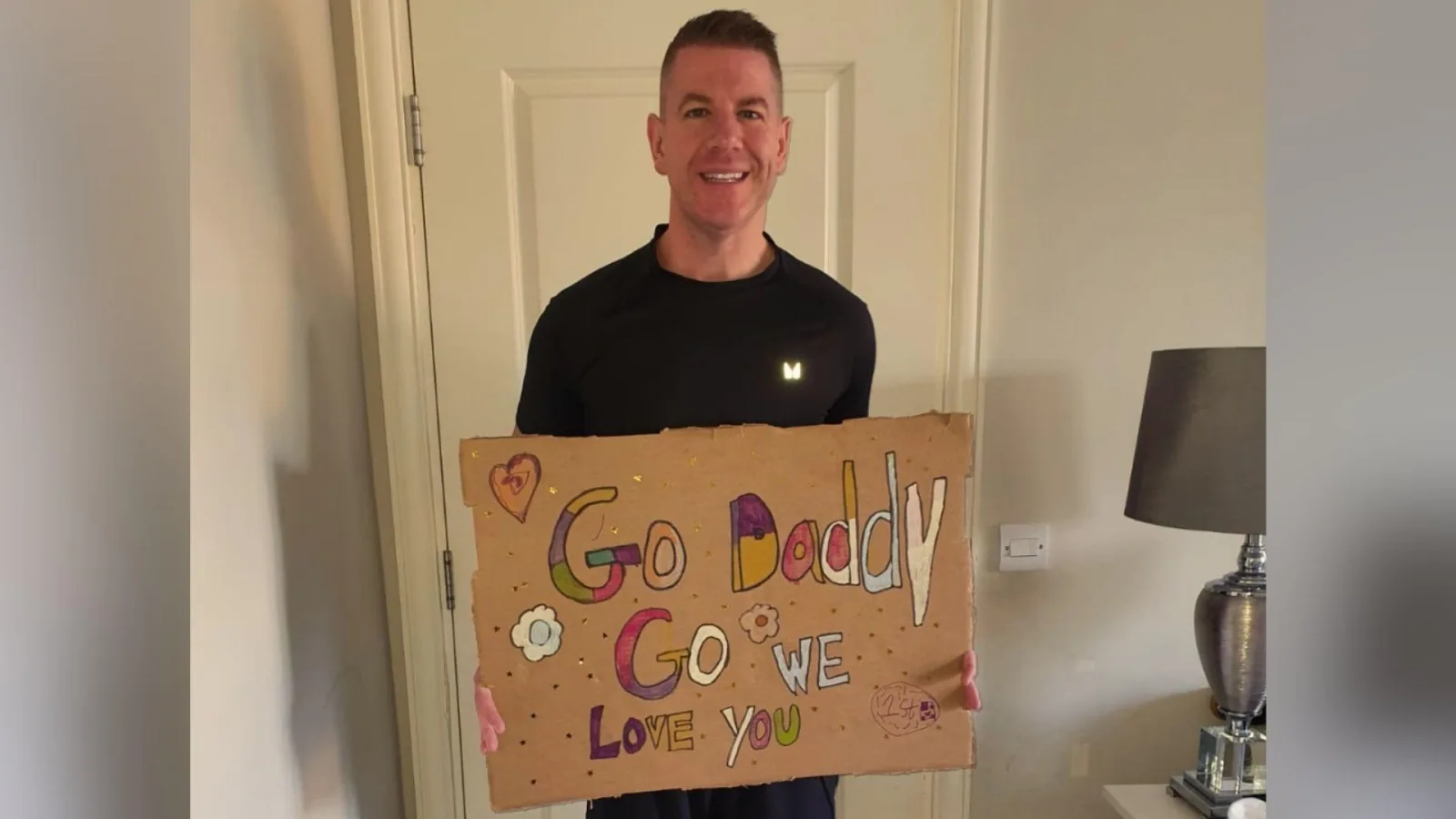
And the kids see all of it. They have their own running t-shirts. They come to parkrun on a Saturday morning and make signs. Where they used to see a grumpy, sore, irritable dad, they now see one who's out the door at six in the morning and back in good form.
"They didn't see that last year," Rob says. "The year before, they saw Daddy grumpy, irritable and sad. It's all changed."
His advice, if you're thinking about it
Two things, and he's emphatic about both.
Find a club. Rob doesn't like running on his own, and having six or eight or ten people around him each week makes the miles pass. "It's nicer to finish with a group of people and everyone gives you high-fives and hugs."
And if you're starting from nothing, start from nothing. Do a Couch to 5K, the VHI one is running now, and do the walk-run properly instead of charging out the door for 5K on day one and never going again.
"Start at zero. That's how I started, and I can't recommend it highly enough."
Rob is running the Dublin Marathon this October for Purple House Cancer Support. You can support his fundraiser here: