For almost 60,000 runners, 42.2 kilometres through New York will now end with the city itself hanging from their necks.
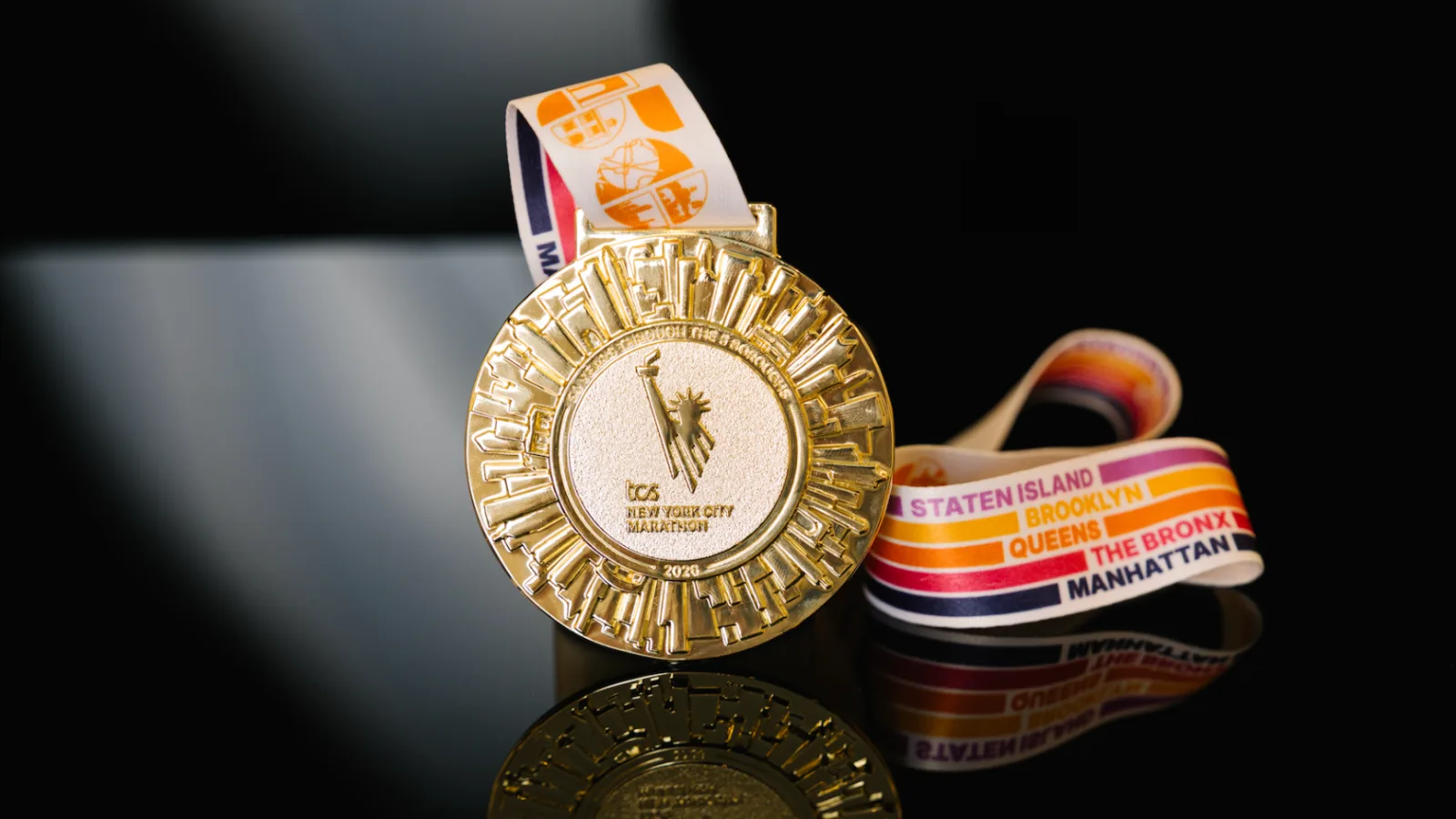
New York Road Runners has revealed the official finisher medal for the 2026 TCS New York City Marathon, which takes place on Sunday November 1st.
The larger gold finished design marks 50 years since the marathon first travelled through all five boroughs in 1976. That historic edition also introduced the event’s first official finisher medals, giving the 2026 design two anniversaries to carry.
A Medal Built Around New York
The medal is made from zinc with an electroplated gold finish and measures 3.5 inches across.
Its 2.12 inch centre medallion remains the same size as the 2025 version, but the area surrounding it has been expanded to create a more prominent design.
A sculptural interpretation of the New York skyline circles the centre, with the buildings arranged in a sunburst pattern. The design also incorporates the five bridges crossed during the marathon’s journey from Staten Island to Central Park.
Runners begin by crossing the Verrazzano Narrows Bridge into Brooklyn. The route later uses the Pulaski Bridge, Queensboro Bridge, Willis Avenue Bridge and Madison Avenue Bridge as it moves through Queens, Manhattan and the Bronx.
The ribbon continues the anniversary theme with a design influenced by the 1970s. It includes the marathon logo, the 50th anniversary mark and references to each of New York’s five boroughs.
The Year That Changed The Marathon
The first New York City Marathon took place in 1970 and remained entirely inside Central Park. Just 127 people entered, with 55 reaching the finish.
Six years later, the race was transformed for the United States Bicentennial celebrations. Instead of completing repeated laps of the park, runners travelled through Staten Island, Brooklyn, Queens, the Bronx and Manhattan.
Bill Rodgers and Miki Gorman won the men’s and women’s races that year, while every finisher received the first official New York City Marathon medal.
The five borough format established the identity the event retains today. New York was no longer simply the setting for the marathon. The city became the course.
The 2026 medal attempts to place that journey into the hands of each finisher, with the skyline and bridges representing the ground they will have covered before entering Central Park.
From 26 Ideas To One Design
New York Road Runners began working on the anniversary medal around a year before its release.
Its creative and marketing team initially produced 26 possible concepts. Those options were gradually reduced through several rounds of changes before the final skyline design was selected for production.
The result is slightly larger than the medal awarded in 2025, although the increase is modest enough that runners should still be able to make their way home without paying for extra baggage.
More importantly, the design gives the anniversary a clear connection to the course. The five bridges are not included simply as familiar New York landmarks. Each represents a physical stage of the race and a particular challenge waiting for runners on November 1st.
Demand Reaches Another Level
The medal will be earned by one of the largest marathon fields ever assembled.
More than 240,000 people from over 160 countries applied through the entry drawing for the 2026 race, representing an increase of almost 20 per cent from the previous year. Only around one per cent of drawing applicants received a place.
That demand followed a 2025 edition in which 59,226 runners reached the finish, setting a world record for the largest marathon at that time.
Nearly 60,000 participants are expected again in 2026, a remarkable change from the 55 finishers who completed the original Central Park race.
For those taking part, the medal will represent far more than an anniversary. It will carry the early journey to Staten Island, the climb over the Queensboro Bridge, the noise of First Avenue and the final approach through Central Park.
Fifty years after the marathon first spread across New York, another vast field will follow the same basic path. This time, the city they have crossed will be waiting for them at the finish.