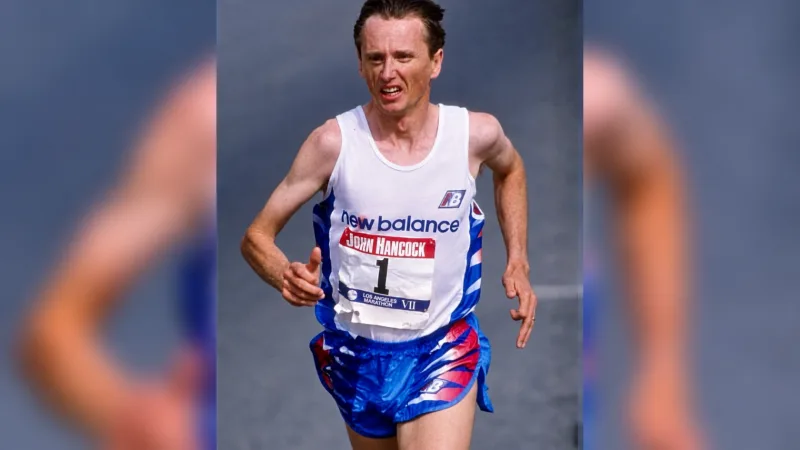
With the New York City Marathon taking place this Sunday, we’re continuing our look back at memorable Irish performances in the race. Yesterday, we revisited John Treacy’s third place finish in 1988. Today, we move forward fourteen years to another Irish runner making his mark on the streets of New York.
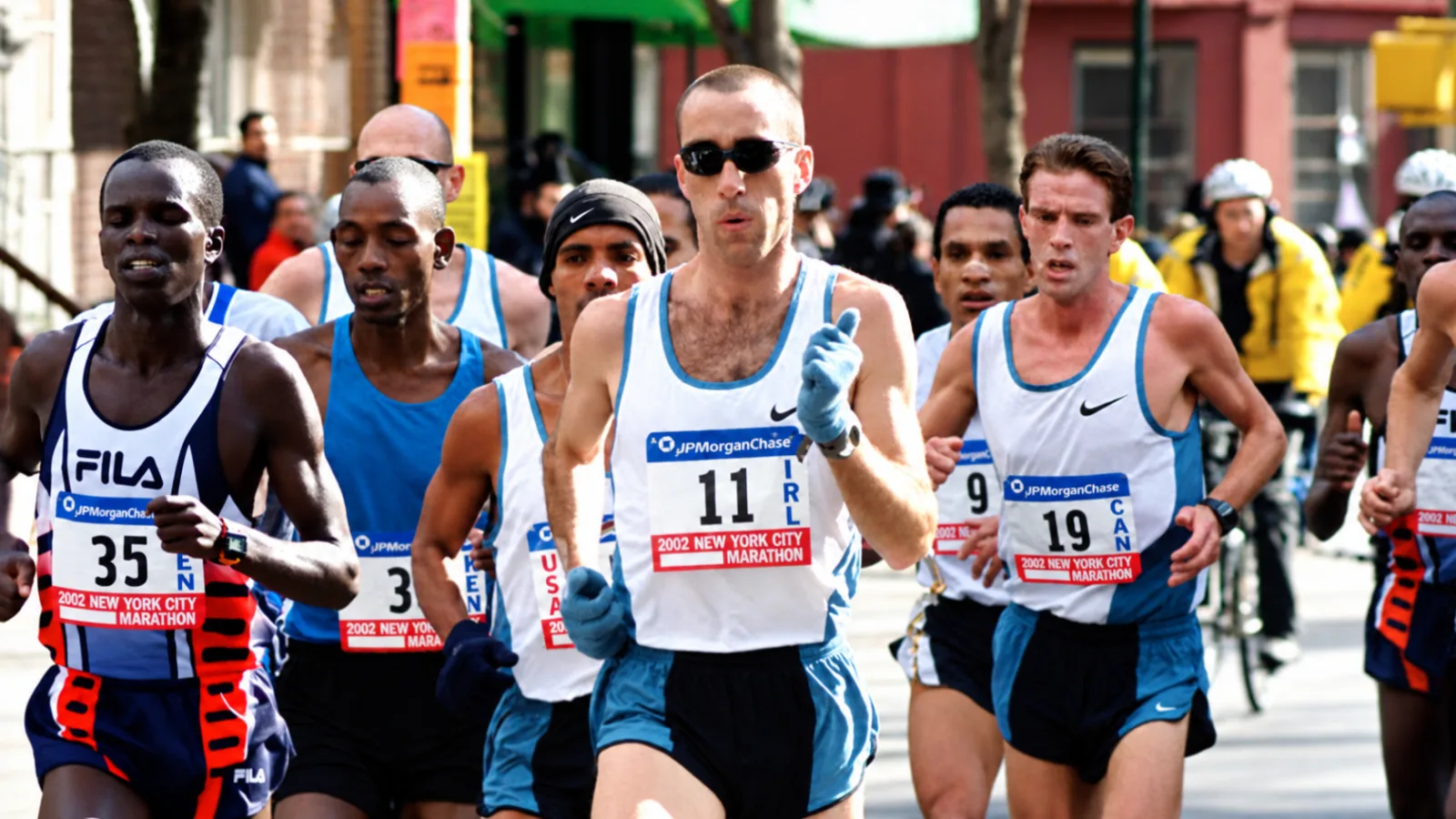
On November 3rd 2002, Mark Carroll of Leevale AC finished sixth in the NYC Marathon with a time of 2:10:54. It was his first marathon, and only Treacy had ever run 26.2 miles faster among Irish men.
It was already a standout performance on it's own. The way Carroll achieved it, recovering from knee surgery earlier that year and making his way through a difficult final few miles, made it all the more impressive
A New Distance After A Difficult Year
Carroll was 30 and already an established international athlete. He held the Irish records for 3,000m, 5,000m and 10,000m, and had won the Wanamaker Mile at Madison Square Garden in 2000.
New York knew him as a track runner. Now he was returning for a very different assignment.
His season had begun with arthroscopic knee surgery in January. By the summer, he was back winning Irish titles at 1,500m and 5,000m and finishing sixth over 5,000m at the European Championships.
Even so, the contrast with the previous year was considerable.
“Twelve months ago I thought I was about done,” he told The Irish Times after the marathon.
Preparing For New York’s Hills
Working with coach Jimmy Harvey, Carroll made the long run a central part of his preparation. A typical outing covered 20 miles over rolling terrain, with the second half faster than the first.
Those hills were deliberate preparation for what awaited him in New York. He also trained in blocks of nine consecutive days followed by two complete days of rest, while Keith Kelly and Gareth Turnbull helped with sessions.
Knowing When To Let Them Go
Carroll wanted to compete with the leading group from the start, but he had also decided beforehand that he would not respond to every surge on First Avenue.
That judgement mattered around 16 miles, when the Kenyan runners accelerated. Rather than chase, he concentrated on preserving his rhythm and form.
“I just made a conscious decision not to chase them,” he recalled in a later interview.
It was a disciplined response from a marathon debutant, but it did not make the remaining miles comfortable.
In his account to The Irish Times, Carroll described a headwind on First Avenue that left him feeling restricted around his ribcage and struggling for breath. Following a break around 22 miles, he put his position at tenth or eleventh.
Ahead, however, runners were beginning to come back to him. Among them were Meb Keflezighi and Hendrik Ramaala. Carroll kept working through the closing miles and reached the finish in sixth.
This was no effortless introduction to the marathon. He had encountered difficulties, resisted the temptation to chase every move, and still improved his position when the race was hurting most.
Only Treacy Had Run Faster
Kenya’s Rodgers Rop won in 2:08:07, ahead of Christopher Cheboiboch and Laban Kipkemboi. Carroll’s 2:10:54 put him behind Stefano Baldini in fifth and ahead of Gert Thys in seventh. Keflezighi finished ninth.
It also made Carroll the second fastest Irish marathon runner at the time, 99 seconds behind Treacy’s 2:09:15 from Boston in 1988.
There was a financial reward, too. Carroll earned $10,000 for sixth and another $8,000 for breaking 2:11, before his appearance fee.
“You would be a long time making that running 5k’s on the track,” he told the Irish Examiner.
A Debut Worth Revisiting
Carroll left New York believing a faster marathon was within reach. Injuries subsequently interrupted those plans, forcing him to miss intended appearances in Boston and New York during 2003.
That makes the 2002 performance worth appreciating on its own terms. On his first attempt at the distance, he had finished sixth in a major international marathon and moved straight to second on Ireland’s all time list.
For all the uncertainty that comes with a first marathon, Carroll had made one decision in advance that served him well: when the surges came, he would run his own race.