As the 2026 Dublin Marathon draws closer, we look back 40 years to one of the race’s unforgettable moments. Few stand taller in Dublin Marathon history than Dick Hooper, whose 1986 triumph secured his third title. Having become the first runner to win the race in consecutive years, he remains, four decades later, the only runner to have claimed three victories in the event.
Ireland in 1986: A Nation on the Brink of Change
By 1986, Ireland was starting to feel the winds of change, even if it didn’t always seem obvious at the time. Economically, the country was still struggling, with high unemployment and emigration dominating headlines. In the year to April 1986, 31,000 people emigrated from Ireland. But beneath the surface, there were hints of the transformation that would follow.
That year, Jack Charlton took over as manager of the Irish football team, an appointment that would eventually lead to one of the greatest periods in Irish sporting history.
Meanwhile, Ryanair was making its presence felt, bringing competition to air travel and laying the groundwork for those famously “relaxed” hand luggage rules we all love today. And, in a quirky twist, Dublin Zoo welcomed two pandas, Ming Ming and Ping Ping, flown in from China for a visit lasting 100 days. Their arrival provided a lighter note in what could often feel like a gloomy decade.
The city of Dublin, much like the country, was changing, but in 1986, marathon day provided a welcome distraction from everyday concerns. And for one man in particular, it would be a day to remember.
Dick Hooper’s 1986 Victory: Writing History
By the time Dick Hooper lined up for the 1986 Dublin Marathon, he was already a seasoned veteran of the event, having won the inaugural race in 1980 and again in 1985. A third victory would make him the first runner to retain the title and give him an unprecedented three wins.
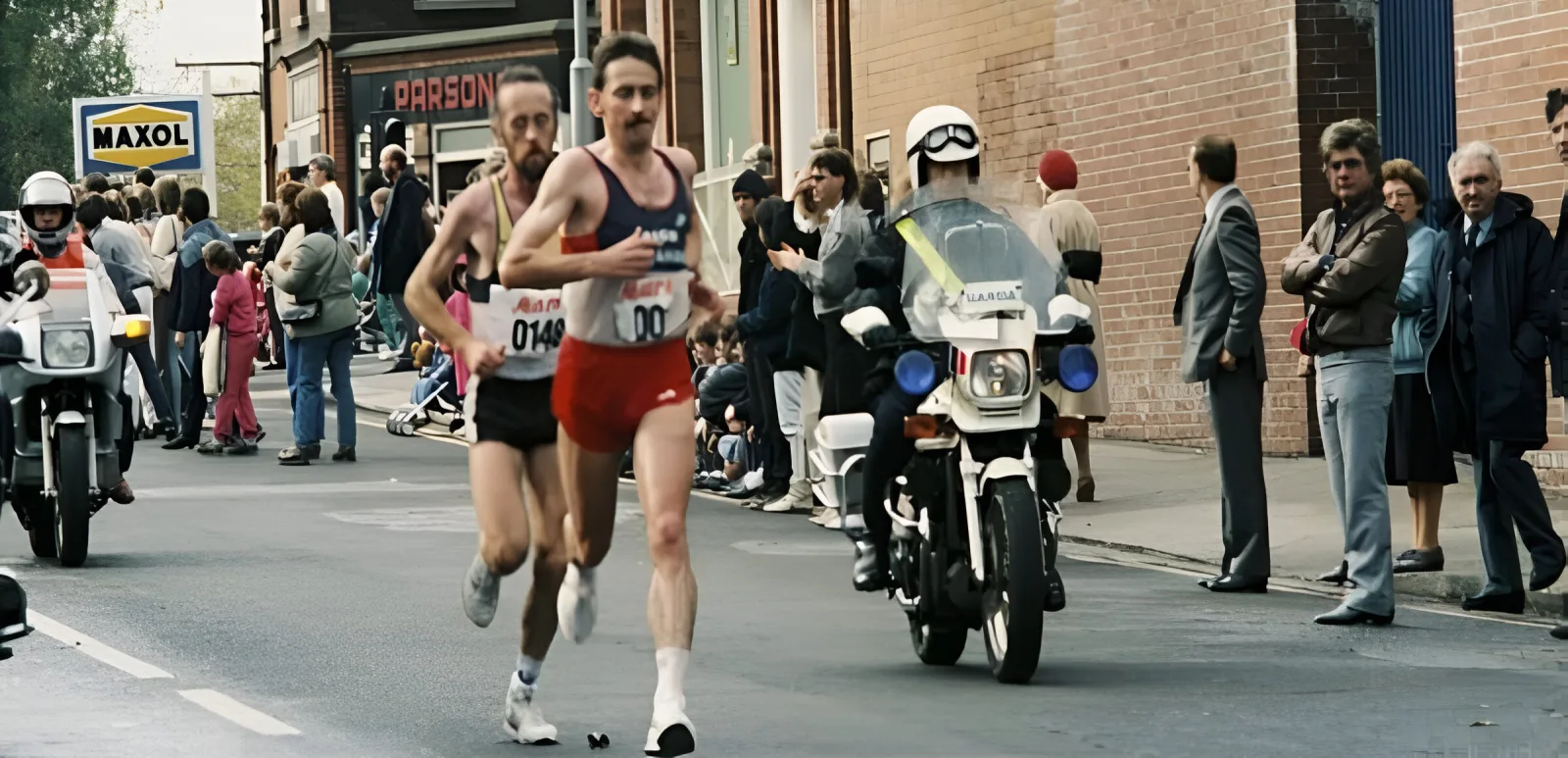
The race started in relatively mild conditions, with a field of around 5,000 runners, but it wasn’t long before complaints about the wind began to surface. The early pace reflected the tough conditions, with the first mile taking 5 minutes and 9 seconds and the next few miles similarly cautious, hovering around 5:20 to 5:30 per mile. At five miles, the leading group clocked 26 minutes and 53 seconds, a pace much slower than expected.
Hooper began to pick up the pace as the runners descended into Harold’s Cross, and only Tony O’Leary of Cork and Moroccan runner Olijab Lahbib could stick with him. However, both eventually faded, leaving Hooper alone at the front with a sizeable lead over Belfast’s Martin Deane, who had twice won the Belfast Marathon. By the time Hooper reached 15 miles, he had built up a 41 second advantage over Deane, but the race was far from over.
As the runners crossed the toll bridge and wound their way towards Fairview, Deane began to close the gap. Hooper’s lead shrank to just 30 seconds by 21 miles. Battling intense pain and fatigue, Hooper admitted later, “At one stage around the 20-mile mark, I promised myself that I would never run another marathon. I was dying on my feet and it was out of pure fear that I never looked behind me.”
Deane continued to stalk Hooper over the last 10K but never quite managed to close the gap. As they approached Raheny, the crowds gave Hooper a welcome boost, although he still looked far from comfortable. Despite Deane’s relentless pursuit, Hooper held on to cross the finish line in 2:18:10. It was his slowest winning time in Dublin, but the clock was secondary.
“My only concern over the last few miles was to keep my act together and ignore everything else,” said a visibly relieved Hooper after securing his third Dublin Marathon title.
Deane finished 36 seconds behind in second, while Eamonn Tierney of Clonliffe Harriers took third in 2:24:49, a full 6 minutes and 39 seconds adrift of Hooper.
The Women’s Race
The women’s event had its own share of drama. Maureen Hurst, a 33 year old English runner, was the favourite to win, but her race took a bizarre turn when she was struck on the leg by an accompanying police motorbike at 18 miles.
Despite the collision, Hurst maintained her composure and went on to win comfortably in 2:46:29.
The Man Behind the Wins
Hooper was a stalwart of Irish athletics whose career extended well beyond Dublin. He represented Ireland at the 1980, 1984 and 1988 Olympic Games, competing on the world stage while building a record in his home city that remains unmatched.
His Dublin victories came six years apart, beginning with the inaugural race in 1980 and ending with that painful defence of his title in 1986. The third win required him to hold his nerve as much as his pace, with Deane close enough to keep the pressure on until the finish.
Other runners have since won consecutive men’s titles: John Griffin in 1988 and 1989, Joshua Kip Kemboi in 1997 and 1998, Alexey Sokolov in 2006 and 2007, and Geoffrey Ndungu in 2011 and 2012. None has matched Hooper’s three wins.
Forty Years On
Forty years later, the lasting image of Hooper’s third victory is of a runner hurting badly, afraid to look behind him and determined to get to the finish first. Dublin has welcomed generations of champions since that afternoon in 1986, but his tally remains untouched. For all the changes to the race and the city around it, three Dublin Marathon victories still belong to Dick Hooper alone.
Image: RTÉ