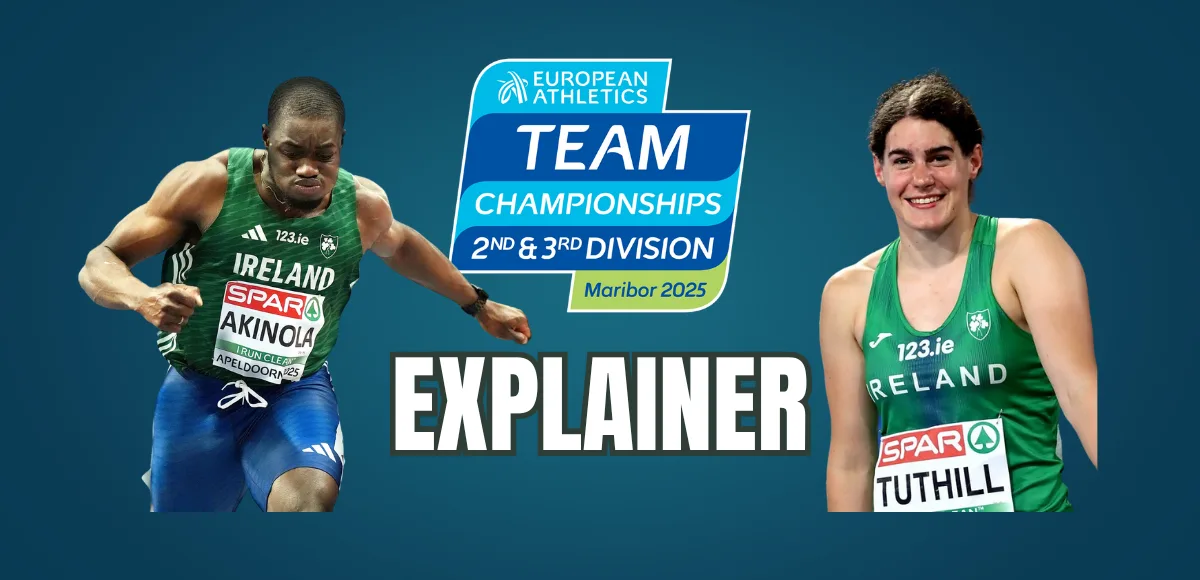
On June 28th and 29th, Ireland will compete in Division Two of what's known as the European Athletics Team Championships, set to take place in Maribor, Slovenia. But what exactly is it, and how does it work? It’s one of the few international track and field events where the spotlight shifts from individual glory to overall team performance. So rather than medals for single events, countries battle it out across the full programme - sprints, throws, jumps, relays and distance races, with points awarded for finishing positions. The goal? Finish high enough across the board to be crowned champions of your division, earn promotion, or simply avoid relegation.
How It Works
Each country fields one athlete per event. Points are earned based on where athletes finish, first place bags the most, last gets the least, and a no-show means zero. The running tally across all events determines a country’s final position in the standings.
What makes the European Athletics Team Championships different from other international meets is that there are no qualifying standards. None. Every country gets to put someone on the start line, the runway, or in the throwing circle, for every single discipline. It means you’ll often see nations competing in events where they’ve never had anyone reach a European or World Championships before. Even for a country like Ireland, it gives us a chance to be represented in less prominent field events that might not usually feature an Irish vest. It’s brilliant for the athletes, and even better for fans who want to see a full programme of events.
There are no individual medals for winning the 1500m or throwing the hammer the furthest. It’s all about scoring points for your team. In recent editions, the mixed 4x400m relay has been added into the mix too, usually landing late on Sunday and adding an extra bit of chaos.
The competition is split into three divisions, First, Second, and Third. with promotion and relegation between them. The top three teams in a division go up next time, the bottom three drop down. It’s a bit like the Nations League in football, but with shot puts instead of shin pads.
A Short History
The Championships was born in 2009, replacing the old European Cup which had run since the 1960s. Back then, men and women competed separately, and the format lacked the all-in national team flavour the current competition offers. The new version merged both genders' points, added more events, and structured the contest like a league.
Initially, there were four divisions, but that was trimmed to three in 2023, when the Championships were temporarily merged with the European Games just for that edition. That year, for the first time, athletes also received European Games medals based on their times, not just where they finished within their division.