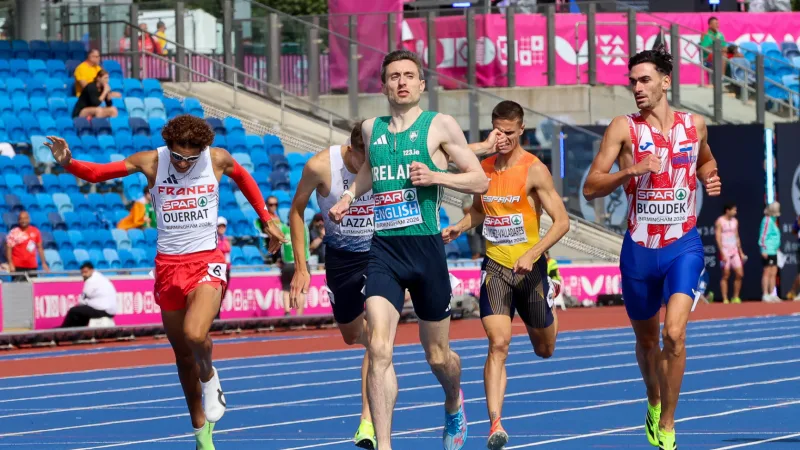
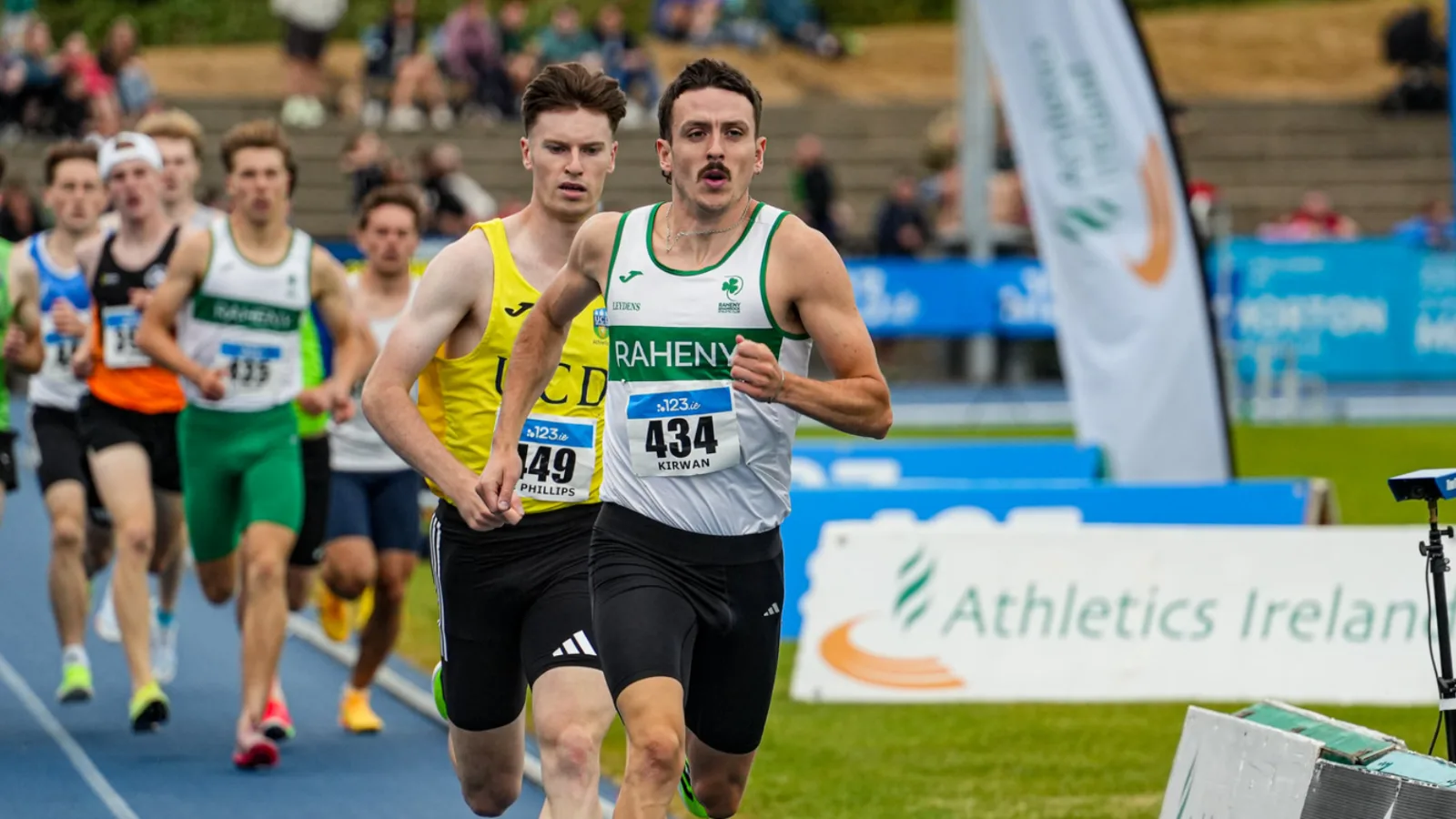
There are two ways to run a national 800m final. You can sit in, watch the lad in front, and back yourself over the last 120 metres. Or you can go to the front and make everybody else earn it.
Cillian Kirwan went to the front. He was reeled in late by Cian McPhillips and took silver in 1:49.36, on a day when the wind made a nonsense of anyone's plans, and he'd do the same thing again tomorrow.
"There's a pureness to it," he says of front running. "If you're going to beat me, you have to be willing to go there too."
The Plan, and Why Everyone Knew It
Kirwan wasn't chasing a title on Sunday. He was chasing ranking points and a time, with the European Championships in Birmingham on the horizon, and he's honest that the whole field could read it off him before the gun.
"I could have just dawdled and gone for a title. But there was more at stake."
That takes a particular kind of nerve. When your rivals know exactly what you're going to do, they only have to hold on. He does wonder aloud what the race looks like if the plan is less obvious, or if he'd arrived with a two or three week block of work behind him instead of a summer of racing. But he isn't sore about it, because for a stretch he genuinely thought he had it won.
"I thought, right, I'm going to win this. And then he just went past me."
His own assessment afterwards is clinical rather than mournful, which is probably no accident given the day job. He lectures in physiotherapy at a college in Dublin, and he breaks his own race down the way you'd break down a patient.
"I can get through 400. Six is pretty good, seven is all right. The last 100 needs work."
He also knows precisely how front running gets read from the stand. His own coach got a text from someone who hadn't twigged who he was coaching, along the lines of: the fella out front looks like he's out for a jog. He tells the story against himself and laughs. Then he makes the case for the defence.
"People come up to you afterwards and say fair play, that was ballsy. And I think you get a lot of respect for that."
It isn't a one-off. He won the national indoor title the same way, refusing to let the race become a sit-and-kick, and he'll argue the point with anyone. A slow championship 800 is a bad 800. Someone has to make it honest.
Six Weeks on the Bounce
The context for Sunday is a season that never let up. He'd been racing more or less continuously since June, across Europe, at one point taking in three 800s in three different countries in the space of ten days.
The racing isn't the hard part, he says. Three 800s won't kill you. It's everything wrapped around them.
"It's not recovering from the race that's difficult. It's getting from place to place, managing trains, planes, accommodation."
And it's the money, which is the part that never makes the highlights reel. A return flight to a meet in Brussels is a few hundred euro out of his own pocket with no guarantee the race gives him anything back.
"I'm haemorrhaging money. All the traffic on the Ryanair website is coming from me."
Race week itself was a careful bit of management. Home from a race abroad, one honest session, a sharpener in Santry midweek, then time on the elliptical to keep load off the legs. He went in physically healthy, which after the previous twelve months is not a small sentence.
He's clear about what he'd change, and he doesn't reach for the calendar to explain it.
"I didn't box clever. I didn't run the times I needed to run when I needed to run them."
That's the professional talking rather than the pessimist. He's already taken a couple of late-season starts off the table, because stacking races onto a season this long is how you finish the year with nothing at either end.
The Year It Nearly Stopped
All of which is a considerably better place than he was in twelve months ago.
"This time last year I was pretty much done with the sport. I thought I was actually going to have to retire."
He tore a hamstring in the build-up to the Morton Games, the proximal kind where the tendon takes a piece of bone away with it. The first consultation pointed towards surgery and around sixteen weeks immobilised in a brace. He's a physio. He knew exactly what that sentence meant for a thirty-year-old middle distance runner, and he says he took it as the end.
A second opinion changed the picture entirely: not as bad as it looked, no scalpel required, it needed time and respect and it would heal. It did.
The cost wasn't only the season. Part of why this summer has felt like a scramble is that he has nothing banked from the previous outdoor year to lean on for points, while the lads ahead of him have championship races still working in their favour. He's had to try to build the whole case from scratch, in one summer, while racing.
Alongside the physical rebuild there's been work with sport psychologist Kate Kirby, and you can hear it in how he talks about a hard day now. The old reaction to filthy conditions and a stacked field was dread. The new one is closer to curiosity.
"It's a great opportunity to see where you're at."
The Queue
He came up in the era of Mark English, and there's a generation arriving behind him now. He describes it, with a grin, as being stuck in a queue, and he means it as a compliment to Irish 800m running rather than a complaint about his own luck.
His view is that the event has been quietly overshadowed here by the strength of the 1500m and the distance races, largely because English simply kept winning, and kept getting better at an age when most people are winding down. Kirwan is genuinely admiring of it.
"It gives an element of depth we didn't have. And racing guys who are world class does give you confidence."
What's Next
There's a 1000m still to come, then a proper reset. Ten days completely away from it, no watch, no plan, eating whatever he likes. He's upfront that recovery is the piece he hasn't nailed, that sleep and nutrition are still where he loses marks, and that the room to get those wrong shrinks every year.
The 1500m question comes up and he isn't jumping yet. He thinks his aerobic base needs to be considerably stronger first, though he's grown to genuinely enjoy the longer work in a way he never used to. The 800 suits him because strength and front running suit him, and what he wants now is one full winter with the speed work that only properly begins in November and December before he decides anything.
"For me to get my metrics up, I think I need another year of that training before I see big gains."
Next season will be harder again, with more athletes on standards and fewer places going. He sounds entirely fine about that.
Raheny
Ask him about the club and the whole register changes.
"There's something about being on a start line for a national final as a Raheny athlete."
He talks about knowing he'll get the loudest roar in Santry because the place is full of familiar voices. About being unable to walk past the hill at home without getting stopped six or seven times. About Pat Hooper, about Brian Corcoran, who he rates as one of the best coaches in the history of Irish athletics, about a club with a real historic link to the Dublin Marathon.
The thing he's proudest of from Sunday isn't his own medal. It's that there were three Raheny men in a national 800m final, which the club hadn't managed since 1991. He's bullish about the young lads coming through, Luke Murphy among them, and reckons at least one of them is a single performance away from a breakthrough.
He's just as keen on the league system and the club's push to take it seriously, and the reason goes back to something he misses.
The Bit Nobody Sees
Kirwan grew up GAA mad, dreaming of Croke Park, and got dragged to athletics by a mother who held that if you're good at something you do it. He's grateful now. He also won't pretend he loved it at the time, and he's refreshingly unromantic about the sell.
"How do you make a sport that's a punishment for most other sports fun and exciting?"
His advice to parents is simple: bring them to a nationals or a Morton Games. The athletes are right there, and accessible in a way stars in other sports simply aren't. His advice for keeping kids in it is the team element, the leagues, the shared thing. Being the physio with his local football club's intermediate championship winning team is still one of the best things he's ever been part of, and he can tell you exactly why.
"If you lose a final you're wrecked for three weeks. But you're wrecked together."
Athletics doesn't hand you that. He's honest about how solitary the bad days are, that people will tell you they've been there and they have, but it stays uniquely yours.
He's also living proof that nobody should be written off at fourteen. He came through the schools system alongside Andrew Coscoran, who was the last lad on their county cross country team at that age and is now a world finalist.
Away from the track it's live music. He's moved from a rock and blues upbringing towards house and techno, he's evangelical about the state of the Irish scene right now, and he goes to gigs partly because he finds the pub exhausting.
"I don't have to talk. I can just be with people."
And he insists there's nothing much to report from the other ten months of the year.
"The lads are all buying houses and getting engaged. I'm running around in an oval."
He's being modest. He's running around it at the front, which is the harder way and, on Sunday's evidence, the more interesting one to watch.
Image: Jimmy English