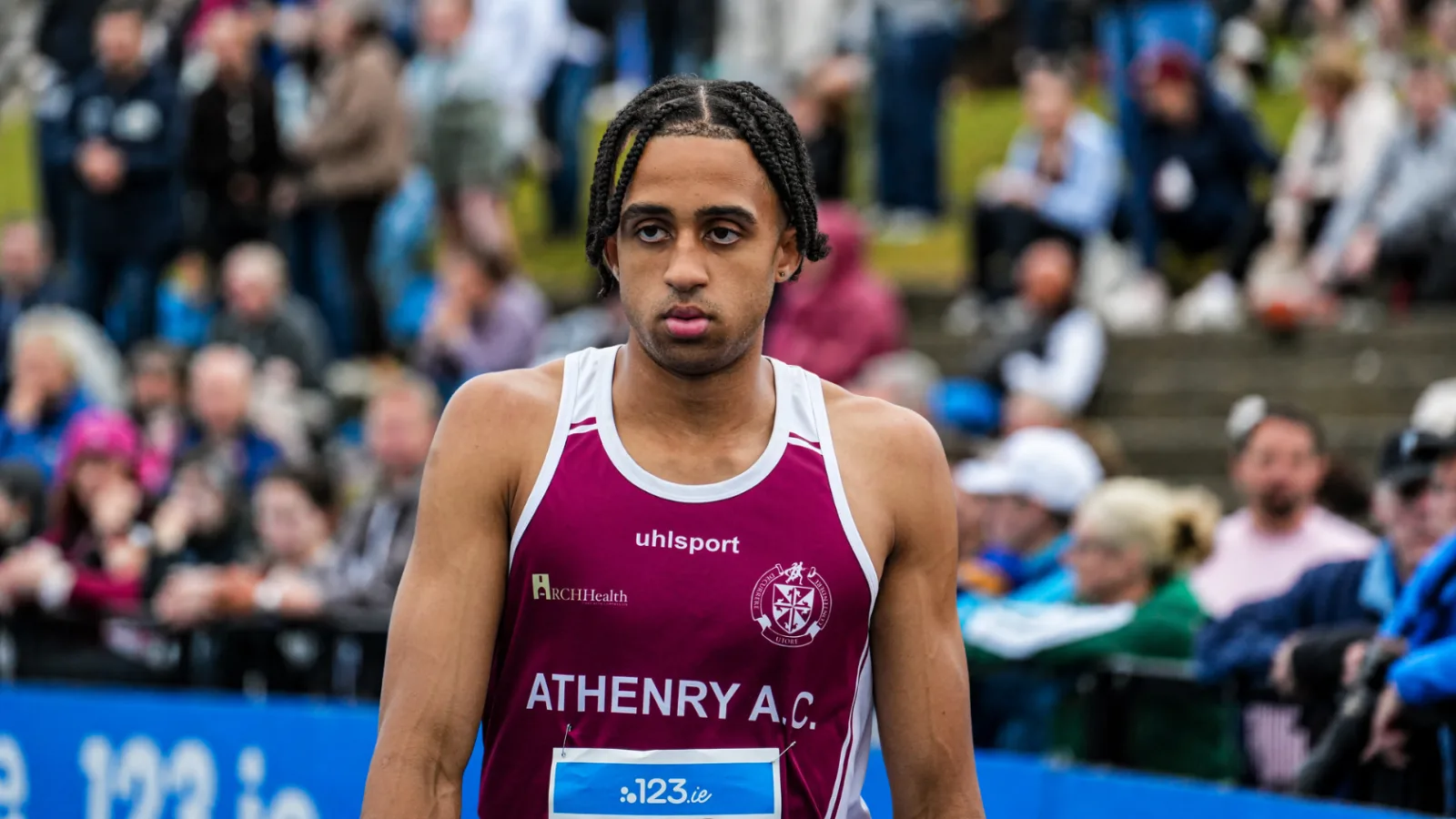
The last time RunRepublic sat down with Seán Doggett, the piece was called The Next Generation. Three years on, he's been to a senior European Championships, a World U20s, a European U20 final and the World Relays, he's a national senior indoor champion, and he's just come off the podium at the nationals in Santry.
He's still nineteen. So the headline still stands.
What a list like that doesn't tell you is how level he is about all of it. There's no hype. He'll tell you what he's good at, he'll tell you just as readily where he needs to improve. "If you run a fast time, yes, you can have your few days of happiness. Then you put the head back down and go back to work."
This is a very grounded comment from a teenager who has genuine reason to get ahead of himself. He knows the ceiling is a long way up. With LA28 an aspiration, he’s focused on getting the work done to make it a reality.
"It's crazy that all that happened in about three years," he says. "And I'm only 19. There's way more there in me. It's actually crazy to say that."
The Race that Changed Everything
The strange part is that none of this was the plan. Doggett was an 800m runner, with age-group national titles to prove it, and the 400m was only ever meant to be speed work.
Then came the Connacht juvenile championships in 2023. He'd never used starting blocks in his life.
"The blocks were terrible," he laughs. "But I came across the line in 49 seconds and I was like, what? This can't be real."
He turned around to look for his father, who is his coach, in the stand. His father was already laughing.
"He goes, yeah, maybe we found a new event."
That was it. One race, and the whole shape of his life changed. "If I didn't do that race, I wouldn't be where I am now."
The 800m hasn't left him, mind. He reckons the endurance from those years is still sitting there underneath everything, which is why almost all of his work now is speed. He hasn't ruled out going back either, eventually, and points at athletes who've gone the other direction late in their careers. But not yet.
"Right now I'm sticking to the 400, and doing more 200s, which I'm actually really happy about."
The Coach Who'd Never Done Athletics
Seán's coach is his father, Stephen Doggett. Stephen played hurling all his life and had, by his son's account, no athletics background whatsoever until three years ago, when he took it on because his son needed someone.
He leaned on Iain Shaw, another Athenry coach, for advice, took it all on board, and built it out from there.
"For somebody that has never done athletics in his life, to bring me to European Championships, World Championships, World Relays, European U20s. It's just crazy. It's mad."
The training itself is six days a week, with doubles on Tuesdays and Fridays where a gym session and a track session land on the same day. He’s not part of a group, Seán is doing it his own way, on his own, with his father by his side.
"Most people don't know this. I actually train by myself."
That's a nineteen-year-old running 46.2 for 400m and 21.3 for 200m with nobody to chase in training.
The father and son thing has its own weather. After the Morton Games this summer, where he was drawn in lane eight against men who've been running 44 and 45 seconds for years, they sat in the car and just laughed at it.
"He said, what can you do, you're 19."
The bad days are different. "If I have a bad one, talking about it is the worst thing ever." But he'd take it over the alternative, because a father can say the thing a coach might soften.
"He's my dad at the end of the day. He can say anything he wants."
He'll be watching from a distance either way. Seán's mother can't watch races at all, she's too nervous, and his father barely can.
Lane Eight, Again
Which brings us to Santry at the weekend, and a mistake he'll only make once.
He came through his heat comfortably in around 47.1, easing down to save something for the final. What he'd forgotten is that Irish lane draws are done on times.
"I shut down way too early and it did not pay off. I looked at the lane draw and put my hand on my head straight away."
Lane eight. Again. No one to see, no one to work off, the loneliest lane on the track.
His father's response was short. You know what to do now. Don't do what you did at Morton.
Then came the part he wasn't expecting. Doggett has run at a senior European Championships. He has run at the World Relays. He has never in his life been as nervous as he was on the morning of a national final.
"It's because you're at home and everybody's watching. Everyone's watching on the stream, everyone's at the track."
The instruction from his dad was simple: strong start, push off the bend. With all the nerves in the build up, he had the best start he's ever executed.
"I got out and put a big gap on already and I was like, oh my goodness, this is crazy. But I knew I wasn't able to hold on."
He held his position, ran 46.8 out of lane eight in windy conditions, and took his place on the senior podium.
"I couldn't ask for any more. I was really happy. It was a really good weekend overall."
There was a reason he wanted that podium so badly. It was insurance.
"I've been up there with the senior lads this year. But I wanted to make sure. If I finished on the podium, they'll guarantee you a spot."
They did. Doggett has been selected in the men's 4x400 for the European Championships in Birmingham, his second senior Europeans in a row, at nineteen.
Learning At The Deep End
He's still slightly startled to be in these rooms at all. The athletes he lines up with now are the ones he grew up watching on the television.
"I remember my first championship in Rome in 2024. Jack Raftery, Chris O'Donnell, Thomas Barr. I'd seen all these athletes since I was really young, and then I'm going to championships with them, talking to them, training with them."
He's equally clear that this is a good time to be an Irish 400m runner, and that it wasn't always so.
"There's so many people running sub 47s, 46s, 45s, 44s. That hasn't happened in a while."
He's grateful too for the support around the national setup, especially the time spent with the high performance coaches at the World Relays. "They know way more than anybody. They know what's right for you." His view is that Irish athletics is on a genuine rise, and that the money going in is showing up on the track.
We asked him what the singlets mean and he doesn't hesitate, but the order might surprise you. The Athenry one comes first.
"I've lived in this small town for so long. Someone will say fair play to you every weekend, and that small message just means so much."
Then the green one.
"Representing your own country at any sport is the best feeling ever. I'm never ashamed to wear my Irish stuff. I love it."
Texas, a Hurley, and a Microphone
The next chapter starts in a few months, and it's a big one. Doggett is moving to America, to South Plains College in Texas, a junior college development programme with a strong 400m setup, to train under coach Wes Miller. The plan is a year there, then a transfer to a Division One school.
The reasoning is clear-eyed for a teenager who could probably have forced the issue.
"I'm not ready for Division One yet. I've never been in that kind of big environment. I want to start smaller, build my way up and get faster there."
He's also going to study broadcast journalism, an ambition that started, of all places, in a mixed zone.
"My first ever interview was with David Gillick, back in 2024. It was spinning in my head afterwards. I was like, that job looks pretty cool."
He journals almost every day already, writing down what he does and how it went, which is a habit that will look very clever in about ten years' time.
Beyond that, the ambition is exactly what you'd expect and no less serious for it.
"The ambition is the Olympics. Simple as that. Even if I go at 21, that'd still be incredible."
He knows the shape of the work required, too, and describes it in a way that sounds like it came from the car on the way home from a lot of races.
"I just want to get quicker and quicker every year. It sounds easy, but it doesn't come that easy. You have to work hard and keep your head down."
Away from the track, it's coffee with friends he never gets to see, the PlayStation, and, lately, a hurl. He played until he was eight or nine, lost interest entirely, and has found his way back to pucking a ball around and going to matches. Whether the hurl makes the flight to Texas is between him and Aer Lingus’ baggage policy.
Athenry
The thing he keeps coming back to is the club, and what's happened to it since the new track went in three years ago.
"Ever since that, everything's just gone up and up. There's so many kids doing athletics now."
He tells a story about being told by his dad to go down to the track after a relay call-up and talk to the juveniles.
"They would not stop talking to me. They were so interested. What do I eat, how do I train, do I sleep more. Kids ask silly questions, but they're funny questions."
He's genuinely moved by it, and clear about what he owes the place. "I'm not going anywhere. I'll be staying with Athenry as long as I can."
Then there's his advice to parents, which he delivers with more force than anything else in the conversation, because he thinks a lot of people are getting it wrong.
"There's a mistake parents are making. They're picking the events for the kids. You see it in other sports too, you have to do soccer because your dad did hurling. I don't think that's how it should work."
His own route was the opposite. He tried every sport put in front of him, every event, for years.
"I did every event. Name it. And I finally picked the one event I liked, and I don't regret it at all."
So let the kids try the lot, he says. If they don't like it, fine, try something else. Keep going until something sticks.
He also had one last thing he wanted in this piece, for any young athlete or any parent reading it, and it's his, word for word.
"Believe in yourself. A lot can change in a year. I never thought the day would come that I'd be representing my country, at such a young age. So believe in yourself, never give up, and always dream big. Because if you dream big, it'll come to you."
Image: Jimmy English