Peter Connolly was lying on a trolley in Connolly Hospital in Blanchardstown in 2023, in the middle of a double stroke, and the staff kept asking him the same questions. His name. His address. His date of birth. Over and over again.
He spent his working life as an IT project and programme manager, and that part of his brain was still clocking in.
"In my head I was going, holy God, these staff are awful. They're not writing this down. Why do they keep asking? What are their systems like? I must have a look at their systems when I get out of here and I feel better. We have to improve this."
It was a long time afterwards before he realised they were checking whether he was still in there.
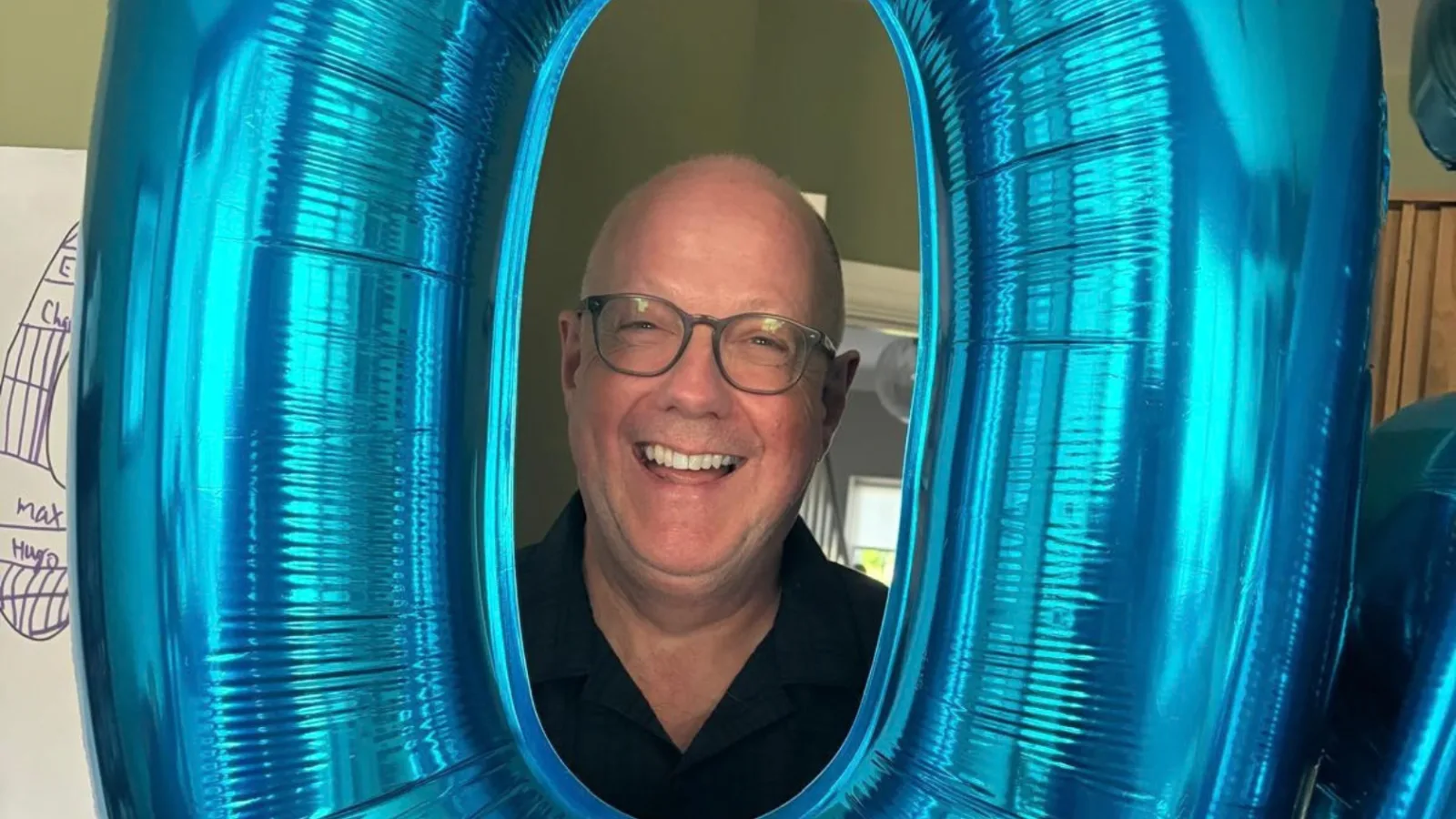
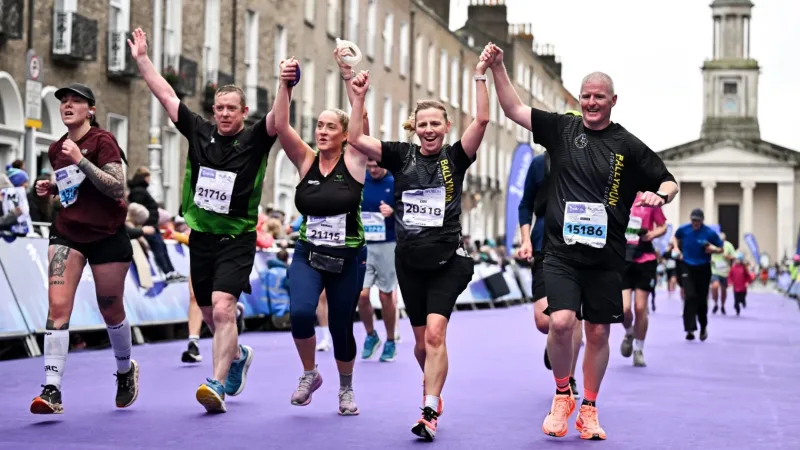
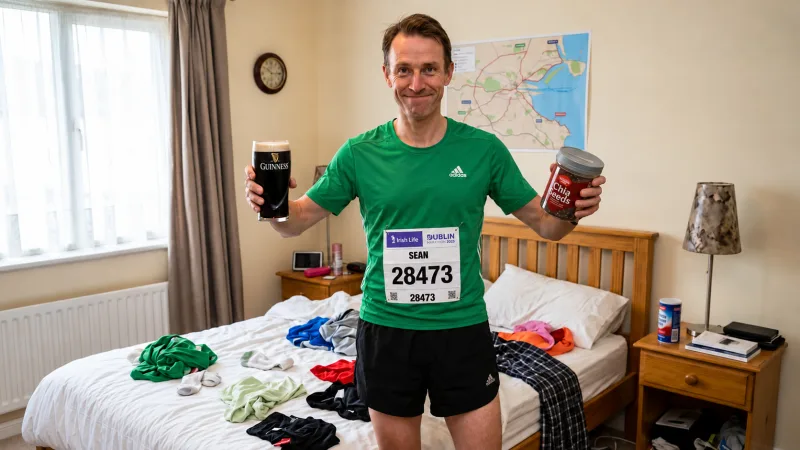
This October, at 60, Peter will run the Dublin Marathon for the Irish Heart Foundation, the charity he went looking for himself when he was released from hospital without a recovery plan..
Blanchardstown, Lucan, Dunshaughlin
Peter grew up around Blanchardstown and went to Coolmine Community School. He met his wife Rachel when he was 19 and married her at 24. They raised three children in Lucan before moving out to County Meath about twenty-three years ago, and into Dunshaughlin village itself around four years back. There are four grandchildren now, and all of the family live close by.
He did a computer course after school and went into programming in the early eighties, and from there into project and programme management. It was big work. He spent five years as global programme manager for a pharmaceutical clinical research company with 10,000 staff across 48 countries, pulling the divisions onto common processes, among other initiatives.. He worked on the Building Schools for the Future programme in the UK. And he worked as a consultant to one of the largest councils in Ireland, who asked for him by name as project manager on a national initiative worth millions.
That last one is what he's proudest of, and the reason is telling.
"They trusted me. That's the biggest thing to me. Integrity."
The Day
Peter was working from home at the tail end of COVID, sat in front of three screens, when he noticed pins and needles in the sole of one foot. Being Peter, he started debugging it. Why the sole and not the top of the foot. Why not the ankle, or the calf.
Then the three screens merged into one.
Rachel was working from home that day too, doing paperwork for the Montessori she runs, with the doors open between the two rooms. He managed to get out that something wasn't right, and she was in to him straight away. Because of her business she keeps her first aid training current, and she recognised what she was looking at almost immediately. She was on to the emergency services in moments.
He can't praise the ambulance crew enough.
"They were amazing. I remember my wife saying they were here so fast."
They took him to the nearest hospital rather than the one he'd normally go to, because with a stroke every minute counts. He remembers a clinician telling him she was about to give him something that would burst the clots.
"Now What?"
Four days later he was at home in Dunshaughlin, and this is where Peter's story turns from a medical one into the reason he's running.
There was no plan. No follow-up appointment he knew of, and no contact number he could remember being given. Someone would be in touch. It was about eight weeks before an advanced nurse practitioner made contact, due to the workload, and when she did she was excellent, but she had been dealing with people in far worse shape than him first.
"There was no plan. There was no contacts. I just remember sitting there going, now what? There's a huge sense of now what? You just sit there and it's just silence."
His peripheral vision was broken in a way he describes vividly, like a film running alongside whatever he was actually looking at. He was sleeping twelve hours a night and then again during the day. Words wouldn't come when he wanted them, he couldn't hold on to what had just been said, and he couldn't read.
Nobody had told him which of those things were normal, or temporary, or permanent.
So he fell back on the one tool he trusted, which was project management. What's the plan? He threw puzzles at himself, sudoku and crosswords and word searches, on the theory that he needed to rebuild the pathways. He negotiated with Rachel, whose first aid training was listing every way it could go wrong, to be allowed walk the few hundred metres to the coffee shop and back on his own.
The eyes were the most pressing problem, and the route to getting them seen was going to mean paying a GP €70 or €80 for a referral. So he went into Vision Express instead, explained what had happened, and asked them to take a look. They confirmed what he suspected, that he did not need an ophthalmologist, and it saved him a fair bit of worry and waiting around in the process.
And he did something he'd never needed to do before, which was type "stroke help" into Google.
"It's not something I'd ever done before."
He contacted a few organisations. One engaged with him partially. The Irish Heart Foundation came back to him properly, just ahead of the nurse practitioner.
The Vuelta
One of the strangest details of Peter's recovery is also one of the most useful for understanding what a stroke does.
He's a huge rugby fan, but he found he couldn't watch rugby. Football was no better.
"It goes this way and that way and this way and that way, and my brain couldn't deal with that."
What he could watch was the Vuelta a España, which happened to be on at the time, because everybody was going in the same direction. He watched it every day, and came out the other side a genuine cycling fan.
The rugby has come back since. Reading and complexity have been slower. It took him over a year to open a book his son-in-law gave him, and he got through a Rory McIlroy biography largely because the scores gave him numbers to hold onto. Numbers were never the problem.
He describes what he lost in terms of what he used to be paid to do.
"As a PM, on multiple projects and programmes, you'd have your mental pin board. I'd go ping ping ping ping. Now if you give me three things, I've lost two of them. Sentences can take ages to understand."
The Circle of Chairs That Wasn't
The Irish Heart Foundation pointed Peter to the Young Stroke Survivors Network, which meets in Kilmainham. He was pleased about the word young, having only just crossed the threshold. He was a lot less pleased about the phrase support group.
"For me, support group meant what you saw in movies. You walk in, everyone's sitting in a circle of chairs, and it's, my name is Peter Connolly, I'm dry for eighteen months. I thought, oh crap. Well, better try it."
It wasn't that at all. It was an hour of exercise, run by Irish Heart Foundation staff with a fitness instructor trained to work with cardiac and stroke patients, chatty from start to finish, and followed by coffee. And it turned out to be the most important thing that happened to him.
"The support groups, although I thought they're going to be lame ducks, turned out to be the most valuable thing for anybody who's had a stroke. It allows you understand, encourage, and be encouraged."
Some of the people in that room were seven years on and still couldn't use an arm or a leg, or speak clearly. Others knew exactly what he meant when he described a quirky feeling in his hand. That second part mattered, because it was the thing nobody at home could give him, and he's careful not to blame them for it.
"Nobody else wants to deal with it. Nobody else is comfortable remembering that their loved one just had a stroke. Nobody else wants to know you're feeling a funny, quirky feeling, out of fear it might be coming back.. The stroke group gave you that."
He has since done every course the Foundation offers, on fatigue, on diet, and on returning to work. He fed back that the first version of the return to work course was pitched far too high, all LinkedIn and CVs, when what he actually needed to know was whether he could work at all. They rebuilt it and ran it again.
Who Am I?
Sitting in that chair waiting for the phone to ring, Peter says, a third question arrived behind the physical and the mental rehab.
"Who am I? Because all I had been was the guy who got up in the morning and went through the traffic, or went straight to my screen when working from home, and worked all day and then came home absolutely wrecked, tried to be dad, tried to be husband, went to bed. I had space to think, actually, who am I? I've never given time for me."
Two answers came back. He used to be the guy who ran. And he liked to sing.
He joined the Irish Heart Foundation choir, discovered he had a decent voice, and sang with them at a European stroke conference in Dublin. From there he joined a community choir near home, which now has a proper fixture list, from Fairyhouse at Christmas to the three-day Dunshaughlin Harvest Festival, and talk of maybe a trip abroad planned for next year. Remembering the words is still a challenge, as is remembering where he is in the song. There are three or four men in it, and a lot of women, and it has quietly become the main social outlet in his week.
He's also become an Irish Heart Foundation patient champion, which covers a lot of ground. Media interviews. Filling in to host support groups when someone is sick. Advocating for the Foundation. A trip down the country to a shop on a crossroads, the centre of its community, where a family wanted to give something back to the Foundation and asked him to come down for a photoshoot. Other patient champions travel to Europe to lobby alongside bodies like the German Stroke Foundation for better support and better links between countries.
And there have been presentations in Leinster House. One of the ones Peter was part of led to the formation of a cross-party cardiovascular group in the Oireachtas, to push initiatives and funding forward. He remembers TDs and senators coming into the room and openly acknowledging their own conditions, and a senator sitting behind him in tears, because some of the people speaking were still living through it.
Two of those people stay with him in particular. Both have had open heart surgery more than once, both have had a stroke on top of that, and both have ongoing problems with their arteries. They're also among the most active people in the Foundation.
"If that was me, I'd be just happy to be lying on the bed. And these people are calling up and it's, now I have to do this, have to do that. They're incredible people. They're highly inspirational people."
It's their enthusiasm, he says, that makes it easy to get involved.
"Physically I'm in a pretty okay place. It's just mentally I'm not in a great place compared to the person I used to be. When you see the people in the worst place, it's easy to get involved."
The Funding Gap
This is the part of the conversation where Peter's voice changes, and it's the reason the marathon matters beyond his own finish line.
He points to the scale of the problem, with around 600,000 people in Ireland likely to be carrying a cardiovascular issue, many without knowing, and a similar number who have survived a major event and need ongoing support. And then to the money.
"The funding cardiovascular gets is minuscule compared to the likes of cancer. The first time the Heart Foundation actually got government support, I believe, was two years ago. And it was a figure in the hundred thousands. The Irish Cancer Society are in the millions."
What the Foundation does with what it raises is, in his experience, exactly what got him through. The support groups around the country and the exercise classes that run with them. The courses for survivors. The prevention and information work on eating, exercise and warning signs. And the mobile unit that travels the country doing blood pressure and blood checks.
The Sprinter
Peter was always a runner, even if the running kept disappearing on him.
He wore glasses from the age of ten or eleven, which made anything with contact awkward, so football was a social thing and running was where he competed. At Coolmine he was a sprinter, doing the 100, the 200 and the relay at the schools championships in Santry and Belfield, and at 16 he won the West Leinster 100 metres in The Iveagh Grounds..
None of it involved much in the way of training. He remembers being on the blocks in Santry, running anchor for the relay, and getting chatting to the lad in the next lane, who was describing early starts, a special diet and sessions after school, and asking what Coolmine did.
"And I was going, play football at lunchtime? That was our training."
They won the relay anyway.
Rugby arrived in his final year, when his woodwork teacher, a founder member of Coolmine RFC, gathered a crew of fifth and sixth years and got them thrown around in the muck. Peter ruptured the intercostal cartilage in his chest in one of the few matches they played, and spent weeks taking very shallow breaths. He credits it, with some embarrassment, for getting him through his oral Irish in the Leaving Cert, when the examiner took one look at him struggling to answer and kindly took over most of the conversation.
The best story from those years, though, is the 800 metres. On the day he won the West Leinster title, one of the school's under-18s went over on his ankle and the PE teacher, Desi Rogers, went looking for someone to fill the 800. Peter had never run 800 metres in his life. He planned to sit in third or fourth and avoid humiliation, and with 100 metres to go he gave up on the plan.
"I went, stuff this. I might as well let it all out. And I sprinted like a lunatic, and I finished second."
He wasn't allowed keep it, being in the wrong age group.
After school the running came and went in waves. Early eighties Ireland meant getting a job and not much else, and then came a career and a young family. In his mid-forties he got properly fit again, on his own and never in a club, running three 10ks a week on Monday, Wednesday and Friday with a longer run at the weekend. He ran a 39 minute 10k on an up and down road between Dunshaughlin and the Trim road, usually in the dark and usually into the wind.
That ended at a roundabout on the Trim road, when a lorry came round wide and he stepped onto what he thought was grass, went over on his ankle and twisted his knee. He never had it looked at and never really got the running back.
The Bug
What brought it back was watching his daughter and son-in-law run the Dublin Marathon. His son-in-law's father had died suddenly of a heart event in his fifties, and the family's connection to the race runs through that loss. One or two people from Peter's exercise group were running too.
He went along to cheer, at Castleknock and again at Ballsbridge.
"That's when some bug bit me good and hard. And I went, oh, I need a bit of this again. I need to be doing this stuff."
Getting to a start line has not been simple. He lost five or six months to knee rehab before he could build anything. Then he did a two-day coast to coast charity cycle to Laytown with a group from Ashbourne, and tore his right calf, which cost him another four or five weeks. Coming out of that, the peroneal tendon and Achilles in his right foot started complaining, and the knees chimed in to say they were still around.
He started marathon training on 2 September.
He runs Monday, Wednesday and Friday, with a longer run on Sunday, and no intervals this year. He swims for the cardio, which was the first instinct he had the moment he was cleared to drive after the stroke, building from a single length back to a kilometre. He does his rehab daily, with extra quad, calf and glute work on recovery days, and he sees a nutritionist who was happy with what he was already doing and has trimmed one or two things.
He has himself pencilled in at around 4:30, possibly 4:45, and he's honest about why he wrote down the quicker one.
"I've noted myself as 4:30 because I believe there's still room for improvement."
The race plan is simple. Run as far as he can, and then go one minute running, one minute walking, to the finish.
As for why he'll get there, he's very clear.
"I'm running out of time here for the marathon. And I am not letting the Heart Foundation down. And I'm not going to have my daughter say to me, oh yeah, I did a marathon, I finished it twice, Dad, why didn't you? So I am doing a marathon."
At the Moment
Peter isn't back at work, and he talks about what he has instead with a phrase he keeps returning to.
"At the moment, I can take some of the load off Rachel. At the moment, I have time to run and do my rehab. At the moment, I have time to sing. At the moment, I can be granddad to my four grandchildren. The meaning of that in my life is massive, because I would have been this distant figurehead person. They would have seen me once in a while. But they actually know me."
He's equally honest about what hasn't healed. I still have problems with reading, words, memory and anything even slightly complex. Near the end of our conversation, unprompted, he said that three and a bit years on he still can't talk about the stroke itself in detail without breaking down.
"It's not me feeling sorry for myself. It's something from deep in here that I can’t control."
Look After You
Peter's message for anyone reading this comes straight out of the life he had before, the one where everything was the next deadline and the next report.
"People need to be able to take that step back and say, no. I have to look after me to be able to achieve anything else. If you don't look after you, you can't look after anyone else or anything else."
He means it practically, too. He twice offered, during the interview, to meet any stroke survivor for a cup of tea and talk about rugby, football, or nothing at all.
"If I can give something to someone, always, always, always."
High Fives
Peter has one more plan for the day, and it comes from standing at Castleknock and Ballsbridge watching his grandchildren's faces every time a runner came over to them.
"I'll give as many high fives as I can to as many kids as possible, because I saw what it meant to my grandkids every time someone gave them a high five."
He's going to do the same all the way round Dublin. He may need the hand sanitiser at the end.
You can support Peter's fundraising for the Irish Heart Foundation ahead of the Dublin Marathon here.
Know the signs of stroke, F.A.S.T. Face: has it fallen on one side? Arms: can they raise both? Speech: is it slurred? Time: call 112 or 999 immediately.