
Blogs
French Sailor Accidentally Outs Aircraft Carrier Location After Uploading Run to Strava
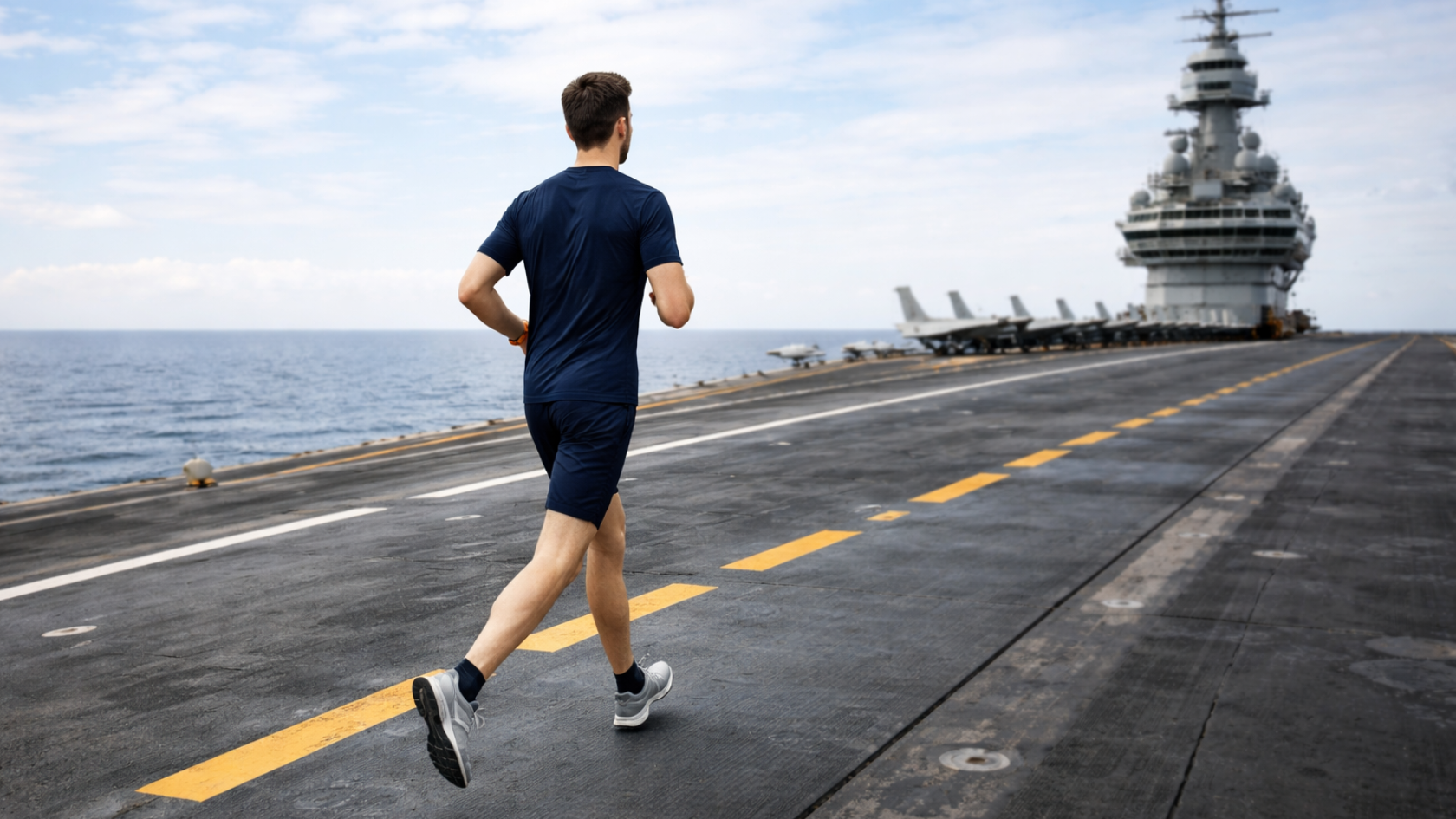
There are bad runs. There are slow runs. There are runs where your watch dies halfway through and you question your entire existence. And then there’s this. Last week, a French sailor managed to turn a casual jog into what can only be described as a minor intelligence incident after uploading his run to Strava… while onboard a nuclear aircraft carrier in the middle of a geopolitical hotspot. You could not script it.
A Casual 4.3 Miles & A Slight Security Breach
The run itself was fairly standard. About 4.3 miles. Roughly 35 minutes. Likely just laps of the deck to keep the legs ticking over. The problem was not the run. The problem was everything that came after. The sailor uploaded the activity publicly. GPS data included. Map included. Route included. And just like that, the location of the Charles de Gaulle was sitting there for anyone to see. Not vaguely. Precisely. Northwest of Cyprus, around 100 kilometres off the Turkish coast, according to follow-up analysis using satellite imagery. That’s not “somewhere in the Mediterranean”. That’s “you could probably draw a circle around it and send a postcard”.
When Your Cooldown Becomes Open-Source Intelligence
This is where it goes from mildly ridiculous to properly surreal. The aircraft carrier was deployed during heightened tensions involving Iran. It is not exactly the sort of place where you would expect someone to be casually broadcasting their location to the internet. Yet here we are. And the mad part is, from a runner’s point of view, it makes perfect sense. You finish a run. You upload it. You check your pace. You maybe give it a title like “Easy Deck Miles” or “Keeping It Ticking Over”. You don’t sit there thinking: “Is this going to compromise national security?” Because, in fairness, that’s not usually part of the post-run routine.
This Is Not Even The First Time
If this sounds like a one-off, it’s not. Investigations have already shown that publicly shared fitness data has been used to track the movements of presidential bodyguards, identify locations linked to high-profile political figures, map patrol routes of military personnel, and highlight previously unknown military bases via heatmaps. All through Strava. The app has over 195 million users globally. That’s a lot of runners, cyclists, and gym-goers casually logging their sessions. And occasionally, without realising it, handing over useful information to anyone paying attention.
The Heatmap Problem Runners Ignore
Most runners have heard of the Strava heatmap. Few actually think about what it means. It is, essentially, a giant global map of human movement. Every public activity layered on top of each other. In a city park, that’s harmless. In a military zone, it’s a different story entirely. What looks like a harmless cluster of runs can quickly become a pattern. And patterns are exactly what analysts look for. The same feature that helps you find a nice loop on holiday can also highlight places that were never meant to be visible.
So What Can Be Done?
Let’s be honest. Nobody reading this is about to accidentally leak the position of a nuclear aircraft carrier off Cyprus. But the underlying point still lands. Most runners treat apps like Strava as a harmless add-on. Something you fire up, forget about, and check later for splits. In reality, you are logging your exact routes, your habits, your timing, and your location patterns every single time. Usually, that’s grand. Until it isn’t.
The Most Relatable Part Of All This
Strip away the warships, the geopolitics, and the headlines, and what you’re left with is something oddly familiar. A runner finishing a session and thinking: “Right, better get that uploaded.” No second thought. No hesitation. Just straight onto the app. In this case, it just happened to involve one of the most valuable military assets in Europe. Which, in fairness, is probably the most extreme example yet of runners refusing to let a session go unrecorded. If it’s not on Strava, did it even happen? Apparently, even national security has limits.

Sharlene Mawdsley Returns to Action in Madrid Tomorrow With Sub 50 in Sight

Rachel McCann Ready for Belgium Test This Evening

Rhasidat Adeleke to Headline Irish Interest in Luzern Tomorrow Evening

Running in the Heat: Why Slowing Down Today Can Make You Faster Tomorrow

Ireland Set to Miss Chance to Defend European Mixed Relay Title

How to Watch Cian McPhillips & Nick Griggs in Action in Belgium Today