Written by Martin Nutty
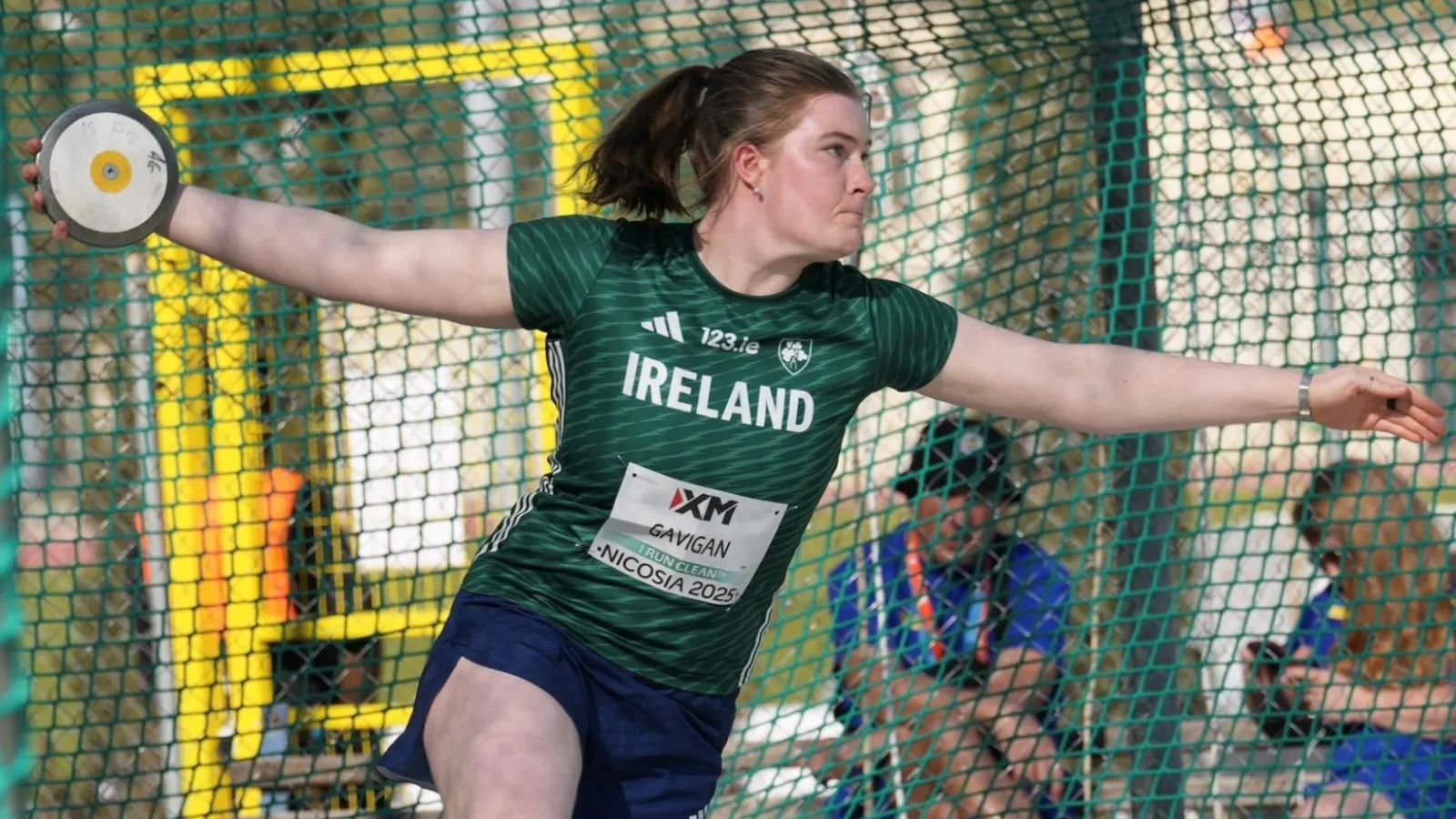
In my last article I focused on how long jumper Lauren Callaghan missed qualifying for the upcoming European Championships in Birmingham. Callaghan is not traveling because Europe found her wanting, but because Athletics Ireland's self-imposed domestic B standard stopped her. Anna Gavigan just missed it the same way, in the same selection cycle, in a different event. Her season's best, 57.38m, an Under-23 record set in June, sits 42 centimeters short of the Irish B standard in the discus, 57.80m. Same shape of miss, different event, different athlete, same self-imposed wrinkle.
At 21, Gavigan is coming off the best two-year stretch of her career. Her season's best didn't come out of nowhere; it capped a rise that's been building since she was a teenager.
The Math of the Field
Thirty athletes will make up the discus field in Birmingham. European Athletics' own published breakdown shows how those 30 spots split: 16 secured automatically by clearing the 61.00m entry A-standard, 1 reserved for Jule Insinna of Liechtenstein under a universality rule guaranteeing one entry to a federation with no other qualified athlete, and the remaining 13 filled by World Ranking position.
Gavigan's 57.38m is 3.62m below the outright A-standard, so that entry route was never in play for her. Her only realistic path was one of those 13 ranking-based slots. She sits 46th among European discus throwers with 1,013 ranking points.
Being Better but not in the Running
Emily Conte of Italy is entered in the Birmingham field based on one of the 13 ranking-based slots. Conte’s ranked 47th with 1,012 points. That’s one place worse than Gavigan. One point worse. The Italian thower’s season's best, 56.17m, is also well short of the automatic A-standard, so she's competing purely on her ranking position, the same route that was theoretically open to Gavigan.
If those 13 slots were filled in strict rank order, Gavigan should have been pulled in ahead of Conte, not left home while Conte competes. She wasn't. The reason is written into Athletics Ireland's own selection policy: “Athletics Ireland requires athletes qualifying by virtue of World Rank to also have achieved a B standard.” That's not a soft preference. An Irish athlete without the B-standard isn't eligible for the World Ranking route at all, regardless of her actual European ranking position.
Gavigan's 57.38m falls 42 centimeters short of the 57.80m B-standard. Under Ireland's own written rule, that alone kept her out of the pool of candidates for the 13 ranking-based slots, independent of where she ranked relative to Conte or anyone else. Italy doesn't appear to impose an equivalent domestic gate on its own athletes' access to the World Ranking route, which is exactly why Conte, ranked worse, ended up with a slot that a better-ranked Irish athlete never got to compete for.
That's the same pattern as Callaghan's case in the long jump, an Irish athlete who outranked the athlete who actually got the spot, kept out not by Europe's own filtering process but by a domestic standard that removed her from consideration before that process ever had the chance to weigh in.
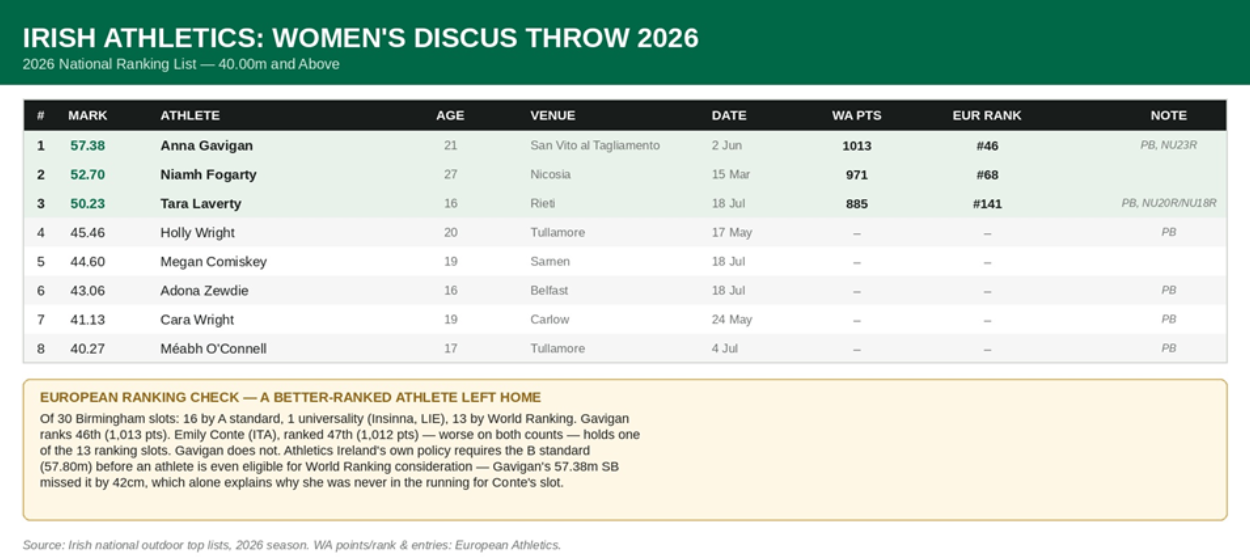
Photo: 2026 National Ranking List (40m+) with European Ranking Check
The Five-Year Climb
Gavigan's progression isn't a single good season. It's a genuine five-year build:
• 2022: 47.95m
• 2023: 49.32m
• 2024: 49.10m (a flat year, essentially unchanged)
• 2025: 54.20m (+5.10m)
• 2026: 57.38m (+3.18m), Under-23 record
That's 9.43 meters over five years, for an athlete who was 18 when this window opened and is 21 now. The flat year between 2023 and 2024 matters: it means the last two seasons aren't a fluke or a single breakthrough meet. They're a plateau that broke, followed by a second big jump, the shape of a career still climbing, not one that peaked and got lucky once.
Discus Takes Longer Than Most Events, and Gavigan Is Still Early
There's a broader point worth making about discus specifically: it's a slow-developing event, and a standard that doesn't account for that is a poor fit for judging someone still on the way up in it.
The average age across the Birmingham field is 28, with a median of 26 (the average is pulled upward by Melina Robert-Michon of France, competing at 47 in what's reportedly a record eighth championship appearance). Peak competitive age in the discus sits solidly in the late twenties, later than most track events and most jumps. Gavigan, at 21, is seven years below the field's mean age and five below its median. She isn't just improving, she hasn't reached the age range where discus throwers typically peak at all.
Then There's Niamh Fogarty
Ireland's national record in the discus belongs to Niamh Fogarty, who threw 58.40m in 2025, sixty centimeters beyond where Gavigan's season ended this year. Fogarty is the standard any Irish discus season gets measured against, and her own five-year record reveals the ups and downs in a thrower’s career.
Here's her full five-year record:
• 2022: 53.95m
• 2023: 51.81m
• 2024: 56.49m
• 2025: 58.40m (national record)
• 2026: 52.70m
Her net change over five years is actually negative, down 1.25m, despite setting the national record in the middle of that window. She built steadily for three years, peaked, and then dropped nearly six meters the very next season.
That 2026 drop has a context worth naming. Fogarty, based in Denmark, lost her coach, Michael Bruun Jepsen who passed away in March 2025, roughly a month before she set her national record. Jepsen was a significant figure in Danish athletics, national throws coach for the Danish federation from 1996, later its talent development coach, and someone who had worked with elite throwers including Joachim Olsen, the shot putter who won Olympic silver in Athens in 2004. Fogarty’s 2025 record came in the immediate aftermath of that loss, before its full weight on her training likely set in. Her limited action and reduced output in 2026 line up with the kind of disruption losing a long-term coach causes. It isn't offered as an excuse. It's context for why a single down year shouldn't be read as decline.
A standard measured against one season doesn't know whether it's catching an athlete at her absolute peak or mid-recovery from a disrupted year, it just applies the same number either way. Fogarty's career shows how easily that can land on a down year for reasons that have nothing to do with her ceiling as a thrower. Gavigan's shows how easily a domestic gate can remove an athlete from a competition she was ranked well enough to contend in.
Tara Laverty Is the Third Name, and She's Sixteen
Neither Gavigan nor Fogarty is the whole story here. Ireland currently has a third discus thrower with a real case for a future in the highest tier of the sport, and she's still in secondary school.
Tara Laverty threw 50.23m this season, a personal best and both an Under-20 and Under-18 national record and finished fourth at the European U18 Championships in Rieti in July. She's 16. A year earlier, her season best was 43.45m. That's a 6.78-meter jump in a single season. There’s likely moreto come with the right kind of support and encouragement.
Two more details are worth sitting with. Laverty finished second at the Irish National Championships, beaten only by Gavigan, ahead of several senior athletes, at 16. Worth noting, her personal best, the mark that set both national age records, didn't come at a quiet club meet. It came at the European U18 Championships itself, under the kind of crucible pressure that tends to expose younger athletes rather than bring out their best. She produced her biggest throw of the year on the biggest stage she'd faced. That's not just talent, that's composure, and it's a harder thing to teach than discus technique.
Laverty isn't part of the selection argument the way Gavigan is, her mark sits well below both the European entry standard and Ireland's own B standard, and nobody expected otherwise at 16. She belongs in this piece for a different reason. A federation that should be worried about depth in an event doesn't just need its best thrower to keep improving. It needs to encourage the pipeline behind her. A 16-year-old finishing second nationally and fourth at a European championship, needs to know that her career will be supported by Athletics Ireland.
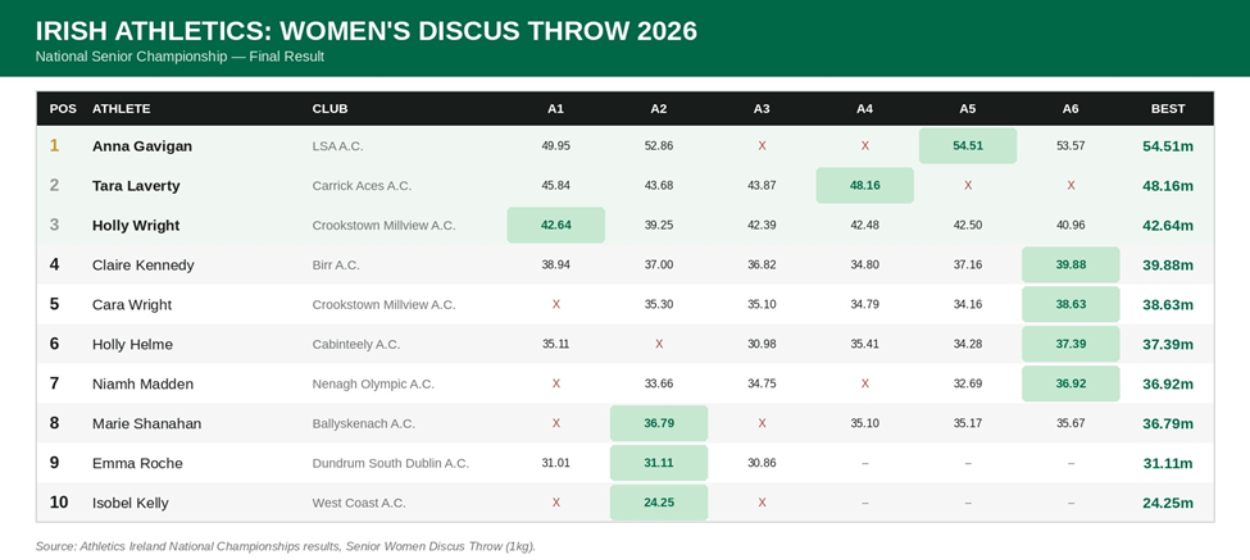
National Senior Championship — Final Result, Senior Women Discus Throw (1kg)
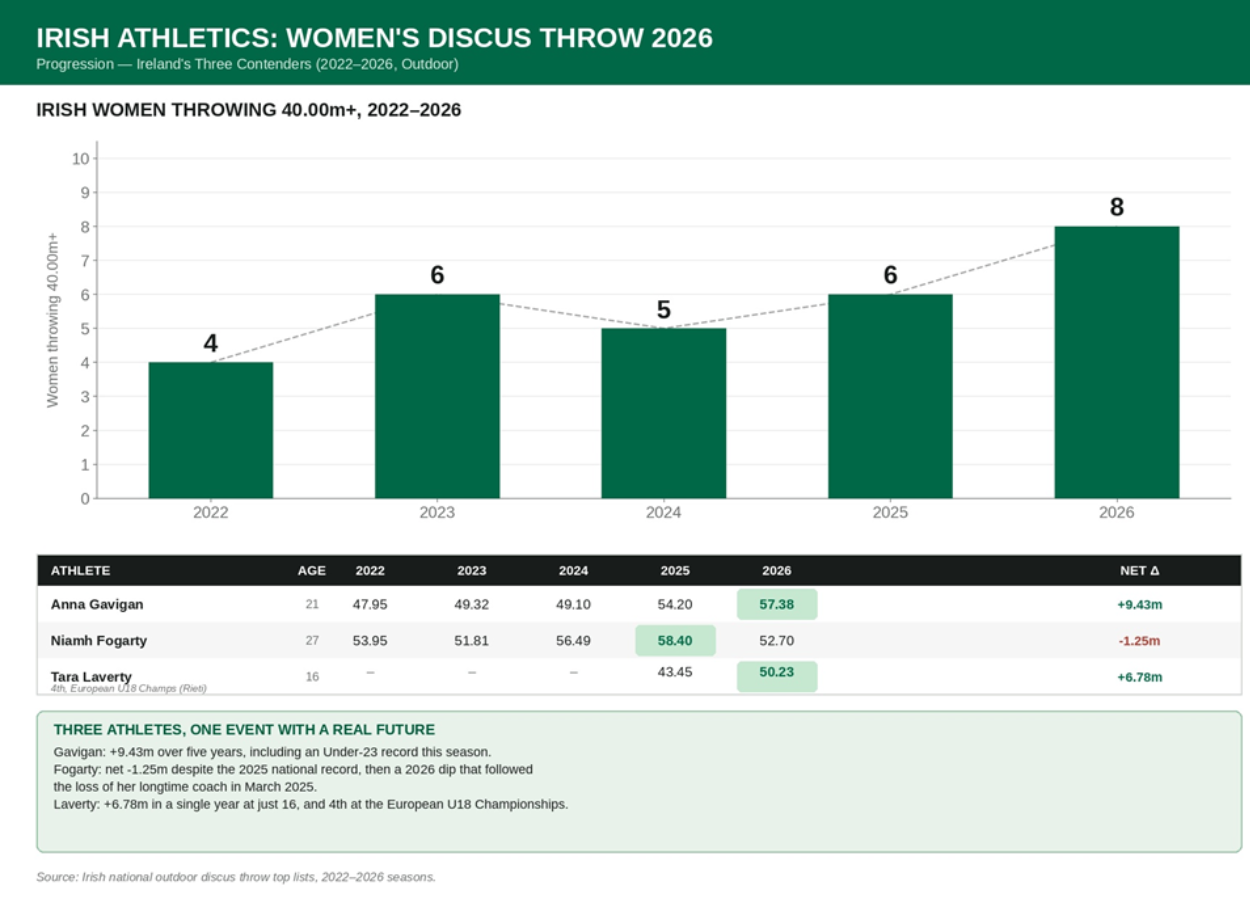
Irish Women Throwing 40.00m+, 2022–2026, and Progression — Gavigan, Fogarty, Laverty
The Depth Underneath All Three of Them
Widen the lens past Gavigan, Fogarty, and Laverty, and the event's growth this season is broader than any one athlete's story. The number of Irish women clearing 40 meters has moved in a real but uneven pattern for five years: four in 2022, six in 2023, five in 2024, six in 2025, eight in 2026. This year's jump isn't just the top names carrying the number up. Several athletes cracked 40 meters for the first time this season, Adona Zewdie, Cara Wright, and Méabh O'Connell among them, all teenagers, a wider base than the event has shown in the previous four years combined.
That's the same signal the long jump piece found. Setting a domestic B-standard above what Europe actually requires, is not transmitting an encouraging signal to those coming up. Stimulating depth requires emerging athletes to understand they’re being supported and that barriers to their success are being removed rather than installed.
A Harder Barrier to Name
There's a second constraint on discus depth in Ireland worth raising plainly, even though it's uncomfortable territory. Ireland doesn't just need one more Gavigan. It needs a wider base of women consistently throwing past 45 meters and growing that base means keeping teenage girls in the sport through the years they're most likely to leave it.
The research on why girls drop out of sport during adolescence is well established, and it isn't specific to the discus. Women in Sport's UK research has found that a third of girls aged 14 to 16 are unhappy with their body image, that seven in ten avoid being watched while active, and that girls leave organized sport at roughly twice the rate of boys by that age. Body image consistently ranks among the top reasons cited, alongside kit, safety, and a sense that sport isn't for them.
Throws events likely carry an extra version of that pressure. A sport that visibly rewards size and strength runs against a culture that's often uneasy with both in teenage girls, whatever the actual health and confidence benefits of that same size and strength. That's not a claim about any individual athlete's body. It's a claim about what a fifteen-year-old girl, already navigating the general body-image gauntlet the research describes, might additionally weigh before walking into a throws circle rather than onto a track.
Whether that pressure has eased in recent years is genuinely an open question, but it's worth noting that discus has had unusually high-profile representation lately. Valarie Sion, formerly Allman, an American two-time Olympic champion who came to the sport from a decade of competitive dance, has drawn mainstream sports media attention that discus rarely gets, magazine profiles, Olympic broadcast coverage, public life covered like any other star athlete. Whether that kind of visibility measurably changes how teenage girls perceive the event is not something this piece can prove. But it's a plausible thread in a much larger tapestry, and it's worth Athletics Ireland thinking about deliberately, through coaching messaging, imagery, and how the sport is introduced at underage level, rather than leaving it to chance.
Is the Criticism of Ireland Actually Fair?
Before going further, it's worth asking directly: is it fair to single out Ireland when eleven other athletes ranked above Gavigan also aren't competing?
Start with the field size itself. Thirty-two women are currently listed in Birmingham's discus entries, two more than the field's actual limit of 30. Germany and Sweden each declared four, and European Athletics caps a federation at three competing athletes per individual event, no exceptions apply to either of them this cycle. That's not optional. One thrower from each of the declared quartets will be trimmed before the championship regardless of what either federation might prefer, it's a hard rule, not a resourcing call they get to make.
In addition to the four already named, Germany has another four athletes ranked higher than Gavigan. Sweden's situation is similar with 4 athletes named and another two ranked ahead of the Irish thrower sitting outside a cap that would exist no matter how deep the team is. That’s what depth looks like.
France is a genuinely different case, and worth being precise about, because it's the one federation here making an actual choice rather than bumping into a cap. France could have entered up to three throwers and didn't, it entered one, Melina Robert-Michon, ranked 9th, and chose to leave behind three more ranked athletes (20th, 28th, 33rd) who were higher on the list than Gavigan. Why France chose to limit itself to just one thrower isn't known. It could be injury among those three, it could be a federation judgment that none of them was likely to make an impact, reach a final, contend for a medal, and wasn't worth the cost of sending, or it could be something else. Unlike Germany and Sweden, this wasn't forced by any rule. France had the room and chose not to send two more athletes in addition to Robert-Michon.
Ireland's situation resembles France's more than Germany's or Sweden's, in that Ireland also wasn't blocked by a hard federation cap, it had room to enter Gavigan if it chose to ignore its B-standard. It was a mark, 42 centimeters short of a bar Ireland set for itself, that made Gavigan ineligible for consideration.
The Opportunity This Represents
There's a more constructive way to frame what's at stake here than grievance. Irish women’s discus throwing is showing real signs of building momentum: a growing number of women clearing 40 meters each year, a new national record holder, an emerging 21-year-old with a five-year upward trajectory, and a 16-year-old who just finished fourth at a European championship. That's a genuine pipeline, not a hypothetical one.
Sending Gavigan to Birmingham, even in a discretionary, “we believe in where this is heading” sense rather than because a formula strictly demanded it, would do something a domestic standard can't measure: it would put a visible marker in front of the teenagers coming up behind her, Laverty foremost among them, but also the group of 16- and 17-year-olds who cracked 40 meters for the first time this season. Athletes that age don't just need better facilities and coaching. They need to see that the path from a national junior meet to a senior European Championship is real and walkable, not theoretical. A federation that should want more depth in field events five years from now has a direct lever to encourage participation. Does enforcement of a self-imposed standard help improve prospects for the event in the future? I don’t think so
The Honest Reckoning
None of these choices guarantees Gavigan will reach a major championship in the next major cycle. The climb to success could plateau again. What the numbers do show in the case of both the women’s long jump and the discus are two Irish athletes with real, sustained trajectories, ranked ahead of athletes who are competing in Birmingham. These two young emerging talents are getting stopped by a questionable standard. Zero long jumpers and zero discus throwers isn't a verdict on the talent; it's a missed chance to cultivate two events that are visibly building momentum. The European Championships are an important showcase where the presence of a green vest will encourage younger Irish athletes to persist in their efforts. The current selection process sends a negative signal and hurts rather than helps.
In my view, Athletics Ireland should dispense with the B standard entirely. The existing European qualification system, an outright standard for automatic entry, backed by a robust World Rankings process that already accounts for competition level, doesn't need a domestic layer bolted on top of it. But short of that, this year offered a simpler option that didn't require changing any rule at all: back an athlete who was ranked ahead of the field's own last-place finisher, in an event that's visibly building momentum, and let a growing pipeline of teenagers watch her do it. Lauren Callaghan and Anna Gavigan are two different athletes in two different events, both stopped by the same extra step, in the same season. That's not a coincidence. It's also not just a fairness problem. It's a missed opportunity Athletics Ireland could have acted on without waiting for anyone else's permission.