
Marathons
The Woman Who Didn't Stop: How Kathrine Switzer Forced Boston to Open Its Doors
"No woman can run the Boston Marathon."
When Arnie Briggs, a seasoned running coach at Syracuse University, uttered those words to Kathrine Switzer in 1966, he wasn’t being a villain, he was simply repeating the "medical wisdom" of the era. To the athletic establishment of the 1960s, the female anatomy was a fragile thing, purportedly incapable of surviving the 26 miles and 385 yards of the world’s most prestigious footrace.
Briggs was not, by instinct, hostile to women in sport. He had welcomed the sight of a woman training alongside the all-male cross country team at Syracuse University. He was, however, was a man of logic. If Switzer could complete a 26-mile training run, he told her, he would take her to Boston.
She did, and as the yanks say, then some.
The Unofficial Pioneer
The year before Switzer’s attempt, another woman had already tested the limits of convention. Roberta Gibb had applied to enter the 1966 Boston Marathon, only to be rejected by race director Will Cloney, who insisted women were not capable of such a distance.
Gibb ignored him.
Having already run training distances exceeding 40 miles in a single day, she hid near the start line on race morning. When the gun sounded, she slipped into the field wearing her brother’s Bermuda shorts and a sweatshirt, her identity disguised.
It did not remain hidden for long. Runners quickly realised a woman was among them. Instead of hostility, she found encouragement. As the race progressed, she shed the sweatshirt, revealing herself to spectators. The response was emphatic. Crowds cheered. Local radio tracked her progress.
Gibb finished in 3:21, placing ahead of the vast majority of the field. It was a performance that should have ended any argument about capability. It did not.
A Loophole in Plain Sight
By 1967, the Boston Marathon still had no formal provision for female entrants. It also had no explicit rule barring them.
Switzer and Briggs recognised the opportunity.
She entered the race under the name “K. V. Switzer”, her initials offering a degree of ambiguity. Her registration was accepted without issue. Three weeks before the race, she and Briggs completed a 26-mile trial run. At the finish, she insisted on continuing for another five miles. Briggs relented. She was ready.
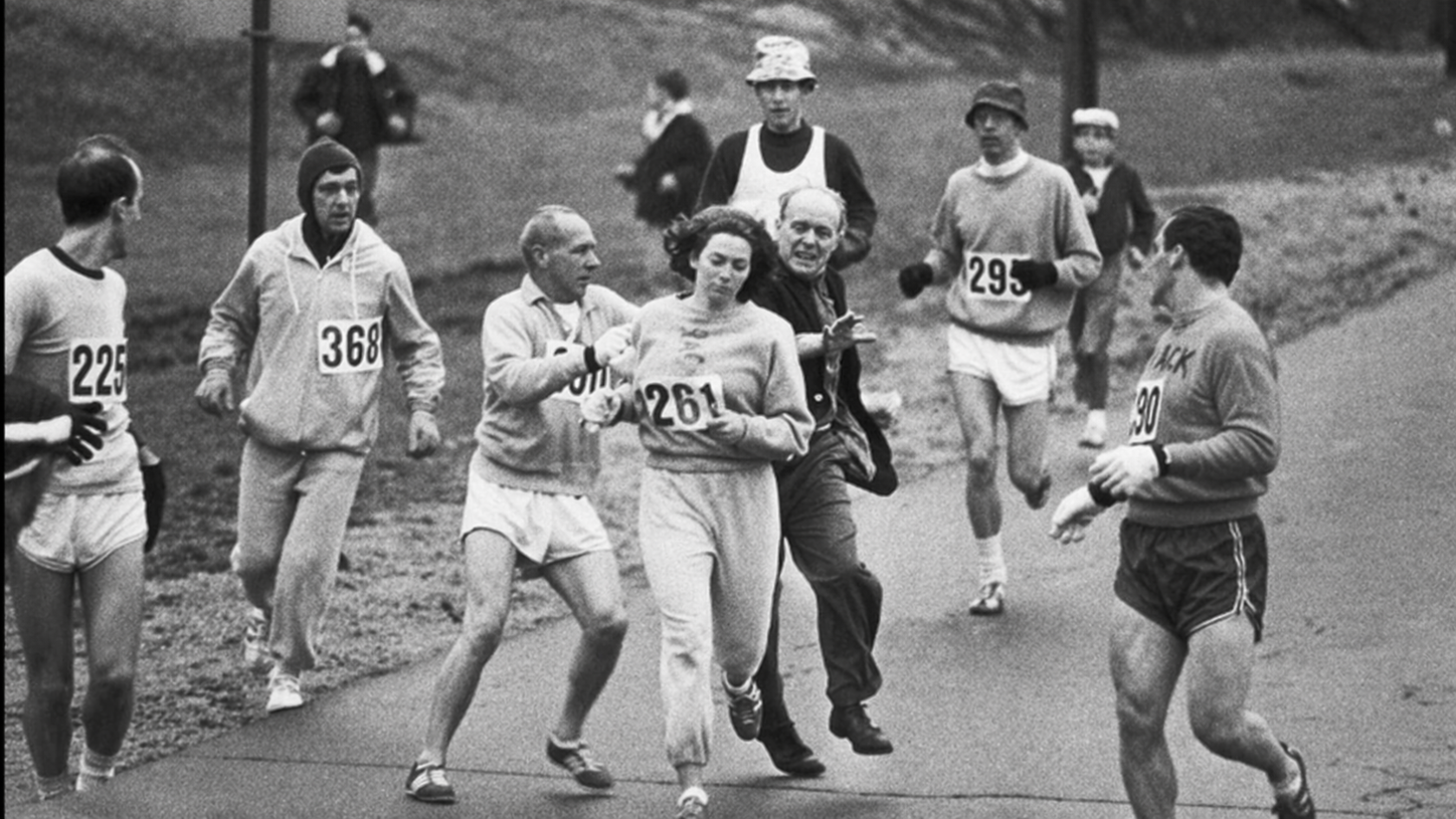
On April 18th, 1967, Switzer travelled to Boston with Briggs, her boyfriend Tom Miller, and teammate John Leonard. The following morning was cold and snowy. She pinned on race number 261, pulled on a sweatshirt against the conditions, and joined the starting line.
No one stopped her.
The Moment That Defined the Race
The early miles passed without incident. Fellow runners offered encouragement. Some were simply curious. One asked how he might persuade his own wife to take up running.
Then, around mile two, everything changed.
A press truck drew alongside the pack, its cameras focusing on Switzer. The sight caught the attention of Jock Semple, a race official who had not realised a woman was running with a number.
Enraged, he charged into the field and attempted to physically remove her from the race, grabbing at her bib. Miller intervened, knocking Semple to the ground. As the group regrouped, Briggs shouted a now famous instruction: run.
They did.
Finishing for More Than a Time
The confrontation shook Switzer. For a moment, she considered dropping out. The humiliation, the attention, the hostility, it was a lot to carry.
But she understood the stakes.
If she stopped, it would confirm every prejudice that had kept women out. If she finished, it would challenge them.
She kept going.
Switzer crossed the line in 4:20. It was not the fastest time of the day, but it was one of the most significant. Despite the absence of any formal rule prohibiting female participation, she was later disqualified.
The message from the establishment was clear. The message from the road was louder.
From Exclusion to Recognition
Change did not come overnight. Switzer faced criticism alongside support. Yet she was no longer alone. In the years that followed, more women joined Gibb and Switzer in running the race unofficially, forcing organisers to confront the reality in front of them.
In 1972, the Boston Marathon finally opened to women, albeit with a qualifying standard that reflected lingering scepticism.
Progress continued. In 1984, the women’s marathon was included in the Olympic Games, marking a decisive shift in how endurance sport viewed female athletes.
Today, women make up a substantial portion of marathon fields, not as anomalies, but as equals.
A Trailblazing Legacy
Switzer’s own career extended far beyond that snowy day in Boston. She won the women’s division of the New York City Marathon in 1974 and recorded a personal best of 2:51:37 in Boston the following year, finishing second.
Yet her legacy rests less on times and more on impact.
What began as a challenge to a coach’s assumption became a defining moment in sporting history. It was not simply about one woman finishing a race. It was about changing who was allowed to stand on the start line in the first place.
And that, more than any finishing time, is what endures.

The Best Supermarket Snacks To Improve Your Runs
Sharlene Mawdsley Set for Diamond League Debut in Paris Next Sunday Evening
Eimear Maher Returns To Action In Copenhagen This Evening
The Brutal Truth About Your Finish Line Photo
Dublin Marathon's €149,000 Unsuccessful Ballot Windfall Comes Under Scrutiny
How to Watch Irish Athletes In Action At The FBK Games This Afternoon