There was a time, now almost impossible to conceive in our era of super shoes and carbon plated tracks, when the four minute mile was not merely a target, but a terrifying frontier. In the early 1950s, the medical consensus, and indeed the popular imagination, held that the human heart might literally burst under the strain of such a pace. It was "Trackdom’s Holy Grail," a mystical barrier that had resisted the best efforts of the world’s elite for decades.
Seventy two years ago today, on a blustery Thursday evening in Oxford, a 25 year old medical student named Roger Bannister proved the doctors wrong.
The Cinder Path to Greatness
The lead up to May 6, 1954, was defined by a desperate, three way international arms race. While Bannister laboured over his studies at St Mary’s Hospital, the Australian John Landy and the American Wes Santee were breathing down the neck of the 4:01.4 world record.
Bannister, ever the scientist, knew he couldn’t win on brute strength alone. He trained in the margins of his day, often during his lunch breaks, using his knowledge of physiology to refine his stride. He understood that the barrier was as much mental as it was physical.
The Day the Wind Relented
The morning of the race at the Iffley Road track was anything but auspicious. The wind was whipping across the cinders at 25mph, conditions that usually made record breaking impossible. Bannister spent the day at the hospital, his mind oscillating between the wards and the weather. He famously remarked that if the wind didn’t die down, he wouldn’t make the attempt.
As the 6:00 PM start time approached, the St. George’s flag atop a nearby church suddenly went limp. The air stilled. Bannister turned to his friends and pacemakers, Chris Brasher and Chris Chataway, and gave the nod.
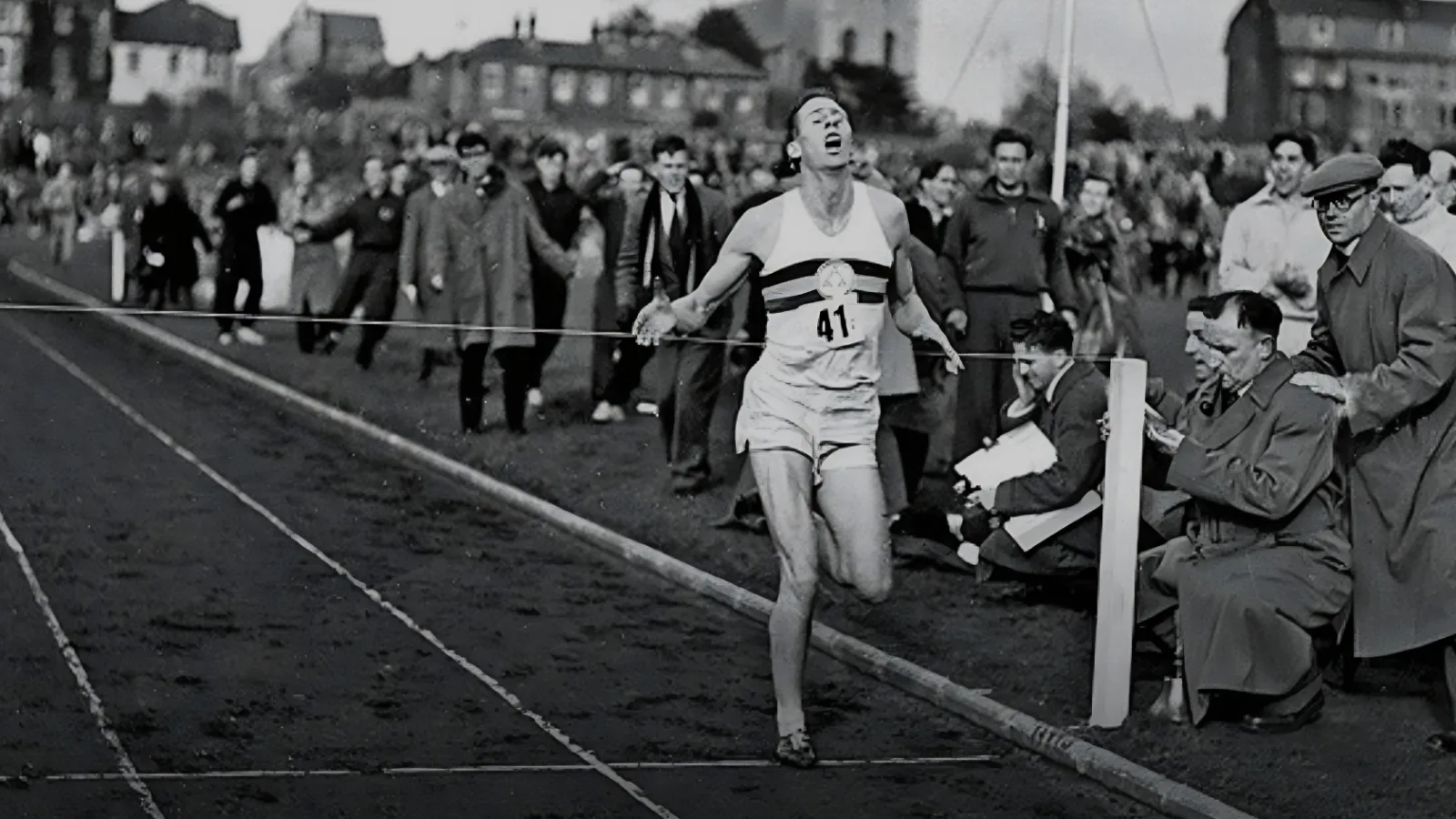
The race itself was a masterpiece of teamwork. Brasher led for the first two laps, with Bannister tucked in behind. Chataway then took over, pulling Bannister through the third lap and into the final turn. With 300 yards to go, the medical student surged. His face was a mask of agony, his head tilted back, his lungs screaming for the oxygen he knew his body was consuming at a lethal rate.
3:59.4
The stadium announcer was Norris McWhirter, who would later co-found the Guinness Book of Records. He understood the theatre of the moment. As Bannister collapsed into the arms of the crowd, McWhirter’s voice crackled over the tannoy:
"Result of Event Eight: One Mile. First, R.G. Bannister, of Exeter and Merton Colleges, in a time which, subject to ratification, is a new meeting and track record, and which, comprising as it does four laps, is a new English Native, British National, British All Comers, European, British Empire and World Record. The time was three..."
The roar of the crowd drowned out the rest: three minutes, fifty nine point four seconds.
A Legacy Beyond the Clock
The seminal nature of Bannister's feat is best proven by what happened next. Once the "impossible" was achieved, the spell was broken. John Landy beat the record just 46 days later. Within a few years, dozens of runners had joined the club.
Bannister’s legacy isn’t just a number in a record book, it is the ultimate proof that our limits are often self imposed. He went on to become a distinguished neurologist, famously claiming he was more proud of his contributions to medicine than his four minutes in the sun.
Yet, for those of us who still find magic in the cinder track, May 6th will always be the day that Roger Bannister taught the world how to breathe.