
Track & Field
What a Weekend in Slovenia Last Summer Told Us About the State of Irish Athletics
Written by Martin Nutty
The Countdown to Birmingham
The countdown is on to the European Athletics Championships in Birmingham. When 2026 is in the books, how we think about this season will largely be defined by what happens in Alexander Stadium starting on Aug 10th and over the subsequent six days. Ireland is sending its largest team in recent memory, a total of 47 athletes with 34 in individual events.
While we wait for the action to commence in Birmingham, there is time to reflect on the state of Irish Athletics. How are things going, what is to be celebrated and how can the sport be improved? Counterintuitively I'm going to focus on a meet from a little more than a year ago.
The place was Maribor in Slovenia, the weather was hot with temps exceeding 30 degrees Celsius. The meet in question was the Second Division of the European Team Championships. 16 teams had gathered in Slovenia's second city to compete over a 37-event, two-day schedule for both men and women. Win an event for your team and you score 16 points, finish 16th and score 1 point, crash out with a DQ, zero points. Every effort by every athlete is key. The top three teams with the highest point total are promoted to the First Division while the bottom three head downwards to the Third Division.
The competition is held biannually, and Ireland's position going in was already a story in itself. The team had been relegated to the Third Division in 2021 not through defeat but through absence, sitting out that edition entirely because of pandemic travel restrictions. Ireland had to win its way back, which they did, taking the Third Division outright in Chorzów, Poland in 2023.
The European Team Championships rewards teams with strength across all the events and makes for an interesting snapshot of the athletic health of a country when represented by a singular athlete in each event. The question being asked the morning of June 28th was whether Ireland would retain its Second Division status. Promotion was considered a dim possibility while demotion was somewhat more plausible.
The team was led by captains Niamh Fogarty and Marcus Lawler and acquitted itself well. While only one win was recorded across the 37 events, Sarah Lavin in the 100m hurdles, the team finished in 5th place overall behind the promoted squads of Belgium, Slovenia and Norway. Turkey was the one remaining team which separated Ireland from the promotion slots.
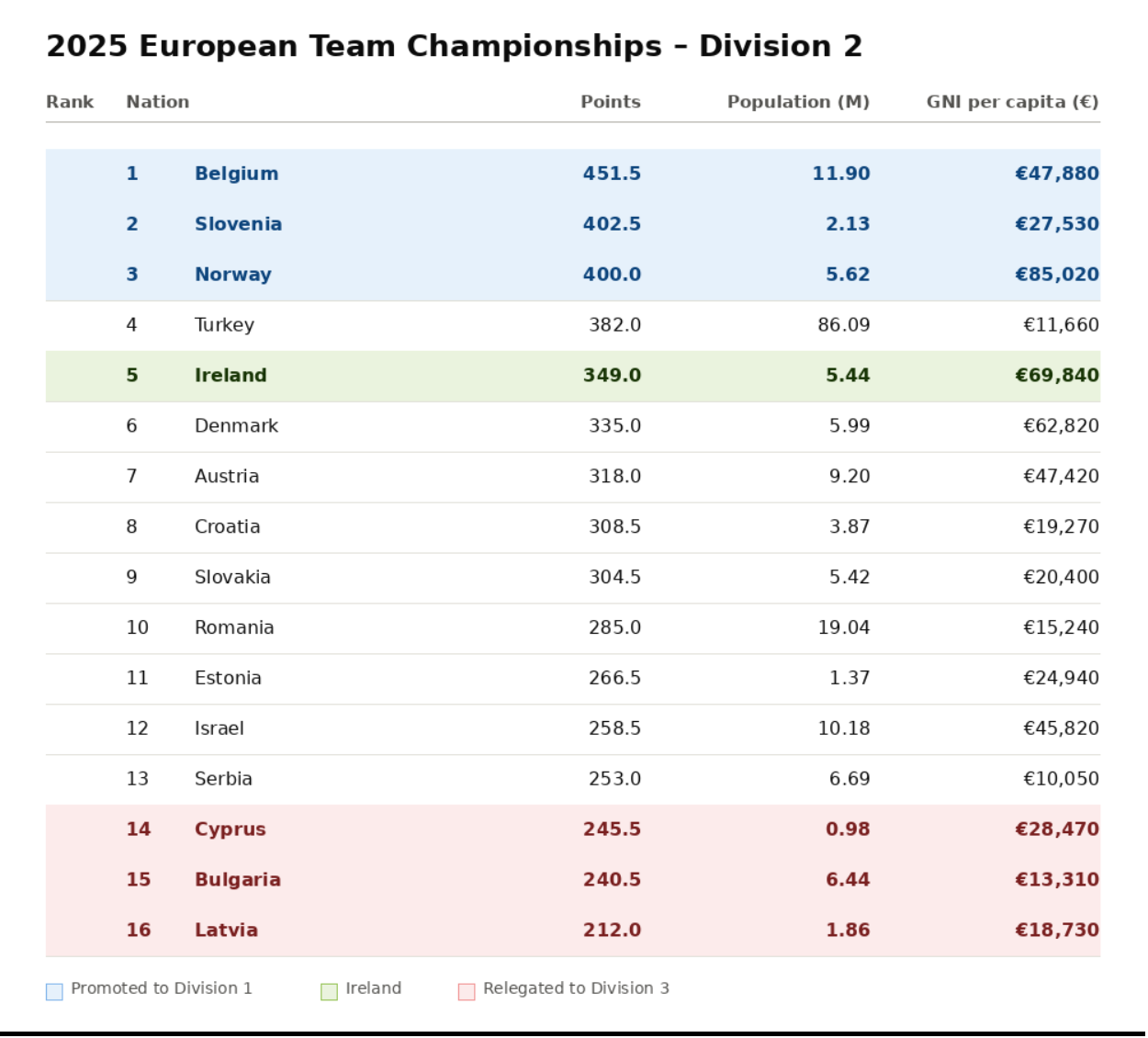
2025 European Team Championships, Second Division final standings.
Two Teams Within One Team
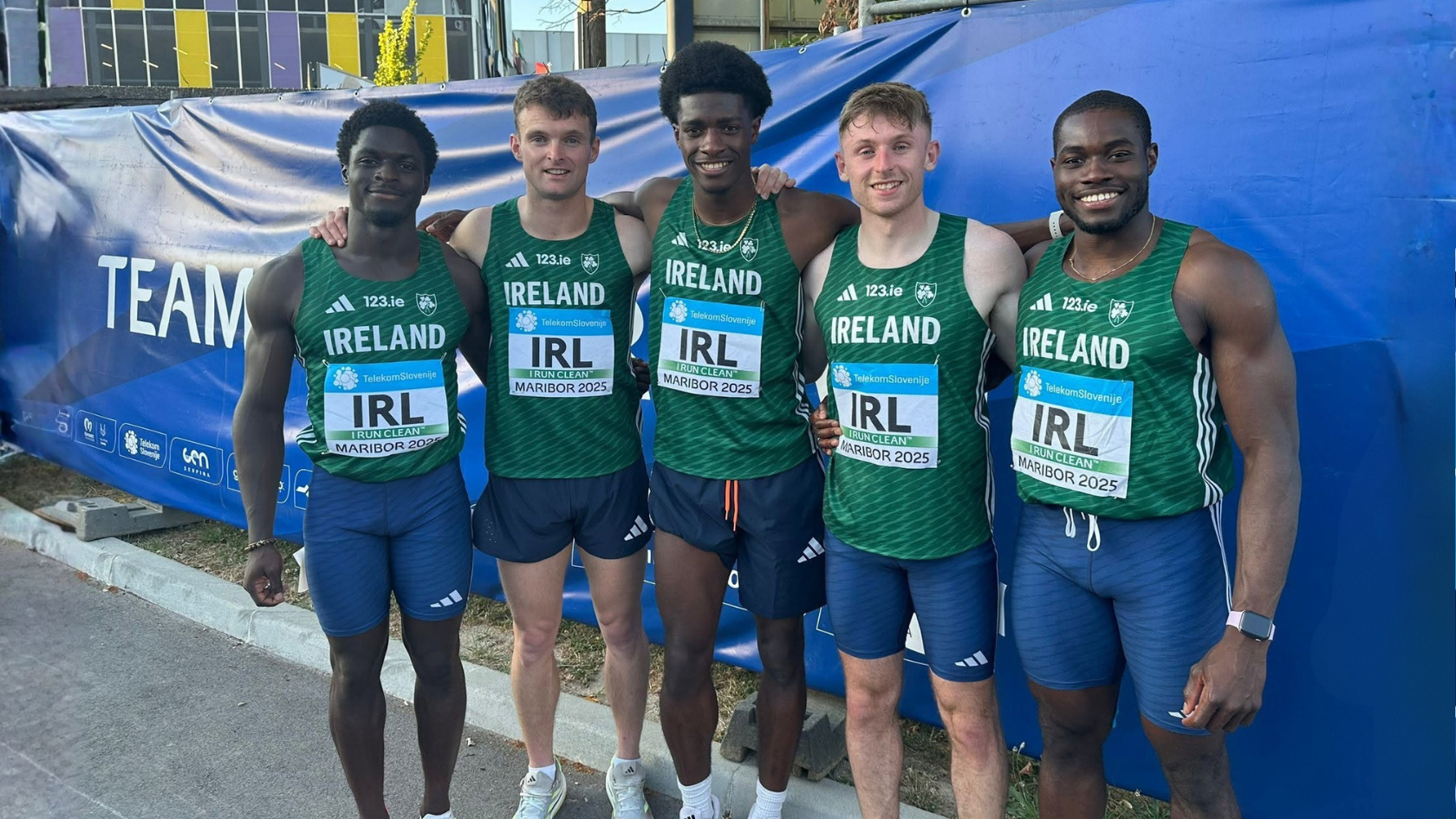
Ireland did not lose to Belgium or Slovenia or Norway because Irish athletes cannot run. The team's sprinters, its middle distance runners, its relay squads all held their own against Second Division opposition, and in one event did more than hold their own: the men's 4x100m relay team ran a national record, 38.88 seconds, to finish 2nd, a sign the sprint program is not just competitive but still improving. What Ireland did less well was jump or throw or clear a hurdle with the same consistency, and that gap, not raw talent, is what kept the team out of the promotion places.
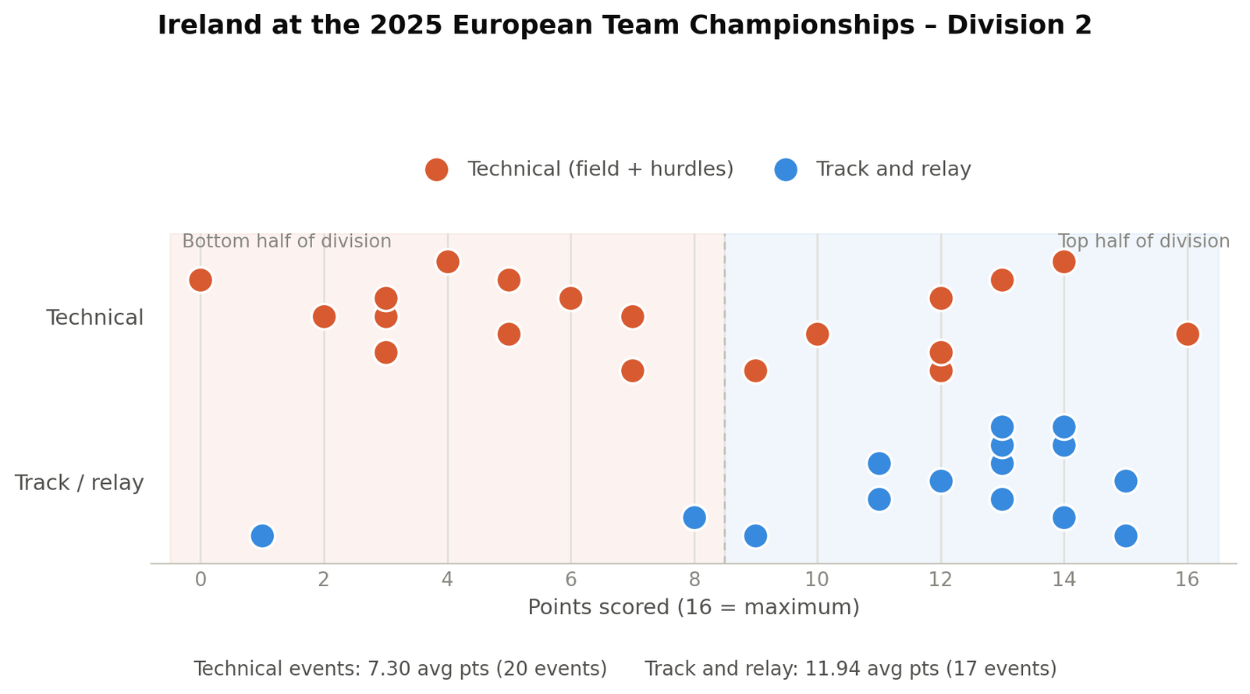
Ireland's points scored across all 37 events, split into technical (field and hurdles) versus track and relay.
Split the 37 events into two families, running (the sprints, the middle distance, the long distance, and the relays) and what I will call the technical program (the jumps, the throws, and the four hurdles events), and the picture sharpens considerably. Across 17 running and relay events, Ireland averaged 11.94 points. Across 20 technical events, the average fell to 7.30. That is not a marginal gap. It is the difference between finishing mid-pack and finishing in the bottom third every time a field or hurdles event came around.
One win from the whole weekend, and it came in a hurdles event, Sarah Lavin's 100m hurdles. She is the outlier, proof that the technical program isn't uniformly weak, just thin, with pockets of real strength. Beyond Lavin, the technical results never got out of the bottom half of the field. None of this should be read as a mean spirited criticism of Ireland's throwers and jumpers as individuals. Niamh Fogarty carried the team captaincy and delivered upper-half finishes in both her events, 5th in the discus and 7th in the shot put. Nicola Tuthill's bronze in the hammer was the single best technical event performance of the weekend, a genuine podium finish against a full field. What the meet cannot tell us, since each nation sends only one athlete per event, is why the rest of the technical program fell short, whether that is a shortage of athletes at the required level, a shortage of one exceptional talent in a given event, or something else in how those athletes are developed and supported. What the data does show is that the shortfall is real and it is not evenly spread across the team. Ireland has proven it can produce a Tuthill. What it would take to produce that level of performance more consistently across the technical program is the harder question, and it's the one worth asking.
What Promotion Actually Requires
Ireland finished 5th, 52 points short of the total it would have needed to overtake Norway's promotion-clinching mark in 3rd. That is the gap that matters, the actual distance between where Ireland finished and where the team should aspire to be. The question worth asking is where that gap is coming from, and the clearest answer sits in the split between Ireland's running events and its technical ones. Ireland's sprinters, middle distance runners, and relay squads scored competitively all weekend. Its jumps, throws, and hurdles did not, and that shortfall, event after event, is the single biggest contributor to the points Ireland left on the table. If there is a lever to pull to close the distance to promotion, this is it. So what would pulling it actually look like? The best place to look is not at Ireland's own results but at the three teams who did get promoted.
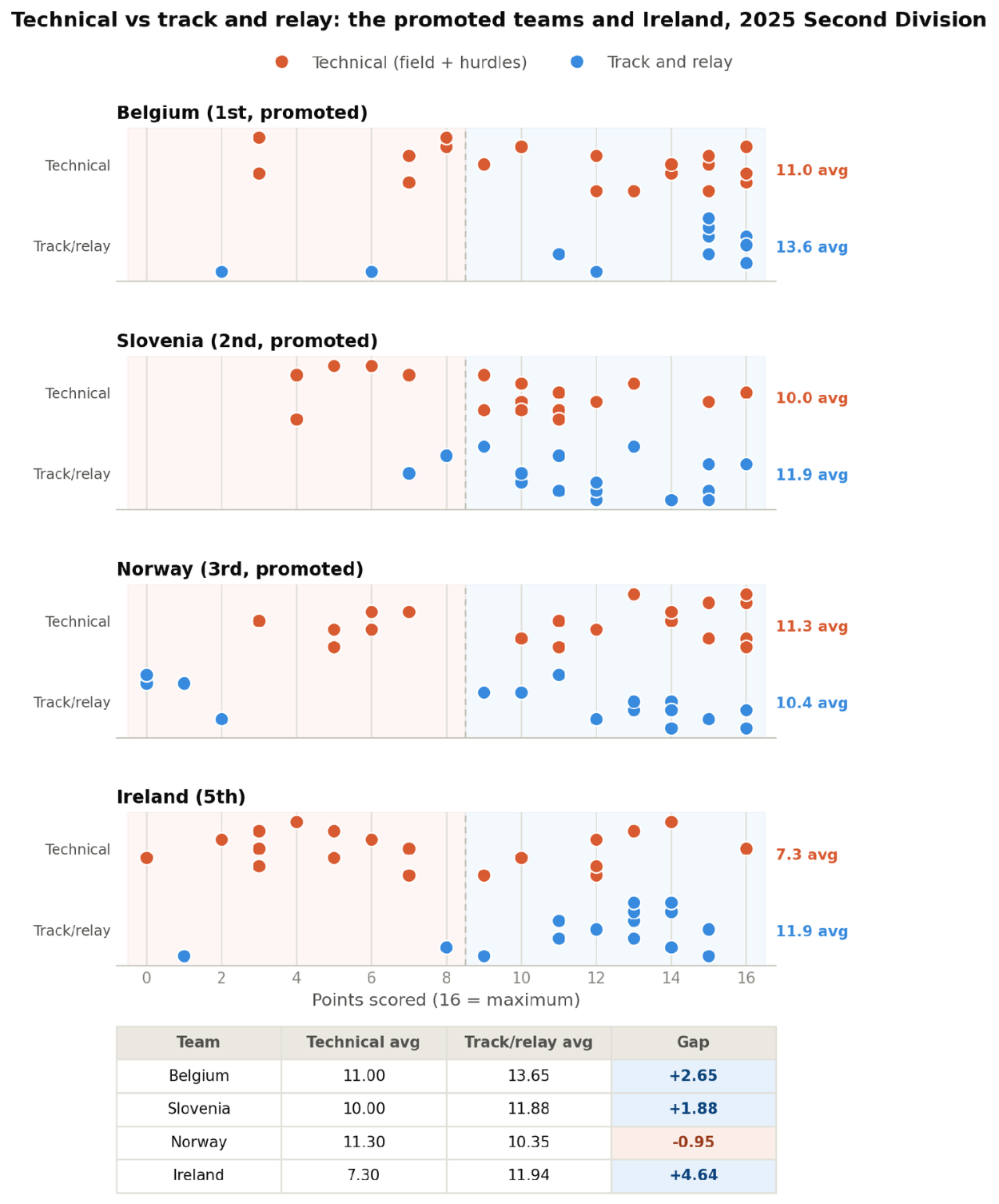
Technical vs track and relay scoring for Belgium, Slovenia, Norway, and Ireland, with summary table.
The comparison is more encouraging than a skeptic's instinct would predict. Belgium, who won the division outright, still leaned on their runners over their technical athletes, 13.65 points per event against 11.0, but that 2.65 point gap is little more than half of Ireland's. Slovenia, promoted in 2nd, shows the same pattern at an even smaller scale, 11.88 versus 10.0, a gap of under two points. Both countries have a technical program worth having. Neither treats it as an afterthought.
Then there is Norway. Third place, promoted, and their technical events actually outscored their running events, 11.3 to 10.35. Norway did not just avoid Ireland's problem. They inverted it. A country of 5.6 million people, barely larger than Ireland, built a team where the throwers, jumpers and hurdlers carried more relative weight than the sprinters and distance runners. Whatever is happening in Norwegian athletics development, it is not that technical events are inherently harder to stock with depth. It is that somebody decided to actively develop them.
That comparison matters because it closes off the easiest excuse available. This is not a story about technical events being a lost cause for a country Ireland's size. Three of the four teams in this picture, three teams Ireland was directly competing against for a promotion place, show that Ireland's shortfall can be small, or nonexistent, or reversed entirely. Ireland's version of this chart is not what technical depth looks like when a small nation does its best. It is what technical depth looks like when a program has not yet been built. Close that distance, and promotion starts to look genuinely within reach.
How Much of Fifth Was Misfortune
If the technical shortfall documented in the previous section is real and structural, a fair question follows. How much of Ireland's scoring potential was actually lost to that shortfall, and how much was lost to bad luck that had nothing to do with depth at all? The distinction matters, because a program cannot fix bad luck. It can only fix depth.
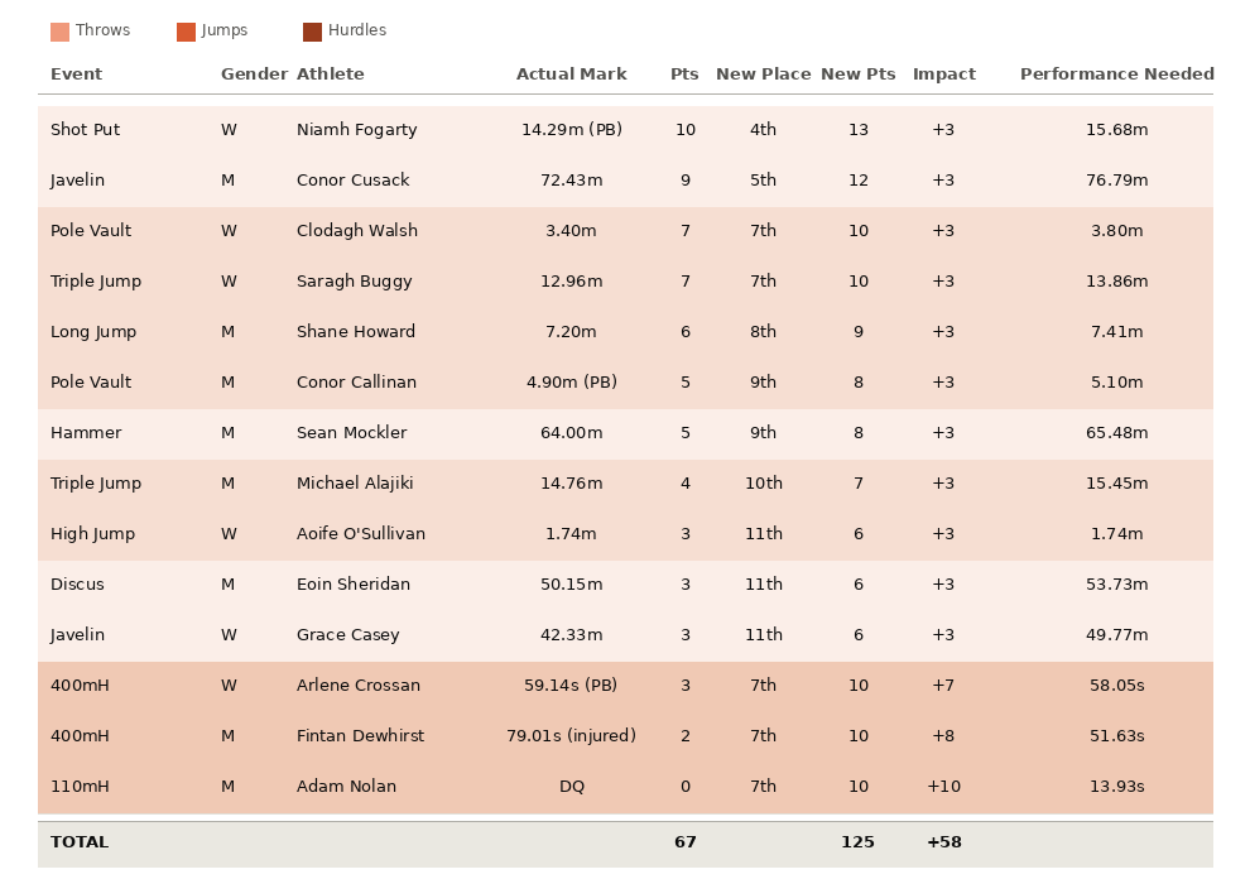
Modelled outcomes for Ireland's lowest-scoring technical and hurdles events, against the real performance that would have been required.
Two results account for the clearest share of the gap. Adam Nolan was disqualified in the 110m hurdles, scoring zero for an event Ireland would ordinarily expect to pick up a handful of points in. Model a merely respectable finish instead, seventh place, nothing heroic, and Ireland gains ten points back. Fintan Dewhirst ran the 400m hurdles in 79.01 seconds, nearly thirty seconds slower than the rest of the field. Cathal Dennehy's reporting for the Irish Examiner confirms why: Dewhirst was battling an injury through his heat, finished last in it, and made sure he crossed the line anyway rather than pull up, which is the only reason those two points exist at all rather than a second zero. Model the same clean run his rivals produced and Ireland gains eight points back. Between those two results alone, misfortune rather than a shortage of ability cost Ireland eighteen points.
A third case is worth naming separately, because it does not belong in the same bucket. Arlene Crossan's 400m hurdles time of 59.14 seconds was already a PB. The model behind the graphic asks what a further improvement of roughly a second would have been worth, seven points, but a second off a PB in the 400m hurdles is a serious jump, not an incremental one. That is not misfortune waiting to be corrected. It is a genuine performance target, the kind that takes a season or more of progress rather than a clean race. It belongs in this piece as a reminder that not every point on the board is equally easy to find.
That reframes the weekend considerably. Eighteen points from a disqualification and a competitor racing injured is not a program failing. It is two specific, mostly unrelated setbacks landing in the same meet, and recovering them through nothing more dramatic than a clean hurdles race would have meaningfully changed where Ireland finished.
It would not, on its own, have delivered promotion. Even after crediting Ireland for the bad luck, the eleven technical events where Ireland finished outside the top six do not move on their own. Clodagh Walsh's pole vault, 3.40m for 10th place, would have needed to reach 3.80m, the mark that actually finished 7th, to register the same three-point gain modelled across the group. Eoin Sheridan's discus, 50.15m for 14th, would have needed 53.73m. Neither is an outlandish ask on its face, both heights and distances were within the compass of these athletes, but stacking eleven improvements of similar size across throws, jumps, and hurdles all at once is a different proposition than any single one of them happening in isolation. Modelling that improvement across all eleven events is worth another 33 points, nearly double what the misfortune alone accounts for. That is the piece that does not go away when the bad breaks are subtracted out. Nolan's disqualification and Dewhirst's injury explain a meaningful share of the shortfall to Norway's promotion-clinching total. They do not explain why Ireland was never seriously competing for 2nd or 3rd. That is the technical shortfall doing exactly what the previous section said it does, quietly costing points across a dozen events rather than in one dramatic moment.
This Has Happened Before
One explanation for everything in the previous two sections is that Maribor was simply an off day, a single unlucky meet where two hurdlers had bad breaks and the throwers and jumpers happened to catch a stronger field than usual. If that were true, the technical shortfall would not be worth writing about. Programs have bad weekends. The question that matters is whether the gap between Ireland's running and its technical events shows up every time Ireland fields a team, or whether Maribor was the exception rather than the rule.
The Team Championships have been played often enough, across enough divisions and against enough different levels of opposition, to actually answer that.
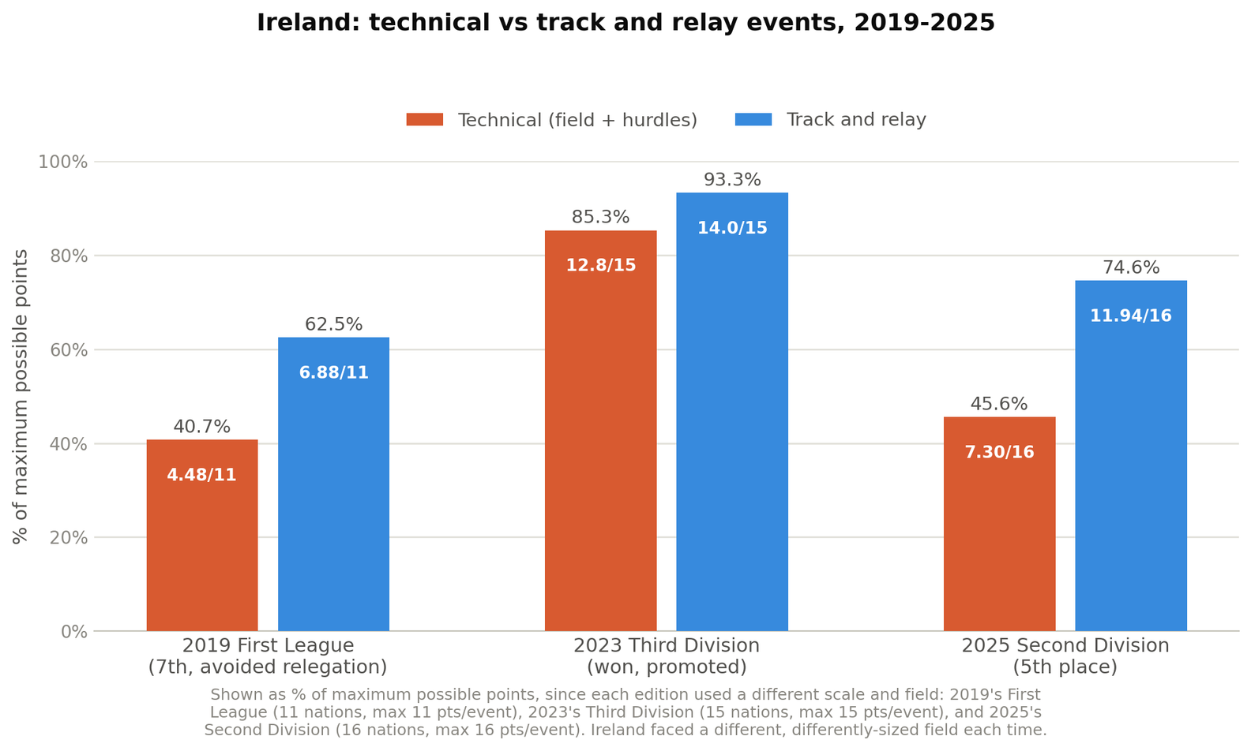
Ireland's technical vs track and relay scoring as a percentage of maximum possible points, 2019, 2023, and 2025.
In 2019, fighting to avoid relegation from a strong First League (what Division 2 was called that year) field, Ireland's technical events managed 40.7 percent of the maximum available score. Track and relay managed 62.5 percent. In 2023, competing in a considerably weaker Third Division and winning the whole competition outright, the gap narrowed sharply, 85.3 percent against 93.3 percent, still present, just smaller against softer opposition. Then Maribor happened, back against a stronger field, and the gap widened right back out to 45.6 percent against 74.6 percent, nearly identical in shape to 2019.
Three editions, three different levels of opposition, and the same story every time. Ireland's running program travels. It holds up whether the competition is fierce or forgiving. The technical program does not. It performs reasonably against weak fields and collapses against strong ones, which is precisely what a thin program looks like rather than an unlucky one. A team can get unlucky once, the way Nolan and Dewhirst were unlucky at Maribor. It does not get unlucky in the same specific way, in the same specific events, in 2019, 2023, and 2025.
That is the real answer to the question the previous section left open. Nolan's disqualification and Dewhirst's injury explain some of the distance to Norway's total in any single meet. They cannot explain a pattern that predates Maribor by six years and reappears every time Ireland faces a field good enough to expose it. Whatever is missing from Ireland's technical program, it was missing in Sandnes in 2019, it was simply invisible in Chorzów in 2023 because the competition there was weak enough to paper over it, and it was back on full display in Maribor. A meet good enough to promote or relegate a team is, by design, good enough to find whatever a program is missing. Three times now, it has found the same thing.
The Wealthiest Team in the Room
There's an excuse that follows a result like this: Ireland is a small country, and small countries can't expect to compete against nations with a bigger population to draw talent from. That excuse has two halves, though, and the smaller one is already dealt with. Slovenia, smaller than Ireland, got promoted. Norway, barely bigger, inverted the technical gap entirely. The other half is resources, and on that count the excuse holds up even less well.
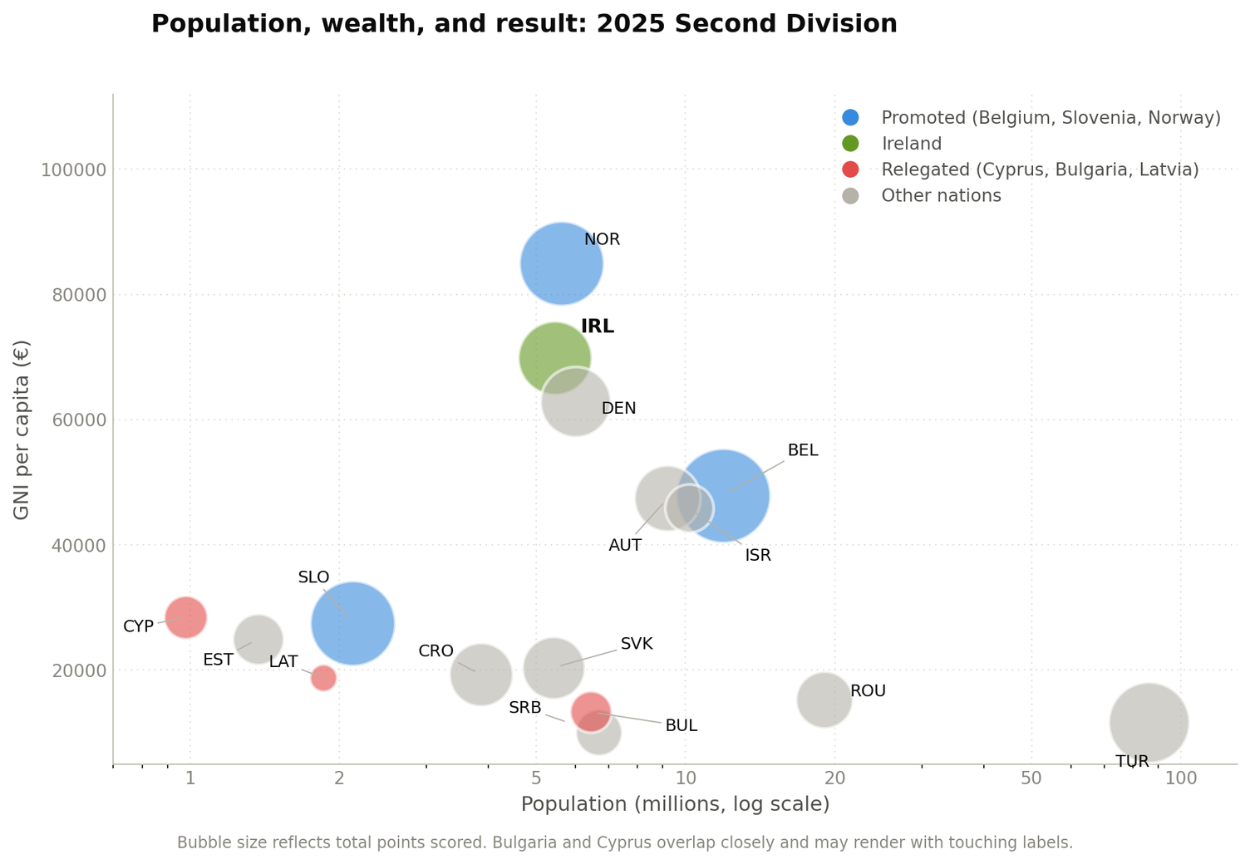
Population, GNI per capita, and total points scored across all 16 Second Division nations.
Plot every nation in the division by population and by Gross National Income (GNI) per capita, and size each bubble by the points it actually scored, and Ireland sits in genuinely rare company. High on the wealth axis, low on the population axis, a small green circle wedged between Norway above it and Denmark below. Turkey sits at the opposite corner entirely, located on the far right with its massive population, low on wealth, a nation sixteen times Ireland's size that still only found 33 more points. Norway occupies the same small-and-wealthy quadrant as Ireland, and its bubble is still visibly larger, a smaller, richer nation outscoring Ireland by a significant margin.
This is not a story about a poor country stretched thin across too many sports. Ireland is, by a comfortable margin, one of the two wealthiest nations that competed in Maribor, and it sits there with a result that is respectable but not remarkable, a mid-sized bubble in a corner of the chart where a nation its size and wealth should be able to compete with anyone in the field, promoted teams included.
None of this proves money was misallocated, and it would be unfair to suggest a scatter plot of national income statistics can diagnose how much funding Athletics Ireland receives and how it is spent. It does, however, close off the last version of the excuse available. Ireland is not too small, Slovenia and Norway already showed that. Ireland is not too poor, the chart above shows that. Whatever explains a technical program that performs well against weak fields and collapses against strong ones, it is not a shortage of people or a shortage of Ireland's economic wealth.
What History Tells Us
None of this would matter as much if the underlying talent weren't there, if Ireland's shortfall in the technical events were a talent problem rather than a resourcing one. A program can be told it lacks investment and simply be wrong, short on athletes rather than short on support. Irish athletics has a longer history than one weekend in Maribor, and it is worth asking, before closing, what that history shows.
Ireland does not have to invent this from nothing. In the first two decades of the 20th century, a group of Irish-born throwers, John Flanagan, Martin Sheridan, Matt McGrath, Pat McDonald among them, dominated Olympic hammer, discus, and shot put competition so completely they earned a nickname, the Irish Whales.
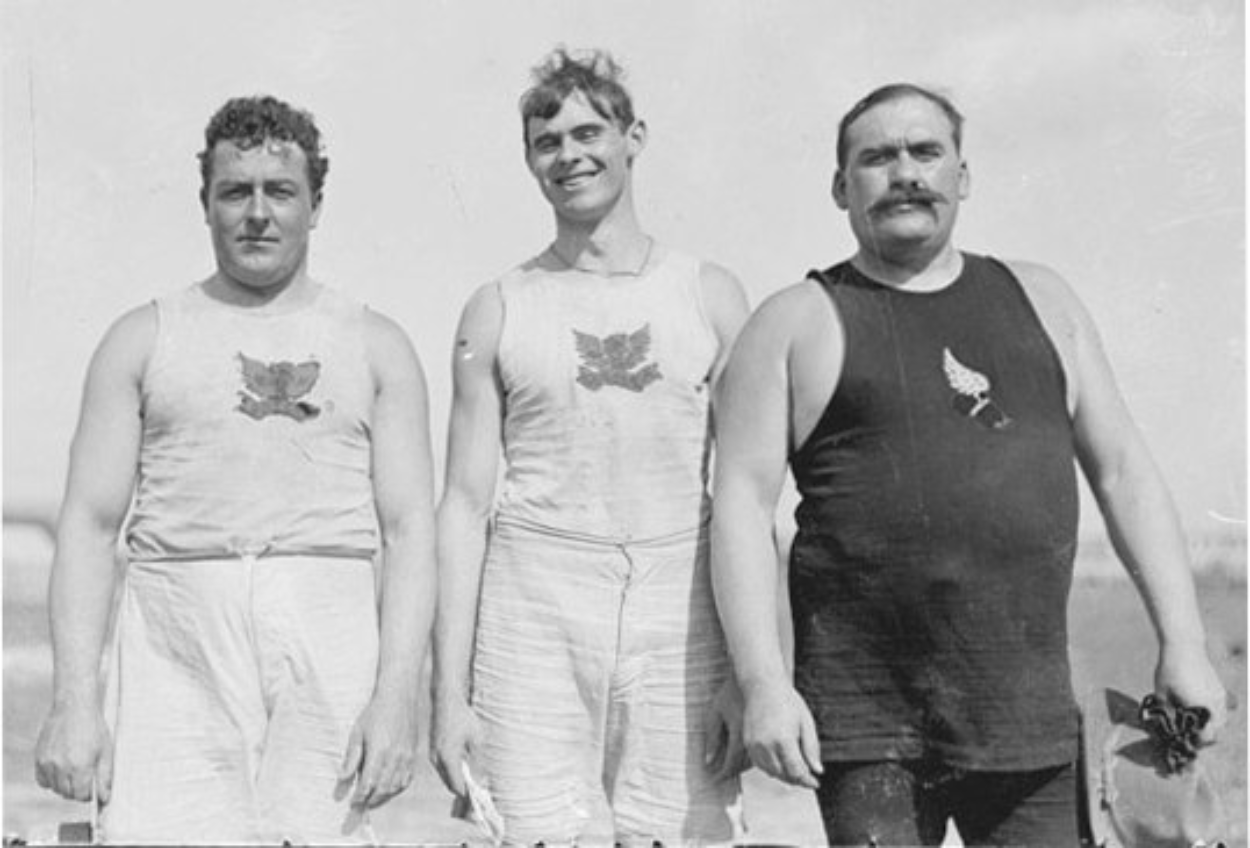
John Flanagan (left), Martin Sheridan (centre), and James Mitchel (right) of the Irish American Athletic Club, photographed at the 1904 St. Louis Olympics. Flanagan won gold in the hammer throw, Sheridan gold in the discus, and Mitchel bronze in the 56lb weight throw.
They learned the sport in Ireland, but it was emigration to the United States, and the clubs, coaching, and competition that came with it, that turned that raw ability into world records and Olympic gold. The talent started in Ireland. The resourcing that turned it into dominance did not, and the difference between the two is close to the entire argument of this piece. Pat O'Callaghan grew up in the shadow of that fame, a schoolboy in Cork while the Whales were front-page news in the Irish press, and by 1928 he had done what none of them managed, won an Olympic hammer title for Ireland itself. He did it with almost none of the resourcing that had built the Whales into champions, a hammer he made himself, a trip to Amsterdam he and his brothers paid for out of their own pockets. Four years later he repeated as champion in Los Angeles, and on the same afternoon Bob Tisdall won gold in the 400m hurdles, two technical events, two Irish medals, one day, one team, barely a decade into the country's independence. That was not a coincidence so much as a confidence, the same belief the Whales had carried decades earlier, that Irish athletes could be the best in the world at events built on power and technique, only now it belonged to the nation itself rather than to the athletic club in New York that had given the Whales their start. It is a genuinely remarkable result, and also a reminder not to lean too hard on the resourcing argument for any one athlete.
What the Whales and O'Callaghan show together, across two very different paths, is that the underlying talent has never been the limiting factor. Sometimes it found resourcing abroad and became world-beating. Once, it found almost none at all and still won gold, twice. What Irish athletics has never really tested is what that same talent could do with real, sustained, national investment behind it, not borrowed from another country's clubs and not scraped together by one family's own pocket. The right aspiration for Irish athletics now is not simply to match Belgium or Norway. It is to become something closer to the Jamaica of Europe, a small nation whose impact on world athletics runs wildly ahead of its size, and one Ireland can outspend rather than simply admire. Jamaica's GNI per capita sits at a small fraction of Ireland's. If a country with those resources can build the deepest sprinting program on Earth, the ceiling for what Ireland could build in its own strongest events, and rebuild in its weakest, is not really a financial question. The Team Championships, held every two years, is where that effort will show up, or fail to, in exactly the events Nicola Tuthill and O'Callaghan's successors are still waiting to see properly resourced.
That aspiration has a real test coming, just not Ireland's own, not yet. Ireland does not need the population or the depth of France, Germany, or Great Britain to hold its own in the First Division of the European Team Championships, only proof that it can. Slovenia and Norway are about to provide the closest thing to an answer available, and they will not be alone in making the case. Switzerland and Hungary, both with populations under ten million, are already fixtures in the First Division field for 2027, alongside the traditional powers. Four small nations, in the same division, is not a coincidence worth ignoring. The goal for any of them, Ireland included whenever it eventually gets there, was never to win the First Division. It is to thrive in the middle of it, punching well above the weight of a small population, the way Slovenia, Norway, Switzerland, and Hungary are each set up to try in Istanbul next year.
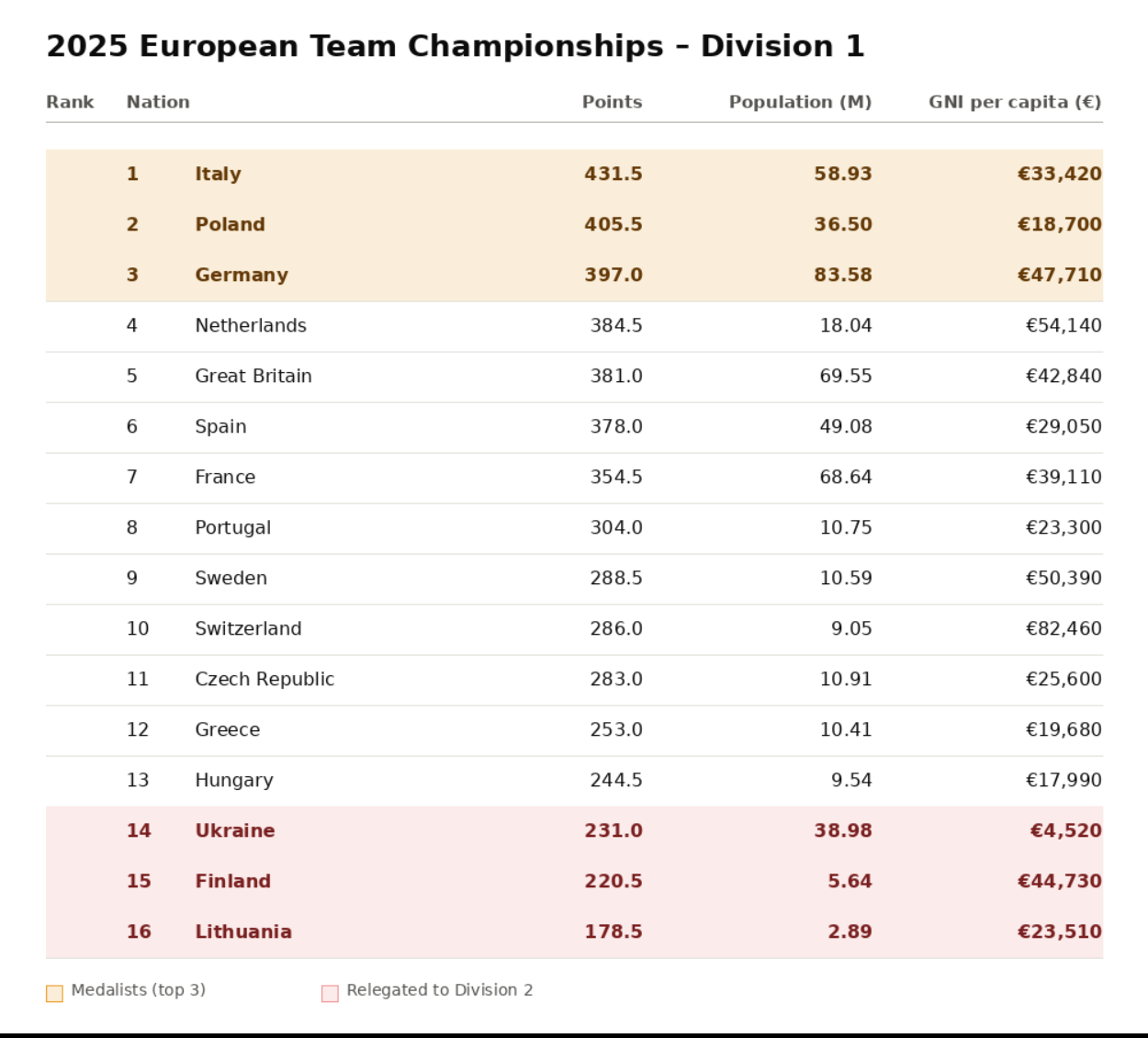
2025 European Team Championships, First Division final standings. Switzerland finished 10th of 16 and Hungary 13th, both comfortably clear of relegation despite modest populations, the mid-pack result Ireland should aspire to replicate.
Ireland's own version of that test is not close. This piece has measured that gap at nearly thirty percentage points in the technical events, present in 2019, present again in 2025, and only narrowed when the competition was weak enough to hide it. Closing it is not a one-off fix, or a single good championship away. It is a multi-year project, the kind that shows up gradually in results like Maribor long before it shows up in a promotion. But it is exactly the project Ireland should be undertaking, aiming not to stay comfortable in the middle of the Second Division but to eventually be the one competing mid-pack in the First, the way Slovenia, Norway, Switzerland, and Hungary already are. Properly resourced, over years rather than a single cycle, Ireland can be in that field too. Watching whether the four of them thrive or struggle in Istanbul is, in its own way, a preview of what Ireland is aiming at, not a preview of Ireland's own timeline to get there.
What Birmingham Should Tell Us
The countdown that opened this piece is almost over. Birmingham begins on August 10th, and the technical gap measured across these pages has not gone away from the team competing there. Of the 34 athletes competing individually, two are throwers. None are jumpers. One is a hurdler. Heptathlete Kate O'Connor competes across both halves of the equation this piece has spent articulating. That is not a team that quietly balances running against technical depth and simply favors one over the other. It is a team where the technical program barely has a seat at the table, in a squad otherwise the largest Ireland has ever sent to a European Championships.
Some of what Birmingham will show is not really a question at all. There will be no Irish athlete in a jumps final, because there is no Irish jumper on the team to put there. That much is already decided, and it was decided by selection, not by what happens on the runway in August. What is still genuinely open is the rest of the technical program. Can an improved Nicola Tuthill produce another result like Maribor's bronze? Shot putter Eric Favors is a different case, a medal is not a realistic expectation, but reaching the final would be a genuine achievement. The hurdles program continues to rest on Sarah Lavin's shoulders alone, the same thinness this piece has been describing, now evidenced by the absence of any other hurdler in the squad.
Birmingham will not settle the question either way in six days. A championship is not a team meet, and Ireland's individual stars, the Rhasidat Adelekes and the Kate O'Connors, will be competing, representing their country, but not carrying a team score in the way the Maribor squad did.
Ireland is not short on talent. Sarah Lavin proved that in Maribor. Kate O'Connor proves it every time she steps into a circle or over a bar as readily as she does onto a track. What the last three editions of the Team Championships showed, patiently and repeatedly, is that talent at the top of a technical event is not the same thing as depth across it. The team sheet for Birmingham suggests the sport still has not closed that gap. In the jumps, for this championship at least, there is no gap left to close, only an absence. Fixing that will not happen by August 10th. But knowing where to look, in the circle and over the bar rather than only on the track, is a start.
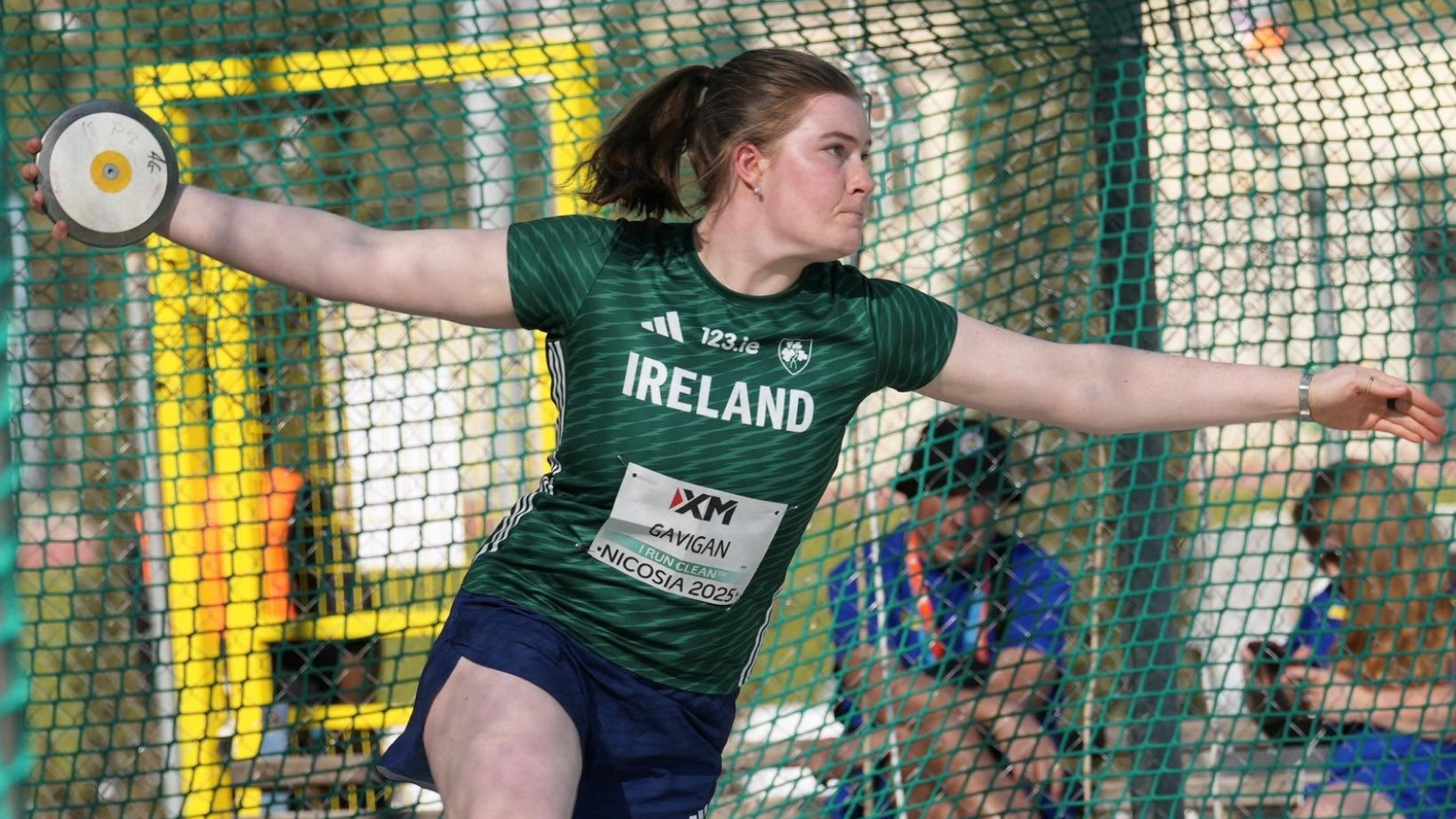
Another Wrinkle, Another Irish Athlete Left Home
Races You Can Enter Across Ireland This Weekend Ending August 10th
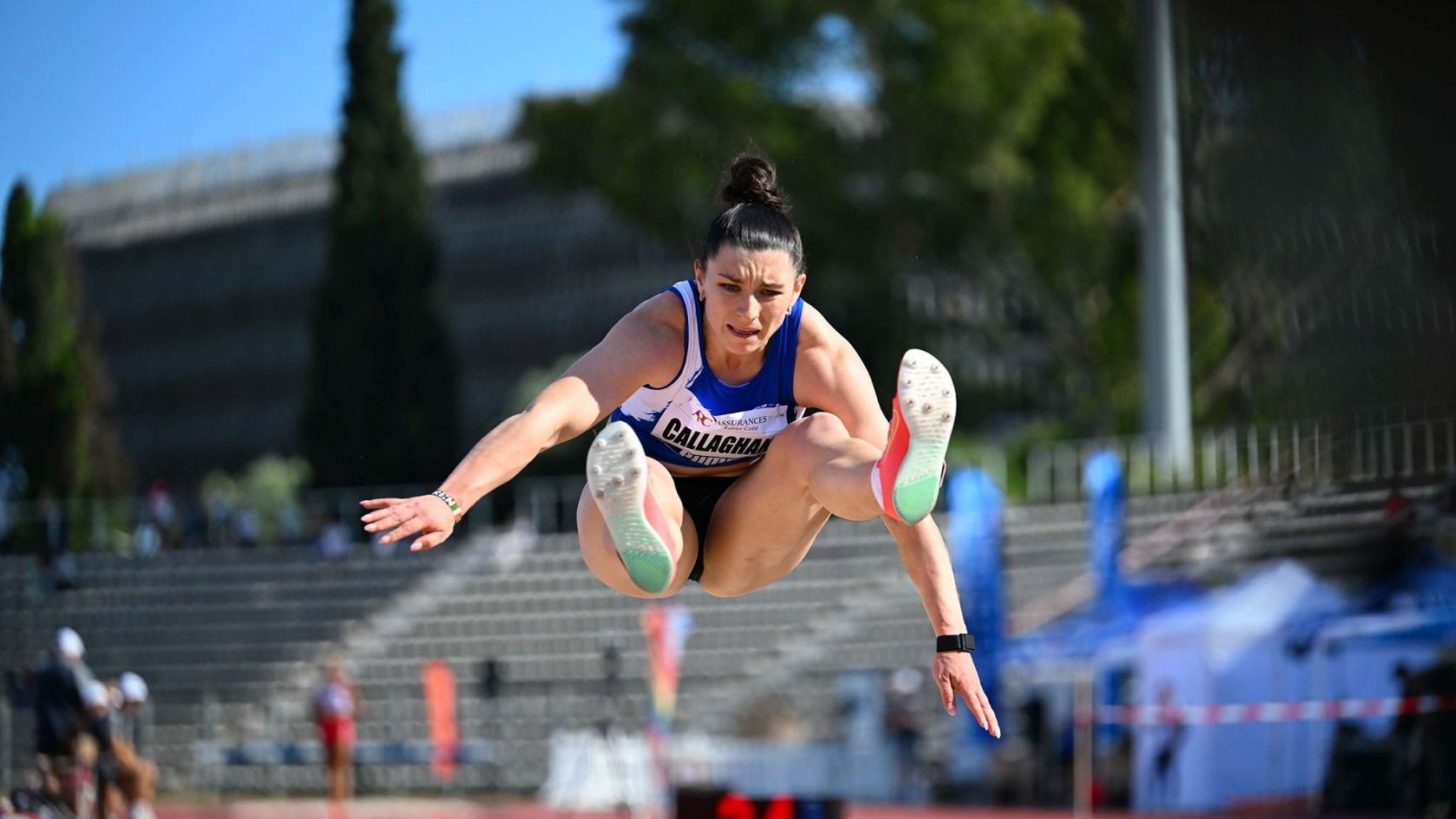
A Self-Imposed Wrinkle Is Keeping an Irish Jumper Home

How to Watch Irish Athletes on Day One of the World Athletics U20 Championships

The World Athletics U20 Championships Start Tomorrow: Everything You Need to Know
The Method Behind the Medal: Andrew Egan on Zurich, Swiss German, and Becoming the Athlete He Decided to Be